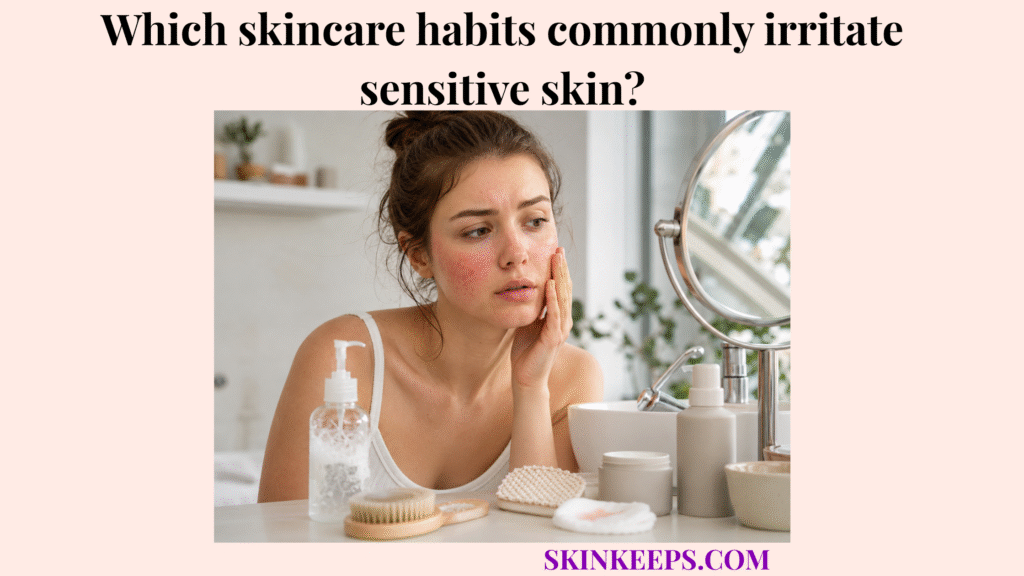
Skincare habits that commonly irritate sensitive skin include excessive cleansing, hot-water washing, frequent exfoliation, overlapping active products, rapid routine changes, heavy layering, repeated rubbing, and continuing products that cause persistent stinging, burning, itching, or tightness. Irritation often reflects frequency, intensity, product overlap, friction, heat, and inadequate recovery rather than one obviously “bad” formula. The pattern may appear as peeling, rawness, a shiny uncomfortable texture, tenderness, flushing, or a sudden loss of tolerance to moisturizer or sunscreen.
This article explains why ordinary routines become irritating, how several mild exposures combine, which cleansing and exfoliation behaviors deserve attention, why stronger routines are not automatically better, and how to separate a formula-specific problem from routine overload. It also provides a controlled simplification method, tracking worksheet, warning signs, and boundaries for professional care.
Why Can Ordinary Skincare Habits Become Irritating for Sensitive Skin?
Ordinary skincare habits can become irritating when their frequency, intensity, friction, or overlap exceeds what sensitive skin can comfortably tolerate and recover from. Cleansing, exfoliation, and active products can serve legitimate purposes, but usefulness does not make a step universally tolerable under every condition.
Chemical exposure and mechanical exposure can accumulate in the same routine. Surfactants remove residue, exfoliants loosen surface cells, active products alter biological processes, and rubbing adds friction. Hot water and repeated drying may increase discomfort even when each product seems mild on its own.
Repeated low-level exposure can exceed the recovery capacity of the sensitive-skin barrier even when no single step appears unusually harsh. Warning sensations and the skin’s response after simplification provide more useful information than the reputation of one ingredient category.
How Does Repeated Low-Level Irritation Build Over Time?
Repeated low-level irritation builds when mild exposures occur often enough that the skin does not fully stabilize before the next routine. Cumulative exposure means the combined effect of repeated cleanser contact, hot water, an acid, a retinoid, towel friction, or other steps that may be manageable separately but uncomfortable together.
No single product has to feel dramatically harsh. A routine can gradually move from mild tightness to repeated stinging, peeling, burning, or reduced tolerance as each new exposure arrives before comfort has returned.
Why Does Sensitive Skin Need Recovery Time Between Stronger Steps?
Sensitive skin needs recovery time between stronger steps because exfoliation, active products, heat, and friction can temporarily reduce comfort and product tolerance. A recovery period is a lower-exposure interval used to reassess the skin; it does not prove permanent barrier damage.
Repeating a strong step while the skin is burning, peeling, or reacting to basic products may prolong the same pattern. No single waiting period fits every formula or person, so the practical boundary is the current reaction and established tolerance rather than a universal timetable.
| Skincare habit | How the habit may irritate sensitive skin |
|---|---|
| Frequent cleansing | Repeatedly exposes the surface to surfactants, water, drying, and product reapplication. |
| Hot-water washing | Adds thermal stress that may intensify dryness, flushing, tightness, or burning. |
| Frequent exfoliation | May remove or loosen surface cells faster than current tolerance permits. |
| Several active products | Creates overlapping drying, exfoliating, turnover, or oil-control effects. |
| Frequent routine changes | Introduces several uncontrolled variables and prevents reliable tolerance assessment. |
| Rubbing or picking | Adds mechanical friction and localized surface injury. |
| Ignoring persistent discomfort | Allows a poorly tolerated exposure pattern to continue. |
| Testing during a flare | Adds new formulas while the skin is already difficult to assess. |
Several manageable exposures can become uncomfortable when their effects overlap and recovery remains incomplete.
What Is Cumulative Irritation Load in Sensitive Skin?
Cumulative irritation load is the combined stress created when several skincare exposures occur close together and collectively exceed sensitive skin’s tolerance. Additive exposure describes stressors that contribute to the same final outcome even when they work through different mechanisms.
The last product applied is not necessarily the sole cause. A moisturizer may sting because cleansing, heat, an exfoliant, and friction have already lowered comfort before the moisturizer reaches the skin.
Several simultaneous variables also create a diagnostic problem. Replacing one product repeatedly may fail when the routine architecture—frequency, overlap, rubbing, or rapid escalation—is the real source of stress.
| Combined habits | Possible result |
|---|---|
| Harsh cleansing plus hot water | Tightness, burning, or moisturizer stinging may follow the combined exposure. |
| Exfoliant plus retinoid | Peeling, rawness, or reduced tolerance may develop. |
| Shaving followed by an acid toner | Stinging, bumps, or tenderness may appear in freshly manipulated areas. |
| Scrub plus cleansing brush | Mechanical friction may produce roughness, tenderness, or visible irritation. |
| Several new products | A rash-like reaction may occur without an obvious single trigger. |
| Strong actives during a flare | Burning or peeling may continue because the routine has not stabilized. |
These examples describe plausible patterns, not guaranteed outcomes or diagnostic combinations.
Which Cleansing Habits Commonly Irritate Sensitive Skin?
Cleansing habits commonly irritate sensitive skin when washing is too frequent, too hot, too prolonged, too abrasive, or stronger than the removal task requires. Cleansing should remove the residue that is actually present without normalizing persistent tightness, burning, or a stripped after-feel.
Readers with repeated post-wash tightness, burning, or moisturizer stinging may need to examine harsh cleansing habits in greater detail. The dedicated topic covers surfactant exposure, water temperature, double cleansing, tools, and drying technique more fully.
Irritating Cleansing Habits
- Wash more often than necessary.
- Use very hot water.
- Cleanse until the skin feels squeaky.
- Leave cleanser on the skin longer than the removal task requires.
- Rub heavily while washing.
- Use brushes, rough cloths, or textured pads during irritation.
- Double cleanse when little residue requires a second step.
- Rub the face aggressively with a towel.
- Rewash whenever mild oiliness appears.
How Does Excessive Exfoliation Irritate Sensitive Skin?
Excessive exfoliation irritates sensitive skin by removing or loosening surface cells faster than the skin can comfortably recover. Physical exfoliation uses friction, while chemical exfoliation loosens connections among surface cells; both can become irritating when strength, frequency, or overlap exceeds tolerance.
Daily acids, scrubs, and overlapping exfoliating steps can turn harsh exfoliation into a recurring source of barrier discomfort. Visible flakes should not automatically be scrubbed away because flaking may already reflect irritation.
Over-exfoliated skin may feel temporarily smooth yet look unusually shiny and feel raw, tight, hot, or painful when basic products are applied. Temporary smoothness is not proof that a stronger or more frequent exfoliation schedule is needed.
Over-Exfoliation Clues
- Exfoliating frequently without established tolerance.
- Combining physical and chemical exfoliation.
- Applying several acid products.
- Scrubbing visible flakes.
- Increasing strength because results feel slow.
- Continuing exfoliation when moisturizer already stings.
- Applying exfoliants to burning, raw, or inflamed skin.
- Restarting exfoliation before the previous reaction has settled.
Why Does Combining Several Active Products Overwhelm Sensitive Skin?
Combining several active products can overwhelm sensitive skin when their drying, exfoliating, turnover-accelerating, or irritating effects overlap within the same routine. Active products are not automatically unsuitable for sensitive skin, but introduction rate, strength, frequency, and current skin condition determine whether the complete routine remains tolerable.
How Do Overlapping Actives Increase Irritation Burden?
Overlapping actives increase irritation burden when several formulas affect exfoliation, turnover, oil control, or dryness at the same time. A retinoid, acid, benzoyl peroxide product, and active cleanser may use different mechanisms yet converge on peeling, burning, tightness, or reduced product tolerance.
An active cleanser plus an active serum still counts as overlap. The correct question is not whether the labels differ, but whether the complete routine concentrates several potentially irritating effects within the same period.
Why Are Stronger Routines Not Always More Effective?
Stronger routines are not always more effective because irritation can reduce adherence, prolong discomfort, and force the reader to stop otherwise useful products. Dose, frequency, and product strength matter only within the limits of actual tolerance.
Visible irritation is not a performance metric. Gradual introduction may preserve long-term use, while rapid escalation can make a useful product impossible to continue. “Purging” should not be used as a blanket explanation for burning, swelling, rash, or persistent pain.
| Habit | Possible sensitive-skin outcome |
|---|---|
| Using an acid exfoliant with a retinoid | May combine surface-cell loosening and turnover-related irritation. |
| Applying several exfoliating formulas | May produce rawness and reduced tolerance to basic products. |
| Combining multiple strong acne treatments | May increase dryness, burning, and inflamed-looking patches. |
| Using an active cleanser with an active serum | Counts as overlapping exposure even though the products are different formats. |
| Increasing several products together | Makes the responsible variable difficult to identify. |
| Using strong actives during active irritation | May prolong discomfort and delay a useful tolerance assessment. |
Why Is Introducing Several New Products at Once a Problem?
Introducing several new products at once is a problem because it exposes sensitive skin to several unfamiliar formulas while removing the ability to identify which product caused the reaction. A baseline routine is the stable group of already tolerated steps used as the reference point for testing a change.
Some reactions appear quickly, while others become noticeable after repeated exposure. One-at-a-time introduction does not guarantee tolerance, but it preserves enough routine stability to make timing and recurrence more interpretable.
Safer Product-Introduction Principles
- Add one new product at a time.
- Keep the rest of the routine stable.
- Begin cautiously when the product category usually requires gradual use.
- Avoid testing a strong new active during an existing flare.
- Observe both immediate and delayed changes.
- Stop the newest suspected product first when irritation develops, unless medical instructions say otherwise.
- Do not deliberately retest a product that caused swelling, blistering, or another severe reaction.
How Does Frequent Product Switching Keep Sensitive Skin Reactive?
Frequent product switching can keep sensitive skin reactive by repeatedly introducing new surfactants, preservatives, textures, fragrances, and active combinations before tolerance has been assessed. Constant replacement is not the same as correcting the underlying habit pattern.
A stable baseline reduces uncontrolled variables. Without it, normal symptom fluctuation, weather changes, or a delayed reaction may be blamed on whichever product was used most recently.
Routine-Instability Clues
- Products are replaced after only a few uses.
- Several formulas are rotated without a clear reason.
- A new product is added whenever a minor symptom appears.
- The routine changes during every flare.
- The skin rarely receives a stable assessment period.
- No products can be identified as consistently tolerated.
Why Is Continuing Through Stinging, Burning, or Itching a Harmful Habit?
Continuing through repeated stinging, burning, or itching is harmful because persistent discomfort can signal poor tolerance, irritation, or dermatitis rather than effective product activity. Context matters, but painful or progressive symptoms should not be treated as the price of results.
A mild brief sensation may be expected with some formulas and may remain tolerable for an established user. Repetition, persistence, increasing intensity, swelling, rash, blistering, or worsening pain move the situation away from routine observation and toward stopping and reassessment.
| Sensation | Better interpretation |
|---|---|
| Mild, brief tingling | Interpret it in the context of the formula, instructions, and established tolerance; it should not intensify or persist. |
| Repeated stinging | Suggests that the product or current skin condition is poorly tolerant. |
| Burning | Requires stopping and assessing the reaction rather than pushing through. |
| Persistent itching | May reflect irritation, dermatitis, or another process that needs reassessment. |
| Tightness after every use | Suggests that cleansing or the complete routine may be too stripping. |
| Moisturizer suddenly stinging | May indicate that cumulative routine stress is already present. |
How Do Rubbing, Picking, and Touching Irritate Sensitive Skin?
Rubbing, picking, scratching, squeezing, and repeated touching irritate sensitive skin by adding pressure, friction, and surface injury to already uncomfortable areas. Mechanical irritation is created by physical manipulation rather than the chemical composition of a product.
Repeatedly checking texture can become part of the problem. Touching the same area, lifting flakes, wiping sweat harshly, or squeezing bumps may create the tenderness or roughness the reader is trying to monitor.
Mechanical Irritation Habits
- Rub products aggressively into the skin.
- Pick flakes or peeling skin.
- Squeeze bumps repeatedly.
- Scratch itchy areas.
- Use rough cotton pads.
- Wipe sweat harshly.
- Rub makeup off instead of loosening it gently.
- Touch the same areas repeatedly to check texture.
Can Excessive Product Layering Irritate Sensitive Skin?
Yes, excessive product layering can irritate sensitive skin when several active, fragranced, occlusive, or poorly tolerated formulas create overlapping exposure and require repeated rubbing. Step count alone does not prove that a routine is harmful; purpose, formula overlap, application friction, heat, and individual tolerance matter more.
Using too many products can increase formula overlap and make it difficult to identify which step caused the reaction. Pilling may also lead to more rubbing as the reader tries to smooth or reapply the layers.
Layering Warning Signs
- Products pill and require repeated rubbing.
- Skin feels hot or itchy after the complete routine.
- Several active serums are applied together.
- Heavy layers trap sweat and increase discomfort.
- Makeup or sunscreen stings over several products.
- Skin feels calmer when unnecessary layers are removed.
- The trigger cannot be identified because several formulas were applied together.
Which Habits Are Mistakenly Treated as Good Sensitive-Skin Care?
Several habits mistaken for good sensitive-skin care can worsen irritation, including repeated washing, scrubbing flakes, increasing product strength, replacing the entire routine, and adding several soothing formulas together. A corrective habit should reduce exposure or improve clarity, not add more variables.
| Mistaken habit | Why the habit may fail | Better direction |
|---|---|---|
| Washing whenever skin feels uncomfortable | The discomfort may not result from dirt or oil. | Identify the likely trigger before washing again. |
| Scrubbing flakes | Flakes may reflect irritation rather than incomplete cleansing. | Reduce friction and allow the surface to settle. |
| Using stronger products for faster results | More intensity does not guarantee a better outcome. | Increase intensity only when established tolerance supports it. |
| Changing the entire routine after one reaction | Several variables change simultaneously. | Remove the newest or most suspicious exposure first when appropriate. |
| Treating burning as product activity | Persistent burning indicates poor tolerance. | Stop and assess the reaction. |
| Adding several soothing formulas | Each formula adds ingredients and another possible trigger. | Simplify rather than stack more products. |
| Aggressively exfoliating bumps | Not every bump reflects clogged surface cells. | Clarify the reaction pattern before increasing exfoliation. |
How Can Someone Tell Whether the Problem Is One Product or the Overall Routine?
A one-product problem usually follows one reproducible formula, while an overall routine problem builds through frequency, friction, layering, or active overlap across several steps. The two patterns can overlap because one poorly tolerated product may become more irritating inside an already overloaded routine.
Improvement after removing one formula supports a product-specific hypothesis. Improvement only after broader simplification supports a cumulative routine hypothesis, but neither response confirms allergy or excludes an underlying skin condition.
| Feature | One-product problem | Overall routine problem |
|---|---|---|
| Reaction timing | Symptoms begin after one specific product is introduced or applied. | Symptoms build after several steps or repeated routines. |
| Repetition | The reaction returns with the same formula. | The reaction continues despite replacing one product. |
| Location | Symptoms often match the product application area. | Symptoms may affect several routine-treated areas. |
| Main clue | Removing one product improves the pattern. | Reducing the complete routine improves the pattern. |
| Common driver | Formula or ingredient intolerance. | Excess frequency, friction, layering, active stacking, or poor recovery. |
Timing, recurrence, location, and response to simplification provide clues, but they do not establish a medical diagnosis.
What Signs Suggest Skincare Habits Are Irritating Sensitive Skin?
Skincare habits are more likely to be irritating sensitive skin when symptoms repeatedly follow the routine, intensify as steps accumulate, and improve when unnecessary exposures are paused. Repeatability is more informative than one isolated episode.
The pattern becomes stronger when the same sequence produces tightness, stinging, burning, peeling, or reduced tolerance and the symptoms ease after the routine is simplified. Illness, weather, medication changes, or another trigger may weaken the skincare-habit hypothesis.
Habit-Related Reaction Checklist
- Skin feels tight after the routine.
- Moisturizer or sunscreen stings after cleansing.
- Burning develops after several products are layered.
- Peeling increases after active-product use.
- Skin feels unusually smooth, shiny, and raw.
- Basic products become harder to tolerate.
- Bumps appear after the routine becomes more intense.
- Symptoms improve when several steps are paused.
- Reactions return when the same habit pattern resumes.
- No single product explains the complete flare.
How Should an Irritating Sensitive-Skin Routine Be Simplified?
An irritating sensitive-skin routine should be simplified by stopping newly added or clearly uncomfortable products, pausing unnecessary actives, reducing friction, and maintaining a stable baseline. The goal is controlled exposure reduction and clearer interpretation, not a promise that every reaction will resolve without medical care.
A temporary minimal sensitive-skin routine can reduce the number of active variables while the reader assesses tolerance. Adding several “repair” products at once defeats this purpose by creating a different overloaded routine.
Sensitive-Skin Habit Reset
- Stop newly added or clearly irritating products.
- Pause unnecessary exfoliation and stronger active products.
- Cleanse only as needed.
- Use comfortably lukewarm water.
- Avoid brushes, scrubs, and rough pads.
- Keep the remaining routine stable.
- Use a simple moisturizer if it is tolerated.
- Avoid introducing new products during active irritation.
- Reintroduce one product at a time when the skin is comfortable enough for reassessment.
- Treat repeated stinging, burning, and itching as feedback rather than progress.
Products associated with swelling, blistering, a severe rash, or another serious reaction should not be deliberately retested at home.
What Mistakes Prevent Sensitive Skin From Recovering?
Sensitive skin often fails to recover when new products are tested during a flare, strong actives are restarted too quickly, exfoliation continues, or repeated warning sensations are ignored. Each mistake either adds another irritant or prevents the routine from reaching a stable lower-exposure state.
| Mistake | Why the mistake delays recovery |
|---|---|
| Testing new products during a flare | Adds new variables and possible irritants while the reaction is already difficult to interpret. |
| Restarting active products too quickly | May reactivate burning, peeling, or tightness before tolerance is clear. |
| Continuing frequent exfoliation | Prevents the routine from reaching a stable lower-exposure state. |
| Picking peeling skin | Adds mechanical surface injury. |
| Using hot water | Adds heat and dryness exposure. |
| Changing products every few days | Prevents reliable tolerance assessment. |
| Adding more products to repair irritation | Can create another overloaded routine. |
| Ignoring repeated warning sensations | Allows the poorly tolerated pattern to continue. |
How Should Someone Track Habit-Related Sensitive-Skin Reactions?
Habit-related reactions should be tracked by recording routine steps, frequency, product overlap, mechanical habits, symptom timing, and the response to simplification. Tracking supports pattern recognition; it does not diagnose allergy, dermatitis, rosacea, eczema, or infection.
Change one major variable at a time where practical, record actual use rather than memory, and use consistent lighting for photographs. Never reproduce a severe reaction simply to strengthen the log.
Habit-Reaction Tracking Worksheet
- Number of routine steps.
- Cleansing frequency, duration, and water-temperature category.
- Exfoliation type and frequency.
- Active products used together.
- New products and introduction dates.
- Brushes, pads, scrubs, or rough towels.
- Rubbing, picking, squeezing, or scratching.
- Symptoms after each routine stage.
- Time from routine to reaction.
- Skin areas affected.
- Whether simplification improved symptoms.
- Whether symptoms returned after a habit resumed.
- Environmental, medication, or health changes.
- Photographs when useful.
Interpret the pattern, not a score
A log may suggest that the trigger is unclear, one product is suspicious, cumulative routine stress is likely, or mechanical irritation is involved. These categories guide the next step and do not establish a diagnosis.
When Should Skincare-Habit Irritation Be Professionally Evaluated?
Skincare-habit irritation should be professionally evaluated when symptoms are severe, persistent, recurrent, spreading, blistering, swollen, painful, or unresponsive to routine simplification. Persistent, severe, spreading, blistering, swollen, or diagnostically unclear reactions are reasons to see a dermatologist.
Strong reactions to water or very basic products require a broader assessment. A clinician may evaluate irritant or allergic contact dermatitis, eczema, rosacea, infection, or another condition rather than assuming that the routine is the only cause.
Professional Evaluation Checklist
- Burning or pain is severe or persistent.
- Skin reacts strongly to water or basic products.
- A rash spreads or repeatedly returns.
- Skin swells, blisters, oozes, crusts, or bleeds.
- Eye or eyelid reactions occur.
- Itching disrupts sleep.
- Skin becomes deeply cracked or infected-looking.
- Symptoms continue after the routine is simplified.
- Reactions continue despite very few gentle products.
- An underlying condition is suspected.
Urgent medical care
Breathing difficulty, rapid facial swelling, throat tightness, faintness, or another severe immediate reaction requires urgent medical attention.
What Should You Remember About Skincare Habits and Sensitive Skin?
Sensitive-skin irritation often reflects the combined frequency, intensity, friction, and overlap of a routine rather than one obviously harmful product.
What Should You Remember?
- Cleansing more often than necessary can increase surfactant, water, and drying exposure.
- Very hot water and aggressive rubbing add thermal and mechanical irritation.
- Exfoliation can become irritating when frequency, strength, or overlap exceeds tolerance.
- Several active products can create a cumulative reaction even when each product seems mild alone.
- Introducing several new products together prevents useful trigger identification.
- Frequent routine switching makes product tolerance harder to assess.
- Persistent stinging, burning, itching, or tightness should not be treated as proof that a product is working.
- Picking, scratching, squeezing, and repeated touching can prolong localized irritation.
- Too many skincare layers can increase overlap and application friction.
- Routine simplification can help distinguish one-product intolerance from cumulative habit stress.
- Strong products should not be restarted before the skin is comfortable enough for reassessment.
- Severe reactions should not be deliberately reproduced.
- Persistent, spreading, swollen, blistering, oozing, painful, or recurrent reactions require professional evaluation.
Frequently Asked Questions
Can Too Many Skincare Products Irritate Sensitive Skin?
Yes. Several products can create overlapping exposure to surfactants, fragrances, preservatives, active ingredients, and repeated rubbing. The problem is not step count alone; irritation becomes more likely when the complete routine exceeds the skin’s current tolerance.
Does Stinging Mean a Skincare Product Is Working?
No. A mild brief sensation may occur with some products, but repeated stinging, burning, itching, or persistent tightness indicates poor tolerance or irritation rather than reliable proof of effectiveness.
Can Sensitive Skin Use Exfoliating Products?
Some people with sensitive skin can tolerate carefully selected exfoliation, but frequency, strength, overlap, and current skin condition matter. Exfoliation should not continue when the skin is burning, raw, peeling, or reacting to basic products.
Should New Skincare Products Be Introduced One at a Time?
Yes. Introducing one new product at a time preserves a stable baseline and makes immediate or delayed reactions easier to interpret. Several simultaneous introductions create too many uncontrolled variables.
How Can Someone Know Whether One Product or the Entire Routine Is the Problem?
A one-product reaction usually follows the same formula repeatedly. A routine-level problem often builds after several steps and improves only when cleansing, exfoliation, active overlap, friction, or layering is reduced.
Can Frequently Changing Products Make Sensitive Skin Worse?
Yes. Frequent product switching repeatedly exposes skin to unfamiliar formulas and prevents a reliable assessment of tolerance. Routine instability can also make unrelated symptom fluctuations appear product-driven.
Conclusion
Common skincare habits can irritate sensitive skin when routine frequency, intensity, friction, product overlap, and poor recovery combine into a cumulative irritation load. Excess cleansing, over-exfoliation, active stacking, multiple new products, frequent switching, rubbing, picking, and ignored warning sensations can all contribute to the same reaction pattern.
More products and stronger treatment do not automatically produce better results. A stable simplified routine improves trigger clarity, while persistent or severe reactions require professional evaluation. Sensitive skin responds best to a routine that does only what is necessary and no more than the skin can consistently tolerate.
Sources & Evidence
American Academy of Dermatology — Face Washing Guidance
Supports lukewarm water, fingertip cleansing, avoiding abrasive tools, resisting scrubbing, and patting the skin dry.
[AAD]American Academy of Dermatology — Skin-Care Habits and Irritation
Supports gentle washing, avoiding rough sweat removal, and recognizing that repeated rubbing can irritate the skin.
[AAD]American Academy of Dermatology — Stop Products That Sting or Burn
Supports treating burning and stinging as irritation signals rather than proof that a product is effective.
[AAD]Ananthapadmanabhan et al., 2004 — Impact of Cleansers on the Skin Barrier
Supports the mechanism that harsher surfactants may interact with skin proteins and lipids and contribute to tightness, dryness, and barrier stress.
[PubMed]Draelos, 2018 — The Science Behind Skin Care: Cleansers
Supports differences in cleansing systems and the principle that cleanser formulation influences irritation and dryness.
[PubMed]DermNet — Irritant Contact Dermatitis
Supports repetitive exposure, friction, water, soaps, retinoids, and benzoyl peroxide as potential irritant factors and distinguishes irritant reactions from allergy.
[DermNet]DermNet — Allergic Contact Dermatitis
Supports the distinction between direct irritation and delayed immune-mediated reactions to a specific contact allergen.
[DermNet]Narsa et al., 2024 — Strategies to Reduce Topical Retinoid Irritation
Supports the fact that topical retinoids are useful but may cause irritation and that tolerability influences continued use.
[PubMed]Foti et al., 2015 — Contact Dermatitis to Topical Acne Drugs
Supports irritant and less common allergic reactions associated with topical acne treatments, including retinoids and benzoyl peroxide.
[PubMed]Disclaimer: This article provides general educational information and does not diagnose or treat allergic contact dermatitis, irritant contact dermatitis, eczema, rosacea, infection, or another skin condition. Stop using a product and seek professional advice for severe, persistent, recurrent, spreading, blistering, swollen, oozing, bleeding, painful, or eye-area reactions. Breathing difficulty, rapid facial swelling, throat tightness, or faintness requires urgent medical care.