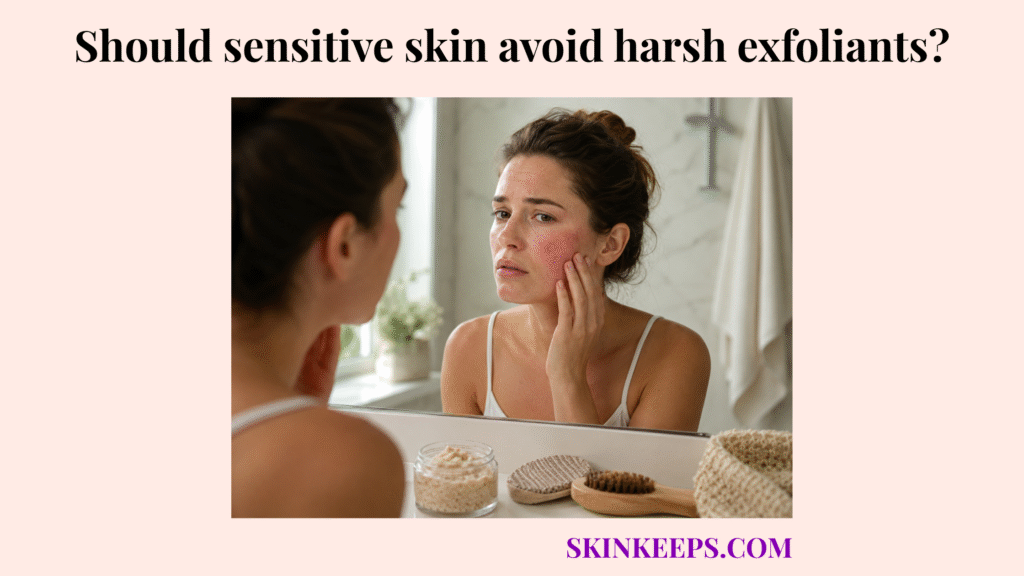
Yes, sensitive skin should generally avoid exfoliants that create excessive friction, strong active exposure, persistent burning, peeling, tightness, or reduced tolerance to basic products. Harshness may come from coarse particles, strong acids, frequent use, long contact time, heavy rubbing, several exfoliating products, or use on already irritated skin. Sensitive skin does not always need to avoid every exfoliant.
This article explains what makes exfoliation harsh, how physical and chemical methods differ, which symptoms mean exfoliation should stop, when exfoliation may be unnecessary, when cautious testing may be possible, how to track tolerance, and when professional care is needed.
What Makes an Exfoliant Too Harsh for Sensitive Skin?
An exfoliant becomes too harsh when its strength, frequency, contact time, friction, or overlap exceeds the skin’s current tolerance. One ingredient name cannot define harshness by itself because formulation, technique, and skin condition change the actual exposure.
Excessive exfoliation is one of several skincare habits that irritate sensitive skin, but harshness depends on strength, frequency, friction, and current skin condition.
How Does Exfoliant Strength Affect Sensitive-Skin Tolerance?
Stronger exfoliating exposure can reduce sensitive-skin tolerance by loosening or removing more surface cells within a shorter period. Concentration, product pH, contact duration, and supporting ingredients all matter.
Why Can Frequency and Friction Make a Mild Product Harsh?
A mild exfoliant can become harsh when it is used too often, applied with heavy rubbing, or combined with another exfoliating step. Pads, brushes, scrubs, and repeated passes add mechanical stress.
| Harshness factor | Why it may irritate sensitive skin |
|---|---|
| Large or jagged scrub particles | Can create excessive friction and tenderness. |
| High active strength | May disrupt more surface-cell cohesion than current tolerance supports. |
| Frequent exfoliation | May leave too little recovery time. |
| Several exfoliants | Can create cumulative irritation. |
| Long application time | Extends chemical exposure. |
| Heavy rubbing | Adds mechanical stress. |
| Use on irritated skin | Can intensify burning, rawness, or peeling. |
| Increasing strength despite stinging | Ignores an early warning signal. |
How Harsh Exfoliation Builds
Strength, frequency, contact time, friction, active overlap, and current skin condition combine to determine whether exfoliation remains tolerable.
Figure 1. Exfoliation becomes harsh when combined exposure exceeds tolerance; no universal threshold applies.
Why Does Harsh Exfoliation Trigger Sensitive-Skin Reactions?
Harsh exfoliation triggers sensitive-skin reactions when surface-cell removal, active exposure, or friction exceeds the skin’s ability to remain comfortable and recover. The stratum corneum is the outer surface layer that limits water loss and outside exposure.
Repeated surface-cell removal can reduce comfort in a sensitive-skin barrier that already has limited tolerance to friction or active exposure. Greater water loss and irritant access may make moisturizer, sunscreen, or water feel uncomfortable.
Are Physical Scrubs Especially Risky for Sensitive Skin?
Physical scrubs are especially risky when coarse particles or repeated rubbing create more friction than sensitive skin can tolerate. Physical exfoliation is not automatically harmful, but particle roughness, pressure, duration, and repetition determine the response.
Physical-Scrub Warning Signs
- Skin feels scratched instead of comfortably smooth.
- Redness or darker irritation follows rubbing.
- Moisturizer stings afterward.
- Flakes become more visible after scrubbing.
- Bumps appear in heavily rubbed areas.
- Skin looks polished but feels tight or raw.
- Discomfort continues after the session.
Can Chemical Exfoliants Also Be Too Harsh for Sensitive Skin?
Yes, chemical exfoliants can be too harsh when their strength, frequency, pH, contact time, or combination with other actives exceeds tolerance. Exfoliating acids belong to the broader group of potentially irritating skincare ingredients, although formula strength and use pattern determine actual tolerance.
| Exfoliation type | Main mechanism | Sensitive-skin concern |
|---|---|---|
| Coarse scrub | Mechanical friction | Rawness, discoloration, or tenderness |
| Cleansing brush | Repeated stimulation | Burning, bumps, or surface stress |
| Strong acid peel | Rapid chemical exfoliation | Peeling, stinging, or inflammation |
| Frequent acid toner | Repeated active exposure | Cumulative tightness and sensitivity |
| Mild low-frequency exfoliant | Controlled loosening | May be tolerated when skin is calm |
| Enzyme exfoliant | Surface-protein breakdown | Can still irritate some sensitive skin |
Which Exfoliation Combinations Commonly Overwhelm Sensitive Skin?
Exfoliation combinations commonly overwhelm sensitive skin when physical friction, chemical exfoliation, retinoids, or acne treatments affect the skin during the same recovery period. Professionally directed combinations may differ.
| Combination | Possible outcome |
|---|---|
| Scrub plus acid toner | Combines friction and chemical irritation. |
| Acid cleanser plus leave-on acid | Creates repeated exfoliating exposure. |
| Retinoid plus strong exfoliant | May produce peeling, burning, and rawness. |
| Several acid serums | Increase cumulative active exposure. |
| Exfoliant plus benzoyl peroxide | May increase dryness and sensitivity. |
| Exfoliation before shaving | May increase stinging and tenderness. |
| Exfoliation after sun exposure | May intensify burning and delay comfort. |
What Signs Show That Exfoliation Is Irritating Sensitive Skin?
Exfoliation is irritating sensitive skin when burning, persistent stinging, peeling, rawness, itching, swelling, or reduced tolerance to basic products appears after use. Warning sensations are feedback, not proof of effectiveness.
Repeated burning after skincare products is a warning signal that should not be treated as proof that exfoliation is working.
| Warning sign | What it may indicate |
|---|---|
| Burning during application | The product is not being tolerated. |
| Persistent stinging afterward | Surface irritation is continuing. |
| Moisturizer suddenly burns | Skin reactivity has increased. |
| Tight, shiny, or raw-looking skin | Exfoliation intensity may be excessive. |
| Peeling beyond mild surface flaking | Exposure may exceed tolerance. |
| Itching or rash-like texture | Irritation or dermatitis may be involved. |
| Small bumps | An inflammatory or friction-related reaction is possible. |
| Basic products begin to sting | Recovery is incomplete. |
When Should Sensitive Skin Stop Exfoliating Completely?
Sensitive skin should stop exfoliating completely when the skin is burning, raw, heavily peeling, swollen, cracked, bleeding, actively inflamed, or painful with water and basic products.
Pause Exfoliation When
- Skin is burning or stinging.
- Water or moisturizer feels painful.
- Heavy peeling is present.
- Cracks, bleeding, or raw patches are present.
- Rash or swelling has developed.
- Eczema, dermatitis, or rosacea is actively flaring.
- Skin is recovering from sunburn.
- Strong acne treatments are already causing irritation.
- The previous reaction has not settled.
Does Sensitive Skin Need Exfoliation at All?
No, sensitive skin does not require a dedicated exfoliating product to remain healthy or clean. The skin naturally sheds surface cells, and exfoliation is an optional cosmetic step.
Exfoliation May Be Unnecessary When
- Skin feels smooth and comfortable.
- Persistent buildup is absent.
- Previous exfoliants repeatedly caused reactions.
- Moisturizing improves visible flaking.
- Another turnover-supporting active is already used.
- Expected benefit is smaller than the irritation risk.
When Might Gentle Exfoliation Be Tolerated by Sensitive Skin?
Gentle exfoliation may be tolerated when the skin is calm, basic products feel comfortable, and one low-intensity method is introduced without other strong actives.
| Skin condition | Better decision |
|---|---|
| Calm and comfortable skin | A mild, infrequent trial may be considered. |
| Mild roughness without stinging | A cautious trial may be reasonable if genuinely needed. |
| Tight or flaky skin | Prioritize comfort and moisturization first. |
| Burning or raw skin | Stop exfoliation. |
| Active rash or swelling | Avoid exfoliation and seek assessment if persistent. |
| Moisturizer or water stings | Skin is not ready for another exfoliating exposure. |
| Recent irritation from strong treatment | Allow symptoms to settle first. |
Which Exfoliation Approaches May Be Gentler for Sensitive Skin?
Gentler exfoliation approaches reduce particle roughness, product strength, frequency, contact time, and active overlap. Actual skin response matters more than “gentle” marketing language.
| Harsh approach | Gentler direction |
|---|---|
| Coarse grain scrub | Avoid friction-based exfoliation. |
| Frequent acid toner | Reduce frequency if tolerated. |
| High-strength peel | Choose a lower-intensity approach or skip exfoliation. |
| Multiple acids together | Use one exfoliating product only. |
| Scrubbing visible flakes | Moisturize and allow loose flakes to shed naturally. |
| Extended contact time | Follow labeled application time. |
| Immediate full-face use | Begin with a limited tolerance test when appropriate. |
How Often Should Sensitive Skin Exfoliate if It Tolerates Exfoliation?
Sensitive skin should exfoliate at the lowest frequency that provides a useful result without causing tightness, stinging, burning, peeling, or reduced product tolerance. No universal weekly number fits every formula or person.
Frequency Adjustment Clues
- If skin remains calm, maintain the pattern rather than increasing automatically.
- If mild tightness develops, reduce frequency.
- If moisturizer begins to sting, pause exfoliation.
- If peeling or burning appears, stop and allow symptoms to settle.
- If no clear benefit appears, reconsider whether exfoliation is needed.
- If one method is tolerated, avoid adding another without a clear reason.
How Should Sensitive Skin Test an Exfoliant Safely?
Sensitive skin should test one exfoliant at a time only when the skin is calm and the rest of the routine is stable. Readers may patch test new products where appropriate, but home testing cannot rule out every delayed or full-face reaction.
Controlled Exfoliant Test
- Test only when skin feels calm.
- Introduce one exfoliating product.
- Keep the rest of the routine unchanged.
- Avoid other strong actives during first trials.
- Begin at a low frequency.
- Apply only as directed.
- Observe immediate and delayed symptoms.
- Stop if burning, persistent stinging, swelling, rash, or peeling develops.
- Do not deliberately retest a severe reaction.
What Mistakes Make Exfoliation More Irritating for Sensitive Skin?
Exfoliation becomes more irritating when stronger exposure is mistaken for better treatment, warning sensations are ignored, or several exfoliating methods are combined.
| Mistake | Why it backfires |
|---|---|
| Assuming stronger means more effective | Raises irritation without guaranteeing benefit. |
| Scrubbing visible flakes | May worsen an already irritated surface. |
| Using several exfoliants together | Increases cumulative exposure. |
| Exfoliating during a flare | Delays stabilization. |
| Increasing frequency after stinging | Turns an early warning into stronger irritation. |
| Combining acids with physical scrubbing | Adds chemical and mechanical stress. |
| Exfoliating after heavy sun exposure | Adds stress to already irritated skin. |
| Calling burning purging | Misclassifies a warning symptom. |
How Can Sensitive Skin Respond After a Harsh Exfoliant Reaction?
Sensitive skin should respond by stopping the exfoliant, pausing unnecessary active products, reducing friction, and keeping the remaining routine simple.
Immediate Response Direction
- Stop the exfoliating product.
- Pause other unnecessary strong actives.
- Avoid scrubs, brushes, and rough towels.
- Use comfortably lukewarm water.
- Cleanse only when necessary.
- Use a simple moisturizer if tolerated.
- Avoid fragrance on irritated areas.
- Reduce sun, wind, heat, and friction exposure.
- Do not restart while water or basic products remain uncomfortable.
How Can Someone Tell Whether Exfoliation or Another Product Caused the Reaction?
Exfoliation becomes the more likely trigger when symptoms follow exfoliant use, intensify after frequency increases, and improve after exfoliation is stopped. Timing and recurrence strengthen suspicion but do not confirm a diagnosis.
Exfoliant-Linked Pattern Checklist
- Symptoms began after frequency increased.
- The reaction followed exfoliant application.
- Burning or tightness occurred in treated areas.
- Moisturizer stung only after exfoliation.
- Skin improved when exfoliation stopped.
- Symptoms returned during ordinary reuse.
- No new cleanser, sunscreen, makeup, or medication better explains the reaction.
- Several exfoliating ingredients were present.
Is Exfoliation the Most Likely Trigger?
Timing, treated area, frequency changes, improvement after stopping, and competing exposures help judge whether exfoliation is the stronger explanation.
Figure 2. A repeatable pattern strengthens suspicion, but tracking cannot diagnose dermatitis, allergy, infection, or chemical injury.
How Should Exfoliation Tolerance Be Tracked?
Exfoliation tolerance should be tracked by recording the exfoliant type, frequency, contact time, other active products, immediate sensations, and delayed symptoms.
Exfoliation Tolerance Tracker
- Product name.
- Exfoliant type.
- Physical, chemical, or enzyme method.
- Stated strength when provided.
- Frequency.
- Contact time.
- Other active products used that day.
- Skin condition before application.
- Immediate sensations.
- Delayed symptoms.
- Whether moisturizer or sunscreen stung.
- Time until skin felt comfortable again.
- Sun, shaving, heat, or friction exposure.
- Photographs when appropriate.
When Should an Exfoliant Reaction Be Professionally Evaluated?
An exfoliant reaction should be professionally evaluated when burning, pain, rash, swelling, blistering, cracking, or reduced tolerance remains severe or persistent after exfoliation stops. Severe, spreading, blistering, swollen, painful, or persistent reactions are reasons to see a dermatologist.
Professional Evaluation Checklist
- Burning or pain is severe or persistent.
- Skin swells, blisters, oozes, crusts, or bleeds.
- A rash spreads beyond treated areas.
- Eye or eyelid exposure causes a reaction.
- Skin becomes deeply cracked or infected-looking.
- Water and basic products remain painful.
- Symptoms do not improve after exfoliation stops.
- Reactions occur with several mild exfoliants.
- Itching interrupts sleep.
- Dermatitis, allergy, rosacea, infection, or chemical injury may be involved.
Urgent Safety Note
Breathing difficulty, throat tightness, faintness, or rapid facial, lip, or tongue swelling requires emergency medical care.
What Should You Remember About Harsh Exfoliants and Sensitive Skin?
Sensitive skin should avoid exfoliation that causes friction, persistent burning, peeling, rawness, or reduced tolerance to basic products.
What Should You Remember?
- Sensitive skin should avoid harsh exfoliation.
- Harshness depends on strength, frequency, contact time, friction, overlap, and current skin condition.
- Physical exfoliation can irritate through rubbing and particle roughness.
- Chemical exfoliation can irritate through excessive strength, acidity, frequency, or overlap.
- A mild exfoliant can become harsh when used too frequently.
- Several exfoliating products can create cumulative irritation.
- Burning, persistent stinging, peeling, swelling, or moisturizer discomfort are stop signals.
- Exfoliation is optional rather than essential.
- Calm skin and comfortable basic-product use are prerequisites for cautious testing.
- The lowest effective frequency is safer than automatic escalation.
- Alternatives should be tested one at a time.
- Severe reactions should not be deliberately reproduced.
- Persistent or spreading reactions require professional assessment.
Frequently Asked Questions
Can Sensitive Skin Exfoliate?
Some sensitive skin can tolerate mild exfoliation, but exfoliation is optional. Test only when skin feels calm, basic products remain comfortable, and no other strong exfoliating or turnover-active products are creating overlap.
Are Physical Scrubs Bad for Sensitive Skin?
Physical scrubs are more likely to cause problems when particles are coarse or the skin is rubbed repeatedly. A product that leaves skin scratched, raw, tight, or tender is not being tolerated.
Are Chemical Exfoliants Gentler Than Scrubs?
Not automatically. Chemical exfoliants avoid scrub particles but can still cause burning, peeling, and irritation when the formula is strong, used frequently, or combined with other active products.
Does Burning Mean an Exfoliant Is Working?
No. Persistent burning indicates poor tolerance or irritation, not better exfoliation. Stop the product and assess the reaction.
How Often Should Sensitive Skin Exfoliate?
No universal frequency suits everyone. Use the lowest frequency that provides a clear benefit without tightness, burning, stinging, peeling, or increased sensitivity to moisturizer and sunscreen.
Should Flaky Sensitive Skin Be Exfoliated?
Not automatically. Flaking can result from dryness, irritation, over-cleansing, active products, or a skin condition. Scrubbing flakes may worsen an uncomfortable surface.
Conclusion
Sensitive skin should avoid exfoliation that exceeds its tolerance through excessive strength, friction, frequency, contact time, or active overlap. Physical and chemical methods can both irritate, and exfoliation is not essential for every reader.
Stop when warning symptoms appear, test only when skin is calm, use one method at a time, and seek professional help for severe or persistent reactions. The right exfoliation level is the lowest exposure that provides a useful result without reducing the skin’s comfort or tolerance.
Sources & Evidence
American Academy of Dermatology — How to Safely Exfoliate at Home
Supports matching exfoliation method to skin type, gentle technique, and stopping when irritation develops.
[AAD]DermNet — Irritant Contact Dermatitis
Supports friction, acids, retinoids, and benzoyl peroxide as potential irritant exposures.
[DermNet]Tang and Yang, 2018 — Dual Effects of Alpha-Hydroxy Acids
Supports concentration-dependent effects on corneocyte cohesion, irritation, and peeling.
[PMC]Almeman, 2024 — Safety and Efficacy of Alpha-Hydroxy Acids
Supports the importance of concentration, pH, formulation, and application method.
[PMC]Green et al., 2009 — Clinical and Cosmeceutical Uses of Hydroxy Acids
Supports differences among hydroxy-acid categories and variable tolerance.
[PubMed]Narsa et al., 2024 — Topical Retinoid Irritation
Supports retinoid-related dryness, peeling, burning, and tolerability limits.
[PubMed]Foti et al., 2015 — Contact Dermatitis to Topical Acne Drugs
Supports irritant reactions associated with retinoids and benzoyl peroxide.
[PubMed]FDA — Alpha Hydroxy Acids
Supports sun caution with AHA use and variation in individual response.
[FDA]Disclaimer: This article provides general educational information and does not diagnose or treat irritant contact dermatitis, allergic contact dermatitis, eczema, rosacea, infection, chemical injury, or another skin condition. Stop exfoliating and seek professional advice for severe, persistent, recurrent, spreading, blistering, swollen, oozing, bleeding, painful, or eye-area reactions. Breathing difficulty, throat tightness, faintness, or rapid facial, lip, or tongue swelling requires urgent medical care.