
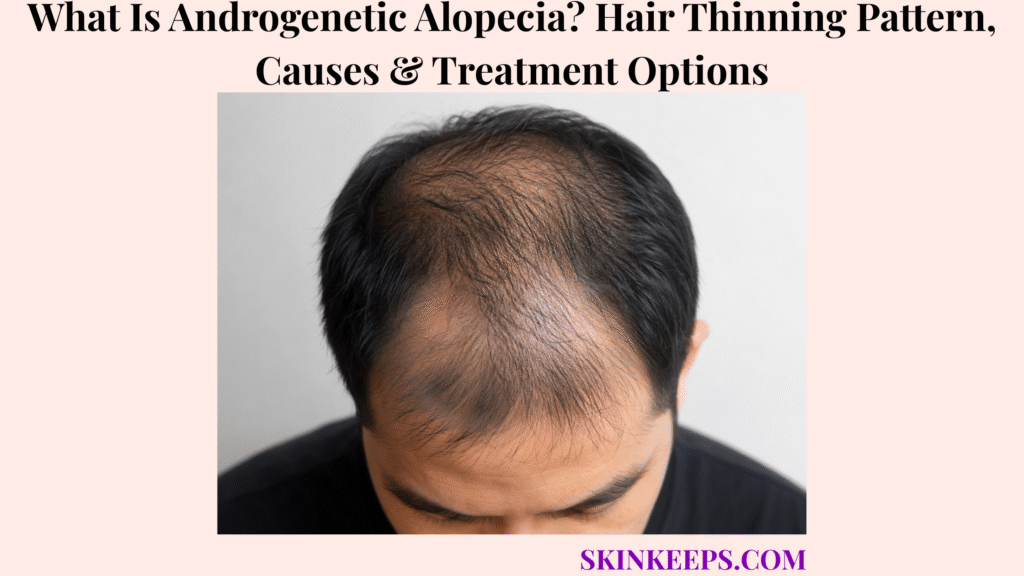
Androgenetic alopecia is inherited pattern hair thinning that develops gradually as susceptible hair follicles shrink and produce finer, shorter hairs over time. It is different from sudden patchy hair loss, telogen shedding, traction-related loss, and scarring alopecia.
This page explains thinning patterns, scalp zones, causes, diagnosis, treatment options, expectations, daily support, mistakes, and dermatologist warning signs. It does not diagnose the reader or promise regrowth.
What Is Androgenetic Alopecia and How Does It Cause Hair Thinning?
Androgenetic alopecia is a common inherited hair-loss condition that causes gradual pattern thinning as hair follicles miniaturize and produce finer, shorter hairs over time.
Pattern hair loss usually develops because genetically susceptible follicles respond to androgen-related signaling in a way that shortens the growth phase and reduces hair shaft diameter. Larger terminal hairs gradually become finer, shorter, and less visible.
This process is called follicle miniaturization. It explains why early androgenetic alopecia may look like reduced density, a widening part, temple recession, crown thinning, or more visible scalp rather than sudden bare patches.
Why Is Androgenetic Alopecia Also Called Pattern Hair Loss?
Androgenetic alopecia is called pattern hair loss because thinning tends to follow recognizable scalp zones instead of appearing randomly across the entire scalp.
Male-pattern hair loss often affects the hairline, temples, crown, vertex, or top scalp. Female-pattern hair loss often appears as widening part-line thinning and reduced top-scalp density, with the frontal hairline usually preserved.
Why Is Androgenetic Alopecia Different From Sudden Shedding?
Androgenetic alopecia is different from sudden shedding because it usually develops slowly through follicle miniaturization rather than abrupt hair fall in clumps.
The scalp surface often lacks heavy scale, crust, pustules, sores, pain, or scarring. Sudden shedding can still overlap with pattern hair loss, so a rapid change deserves evaluation rather than guesswork.
Practical rule: Androgenetic alopecia is best recognized by gradual pattern thinning and follicle miniaturization, not by sudden bald patches.
What Hair Thinning Pattern Does Androgenetic Alopecia Usually Create?
Androgenetic alopecia usually creates gradual thinning in predictable scalp zones rather than sudden smooth bald patches.
The pattern can differ by person. Some people first notice temple recession, some notice crown thinning, and others notice a widening part or reduced ponytail fullness.
What Does Male-Pattern Androgenetic Alopecia Look Like?
Male-pattern androgenetic alopecia often appears as a receding hairline, temple recession, crown thinning, vertex thinning, or top-of-scalp density loss.
The sides and back of the scalp are often less affected than the top in classic male-pattern loss. The pattern can still vary, so a clinician should confirm whether thinning fits androgenetic alopecia or another cause.
What Does Female-Pattern Androgenetic Alopecia Look Like?
Female-pattern androgenetic alopecia often appears as a widening part, reduced ponytail fullness, and diffuse thinning across the top of the scalp while the frontal hairline is usually preserved.
Women usually do not lose all hair in the same pattern seen in some advanced male-pattern loss. Recession can happen in some women, but widening part and top-scalp thinning are common clues.
| Pattern Clue | Male-Pattern AGA | Female-Pattern AGA | Why It Matters |
|---|---|---|---|
| Hairline | Often recedes at temples or frontal edge | Usually preserved | Helps separate common male/female patterns |
| Crown / vertex | Common thinning zone | May thin as part of top-scalp loss | A classic pattern area |
| Part line | Less central than crown/hairline in many men | Often becomes wider | Early clue in many women |
| Ponytail fullness | May reduce if top density declines | Often noticeably reduced | Practical patient-reported clue |
| Speed | Usually gradual | Usually gradual | Sudden loss suggests another or overlapping cause |
Where Does Androgenetic Alopecia Usually Affect the Scalp?
Androgenetic alopecia usually affects the hairline, temples, crown, vertex, mid-scalp, part line, or top of the scalp, depending on the person’s pattern.
Hairline recession can show as a gradually higher frontal edge. Temple thinning can create a more visible corner recession, while crown or vertex thinning can make the scalp more visible at the top-back area.
Mid-scalp thinning and widening part-line thinning can reduce overall scalp coverage. Zone maps can guide recognition, but they should not be treated as diagnostic certainty.
| Scalp Zone | Common Change | Pattern Clue |
|---|---|---|
| Hairline | Gradual recession or frontal thinning | Common male-pattern clue |
| Temples | Corner recession or reduced density | Often appears early in male-pattern loss |
| Crown / vertex | Visible scalp at the top-back area | Classic pattern area |
| Mid-scalp | Reduced density between front and crown | May connect frontal and crown thinning |
| Part line | Widening visible part | Common female-pattern clue |
| Top scalp | Diffuse density reduction over the top | Common in female-pattern thinning |
What Causes Androgenetic Alopecia Beneath the Scalp?
Androgenetic alopecia is driven by inherited follicle sensitivity, androgen-related signaling, age, and gradual follicle miniaturization, not simply by poor hair care.
The cause is not usually “too much testosterone.” The more accurate explanation is that genetically susceptible follicles respond to androgen-related signaling in a way that makes hairs progressively finer and shorter.
How Does Follicle Miniaturization Cause Androgenetic Alopecia?
Follicle miniaturization causes androgenetic alopecia by turning larger terminal hairs into thinner, shorter, less visible hairs over repeated growth cycles.
Terminal hair is thicker, longer, and more pigmented. Vellus-like hair is finer, shorter, and less visible. As miniaturization progresses, hair shaft diameter decreases and scalp coverage becomes thinner.
The growth phase, called the anagen phase, can shorten over repeated cycles. This produces lower density and makes the hairline, crown, part line, or top scalp look thinner over time.
How Do Androgens and DHT Relate to Androgenetic Alopecia?
Androgens and DHT relate to androgenetic alopecia because genetically susceptible follicles respond to androgen signaling in a way that promotes miniaturization.
DHT means dihydrotestosterone. It is formed from testosterone through 5-alpha reductase activity and can act on androgen receptors in susceptible scalp follicles.
DHT-targeting medicines such as finasteride or dutasteride need clinician guidance. Supplements or casual “DHT blocker” claims should not replace diagnosis and safety review.
Which Risk Factors Make Androgenetic Alopecia More Likely?
Androgenetic alopecia is more likely with family history, increasing age, inherited follicle sensitivity, earlier onset, and pattern hair-loss traits.
Risk is context, not diagnosis. Endotext describes male androgenetic alopecia as affecting about 30% to 50% of men by age 50 and notes strong hereditary influence, while DermNet describes female-pattern hair loss signs in about 40% of women by age 50.
Menopause-related timing and hormonal symptoms can matter in some women. Sudden shedding or scalp symptoms can also overlap with androgenetic alopecia and should not be ignored.
- Family history of pattern hair loss.
- Gradual thinning over months or years.
- Receding hairline, temples, crown, or widening part.
- Increasing age.
- Early-onset pattern thinning.
- Menopause-related timing in some women.
- Hormonal symptoms in women, when present.
- Sudden shedding or scalp symptoms suggesting overlap.
How Is Androgenetic Alopecia Different From Other Hair Loss Conditions?
Androgenetic alopecia is usually gradual and pattern-based, while other hair-loss conditions may cause sudden patches, heavy shedding, scalp inflammation, traction-related edges, or permanent scarring.
This distinction prevents weak self-treatment decisions. A gradual widening part, sudden round patch, diffuse shedding event, and painful scaly scalp do not point to the same cause.
How Is Androgenetic Alopecia Different From Alopecia Areata?
Androgenetic alopecia usually causes gradual patterned thinning, while alopecia areata more often causes sudden smooth round or oval bald patches.
Gradual crown thinning points away from alopecia areata, which is an autoimmune hair-loss condition that more often creates sudden smooth patches rather than progressive patterned thinning.
How Is Androgenetic Alopecia Different From Telogen Effluvium?
Androgenetic alopecia causes progressive pattern thinning, while telogen effluvium usually causes diffuse shedding after a trigger such as illness, childbirth, major stress, weight change, or medication.
The two can overlap. A person may have long-term pattern thinning and then notice sudden shedding after illness, surgery, childbirth, medication changes, or major weight change.
How Is Androgenetic Alopecia Different From Traction or Scarring Alopecia?
Androgenetic alopecia is different from traction or scarring alopecia because pattern miniaturization usually lacks the tension history, pain, redness, scale, pustules, or permanent follicle damage seen in other forms.
Patchy scalp loss with scale, inflammation, or broken hairs can suggest tinea capitis, especially in children. Painful bumps or pustules may point toward scalp folliculitis rather than ordinary pattern thinning.
Thick inflammatory scale can appear with psoriasis, while greasy flakes and scalp irritation may fit seborrheic dermatitis. These conditions can coexist with thinning, but they need separate evaluation.
| Condition | Pattern | Scalp Clues | Best Next Step |
|---|---|---|---|
| Androgenetic alopecia | Gradual hairline, crown, part-line, or top-scalp thinning | Usually no heavy scale, pain, pustules, or scarring | Confirm pattern and discuss evidence-led treatment |
| Alopecia areata | Sudden smooth round or oval patches | Often smooth bare skin | Dermatology evaluation if sudden, spreading, or unclear |
| Telogen effluvium | Diffuse shedding across the scalp | Often follows illness, childbirth, stress, weight change, or medication | Review timeline and triggers |
| Traction alopecia | Edges, temples, or pulled areas | Tight hairstyle history, breakage, tenderness | Reduce traction early |
| Tinea capitis | Patchy loss with scale or broken hairs | Itching, scale, inflammation, sometimes lymph nodes | Prompt medical evaluation |
| Scalp folliculitis | Hair loss with inflamed bumps or pustules | Pain, pus, follicle-centered bumps | Medical evaluation if recurrent or painful |
| Scarring alopecia | Patchy or spreading permanent loss | Pain, scale, redness, scarring, loss of follicle openings | Prompt dermatologist evaluation |
How Is Androgenetic Alopecia Diagnosed or Checked?
Androgenetic alopecia is usually checked through hair-loss pattern, scalp examination, medical history, family history, and sometimes tests to rule out overlapping causes.
Many cases are identified by the distribution and progression of thinning. Testing becomes more relevant when the pattern is unclear, symptoms are present, or another cause may be overlapping.
What Does a Dermatologist Look for in Androgenetic Alopecia?
A dermatologist looks for scalp-zone pattern, hair density, hair-shaft diameter variation, miniaturized hairs, family history, progression timeline, and whether scalp inflammation is absent or present.
Trichoscopy can help show hair-shaft diameter variation and miniaturized hairs. Older photos can also help compare hairline, crown, part-line, or ponytail changes over time.
When Might Androgenetic Alopecia Need Lab Tests or Scalp Biopsy?
Androgenetic alopecia may need lab tests or scalp biopsy when shedding is sudden, patches are irregular, scalp symptoms are present, hormonal symptoms appear, nutrition or thyroid issues are suspected, or scarring alopecia must be ruled out.
Scalp pain, itching, redness, scale, pustules, sores, or scarring changes the evaluation. In women, menstrual irregularity, acne, or hirsutism can make hormonal review important.
A biopsy is a small skin sample used when the diagnosis is unclear or scarring disease is suspected. Not every person with androgenetic alopecia needs lab tests or biopsy.
- Timeline of thinning.
- Older photos showing hairline, crown, part, or ponytail changes.
- Family history of pattern hair loss.
- Shedding pattern: gradual thinning vs sudden shedding.
- Scalp symptoms: pain, itching, redness, scale, pustules, sores, or scarring.
- Medicines, supplements, and recent treatment changes.
- Recent illness, childbirth, surgery, weight change, or major stress.
- Menstrual or hormonal symptoms when relevant.
- Hair practices, tight styles, heat, color, chemical treatments.
- Previous treatments tried and how long they were used.
What Treatment Options Are Used for Androgenetic Alopecia?
Androgenetic alopecia treatment aims to slow further thinning, maintain existing hair, and sometimes improve density, but results usually require months of consistent use.
Treatment is usually long-term. Maintenance is a valid goal because preserving responsive follicles can matter as much as visible regrowth.
How Does Minoxidil Help Androgenetic Alopecia?
Minoxidil can help androgenetic alopecia by supporting hair growth and reducing further loss in some people, but it requires consistent long-term use and does not usually restore a full head of hair.
Topical minoxidil may reduce hair loss, stimulate some growth, and strengthen existing strands in responsive users. It commonly takes about 6 to 12 months to judge, and stopping treatment can allow benefits to fade.
For female-pattern hair loss, FDA-approved 2% and 5% topical minoxidil products exist. Some women may notice temporary increased shedding during the first 2 to 8 weeks, which should be discussed with a clinician if concerning.
How Do Finasteride and Other Anti-Androgen Options Fit Androgenetic Alopecia?
Finasteride and other anti-androgen options fit androgenetic alopecia by reducing androgen-related miniaturization signals in selected patients, but they require clinician guidance because safety, pregnancy risk, and side effects matter.
Finasteride is used for male-pattern hair loss and may slow further hair loss in many men when taken consistently. Results may begin around 6 months if it helps, and continuing treatment is usually needed to maintain benefit.
People who may become pregnant should not take or handle finasteride because pregnancy-related safety concerns matter. Spironolactone may be used by dermatologists in selected female-pattern cases, but it is prescription-only and requires medical review.
Which Procedures or Devices May Support Androgenetic Alopecia Treatment?
Procedures and devices may support androgenetic alopecia treatment when diagnosis is clear, expectations are realistic, and the person understands that maintenance may still be needed.
Low-level laser therapy, platelet-rich plasma, hair transplantation, scalp micropigmentation, and hair fibers may be discussed in selected cases. These options are not first-line for everyone and do not replace diagnosis.
Hair transplantation redistributes donor hair in selected people with stable pattern loss and suitable donor area. Scalp micropigmentation and fibers can improve appearance but do not treat follicle miniaturization.
| Option | Best-Fit Pattern | Goal | Timeframe | Key Caution |
|---|---|---|---|---|
| Topical minoxidil | Early male or female pattern thinning | Reduce loss, support growth, maintain density | Often 6–12 months to judge | Must continue to maintain benefit |
| Finasteride | Male-pattern hair loss, clinician-selected cases | Slow androgen-related miniaturization | Around 6 months if effective | Prescription; side effects and pregnancy handling risks matter |
| Spironolactone | Selected female-pattern cases | Reduce androgen-related contribution | Months | Prescription; pregnancy and potassium/medical risks require clinician review |
| Dutasteride | Selected/off-label or country-dependent cases | Stronger 5-alpha reductase inhibition | Months | Clinician-guided; not casual self-treatment |
| Low-level laser therapy | Selected mild/moderate thinning | Support density in some users | Months | FDA-cleared is not the same as FDA-approved |
| PRP | Selected patients seeking procedural support | Reduce shedding or support thickening in some cases | Repeated sessions | Not permanent; maintenance may be needed |
| Hair transplant | Stable pattern loss with suitable donor area | Redistribute permanent donor hair | Surgical timeline | Needs realistic donor-area assessment |
| Scalp micropigmentation / fibers | Cosmetic coverage | Improve appearance of density | Immediate cosmetic effect | Does not treat follicle miniaturization |
What Should You Expect From Androgenetic Alopecia Treatment?
Androgenetic alopecia treatment usually works by maintenance first and regrowth second, so early recognition and consistent use matter more than quick-fix products.
Results take months, not days. Stabilization, reduced shedding, or slower progression can be meaningful even when dramatic regrowth does not happen.
Stopping treatment can allow thinning to resume. Monthly photos under the same lighting are more useful than daily mirror checks under changing angles.
| Timeline | What May Happen | What Not to Assume |
|---|---|---|
| First weeks | Some shedding may occur with minoxidil in some users | Early shedding does not always mean failure |
| 3–4 months | Some people begin noticing stabilization | Lack of dramatic regrowth does not prove treatment is useless |
| 6 months | Finasteride or minoxidil response may become easier to judge | Full restoration is unlikely |
| 6–12 months | Density or shedding changes may be clearer | Results require consistent use |
| After stopping | Benefits may fade and thinning may resume | Treatment is not a permanent cure |
How Can Daily Hair Care Support Androgenetic Alopecia Without Making It Worse?
Daily hair care cannot reverse androgenetic alopecia by itself, but it can reduce breakage, protect fragile hair, and make treatment easier to follow.
Gentle washing, conditioning, reduced heat styling, fewer harsh chemical treatments, and avoiding tight hairstyles can reduce avoidable breakage. Visible scalp should be protected from sun exposure.
Volumizing products, hair fibers, or styling camouflage can improve appearance. Supplements should be used only when deficiency is confirmed or suspected by a clinician; stacking random supplements can backfire.
- Wash and condition gently.
- Avoid tight hairstyles and repeated pulling.
- Reduce heat and chemical damage.
- Protect visible scalp from sun.
- Track photos monthly under the same lighting.
- Keep evidence-led treatments consistent.
- Avoid stacking oils, supplements, and shampoos with guaranteed-regrowth claims.
- Ask about medical evaluation if shedding suddenly increases.
What Androgenetic Alopecia Mistakes Should You Avoid?
The biggest androgenetic alopecia mistake is waiting too long while trying random oils, supplements, or shampoos that do not address follicle miniaturization.
Other mistakes include assuming all thinning is vitamin deficiency, treating pattern loss as dandruff only, stopping minoxidil too early, ignoring sudden shedding, and using prescription options without medical guidance.
| Mistake | Why It Fails | Better Action |
|---|---|---|
| Treating AGA as dandruff | Misses follicle miniaturization | Confirm pattern and scalp signs |
| Relying only on oils | Does not address androgen-sensitive miniaturization | Discuss evidence-led options |
| Stopping too early | Results need months | Track photos and timing |
| Ignoring sudden shedding | Overlap conditions can be missed | Ask for evaluation |
| Using prescription options casually | Safety and pregnancy risks matter | Use clinician guidance |
| Buying guaranteed cures | Creates false expectations | Use realistic treatment goals |
When Should Androgenetic Alopecia Be Checked by a Dermatologist?
Androgenetic alopecia should be checked by a dermatologist when thinning is progressive, early-onset, emotionally distressing, unclear in pattern, associated with scalp symptoms, or not responding to consistent treatment.
Dermatology review is especially useful when the diagnosis is uncertain or when pregnancy-related safety, hormonal symptoms, prescription treatments, or procedure decisions are involved.
Which Hair-Thinning Signs Need Faster Evaluation?
Hair thinning needs faster evaluation when it is sudden, patchy, painful, scaly, pustular, rapidly progressive, associated with eyebrow or eyelash loss, or linked with hormonal symptoms.
Sudden heavy shedding, patchy bald spots, scalp redness, sores, scarring, or a rapidly widening part should not be treated as ordinary androgenetic alopecia. In women, acne, hirsutism, irregular periods, or other hormonal signs should be discussed with a clinician.
What Should You Bring to an Androgenetic Alopecia Appointment?
A useful androgenetic alopecia appointment starts with photos, timeline, family history, shedding pattern, medicines, supplements, scalp symptoms, hair practices, and previous treatments.
Older photos can show whether thinning has been gradual and patterned. Bring exact treatment names and durations instead of estimating from memory.
What Should You Remember About Androgenetic Alopecia?
The most important thing to remember about androgenetic alopecia is that it is gradual pattern hair thinning where early recognition, correct diagnosis, and long-term consistency matter more than quick-fix products.
Follicle miniaturization makes hairs finer and shorter over time. Treatment usually focuses on slowing loss and maintaining hair before regrowth, and warning signs such as sudden, patchy, painful, scaly, pustular, or scarring hair loss need evaluation.
Frequently Asked Questions About Androgenetic Alopecia
Is androgenetic alopecia the same as male-pattern baldness?
Male-pattern baldness is one form of androgenetic alopecia. Female-pattern hair loss is another common form, and both involve progressive pattern thinning linked with inherited follicle sensitivity and miniaturization.
What causes androgenetic alopecia?
Androgenetic alopecia is caused by inherited follicle sensitivity, androgen-related signaling, DHT involvement, age, and follicle miniaturization. It is not simply caused by “too much testosterone.”
Can androgenetic alopecia be reversed?
Treatment may slow loss, maintain existing hair, and improve density for some people, but full reversal is not guaranteed. Results depend on duration, severity, treatment consistency, and follicle responsiveness.
Does minoxidil work for androgenetic alopecia?
Minoxidil can reduce hair loss and support growth in some people, but it needs consistent long-term use and may take 6 to 12 months to assess.
Is finasteride used for androgenetic alopecia?
Finasteride is FDA-approved for male-pattern hair loss and may slow further loss in many men, but it requires clinician discussion because side effects and pregnancy-related safety issues matter.
Is spironolactone used for female-pattern hair loss?
Dermatologists may use spironolactone for selected women with female-pattern hair loss, but it is prescription-only and requires medical review.
Can shampoo or hair oil stop androgenetic alopecia?
Shampoo or oil may support scalp comfort or reduce breakage, but they do not reverse inherited follicle miniaturization.
When should androgenetic alopecia need a dermatologist?
Dermatology evaluation is important for rapid progression, sudden shedding, unclear diagnosis, scalp pain, scaling, pustules, patchy loss, early onset, hormonal symptoms, emotional distress, or treatment failure.
Sources & Evidence About Androgenetic Alopecia
American Academy of Dermatology — Finding the Right Treatments for Genetic Hair Loss was used for hereditary pattern hair loss, male and female scalp-zone patterns, follicle shrinking, minoxidil, finasteride, spironolactone, treatment continuity, and supplement caution.
American Academy of Dermatology — Male Pattern Hair Loss Treatment was used for minoxidil expectations, 6–12 month timing, finasteride response framing, side effects, stopping-treatment recurrence, PRP context, and dermatologist-guided treatment.
American Academy of Dermatology — Female Pattern Hair Loss was used for widening part, reduced ponytail fullness, midlife onset, frontal hairline preservation, 2% and 5% minoxidil, and possible temporary shedding during the first 2–8 weeks.
American Academy of Dermatology — Hair Loss Diagnosis and Treatment was used for dermatologist diagnosis, hair-loss tests, minoxidil limitations, laser-device evidence, and treatment planning.
Endotext / NCBI Bookshelf — Male Androgenetic Alopecia was used for 30–50% male prevalence by age 50, heredity predisposition, follicle miniaturization, anagen shortening, and male-pattern treatment context.
DermNet — Male Pattern Hair Loss was used for androgen and genetic influence, receding hairline, top/front scalp involvement, and male-pattern overview.
DermNet — Female Pattern Hair Loss was used for female-pattern overview, 40% by age 50 context, less than 45% full-hair-by-80 context, and treatment overview.
MedlinePlus Genetics — Androgenetic Alopecia was used for patient-friendly male and female pattern descriptions and genetic background.
Peer-Reviewed Review — Treatment of Androgenetic Alopecia: Current Guidance and Unmet Needs was used for treatment categories including minoxidil, finasteride, low-level laser/light therapy, PRP, procedural options, and treatment-evidence context.
Educational Disclaimer: This SkinKeeps article is for educational purposes only and does not diagnose or replace medical care. Sudden, patchy, painful, scaly, pustular, scarring, rapidly progressive, hormonally linked, or emotionally distressing hair loss should be checked by a qualified healthcare professional or dermatologist.