Alopecia areata is an autoimmune hair-loss condition that often causes sudden smooth round or oval bald patches when immune activity disrupts hair follicles. It is different from ordinary shedding, dandruff, poor hair care, and gradual pattern baldness.
This page explains the hair-loss pattern, affected body areas, types, causes, risk factors, diagnosis, treatment options, regrowth expectations, daily support, mistakes, and dermatologist warning signs. It does not diagnose the reader or promise regrowth.
What Is Alopecia Areata and How Does It Cause Hair Loss?
Alopecia areata is an autoimmune condition that causes hair loss when the immune system mistakenly targets hair follicles.
Hair follicles are the small structures in the skin that grow hair. In alopecia areata, immune activity can create inflammation around the follicle and interrupt normal hair growth without permanently destroying the follicle in many cases.
This is why alopecia areata is usually described as a non-scarring hair loss condition. The hair-bearing skin may look smooth rather than red, crusted, or scarred.
Why Is Alopecia Areata Different From Ordinary Hair Shedding?
Alopecia areata is different from ordinary shedding because it often creates sudden distinct hair-loss patches instead of gradual diffuse hair fall.
Ordinary shedding tends to be spread across the scalp. Alopecia areata more often creates visible patches on the scalp, beard, eyebrows, eyelashes, or other hair-bearing areas, although every sudden patch still needs proper evaluation.
Why Can Alopecia Areata Be Unpredictable?
Alopecia areata can be unpredictable because hair may regrow, new patches may appear, and the condition can recur or become more extensive in some people.
Regrowth may start as fine, white, gray, or lighter hair before color returns in some cases. Some people have one limited episode, while others develop recurring or more widespread disease.
Practical rule: Alopecia areata should be understood as autoimmune hair loss, not ordinary shedding or poor hair care.
What Hair Loss Pattern Does Alopecia Areata Usually Create?
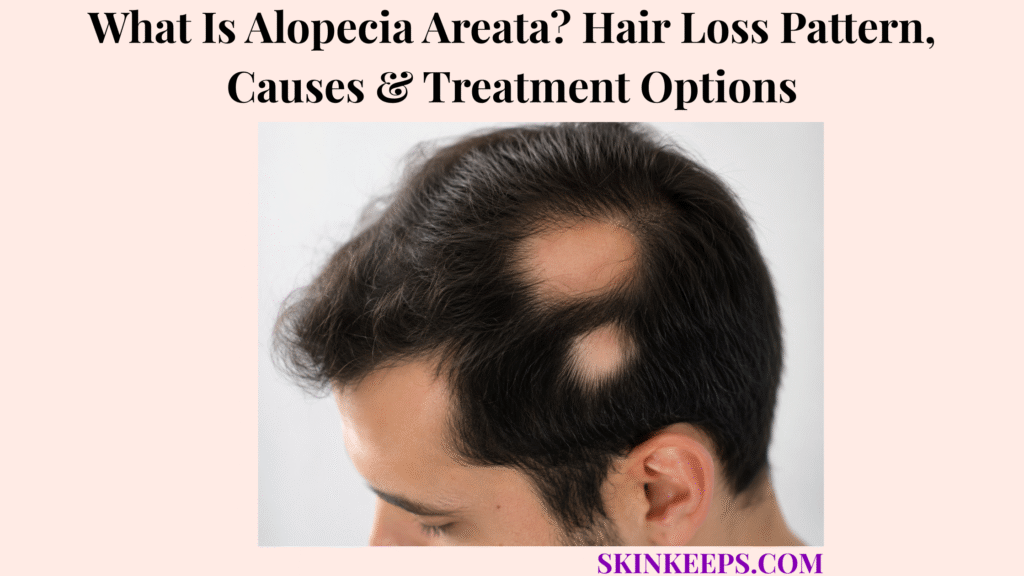
Alopecia areata often causes sudden round or oval smooth bald patches, most commonly on the scalp or beard area, but it can affect any hair-bearing part of the body.
The classic pattern is a smooth patch with clear edges and little or no scale, crusting, redness, or scarring. Some people develop one patch, while others develop several patches that may spread or merge.
What Does Patchy Alopecia Areata Look Like?
Patchy alopecia areata often looks like one or more smooth round or oval bald patches with little or no scale, crusting, redness, or scarring.
Heavy scale, crusting, swelling, pus, pain, or inflamed broken hairs may suggest another diagnosis. In children, scaly patchy hair loss should be checked promptly because tinea capitis can also cause patchy scalp hair loss.
What Are Exclamation Mark Hairs in Alopecia Areata?
Exclamation mark hairs are short broken hairs near the edge of an alopecia areata patch that appear wider at the tip and narrower near the scalp.
These hairs can suggest active disease, but they are best identified with dermoscopy or trichoscopy by a clinician. A reader does not need to find this sign at home to need evaluation.
| Hair-Loss Sign | What It Looks Like | Why It Matters |
|---|---|---|
| Round or oval patch | Smooth bald area with clear borders | Classic alopecia areata pattern |
| Smooth surface | Little or no scale, crust, or scarring | Helps separate AA from some infections or inflammatory scalp diseases |
| Multiple patches | More than one bald area on scalp, beard, or body | May suggest more active or recurrent disease |
| Exclamation mark hairs | Short tapered hairs at patch edge | Can suggest active alopecia areata |
| Nail pitting or ridging | Small dents or rough nail texture | May support severity assessment |
Practical rule: Smooth sudden patches point toward alopecia areata, while scale, pain, crusting, or pus should raise concern for another scalp condition.
Where Can Alopecia Areata Hair Loss Appear?
Alopecia areata can affect the scalp, beard, eyebrows, eyelashes, and other hair-bearing areas, not only the top of the head.
Scalp patches are common, but beard gaps, eyebrow thinning, eyelash loss, and body-hair loss can also occur. Eyebrow or eyelash involvement can affect appearance, confidence, and eye protection.
Patchy beard loss can resemble shaving irritation or fungal infection. Painful, inflamed, scaly, or swollen beard patches should be checked because tinea barbae needs a different diagnosis and treatment plan.
| Area Affected | Common Pattern | Why It May Need Evaluation |
|---|---|---|
| Scalp | Round or oval smooth patches | Most common visible pattern |
| Beard | Patchy beard gaps | Can mimic fungal beard infection or shaving irritation |
| Eyebrows | Thinning or missing segments | Can affect appearance and confidence |
| Eyelashes | Partial or complete lash loss | May reduce eye protection |
| Body hair | Patchy or widespread loss | May indicate more extensive disease |
| Nails | Pitting, ridging, roughness, brittleness | Can support severity assessment |
What Types of Alopecia Areata Can Happen?
Alopecia areata can range from small patchy hair loss to complete scalp hair loss or widespread body hair loss.
Type labels describe the extent of hair loss. They do not predict the emotional impact or guarantee how the condition will behave later.
What Is Patchy Alopecia Areata?
Patchy alopecia areata is the most common type and causes one or more coin-like bald patches on the scalp or another hair-bearing area.
Patchy disease may regrow, recur, spread, or remain limited. Treatment depends on age, patch size, location, duration, disease activity, and patient priorities.
What Are Alopecia Totalis and Alopecia Universalis?
Alopecia totalis means loss of all or nearly all scalp hair, while alopecia universalis means complete or nearly complete hair loss across the scalp, face, and body.
These are more extensive forms of alopecia areata. They need dermatologist-led discussion because treatment complexity, monitoring needs, and quality-of-life impact are often higher.
| Type | Hair-Loss Pattern | Treatment Implication |
|---|---|---|
| Patchy alopecia areata | One or more round patches | May involve observation, topical/injected therapies, or other clinician-led options |
| Alopecia totalis | All or nearly all scalp hair is lost | Requires specialist evaluation and systemic treatment discussion |
| Alopecia universalis | Complete or nearly complete hair loss across scalp, face, and body | Extensive disease with stronger monitoring and treatment complexity |
What Causes Alopecia Areata Beneath the Skin Surface?
Alopecia areata happens when immune activity targets hair follicles, interrupting normal hair growth and causing hair to fall out.
The immune system is not “weak” in alopecia areata. It is misdirected toward the hair-growth unit, which can interrupt the growth cycle and create patchy hair loss.
Why Does the Immune System Attack Hair Follicles in Alopecia Areata?
The immune system attacks hair follicles in alopecia areata because immune cells mistakenly treat follicle structures as targets, creating inflammation around the hair-growth unit.
Researchers do not fully understand why the immune attack begins. Genetic tendency and environmental factors may contribute, but stress alone should not be presented as the single cause.
Can Genetics Increase Alopecia Areata Risk?
Genetics can increase alopecia areata risk, but the condition is not controlled by one simple gene and does not always appear in relatives.
Family tendency can matter, but inheritance is not simple. Even when genes contribute, they do not fully decide who develops alopecia areata or how severe it becomes.
Which Risk Factors Are Linked With Alopecia Areata?
Alopecia areata can affect children and adults, and risk may be influenced by genetic tendency, family history, autoimmune background, atopic conditions, nail changes, and disease recurrence.
Alopecia areata can affect people of different ages, genders, and racial or ethnic groups. Risk associations do not mean every person will develop related conditions or need broad testing.
Atopic conditions such as atopic dermatitis may appear in the broader risk context for some people. Autoimmune overlap can also include conditions such as vitiligo or psoriasis, but these associations are not required for diagnosis.
- Family history of alopecia areata.
- Personal or family autoimmune history.
- Thyroid disease or type 1 diabetes context.
- Atopic conditions such as eczema or asthma.
- Childhood or young-adult onset.
- Recurrent patches.
- Nail pitting, ridging, or brittle changes.
- Extensive or rapidly spreading hair loss.
How Is Alopecia Areata Different From Other Hair Loss Conditions?
Alopecia areata is different from pattern hair loss, shedding-related hair loss, traction hair loss, and scalp infection because it often creates sudden smooth patches rather than gradual thinning or scaly inflamed areas.
This comparison helps prevent wrong self-treatment. A smooth patch, diffuse shedding, tension-related edge loss, and scaly infected patch do not point to the same cause.
How Is Alopecia Areata Different From Male or Female Pattern Hair Loss?
Alopecia areata usually appears as sudden patches, while male or female pattern hair loss usually causes gradual thinning in predictable scalp zones.
Sudden smooth patches point away from gradual androgenetic alopecia, which usually follows a patterned thinning distribution on the hairline, crown, or part line.
How Is Alopecia Areata Different From Telogen Effluvium?
Alopecia areata often causes distinct patches, while telogen effluvium usually causes diffuse shedding across the scalp.
Diffuse shedding may require a timeline review that includes illness, medicines, nutritional concerns, stressors, or hormonal changes. Patchy hair loss still needs pattern-based evaluation.
How Is Alopecia Areata Different From Scalp Ringworm or Infection?
Alopecia areata patches are often smooth, while scalp ringworm or infection may cause scale, redness, broken hairs, swelling, pain, crusting, or pus.
Painful bumps, pustules, or recurrent inflamed follicles may fit scalp folliculitis more closely than smooth alopecia areata. Possible infection should be evaluated rather than treated with harsh home remedies.
| Condition | Hair-Loss Pattern | Skin Clues | Best Next Step |
|---|---|---|---|
| Alopecia areata | Sudden smooth round or oval patches | Usually little scale, crust, redness, or scarring | Dermatology evaluation if spreading, unclear, or distressing |
| Androgenetic alopecia | Gradual patterned thinning | Hairline, crown, or part-line pattern | Discuss diagnosis and treatment options |
| Telogen effluvium | Diffuse shedding | More hair fall across the scalp | Review timeline, illness, stressors, nutrition, and medicines |
| Traction alopecia | Hair loss along tension areas | Tight hairstyle history, edge thinning | Reduce traction and seek care if persistent |
| Tinea capitis | Patchy hair loss with scale or broken hairs | Itching, scaling, inflammation, lymph nodes in some cases | Prompt medical evaluation, especially in children |
| Scalp folliculitis | Patchy irritation with bumps or pustules | Painful inflamed follicles or pus | Medical evaluation if painful, spreading, or recurrent |
How Is Alopecia Areata Diagnosed or Checked?
Alopecia areata is usually checked through scalp or skin examination, hair-loss pattern review, medical history, and sometimes tests to rule out other causes.
Many cases are diagnosed clinically, but testing may be needed when the pattern is unclear, the scalp is inflamed, or another hair-loss condition needs to be excluded.
What Does a Dermatologist Look for in Alopecia Areata?
A dermatologist looks for patch shape, smooth skin surface, patch edges, exclamation mark hairs, nail changes, and signs that another scalp condition may be causing the hair loss.
Trichoscopy or dermoscopy is a magnified examination of the scalp and hair shafts. A clinician may also examine beard, eyebrow, eyelash, body-hair, and nail changes.
A hair pull test may be used as a clinician-level assessment when active shedding is suspected. It should not be treated as a home diagnostic test.
When Might Alopecia Areata Need Lab Tests or Biopsy?
Alopecia areata may need lab tests or biopsy when the diagnosis is unclear, hair loss is diffuse, the scalp is inflamed or scaly, or another thyroid, nutritional, infectious, medication-related, or scarring condition must be ruled out.
A biopsy is a small skin sample used when the diagnosis is uncertain. Extensive testing is not required for every person; testing should follow the clinician’s findings and history.
- When did the first patch appear?
- Did the patch appear suddenly or gradually?
- Are patches spreading or recurring?
- Are eyebrows, eyelashes, beard, or body hair affected?
- Are there nail pits, ridges, or brittle changes?
- Are there scalp symptoms such as scale, pain, redness, or swelling?
- Have there been recent illnesses, major stressors, medicines, or supplements?
- Is there personal or family autoimmune history?
- What hair products, styles, or treatments have been used?
- Bring photos showing changes over time.
What Treatment Options Are Used for Alopecia Areata?
Alopecia areata treatment depends on age, extent of hair loss, location, disease activity, duration, treatment risk, and how much the condition affects quality of life.
No single treatment is right for everyone. Limited patchy disease, eyebrow or eyelash disease, childhood disease, and extensive disease can require different discussions.
Which Treatments May Help Limited Patchy Alopecia Areata?
Limited patchy alopecia areata may be managed with observation, topical corticosteroids, corticosteroid injections, minoxidil support, anthralin, or contact immunotherapy depending on age, patch size, location, and clinician judgment.
Watchful waiting may fit selected small patches, especially when risks of treatment outweigh benefits. Minoxidil may support hair growth, but it does not treat the autoimmune cause directly.
Which Treatments May Help Extensive or Severe Alopecia Areata?
Extensive or severe alopecia areata may require dermatologist-led systemic treatment discussion, including JAK inhibitors, contact immunotherapy, corticosteroids, methotrexate, or other immune-directed options.
Three JAK inhibitors have FDA approval for alopecia areata in specific severe or extensive contexts: baricitinib for adults with severe alopecia areata, ritlecitinib for adults and adolescents 12 years and older with severe or extensive disease, and deuruxolitinib for adults with severe alopecia areata. Eligibility, side effects, monitoring, and risk-benefit review must be handled by a dermatologist.
Why Should Alopecia Areata Treatment Be Dermatologist-Guided?
Alopecia areata treatment should be dermatologist-guided because the condition varies widely, treatment response can take time, recurrence can happen, and stronger medicines require risk-benefit review and monitoring.
Scalp, eyebrow, eyelash, beard, nail, and body-hair involvement can change treatment priorities. Emotional impact also matters when treatment goals are being discussed.
| Treatment Option | Best-Fit Situation | Goal | Key Caution |
|---|---|---|---|
| Observation | Small limited patches in selected cases | Monitor for spontaneous regrowth or spread | Not enough if disease spreads or distress is high |
| Topical corticosteroids | Selected limited or pediatric cases | Reduce local inflammation | Must be used safely, especially on face or thin skin |
| Corticosteroid injections | Limited patchy adult disease when appropriate | Stimulate regrowth in targeted patches | Requires clinician administration |
| Minoxidil | Supportive regrowth plan | Support hair growth | Does not treat the autoimmune cause directly |
| Anthralin | Selected specialist-directed cases | Create controlled irritation to influence regrowth | Can irritate and stain skin or clothing |
| Contact immunotherapy | More persistent or extensive disease in specialist care | Redirect immune response | Requires specialist supervision |
| JAK inhibitors | Severe or extensive eligible cases | Calm immune signaling involved in AA | Requires risk review, monitoring, and eligibility assessment |
| Methotrexate / systemic options | Selected severe or refractory cases | Immune-directed control | Needs clinician monitoring |
What Should You Expect From Alopecia Areata Regrowth?
Alopecia areata regrowth is unpredictable: some patches regrow without aggressive treatment, while others recur, spread, or require medical therapy.
Regrowth may begin as fine, white, gray, or lighter hair before color returns in some people. New patches can appear while older patches are regrowing.
Small patchy disease may behave differently from extensive scalp or body hair loss. Emotional distress is valid and should be included in treatment planning.
| Scenario | Possible Course | What to Discuss With Dermatologist |
|---|---|---|
| One small patch | May regrow, remain stable, or recur | Whether monitoring or local treatment fits |
| Several patches | May expand or merge | Disease activity and treatment options |
| Eyebrow or eyelash loss | Can affect appearance and protection | Safe treatment options for delicate areas |
| Nail changes | May signal more active or severe disease | Whether severity assessment should change |
| Extensive scalp/body loss | May need systemic discussion | Risk-benefit review for stronger treatments |
| Emotional distress | Can affect sleep, confidence, work, or school | Support resources, camouflage, counseling, or treatment goals |
How Can Daily Care Support Alopecia Areata Without Making It Worse?
Daily care cannot cure alopecia areata, but it can protect exposed skin, reduce breakage, support comfort, and help people track hair-loss changes.
Gentle hair handling, sun protection for exposed scalp, and regular photos can help. Tight hairstyles, harsh scalp irritants, burning remedies, and guaranteed growth products should be avoided.
Wigs, hats, scarves, brow products, and support groups can be useful coping tools. These support appearance and comfort but do not reverse the autoimmune process by themselves.
- Handle hair gently.
- Avoid tight hairstyles that pull on affected areas.
- Protect exposed scalp from sunburn.
- Avoid harsh scalp irritants and guaranteed growth products.
- Photograph patches regularly for tracking.
- Track eyebrow, eyelash, beard, nail, and body-hair changes.
- Discuss spreading or distressing changes early with a dermatologist.
What Alopecia Areata Mistakes Should You Avoid?
The biggest alopecia areata mistake is treating sudden patchy hair loss as ordinary shedding or product damage without checking whether an autoimmune hair-loss pattern is present.
Other mistakes include assuming every patch is stress-related, using harsh growth products, ignoring eyebrow or eyelash loss, delaying care when patches spread, and buying guaranteed regrowth cures.
| Mistake | Why It Fails | Better Action |
|---|---|---|
| Calling every patch “stress hair loss” | Misses autoimmune pattern | Check pattern, timeline, and associated signs |
| Using harsh growth products | Irritates scalp and wastes time | Keep scalp care gentle |
| Ignoring fast spread | Delays treatment discussion | See a dermatologist |
| Ignoring eyebrow, eyelash, or nail changes | Misses severity clues | Document changes and report them |
| Expecting instant regrowth | Creates false expectations | Track progress over months |
| Buying guaranteed cures | Wastes money and may irritate skin | Use evidence-led care |
| Treating scaly patches as AA | May miss infection | Seek evaluation for scale, pain, redness, or swelling |
When Should Alopecia Areata Be Checked by a Dermatologist?
Alopecia areata should be checked by a dermatologist when hair loss is sudden, patchy, spreading, affecting eyebrows or eyelashes, associated with nail changes, emotionally distressing, or unclear in cause.
Evaluation is also important when the scalp is red, scaly, painful, swollen, crusted, or pus-filled because that pattern can point away from simple alopecia areata and toward another diagnosis.
Which Alopecia Areata Signs Need Faster Evaluation?
Alopecia areata signs need faster evaluation when patches spread quickly, eyebrows or eyelashes are affected, nails change, a child develops patchy hair loss, or the scalp becomes red, scaly, painful, swollen, or crusted.
Nail pitting, ridging, or brittleness can be part of alopecia areata assessment, but nail pitting can also have other causes such as nail psoriasis. A dermatologist can interpret nail and hair findings together.
What Should You Bring to an Alopecia Areata Appointment?
A useful alopecia areata appointment starts with a clear timeline, photos, patch locations, family history, medicines, recent illnesses, stressors, hair products, nail changes, and prior treatments.
Photos are helpful because patches can change between visits. Avoid performing diagnostic tests at home; bring observations and let the clinician examine the pattern.
What Should You Remember About Alopecia Areata?
The most important thing to remember about alopecia areata is that it is an autoimmune hair-loss condition that often creates smooth round patches and needs pattern-based evaluation rather than random hair-growth treatment.
Hair may regrow, recur, spread, or require treatment. Treatment decisions should consider age, extent, location, severity, treatment safety, emotional impact, and patient goals.
Frequently Asked Questions About Alopecia Areata
Is alopecia areata permanent?
Alopecia areata is unpredictable. Some people regrow hair, some have recurrent patches, and some develop more extensive hair loss. Permanent regrowth should not be promised because the course varies by person.
What causes alopecia areata?
Alopecia areata happens when immune activity mistakenly targets hair follicles. Genetics and environmental factors may contribute, but the exact trigger is not always clear.
What does alopecia areata look like at first?
Alopecia areata often starts as sudden smooth round or oval bald patches, commonly on the scalp or beard area, with little or no redness, scale, crusting, or scarring.
Can stress cause alopecia areata?
Stress may be discussed as a possible flare context for some people, but alopecia areata is an autoimmune condition and should not be reduced to stress alone.
Can alopecia areata affect eyebrows or eyelashes?
Yes. Alopecia areata can affect eyebrows, eyelashes, beard hair, scalp hair, and other body hair.
What is the best treatment for alopecia areata?
There is no one best treatment for everyone. Treatment depends on age, patch size, disease extent, duration, location, severity, treatment risk, and quality-of-life impact.
Are JAK inhibitors approved for alopecia areata?
The FDA has approved three JAK inhibitors for alopecia areata in specific severe or extensive cases. Eligibility, risks, monitoring, age limits, and severity requirements must be reviewed by a dermatologist.
When should alopecia areata need a dermatologist?
Dermatology evaluation is important for sudden patches, spreading hair loss, eyebrow or eyelash involvement, nail changes, scalp inflammation, children, unclear cause, or emotional distress.
Sources & Evidence About Alopecia Areata
NIAMS — Alopecia Areata was used for the autoimmune definition, hair follicle mechanism, sudden round or oval patches, affected body areas, main types, nail changes, and regrowth unpredictability.
American Academy of Dermatology — Alopecia Areata Signs and Symptoms was used for smooth round or oval bald patches, scalp or beard onset, eyebrow, eyelash, body-hair involvement, and nail changes.
American Academy of Dermatology — Alopecia Areata Diagnosis and Treatment was used for treatment variability, corticosteroids, minoxidil support, JAK inhibitors, children’s treatment caution, and the need for individualized treatment plans.
DermNet — Alopecia Areata was used for exclamation point hairs, tingling or itching before loss, white or blonde early regrowth, nail-change estimate, trichoscopy, hair pull test, biopsy context, and autoimmune associations.
National Alopecia Areata Foundation — Alopecia Areata was used for lifetime prevalence context, U.S. and worldwide affected estimates, onset timing, family history, polygenic disease context, and patient impact.
National Alopecia Areata Foundation — FDA-Approved JAK Inhibitors was used for baricitinib, ritlecitinib, and deuruxolitinib approval context, age and severity eligibility, and treatment caution.
British Association of Dermatologists — Alopecia Areata was used for coin-sized patches, non-scarring hair loss, scalp, beard, eyebrow, eyelash, body involvement, and alopecia totalis / universalis definitions.
Cleveland Clinic — Alopecia Areata was used for patient-friendly autoimmune mechanism, treatment and regrowth framing, and the caution that severe cases may not respond to treatment.
Educational Disclaimer: This SkinKeeps article is for educational purposes only and does not diagnose or replace medical care. Sudden, spreading, unclear, painful, inflamed, scaly, infected-looking, eyebrow-related, eyelash-related, child-related, or emotionally distressing hair loss should be checked by a qualified healthcare professional or dermatologist.