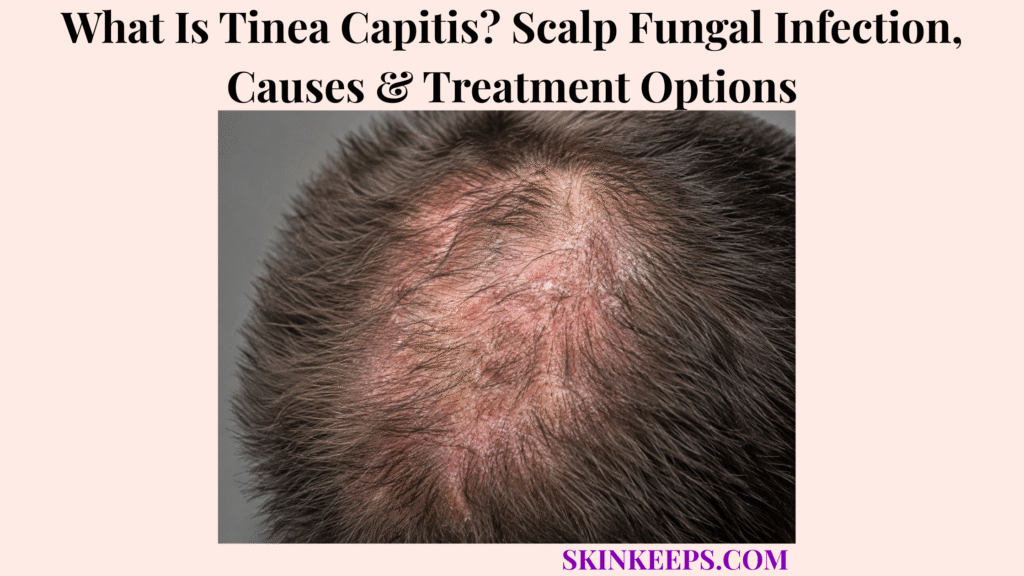
Tinea capitis, or scalp ringworm, is a contagious dermatophyte fungal infection involving both scalp skin and hair shafts. It commonly causes scaling, broken hairs and patchy hair loss, especially in children, and it can range from mild non-inflammatory disease to a painful inflammatory kerion.
Because dermatophytes can live inside infected hairs and follicular structures, scalp ringworm usually needs prescription oral antifungal treatment rather than cream alone. Fungal microscopy or culture can confirm uncertain cases, while contact, animal and contaminated-object assessment helps reduce reinfection and protect follicles from prolonged inflammation.
Medical note: This article is for educational purposes only. Scalp scaling with patchy hair loss, painful boggy swelling, rapidly worsening alopecia, scarring or suspected tinea capitis in a child should be medically evaluated.
What Is Tinea Capitis and What Does Scalp Ringworm Look Like?
Tinea capitis is a dermatophyte infection of scalp skin and hair that can cause scale, broken hairs, patchy alopecia and, in severe inflammatory cases, kerion-like swelling.
Which Parts of the Scalp Does Tinea Capitis Infect?
Tinea capitis affects keratinized scalp skin and hair structures. Dermatophytes grow around or within the hair shaft and follicular unit, weakening infected hairs so they can break close to the scalp or shed from inflamed areas.
Which Fungi Cause Tinea Capitis?
The main dermatophyte genera are Trichophyton and Microsporum. The dominant species varies by geography and transmission source; for example, human-associated Trichophyton species are common in some regions, while animal-associated Microsporum species remain important elsewhere.
Why Is Tinea Capitis Called Scalp Ringworm?
“Ringworm” means dermatophyte fungal infection rather than a worm, and scalp disease does not need to form a perfect ring. The broader ringworm category includes several body-site infections, but tinea capitis is distinct because scalp hairs are directly involved.
What Does Non-Inflammatory Tinea Capitis Look Like?
Non-inflammatory disease commonly causes dry or fine scaling, itch, patchy alopecia and broken or shortened hairs with relatively little swelling. Some cases can resemble dandruff, so focal hair breakage and loss are especially useful clues.
What Is Black-Dot Tinea Capitis?
Black-dot tinea capitis develops when infected hairs become fragile and break at or near scalp level, leaving dark hair stumps within follicular openings. The black dots reflect broken shafts rather than pigment spots.
What Is Gray-Patch Tinea Capitis?
Gray-patch tinea capitis is a clinical pattern of scaling, dull infected hairs and patchy alopecia. It is not a separate disease; the gray appearance reflects scale and altered hairs within a dermatophyte infection.
What Is a Kerion?
A kerion is a highly inflammatory form of tinea capitis that produces a painful boggy plaque with pustules, crusting, drainage and loose hairs. Nearby lymph nodes may enlarge, and the lesion can resemble a bacterial abscess even though the underlying process is dermatophyte infection.
Can Tinea Capitis Cause Permanent Hair Loss?
Most uncomplicated tinea capitis causes temporary alopecia because infected hairs break or shed while follicles remain capable of regrowth. Prolonged severe inflammation—especially kerion—can scar follicles and produce permanent alopecia in affected areas.
What Causes Tinea Capitis and How Does Scalp Ringworm Spread?
Tinea capitis spreads when dermatophytes move from infected people, animals or contaminated objects to another person’s scalp and hair.
Why Is Tinea Capitis More Common in Children?
Tinea capitis predominantly affects prepubertal children, although adults can still develop it. Age is therefore a probability clue rather than a rule that excludes scalp ringworm later in life.
How Does Tinea Capitis Spread Between People?
Direct head-to-head or close skin contact can transfer dermatophyte-containing hair or scalp material. Household clustering and close-contact settings are especially relevant when human-associated species are circulating.
Can Combs, Hats, Pillows or Hair Tools Spread Tinea Capitis?
Yes. Combs, brushes, hats, towels, bedding and reusable grooming tools can carry infected hairs or fungal material and contribute to transmission. Sharing these items should be avoided during active infection.
Can Tinea Capitis Spread From Animals?
Yes. Some dermatophytes have animal reservoirs, so infected cats, dogs or other animals can be a source. When an animal exposure fits the clinical history, veterinary assessment may be needed to prevent repeated reinfection.
Can Someone Carry the Fungus Without Symptoms?
Yes. Asymptomatic scalp carriage can occur, particularly among close contacts of people with anthropophilic tinea capitis. Carrier status can help sustain household spread, but the possibility of carriage does not mean every contact should automatically receive treatment.
How Is Tinea Capitis Diagnosed and Distinguished From Other Scalp Conditions?
Tinea capitis is suspected from scaling, broken hairs and patchy alopecia and can be confirmed with fungal microscopy or culture when the clinical pattern overlaps with other scalp disorders.
How Does a Clinician Recognize Suspected Tinea Capitis?
Clinical suspicion rises when scalp scale occurs together with broken hairs, focal alopecia, black-dot areas or kerion-like inflammation. Exposure history, age and household clustering can strengthen the fungal hypothesis but do not replace examination or testing.
How Do KOH Microscopy and Fungal Culture Confirm Tinea Capitis?
Microscopy of scalp scale or plucked affected hairs treated with potassium hydroxide can reveal fungal structures, while fungal culture can confirm dermatophyte infection and identify the causative species. Culture is slower, but species information can matter for source tracing and treatment choice.
Can Dermoscopy or Trichoscopy Help?
Yes. Trichoscopy can quickly reveal infected-hair patterns such as comma, corkscrew, zigzag or barcode-like hairs and can support early suspicion while culture is pending. It is an adjunct rather than a universal substitute for microbiologic confirmation.
How Is Tinea Capitis Different From Seborrheic Dermatitis?
Tinea capitis commonly combines scale with broken hairs or focal alopecia, while seborrheic dermatitis more often produces diffuse flaky or greasy scale without dermatophyte invasion of the hair shaft.
How Is Tinea Capitis Different From Scalp Psoriasis?
Scalp psoriasis can produce thick scale and inflammation, but it does not typically create the infected broken-hair pattern or fungal microscopy findings seen in tinea capitis.
How Is Tinea Capitis Different From Alopecia Areata?
Tinea capitis usually includes scale, broken hairs or inflammation, whereas alopecia areata more often creates smooth non-scarring hairless patches without the same fungal scaling or hair-shaft infection. A smooth patch alone should not be labeled tinea capitis.
How Is Tinea Capitis Different From Bacterial Folliculitis?
Folliculitis centers on inflamed or infected follicles and can produce pustules, while tinea capitis is a dermatophyte infection that characteristically involves scalp skin plus hair shafts and can cause distinctive hair breakage.
Why Can Kerion Be Mistaken for a Scalp Abscess?
Kerion and a skin abscess can both be painful, swollen and draining. The key difference is mechanism: kerion is an intense inflammatory response to dermatophyte infection, while an abscess is a localized bacterial pus collection.
How Is Tinea Capitis Treated?
Tinea capitis generally requires prescription oral antifungal treatment because dermatophytes live within infected hair shafts and follicular structures that topical products cannot adequately eradicate.
Why Does Tinea Capitis Need Oral Antifungal Medicine?
Oral antifungals reach infected growing hair and follicular structures, while topical creams and lotions do not penetrate deeply enough to reliably clear scalp infection on their own. This is the key treatment distinction between scalp ringworm and many small superficial body-ringworm lesions.
Which Oral Antifungals Are Used?
Prescription options include terbinafine, griseofulvin, itraconazole and fluconazole. The clinician chooses among them according to the suspected or confirmed organism, age, weight, medical history, interactions, availability and other patient-specific factors.
Why Can the Dermatophyte Species Affect Treatment Choice?
Species matters because Trichophyton and Microsporum infections do not respond identically to every systemic antifungal. Terbinafine often performs well for Trichophyton, while griseofulvin may be more effective for many Microsporum infections in children; this is a treatment-selection principle rather than an absolute rule.
Can Antifungal Shampoo Alone Cure Tinea Capitis?
No. Antifungal shampoo can reduce surface spores and infectiousness, making it useful as an adjunct, but it does not eradicate fungus living inside infected hair shafts and therefore does not replace oral treatment.
How Is Kerion Treated?
Kerion still requires effective systemic antifungal therapy because the underlying condition is dermatophyte infection despite its abscess-like appearance. Clinicians separately assess severe inflammation, secondary bacterial infection and scarring risk rather than treating it as a routine drainable abscess.
Why Should Steroid Creams Not Be Used as the Only Treatment?
Corticosteroids can suppress redness and inflammation without eradicating dermatophytes, allowing fungal infection to persist or become harder to recognize. Steroid monotherapy is therefore not appropriate treatment for suspected scalp ringworm.
What If Tinea Capitis Does Not Improve?
Treatment failure should prompt reassessment of the diagnosis, treatment completion, fungal species, ongoing exposure or reinfection and, when relevant, antifungal resistance. Repeating the same empiric therapy indefinitely can delay recognition of a wrong diagnosis or persistent reservoir.
How Can Tinea Capitis Spread or Recurrence Be Prevented, and When Is Prompt Medical Care Needed?
Preventing recurrence requires completing oral treatment, reducing contaminated hair and object exposure, checking relevant contacts or animals and promptly reassessing kerion, scarring or treatment failure.
How Can Household Transmission Be Reduced?
Household spread can be reduced by avoiding shared combs, brushes, hats and towels, cleaning reusable grooming items, laundering contaminated bedding or pillowcases appropriately and completing prescribed antifungal therapy. Practical infection control should focus on fungal material rather than blaming the family for poor hygiene.
Should Household Members Be Checked?
Close contacts may need assessment when several people have scalp symptoms, infection keeps returning or asymptomatic carriage is suspected. Assessment is selective and does not automatically mean every family member requires systemic treatment.
Should Pets or Other Animals Be Checked?
Yes when an animal is a plausible source. An untreated infected pet or other animal can repeatedly reintroduce dermatophytes after the patient has completed therapy, so veterinary evaluation can be part of source control.
Can Haircuts or Shaving Cure Tinea Capitis?
No. Cutting or shaving hair does not eliminate dermatophytes already within infected hairs and follicular structures. Very close shaving can also traumatize an inflamed scalp; medical antifungal treatment remains the core therapy.
What Should Be Done if Tinea Capitis Keeps Returning?
Recurrent disease should trigger review of the original diagnosis, completion and suitability of oral treatment, fungal species, infected contacts or animals, contaminated personal items and possible resistance. Recurrence is not automatically evidence of poor hygiene.
When Should Tinea Capitis Be Evaluated Promptly?
Prompt assessment is appropriate for scalp scale with patchy hair loss or broken hairs, spreading lesions, persistent inflammation, a suspected household outbreak, failure of dandruff treatment or suspected tinea capitis in a child.
Which Signs Suggest Kerion Needs Prompt Treatment?
Painful boggy swelling, extensive pustules or crusting, drainage, rapidly worsening hair loss, marked tenderness and enlarged nearby lymph nodes raise concern for kerion and deserve timely medical treatment to control infection and limit follicular damage.
When Is Permanent Hair-Loss Risk Higher?
Permanent alopecia risk rises when inflammation is severe or prolonged, especially with kerion, delayed diagnosis or persistent untreated disease. Early effective antifungal treatment reduces the duration of follicular inflammation but cannot reverse established scar tissue.
When Does Treatment Failure Need Specialist Reassessment?
Specialist reassessment is appropriate when proper oral therapy produces little improvement, cultures remain positive, disease repeatedly recurs, diagnosis is uncertain or scarring alopecia develops. Adherence, reinfection and diagnostic confirmation should be reviewed before resistance is assumed.
What Should You Remember About Tinea Capitis?
Tinea capitis is a contagious dermatophyte infection of scalp and hair that commonly causes scaling, broken hairs and patchy alopecia and generally requires oral antifungal treatment.
- Scalp ringworm infects scalp skin and hair shafts, not just the skin surface.
- Trichophyton and Microsporum are major dermatophyte groups.
- Children are affected most often, but adults can still develop tinea capitis.
- A perfect ring is not required; scale, broken hairs, black dots or alopecia may dominate.
- Gray-patch and black-dot tinea capitis are clinical patterns, not separate diseases.
- Kerion is inflammatory fungal disease, not simply a bacterial abscess.
- Most uncomplicated hair loss is temporary, but severe inflammation can scar permanently.
- Spread can occur from people, animals and contaminated objects.
- Asymptomatic carriage can contribute to ongoing transmission.
- KOH microscopy and fungal culture can confirm uncertain cases.
- Trichoscopy is a useful diagnostic adjunct.
- Seborrheic dermatitis, psoriasis, alopecia areata, bacterial folliculitis and abscess can mimic parts of the presentation.
- Oral antifungal treatment is the therapeutic core.
- Topical creams do not cure scalp hair-shaft infection by themselves.
- Antifungal shampoo is an adjunct that helps reduce surface spores.
- Species can influence systemic drug choice.
- Corticosteroid monotherapy should not be used for presumed ringworm.
- Relevant contacts, animals and contaminated items may need assessment.
- Haircuts do not eradicate infection.
- Kerion, scarring and refractory disease need timely reassessment.
Frequently Asked Questions About Tinea Capitis
The main tinea capitis questions concern contagiousness, hair loss, antifungal shampoo, hair regrowth and kerion.
Is Tinea Capitis Contagious?
Yes. Scalp ringworm can spread through close contact with infected people or animals and through contaminated hair, combs, hats, bedding, or other personal items.
Why Does Tinea Capitis Cause Patchy Hair Loss?
Dermatophytes weaken infected hair shafts, causing them to break or loosen and creating focal areas of alopecia.
Can Antifungal Shampoo Alone Cure Tinea Capitis?
No. Antifungal shampoo can reduce surface fungal spores and transmission, but it cannot reliably eradicate dermatophytes living inside infected hairs and follicular structures.
Will Hair Grow Back After Tinea Capitis Treatment?
Most uncomplicated tinea capitis causes temporary hair loss with regrowth after the infection clears, but severe scarring inflammation can cause permanent loss.
What Is the Difference Between Tinea Capitis and a Kerion?
Tinea capitis is the scalp dermatophyte infection itself, while kerion is its highly inflammatory boggy, pustular form with a greater risk of follicular damage and scarring.
DermNet — Tinea Capitis. Supports scalp and hair-shaft involvement, black-dot and gray-patch patterns, kerion, scarring alopecia, microscopy/culture, trichoscopy, oral treatment and adjunctive shampoos.
CDC — Treatment of Ringworm. Supports prescription oral antifungal treatment for scalp ringworm and the warning that corticosteroid creams can worsen ringworm.
MSD Manual Professional — Tinea Capitis. Supports KOH examination, oral therapy, species-dependent treatment selection and the need to consider kerion before treating a scalp swelling as an abscess.
American Academy of Dermatology — Ringworm Diagnosis and Treatment. Supports scalp prescription therapy, fungal sampling and treatment adherence.
World Health Organization — Ringworm (Tinea). Supports dermatophyte transmission through people, animals and contaminated objects and the relevance of emerging antifungal resistance.