
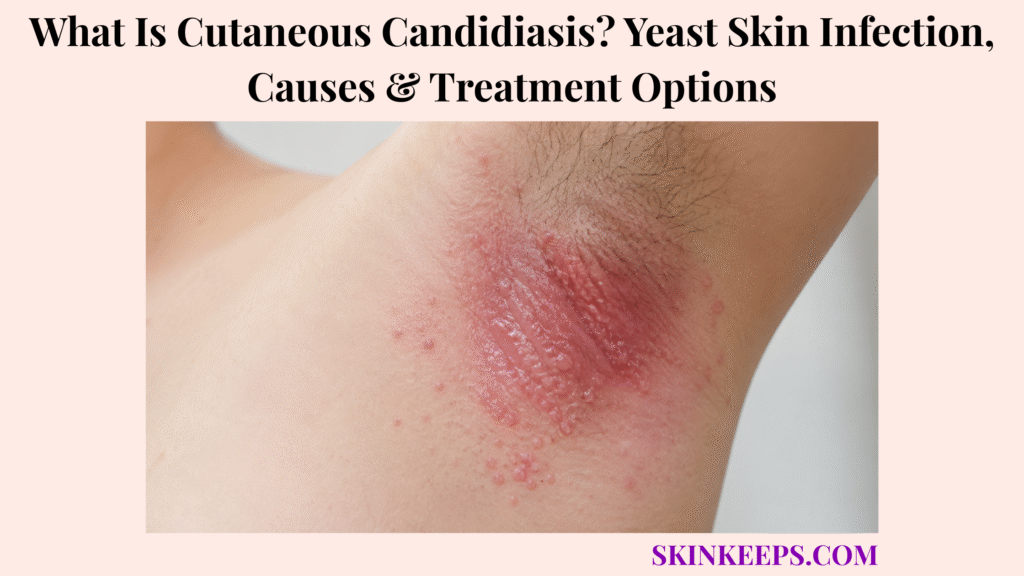
Cutaneous candidiasis is a superficial yeast infection of the skin caused by overgrowth of Candida, a yeast that can normally live on the skin but can cause infection when moisture, friction, warmth, or lowered defenses allow it to multiply.
It is not a dirty-skin problem or a simple friction rash only. Safe care usually combines antifungal treatment with moisture and friction control, while recurrent, severe, spreading, infected-looking, diabetic, infant, or immune-risk cases need clinician review.
What Is Cutaneous Candidiasis and Why Does Yeast Infect the Skin?
Cutaneous candidiasis is a superficial yeast infection of the skin caused by overgrowth of Candida, a yeast that can normally live on the skin but can cause infection when moisture, friction, warmth, or lowered defenses allow it to multiply.
Candida albicans is a common species, but the exact organism is not always identified without testing.
The key problem is overgrowth. Warm moist folds, skin breakdown, friction, recent antibiotics, steroid exposure, diabetes, or immune suppression can shift the local balance and allow a yeast skin infection to develop.
Why Can Candida Live on Skin Without Always Causing Infection?
Candida can live on the skin without causing infection because it may be part of the body’s normal microbial environment until local conditions allow it to overgrow.
Moisture, heat, friction, skin breakdown, antibiotics, diabetes, or immune suppression can increase risk.
The problem is not poor hygiene alone. A person can wash well and still develop cutaneous candidiasis if the fold environment stays warm, damp, and irritated.
Why Are Skin Folds Common Sites?
Skin folds are common sites because they trap sweat, heat, and moisture while friction weakens the skin barrier.
Fold irritation can start as intertrigo, then become secondarily infected when yeast overgrows in the moist damaged area.
That is why treatment usually needs both antifungal care and fold-environment control.
Practical rule: A suspected yeast skin infection needs antifungal treatment plus a drier, cooler, lower-friction fold environment.
What Cutaneous Candidiasis Symptoms Appear on Skin?
Cutaneous candidiasis often causes a red, raw, itchy, burning, sore, or moist rash, sometimes with small nearby satellite bumps or pustules around the main rash.
Symptoms often feel worse with sweat, rubbing, tight clothing, movement, bathing, or occlusion.
What Does a Yeast Skin Rash Look Like?
A yeast skin rash may look moist, shiny, raw, red, pink, purple, brown, gray-brown, or darker depending on skin tone and location.
The surface may look macerated, which means softened and wet from trapped moisture.
Small satellite papules or pustules near the edge of the main rash are a useful clue, but they are not required in every case.
What Symptoms Suggest the Rash Is Worsening?
A yeast rash may be worsening when cracks, oozing, bleeding, bad smell, increasing pain, spreading rash, pus, warmth, swelling, or fever develops.
These signs can suggest bacterial infection, deeper infection, severe irritation, or another diagnosis.
Worsening pain, fever, spreading warmth, or pus should not be treated as simple yeast without medical review.
How Can Cutaneous Candidiasis Look on Darker Skin?
On darker skin, cutaneous candidiasis may look purple, gray-brown, dark brown, or darker rather than bright red, so texture and symptoms matter.
Redness may be subtle. Moisture, soreness, itch, burning, shiny raw texture, cracks, and satellite bumps may be more helpful clues.
A darker fold rash that is painful, spreading, oozing, or recurrent still needs the same safety review as a bright red rash.
| Symptom | What User May Notice | Why It Matters |
|---|---|---|
| Itch / burning | Fold feels irritated, hot, or sore. | Common yeast-rash clue. |
| Moist / raw skin | Shiny or macerated fold. | Barrier breakdown. |
| Satellite bumps | Small nearby papules or pustules. | Candida pattern clue. |
| Cracks / fissures | Painful splits. | Infection and worsening risk. |
| Oozing / bleeding | Broken skin. | Needs careful care. |
| Pus / fever | Systemic or bacterial concern. | Medical review. |
| Spreading warmth | Deeper bacterial infection concern. | Urgent assessment if worsening. |
Where Does Cutaneous Candidiasis Usually Appear?
Cutaneous candidiasis commonly appears in warm, moist skin folds such as the armpits, under the breasts, groin, buttocks, belly button, abdominal folds, between fingers or toes, and diaper area.
It can also affect neck folds, inner thighs, gluteal folds, and skin around devices, dressings, braces, pads, or occlusive clothing.
Location helps, but it does not diagnose the rash by itself. Tinea, eczema, psoriasis, allergic contact dermatitis, heat rash, bacterial infection, and cellulitis can overlap.
| Location | Moisture / Friction Trigger | Diagnosis Caution |
|---|---|---|
| Under breasts | Sweat, rubbing, poor airflow. | Intertrigo, eczema, psoriasis can mimic. |
| Armpits | Sweat, deodorant irritation, friction. | Contact dermatitis also possible. |
| Groin / inner thighs | Moisture, tight clothing, rubbing. | Tinea cruris can mimic. |
| Buttocks / gluteal fold | Sweat, friction, sitting. | Bacterial infection if painful or pus-filled. |
| Diaper area | Moisture and occlusion. | Persistent infant rash needs care. |
| Belly button / abdominal folds | Trapped sweat and poor drying. | Recurrent rash needs diagnosis review. |
| Finger or toe webs | Moisture between digits. | Tinea or athlete’s foot may mimic. |
| Device/dressing folds | Occlusion and trapped moisture. | Watch bacterial infection and pressure injury. |
What Causes Cutaneous Candidiasis?
Cutaneous candidiasis is caused by Candida overgrowth when skin conditions become warm, moist, irritated, or less able to resist yeast growth.
The rash usually reflects both organism overgrowth and the local environment that allowed that overgrowth.
How Do Moisture and Friction Trigger Yeast Overgrowth?
Moisture and friction trigger yeast overgrowth by softening the skin barrier and creating a warm, damp environment where Candida can multiply.
Sweat collects in folds. Friction breaks down the outer skin barrier. Tight clothing and poor airflow keep the area damp.
This is why a fold yeast rash often returns when the fold stays sweaty, covered, and rubbing every day.
How Do Antibiotics and Steroids Affect Candida Risk?
Antibiotics and steroids can increase Candida risk by disrupting normal microbial balance or reducing local immune control.
Recent antibiotics can change the balance of microbes that help control yeast growth.
Steroid creams may reduce redness temporarily, but steroid-only treatment can worsen or mask a yeast or fungal rash if the diagnosis is wrong.
How Do Diabetes and Immune Suppression Affect Candida Risk?
Diabetes and immune suppression can make Candida skin infections more persistent, extensive, recurrent, or harder to clear.
Immune-risk settings include chemotherapy, transplant medicines, advanced HIV, long-term steroid use, cancer treatment, chronic wounds, or other conditions that weaken infection defense.
Recurrent, widespread, or hard-to-clear yeast-pattern rashes should prompt review for underlying risks and diagnosis accuracy.
| Cause Factor | Skin Effect | Practical Implication |
|---|---|---|
| Sweat / moisture | Yeast-friendly environment. | Keep folds dry. |
| Heat | Increases sweating and maceration. | Cool, breathable clothing. |
| Friction | Barrier damage. | Reduce rubbing. |
| Antibiotics | Microbial balance disruption. | Review medicine history. |
| Steroids | Lowered local immune response. | Avoid steroid-only misuse. |
| Diabetes | Higher yeast risk. | Check recurrent infections. |
| Immune suppression | More severe or persistent infection. | Lower threshold for care. |
| Devices/dressings | Occlusion and trapped moisture. | Drying and skin checks. |
Who Is More Likely to Get Cutaneous Candidiasis?
Cutaneous candidiasis is more likely when moisture, friction, skin folds, diabetes, antibiotics, steroid use, or immune suppression allow Candida to overgrow.
Risk factors help decide whether self-care is reasonable or whether a clinician should check the rash earlier.
- Hot or humid weather.
- Heavy sweating.
- Tight or non-breathable clothing.
- Under-breast, groin, armpit, belly, neck, or abdominal folds.
- Diaper use or prolonged moisture exposure.
- Recent antibiotics.
- Steroid creams or systemic steroids.
- Diabetes.
- Obesity or deeper skin folds.
- Immune suppression.
- HIV, chemotherapy, transplant medicines, or cancer treatment.
- Bedbound or limited-mobility status.
- Moist dressings, braces, pads, or medical devices.
How Is Cutaneous Candidiasis Different From Other Skin Rashes?
Cutaneous candidiasis can resemble intertrigo, tinea, eczema, psoriasis, bacterial infection, contact dermatitis, heat rash, and cellulitis, so location, satellite pustules, moisture, scaling pattern, and treatment response matter.
Wrong treatment can worsen irritation, delay the correct diagnosis, or miss bacterial infection.
How Is Cutaneous Candidiasis Different From Simple Intertrigo?
Simple intertrigo is inflammation from skin-fold friction and moisture, while cutaneous candidiasis is Candida overgrowth that can infect an already irritated fold.
Chafing can irritate folds through friction alone, but Candida-pattern rash often needs antifungal treatment as well as drying and friction reduction.
Satellite papules or pustules around a moist fold rash support Candida involvement, although testing may be needed when the pattern is unclear.
How Is Cutaneous Candidiasis Different From Tinea or Ringworm?
Cutaneous candidiasis is caused by yeast, while tinea or ringworm is caused by dermatophyte fungi and often has a scaly ring-like border.
Candida favors warm moist folds and may show satellite pustules, while tinea often has a more active scaly edge.
Toe-space rashes may overlap with athlete’s foot, so diagnosis matters before choosing treatment.
How Is Cutaneous Candidiasis Different From Eczema or Psoriasis?
Cutaneous candidiasis is usually moist, sore, fold-based, and may have satellite pustules, while eczema and psoriasis follow different inflammatory patterns.
Atopic dermatitis often involves chronic itch, dry barrier sensitivity, and recurrent eczema patterns rather than a moist yeast-fold pattern.
Psoriasis can affect folds as smoother inverse psoriasis, so persistent nonresponsive fold rash should be reassessed rather than repeatedly treated blindly.
How Is Cutaneous Candidiasis Different From Contact Dermatitis or Heat Rash?
Cutaneous candidiasis is yeast overgrowth, while contact dermatitis follows exposure to an irritant or allergen and heat rash follows sweat blockage or overheating.
Allergic contact dermatitis may follow deodorant, detergent, adhesive, pad, fragrance, fabric, brace, or device exposure.
Heat rash may feel prickly or itchy after hot sweaty occlusion, but it is not the same as Candida overgrowth.
How Is Cutaneous Candidiasis Different From Bacterial Infection or Cellulitis?
Cutaneous candidiasis is usually superficial and fold-based, while bacterial infection or cellulitis may cause worsening pain, warmth, swelling, pus, fever, or spreading tenderness.
Mixed yeast and bacterial infection can occur when the skin barrier is cracked, oozing, or open.
Spreading warmth, swelling, fever, or worsening tenderness can suggest cellulitis or another bacterial infection rather than simple yeast alone.
| Condition | Main Clue | Why Confusion Happens | Safer Next Step |
|---|---|---|---|
| Cutaneous candidiasis | Moist fold rash + satellite bumps. | Looks like intertrigo. | Antifungal + dryness. |
| Simple intertrigo | Fold irritation from friction/moisture. | Same location. | Dry/protect; check yeast if persistent. |
| Tinea / ringworm | Scaly ring border or edge activity. | Fungal rash overlap. | Confirm pattern or test if unclear. |
| Eczema | Dry itchy recurring rash. | Itch/redness overlap. | Avoid steroid-only use if yeast possible. |
| Psoriasis | Defined plaques or inverse fold rash. | Fold rash overlap. | Dermatology if persistent. |
| Bacterial infection | Pus, warmth, swelling, fever. | Soreness overlap. | Medical review. |
| Cellulitis | Painful spreading deeper infection. | Red fold area may confuse. | Urgent care if spreading or systemic. |
How Is Cutaneous Candidiasis Diagnosed or Checked?
Cutaneous candidiasis is often diagnosed from the rash pattern, skin-fold location, moisture history, and satellite lesions, but testing may be used when the rash is recurrent, severe, unclear, or not improving.
A clinician also checks for mimics and bacterial complications because every fold rash is not Candida.
What Does a Clinician Check With Suspected Candida Skin Infection?
A clinician checks suspected cutaneous candidiasis by reviewing rash location, moisture, friction, satellite bumps, medication history, underlying health risks, and signs of mimics or bacterial infection.
The review may include sweating, tight clothing, diapers, dressings, braces, devices, recent antibiotics, steroid use, diabetes, immune suppression, prior antifungal or antibiotic use, and whether the rash improved or returned.
Cracks, fissures, oozing, odor, severe pain, warmth, swelling, pus, or fever should be mentioned because the treatment plan may change.
When Might Scraping, Swab, or Culture Be Needed?
Scraping, swab, or culture may be needed when a rash is recurrent, severe, unclear, widespread, treatment-resistant, possibly bacterial, or occurring in an immunocompromised person.
Testing can help separate Candida from tinea, bacterial infection, psoriasis, eczema, erythrasma, or another diagnosis.
KOH microscopy, swab, culture, or other clinician-selected tests may be used depending on location and severity.
- Where the rash appears.
- Whether the area stays sweaty, damp, or covered.
- Clothing, diapers, pads, braces, dressings, or devices touching the area.
- Itch, burning, soreness, odor, oozing, bleeding, cracks, or pain.
- Satellite bumps or pustules near the rash.
- Recent antibiotics.
- Steroid cream or steroid medicine use.
- Diabetes, immune suppression, chemotherapy, HIV, transplant medicines, or chronic wounds.
- Prior antifungals, antibiotics, barrier creams, or steroid creams tried.
- Whether the rash improved, returned, spread, or failed treatment.
What Treatment Options Help Cutaneous Candidiasis?
Cutaneous candidiasis treatment usually combines topical antifungal medicine with keeping the skin clean, dry, cool, and protected from friction.
The treatment type, strength, and length should match the infection site, severity, health risks, pregnancy status, medication history, and whether bacteria or another diagnosis is involved.
When Are Topical Antifungals Used?
Topical antifungals are commonly used for mild to moderate localized Candida skin infections when the rash is limited and there are no severe or systemic warning signs.
Clinician-directed options may include azole antifungals or nystatin depending on the site and diagnosis.
Apply antifungal treatment to clean dry skin as directed, and do not stop early without guidance just because symptoms improve.
When Are Oral Antifungals Considered?
Oral antifungals may be considered when cutaneous candidiasis is severe, widespread, recurrent, not responding to appropriate topical care, or occurring in an immunocompromised patient.
Oral treatment should be clinician-directed because drug interactions, liver concerns, pregnancy status, kidney function, and medication history can matter.
Do not use leftover oral antifungal medicine or share antifungal tablets.
When Are Barrier Creams, Drying Measures, or Powders Used?
Barrier creams, drying measures, or powders may help when moisture and friction keep irritating the skin fold alongside the yeast infection.
Zinc oxide, petrolatum, absorbent textiles, careful drying, and breathable clothing may support fold protection.
Powders should be used carefully because clumping in wet folds can irritate skin. Barrier care supports treatment, but it does not replace antifungal therapy when yeast is active.
When Are Antibiotics or Anti-Inflammatory Medicines Needed?
Antibiotics or anti-inflammatory medicines are not routine for simple cutaneous candidiasis and should be used only when bacterial infection or severe inflammation is clinician-assessed.
Antibiotics treat bacteria, not Candida yeast.
Steroid creams should not be used alone on a suspected yeast rash unless the diagnosis is clear and a clinician directs their use.
| Situation | Treatment Direction | Key Caution |
|---|---|---|
| Mild fold yeast rash | Topical antifungal + dry skin folds. | Must control moisture. |
| Raw irritated fold | Antifungal + barrier/friction reduction. | Avoid harsh scrubbing. |
| Recurrent rash | Confirm diagnosis + risk-factor review. | Check diabetes, immunity, tinea, psoriasis, eczema. |
| Widespread/severe rash | Medical review ± oral antifungal. | Drug interactions and underlying risks matter. |
| Pus / warmth / fever | Check bacterial infection. | May need antibiotics, not just antifungal. |
| Steroid-exposed rash | Reassess diagnosis. | Steroids can worsen fungal or yeast rash. |
How Should Skin Folds Be Cared for During a Candida Rash?
Skin-fold care during cutaneous candidiasis should reduce moisture and friction while protecting irritated skin from further breakdown.
Wash gently with a mild cleanser, rinse fully, and pat dry instead of scrubbing.
Use cool air or a clean towel to dry folds completely, apply antifungal as directed, wear loose breathable clothing, and avoid fragrance, alcohol, harsh acids, and aggressive scrubs.
- Wash gently with mild cleanser.
- Rinse fully.
- Pat dry; do not scrub.
- Dry folds completely with a clean towel or cool air.
- Apply antifungal as directed.
- Use barrier protection if friction continues.
- Wear loose, breathable clothing.
- Change sweaty clothing quickly.
- Avoid fragrance, alcohol, harsh acids, and aggressive scrubs.
- Keep nails short to reduce scratch injury.
How Can Cutaneous Candidiasis Be Prevented From Coming Back?
Recurrent cutaneous candidiasis usually means the yeast-friendly environment or underlying risk factor has not been controlled.
Keep folds dry after bathing and sweating, reduce skin-on-skin rubbing, use breathable clothing, change damp clothes quickly, and avoid steroid-only treatment unless prescribed.
Recurrent “yeast” may also be tinea, psoriasis, eczema, contact dermatitis, erythrasma, bacterial infection, or mixed infection, so repeated recurrence should prompt diagnosis review.
- Keep folds dry after bathing and sweating.
- Reduce skin-on-skin rubbing.
- Wear breathable clothing.
- Change damp clothes quickly.
- Avoid steroid-only treatment unless prescribed.
- Review recent antibiotic exposure.
- Check diabetes or immune-risk factors if recurrent.
- Confirm diagnosis if rash does not respond.
- Treat intertrigo triggers early.
- Seek care for recurrent, widespread, severe, or infected-looking rash.
What Cutaneous Candidiasis Mistakes Should You Avoid?
The biggest cutaneous candidiasis mistake is applying cream while leaving the skin fold wet, tight, sweaty, and rubbing every day.
Do not treat active yeast with barrier cream alone, use steroid cream alone, stop antifungal treatment early, scrub raw skin, or keep wearing tight sweaty clothing.
Do not assume every groin or fold rash is Candida, use leftover antibiotics, ignore diabetes or immune suppression, or delay care for pus, fever, spreading pain, or worsening swelling.
| Mistake | Why It Fails | Better Action |
|---|---|---|
| Cream but fold stays wet | Yeast-friendly environment continues. | Dry + antifungal + friction control. |
| Steroid-only use | Can worsen yeast/fungal rash. | Confirm diagnosis. |
| Stopping antifungal early | Recurrence or incomplete treatment risk. | Complete directed course. |
| Harsh scrubbing | More barrier damage. | Gentle cleansing and pat drying. |
| Calling every fold rash Candida | Mimics exist. | Reassess if not improving. |
| Ignoring pus or fever | Bacterial infection may be present. | Medical review. |
| Ignoring diabetes/immune risk | Infection may be recurrent or severe. | Clinician-guided plan. |
When Should Cutaneous Candidiasis Be Checked by a Doctor?
A suspected yeast skin infection should be checked by a clinician when it is severe, recurrent, spreading, painful, oozing, infected-looking, not improving with appropriate care, or occurring in someone with diabetes, immune suppression, or poor healing.
Medical review helps confirm the diagnosis, check for bacterial infection, and choose safe antifungal or other treatment.
Which Yeast-Rash Signs Need Medical Review?
Medical review is needed when a yeast-like rash does not improve with appropriate antifungal care, keeps coming back, spreads, becomes very painful, oozes, bleeds, smells bad, forms pus, or causes fever.
Open sores, bleeding cracks, widespread rash, severe infant rash, or worsening warmth and swelling should also be checked.
These signs may reflect bacterial infection, cellulitis, severe inflammation, treatment failure, or another diagnosis.
Which People Should Be More Cautious?
People with diabetes, immune suppression, chronic steroid use, cancer treatment, transplant medicines, chronic wounds, or recurrent infections should be more cautious with suspected cutaneous candidiasis.
Infants with severe or persistent diaper-area rash and frail older adults also need a lower threshold for care.
Recurrent infections in multiple body sites can signal an underlying risk that needs clinician review.
Seek medical review if the rash is:
- Recurrent.
- Severe or very painful.
- Spreading.
- Widespread.
- Not improving with appropriate antifungal care.
- Oozing, bleeding, cracked, or open.
- Pus-filled or bad-smelling.
- Warm, swollen, or increasingly tender.
- Associated with fever.
- In an infant and severe or persistent.
- In someone with diabetes, immune suppression, HIV, chemotherapy, transplant medicines, long-term steroids, chronic wounds, or poor healing.
What Should You Remember About Cutaneous Candidiasis?
The most important thing to remember about cutaneous candidiasis is that it is a superficial yeast skin infection, so safe treatment depends on antifungal therapy, moisture control, friction reduction, and checking for underlying risk factors when it recurs.
It is not dirty skin, not every fold rash, and not something that should be repeatedly treated with steroid-only cream when the diagnosis is uncertain.
- Cutaneous candidiasis is caused by Candida overgrowth.
- It often affects warm, moist skin folds.
- It can cause itchy, burning, raw, red, purple, brown, or darker rash.
- Satellite papules or pustules are a helpful clue.
- Moisture and friction must be controlled.
- Topical antifungals are commonly used for localized disease.
- Recurrent, severe, widespread, or nonresponsive rash needs diagnosis review.
- Diabetes, immune suppression, steroid use, or antibiotics can increase risk.
- Pus, fever, spreading pain, warmth, or swelling suggests possible bacterial infection and needs medical care.
Frequently Asked Questions About Cutaneous Candidiasis
Is cutaneous candidiasis a yeast infection?
Yes. Cutaneous candidiasis is a yeast infection of the skin caused by overgrowth of Candida.
What does cutaneous candidiasis look like?
It may look like an itchy, burning, moist, raw, red, purple, brown, gray-brown, or darker skin-fold rash, often with small nearby satellite bumps or pustules.
Where does cutaneous candidiasis usually appear?
It usually appears in skin folds such as armpits, under breasts, groin, buttocks, belly button, abdominal folds, diaper area, neck folds, and between fingers or toes.
What causes Candida to overgrow on skin?
Moisture, heat, friction, skin breakdown, antibiotics, steroid use, diabetes, obesity or deeper folds, immune suppression, occlusion, and poor airflow can allow Candida to overgrow.
Is cutaneous candidiasis contagious?
It is usually more about local Candida overgrowth than simple person-to-person spread, but keeping the area dry, washing hands, and not sharing damp towels or clothing during an active rash are reasonable precautions.
What is the best treatment for cutaneous candidiasis?
There is no one best treatment for every case. Localized cases often use topical antifungal treatment plus moisture and friction control; severe, recurrent, widespread, nonresponsive, diabetic, infant, or immune-risk cases may need clinician review and sometimes oral antifungal treatment.
Can steroid cream make cutaneous candidiasis worse?
Yes. Steroid-only treatment can reduce redness temporarily but may worsen or mask fungal or yeast infection if the diagnosis is wrong. Steroid use should be clinician-directed.
When should a yeast skin infection be checked?
Medical review is needed for recurrent rash, no improvement, severe pain, pus, fever, spreading warmth or swelling, open sores, bleeding cracks, widespread rash, diabetes, immune suppression, infants with severe diaper rash, or uncertainty between yeast, tinea, eczema, psoriasis, intertrigo, and bacterial infection.
Sources & Evidence About Cutaneous Candidiasis
CDC — Candidiasis Basics was used for Candida overgrowth definition and the point that Candida can normally live on skin and other body sites.
CDC — Treatment of Candidiasis was used for the principle that antifungal type, dose, and treatment length depend on infection type, severity, and patient health.
CDC — Risk Factors for Candidiasis was used for diabetes, HIV/AIDS, cancer, corticosteroids, chemotherapy, antibiotics, and other health or medicine contexts that can make Candida harder to control.
DermNet — Candidal Intertrigo was used for superficial Candida infection of skin folds and satellite papules or pustules.
DermNet — Intertrigo was used for fold locations, toe/finger web involvement, and differential context for fold rashes.
Cleveland Clinic — Intertrigo was used for the moist friction-prone fold setting and Candida as a common secondary infection related to intertrigo.
Cleveland Clinic — Candidiasis was used for cutaneous candidiasis in skin folds such as underarms, under breasts, and near the buttocks.
Merck Manual Professional — Mucocutaneous Candidiasis was used for superficial Candida skin infection, Candida albicans, antibiotic-related flora changes, diabetes, steroids, and immunosuppression risks.
StatPearls / NCBI Bookshelf — Intertrigo was used for high-moisture fold conditions, satellite papules and pustules, KOH/scraping context, drying and barrier measures, and antifungal treatment for candidal intertrigo.
Educational Disclaimer: This SkinKeeps article is for educational purposes only and does not diagnose or replace medical care. Severe, recurrent, spreading, painful, oozing, pus-filled, bad-smelling, fever-associated, open, bleeding, widespread, infant-related, diabetes-related, immune-risk, chemotherapy-related, HIV-related, transplant-medicine-related, chronic-steroid-related, chronic-wound-related, nonresponsive, or unclear yeast-like skin rashes should be checked by a qualified healthcare professional. Do not use steroid creams, antibiotics, oral antifungals, harsh scrubs, alcohol, or strong acids on a suspected yeast rash without appropriate medical guidance.