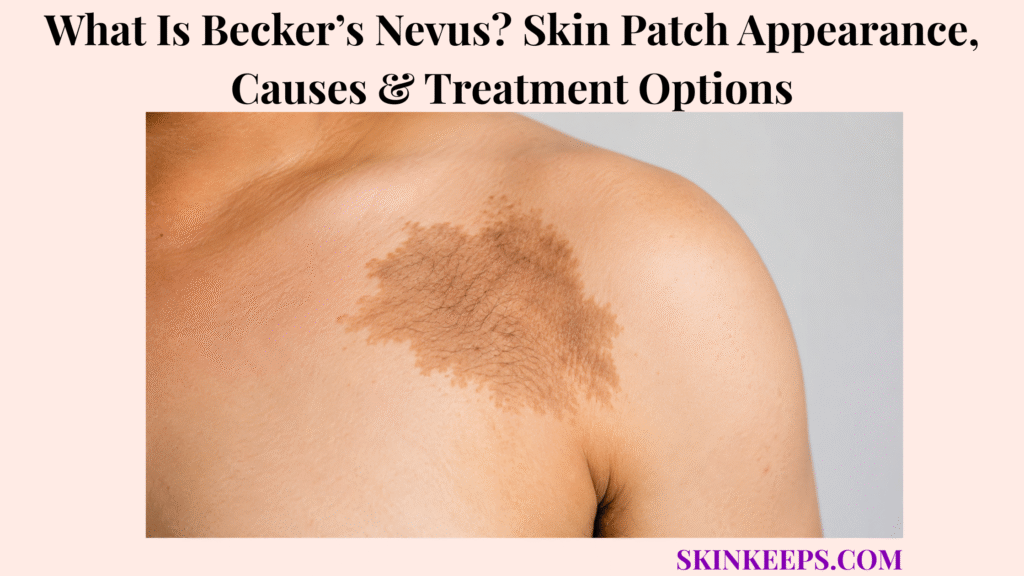
Becker’s nevus is a usually benign brown or tan skin patch that often becomes noticeable around adolescence and may develop increased hair, darker color, acne, eczema, or mild thickening.
This page explains appearance, body locations, causes, diagnosis, treatment options, cosmetic expectations, mistakes, and dermatologist signs. Becker’s nevus is usually benign, but a new, changing, symptomatic, or atypical pigmented patch should not be self-diagnosed from appearance alone.
What Is Becker’s Nevus and Why Does It Form a Brown Skin Patch?
Becker’s nevus is a usually benign acquired skin patch that often appears as a larger tan or brown area and may become darker, hairier, or slightly thicker over time.
It is also called Becker nevus, Becker naevus, or Becker melanosis. The word melanosis points to increased pigmentation, while the term nevus describes a localized skin lesion.
Most cases are noticed around adolescence or puberty. The patch may stay localized, often on one side of the body, and may later show hypertrichosis, which means increased hair growth in the affected area.
Why Does Becker’s Nevus Often Appear Around Puberty?
Becker’s nevus often appears around puberty because the patch may become more visible during adolescence, when local pigment, hair follicles, and possible androgen sensitivity become more active.
The patch may darken first, and coarse hair can develop later. Acne-like bumps or mild thickening may also appear inside the patch in some people.
Androgen sensitivity is a suspected contributor, not the only known cause. Becker’s nevus is reported more often in males, but females can develop it too.
Why Is Becker’s Nevus Usually Benign?
Becker’s nevus is usually benign, meaning it is not typically treated because it is medically dangerous, but diagnosis still matters when the patch is atypical or changing.
Treatment is often considered for cosmetic concerns, excess hair, acne, eczema, or distress about appearance rather than because the patch is usually harmful.
“Usually benign” should not mean “never check it.” Rapid change, multiple new colors, bleeding, ulceration, pain, a new lump, or diagnostic uncertainty should be reviewed by a dermatologist.
Practical rule: A stable adolescent-onset brown patch may fit Becker’s nevus, but rapid change, bleeding, ulceration, pain, new nodules, or unclear diagnosis should be checked before cosmetic treatment.
What Does Becker’s Nevus Look Like on Skin?
Becker’s nevus usually looks like a large tan, brown, or darker patch with irregular but often fairly defined borders, and it may develop coarse hair or a slightly thickened surface.
The patch may be light brown, dark brown, mixed brown, or more subtle depending on skin tone. It often has a one-sided or segmental pattern rather than appearing as many small identical spots.
What Color and Shape Can Becker’s Nevus Have?
Becker’s nevus can be tan, light brown, dark brown, or mixed brown, often forming a larger one-sided patch with irregular or geographic borders.
The outline may look uneven without automatically meaning melanoma. Smaller nearby speckled areas can sometimes appear, and the patch can become more noticeable over months or years.
A changing border, new multiple colors, bleeding, ulceration, pain, or a new lump is different from a long-standing stable geographic outline.
How Does Hair Growth Change Becker’s Nevus Appearance?
Hair growth can change Becker’s nevus appearance when coarse or darker hairs develop inside the patch, sometimes after the pigmentation first appears.
Not every Becker’s nevus is hairy. When hypertrichosis is present, it can become the main cosmetic concern even if the pigment itself is stable.
Can Acne or Eczema Appear Inside Becker’s Nevus?
Acne or eczema can sometimes occur inside Becker’s nevus, and those conditions should be treated separately from the pigment or hair concern.
Acneiform bumps inside the patch should be approached as acne when the pattern fits. Itchy or inflamed eczema-like areas may need barrier care and anti-inflammatory treatment rather than pigment laser.
A new painful lump, ulcer, bleeding area, or changing nodule inside the patch should not be assumed to be simple acne.
| Patch Feature | What the Reader May Notice | Why It Matters |
|---|---|---|
| Brown/tan color | Light brown, dark brown, or mixed brown patch | Core recognition feature |
| Large patch | Often broader than a small mole | Helps separate from small nevi |
| Irregular/geographic border | Uneven outline | Typical pattern, but changing borders need review |
| One-sided pattern | Appears mainly on one side or segment | Supports Becker pattern |
| Increased hair | Coarse hair inside the patch | Common cosmetic concern, not always present |
| Mild thickening | Slight plaque-like surface | May occur with epidermal change |
| Acne/eczema inside patch | Bumps or itchy inflamed areas | Treat separately |
| Rapid change/bleeding/pain | New concerning symptoms | Needs evaluation |
Where Does Becker’s Nevus Usually Appear?
Becker’s nevus most often appears on the upper trunk or shoulder area, but it can also occur on the chest, back, upper arm, neck, or less common body sites.
The patch may follow a one-sided or segmental distribution. Shoulder, upper chest, upper back, upper arm, and trunk patterns are common recognition clues, but shoulder location is not required for diagnosis.
Less typical locations, lower-body sites, or lesions that are difficult to classify may need closer dermatology evaluation, especially before cosmetic procedures.
| Common Site | Appearance Clue | What Else to Rule Out |
|---|---|---|
| Shoulder | One-sided brown patch, possible hair | Café-au-lait spot, congenital nevus |
| Upper chest | Large brown patch, possible acne/hair | PIH, melanocytic nevus, segmental pigmentation |
| Upper back | Brown patch with irregular border | PIH, café-au-lait spot, epidermal nevus |
| Upper arm | Segmental brown patch | Congenital nevus, PIH |
| Neck | Visible cosmetic site | Melasma, PIH, contact pigmentation depending on history |
| Lower body / unusual site | Less typical pattern | Dermatologist confirmation if uncertain |
What Causes Becker’s Nevus?
The exact cause of Becker’s nevus is not fully understood, but it is thought to involve localized skin development, pigment activity, hair follicles, and possible androgen sensitivity.
The patch is localized, so the cause is not usually explained by a whole-body pigment problem. Local pigment cells, epidermal changes, hair follicles, smooth muscle elements, and androgen responsiveness may all contribute.
Why May Hormones Influence Becker’s Nevus?
Hormones may influence Becker’s nevus because many patches become more noticeable during puberty and may develop darker pigmentation, coarse hair, acne, or thickening.
Androgen sensitivity may help explain why the patch can become hairier or more acne-prone during adolescence. This does not mean hormones are the only cause or that every person with Becker’s nevus has a hormone disorder.
Is Becker’s Nevus Inherited?
Becker’s nevus is usually sporadic, so most cases are not explained as a simple inherited trait passed directly through families.
Family cases have been reported but are uncommon. Rare Becker nevus syndrome features need clinician evaluation, but most isolated Becker’s nevi are not part of a broad genetic syndrome.
| Possible Factor | Clue | What It May Explain | Uncertainty |
|---|---|---|---|
| Localized skin development | One-sided or segmental patch | Why the patch stays localized | Exact mechanism unclear |
| Pigment activity | Brown/tan color | Hyperpigmentation | Not always uniform |
| Hair follicle response | Coarse hair in patch | Hypertrichosis | Not every lesion is hairy |
| Androgen sensitivity | Puberty onset, hair, acne | Adolescent visibility | Not the only cause |
| Sporadic development | No family history | Most cases | Rare familial reports exist |
| Syndrome association | Breast/muscle/skeletal asymmetry | Rare developmental link | Needs clinician evaluation |
How Is Becker’s Nevus Different From Other Skin Patches?
Becker’s nevus can resemble other brown patches, including café-au-lait spots, congenital melanocytic nevi, post-inflammatory hyperpigmentation, and rarely concerning pigmented lesions, so pattern, timing, hair growth, and change history matter.
The goal is not to create fear about every brown patch. The goal is to avoid assuming that every large or hairy patch is Becker’s nevus without checking timing, stability, symptoms, and mimics.
How Is Becker’s Nevus Different From Café-au-Lait Spots?
Becker’s nevus is different from café-au-lait spots because Becker’s nevus often becomes noticeable around puberty, may have irregular geographic borders, and may develop coarse hair, while café-au-lait spots are often smoother and more uniform.
Multiple café-au-lait spots may need a separate medical evaluation, especially in children, because that pattern belongs to a different diagnostic pathway.
How Is Becker’s Nevus Different From Congenital Melanocytic Nevus?
Becker’s nevus is different from congenital melanocytic nevus because Becker’s nevus often appears later around puberty, while congenital melanocytic nevus is present at birth or early infancy.
A melanocytic nevus / mole may have a mole-like surface, congenital history, or nodular features that follow a different monitoring framework. Timing is one of the most useful separation clues.
How Is Becker’s Nevus Different From Post-Inflammatory Hyperpigmentation?
Becker’s nevus is different from post-inflammatory hyperpigmentation because PIH usually follows a prior rash, acne, burn, scratch, procedure, or irritation, while Becker’s nevus often appears as a localized developmental patch.
Acne inside a Becker’s nevus does not mean the whole patch is PIH. The acne can be treated separately while the background patch remains.
How Is Becker’s Nevus Different From Melanoma or Suspicious Pigmentation?
Becker’s nevus is usually stable and benign, while melanoma concern rises when a pigmented lesion rapidly changes, develops multiple irregular colors, bleeds, ulcerates, hurts, or forms a new lump.
Diagnosis should not be made from internet appearance. A new evolving lesion, changing border, new dark nodule, bleeding area, ulceration, or painful patch needs dermatologist evaluation.
| Condition | Typical Clue | Timing Clue | Why It Matters |
|---|---|---|---|
| Becker’s nevus | Large brown patch, possible coarse hair | Often puberty/adolescence | Usually benign; cosmetic treatment optional |
| Café-au-lait spot | Smooth, uniform light-brown patch | Often childhood | Multiple spots may need separate evaluation |
| Congenital melanocytic nevus | Pigmented mole/plaque | Birth or early infancy | Different monitoring framework |
| Post-inflammatory hyperpigmentation | Dark mark after rash/injury | After inflammation | Treat cause and avoid irritation |
| Melanoma | Changing pigmented lesion | New or evolving | Needs prompt evaluation |
| Melasma | Brown facial pigmentation | Hormone/sun pattern | Different distribution and treatment path |
How Is Becker’s Nevus Diagnosed or Checked?
Becker’s nevus is often diagnosed clinically from its appearance, location, timing, and hair-growth pattern, but biopsy or further evaluation may be used when the patch is atypical, changing, symptomatic, or difficult to distinguish from other pigmented lesions.
A typical stable patch may not need invasive testing. Atypical behavior, diagnostic uncertainty, or concern for another pigmented lesion changes the evaluation threshold.
What Does a Dermatologist Check With Becker’s Nevus?
A dermatologist checks Becker’s nevus by reviewing when the patch appeared, where it is located, whether it is one-sided, how the borders and color look, and whether hair, acne, eczema, thickening, or symptoms are present.
Change history matters. The clinician may ask about rapid growth, new colors, pain, bleeding, ulceration, persistent inflammation, new nodules, and whether the patch was present at birth.
When Might Biopsy Be Considered?
Biopsy may be considered when a Becker-like patch has unclear diagnosis, rapid change, irregular colors, concerning borders, bleeding, ulceration, pain, new nodules, or features that need melanoma or another pigmented lesion ruled out.
Biopsy is not required for every typical Becker’s nevus. It becomes useful when the appearance or behavior does not fit a straightforward benign pattern.
- Appearance is assessed.
- Age and timing are reviewed.
- One-sided or segmental pattern is checked.
- Hair growth is documented.
- Acne, eczema, or thickening inside the patch is noted.
- Change history is reviewed.
- Symptoms such as bleeding, pain, ulceration, or new nodules are assessed.
- Biopsy is considered if the lesion is atypical or uncertain.
What Treatment Options Are Used for Becker’s Nevus?
Becker’s nevus usually does not require medical treatment, but cosmetic options may be considered for dark pigmentation, excess hair, acne, eczema, or distress about appearance.
Choosing no treatment is reasonable when the diagnosis is clear and the patch is stable. Treatment decisions should be based on the person’s goals, skin type, hair type, pigment risk, cost, irritation risk, and expectations.
How Can Excess Hair in Becker’s Nevus Be Treated?
Excess hair in Becker’s nevus can be managed with methods such as shaving, waxing, threading, depilatory creams, electrolysis, or laser hair reduction, depending on skin type, hair type, tolerance, and goals.
Shaving, waxing, threading, and depilatory creams do not make the hair grow more because of the method itself, but irritation is possible. Electrolysis and laser hair reduction may reduce hair more strongly, yet multiple sessions may be needed.
Pigment-rich skin needs careful laser settings and experienced treatment to reduce burn, hyperpigmentation, or hypopigmentation risk.
Which Treatments May Reduce Becker’s Nevus Pigmentation?
Pigmentation treatments for Becker’s nevus may include cosmetic camouflage or selected pigment lasers, but fading is unpredictable and pigment can recur or worsen.
Cosmetic camouflage can help appearance without changing the patch. Pigment lasers, including Q-switched or other selected lasers, may be discussed in some cases, but results vary.
Post-inflammatory hyperpigmentation, hypopigmentation, incomplete fading, or recurrence can occur after procedures. Complete removal should not be promised.
How Are Acne or Eczema Inside Becker’s Nevus Treated?
Acne or eczema inside Becker’s nevus should be treated as acne or eczema, because pigment treatment does not automatically treat inflammation or breakouts inside the patch.
Acne treatment should match acne severity. Eczema treatment may include gentle barrier care and anti-inflammatory treatment when appropriate, similar to atopic dermatitis principles when the pattern fits.
A painful, changing, bleeding, or nodular bump inside the patch should not be assumed to be ordinary acne.
| Concern | Possible Option | Goal | Limitation |
|---|---|---|---|
| Excess hair | Shaving, waxing, threading, depilatory creams | Temporary hair control | Needs repeat use; irritation possible |
| Excess hair | Electrolysis | Hair reduction | Time-consuming; operator dependent |
| Excess hair | Laser hair reduction | Reduce coarse hair | Multiple sessions; pigment-risk counseling needed |
| Pigmentation | Camouflage makeup | Appearance support | Does not treat patch |
| Pigmentation | Pigment laser in selected cases | Partial fading | Variable response; recurrence or worsening possible |
| Acne inside patch | Standard acne therapy | Reduce breakouts | Does not remove nevus |
| Eczema inside patch | Eczema treatment plan | Calm itch/inflammation | Does not remove pigment |
| Distress/cosmetic concern | Dermatology discussion | Align goals and risks | Complete removal is difficult |
What Should You Expect From Becker’s Nevus Treatment?
Becker’s nevus treatment results are unpredictable because pigment, hair growth, skin thickness, and recurrence risk do not respond the same way in every person.
Treatment is usually optional and cosmetic. Pigmentation may fade partly rather than fully, hair reduction may need repeated sessions, and pigment may recur after laser treatment.
Darker skin tones and pigment-rich skin need careful laser-risk counseling because burns, darker marks, or lighter marks can occur. Acne or eczema can improve even if the background pigment remains.
| Treatment Goal | Realistic Outcome | Possible Downside |
|---|---|---|
| Lighten pigment | Partial fading possible | Incomplete response, recurrence, darker or lighter marks |
| Reduce hair | Hair may become less dense or noticeable | Multiple sessions, irritation, pigment change |
| Treat acne | Breakouts can improve | Patch color may remain |
| Treat eczema | Itch and inflammation can improve | Pigment may remain |
| Camouflage | Immediate appearance support | Washes off; irritation if product is not tolerated |
| No treatment | Reasonable for stable benign patch | Must still monitor new changes |
What Becker’s Nevus Mistakes Should You Avoid?
The biggest Becker’s nevus mistake is treating a large brown patch with aggressive lightening or laser procedures before confirming the diagnosis and understanding the risk of pigment change.
Do not assume every brown patch is Becker’s nevus. Do not use harsh bleaching, burning, DIY removal, or laser treatment before diagnosis when the patch is atypical, new, or changing.
Do not expect full removal from one treatment. Do not ignore rapid change, bleeding, pain, ulceration, new nodules, multiple colors, body asymmetry, or acne and eczema that need separate care.
| Mistake | Why It Fails | Better Action |
|---|---|---|
| Self-diagnosing any brown patch | Mimics exist | Dermatology confirmation if uncertain |
| Harsh bleaching | Irritation and pigment worsening | Avoid aggressive products |
| Laser without diagnosis | Wrong lesion or wrong risk | Diagnose first |
| Expecting full removal | Results vary | Set cosmetic expectations |
| Ignoring new symptoms | Could be another process | Seek evaluation |
| Treating acne/eczema as pigment | Inflammation needs separate care | Treat acne or eczema directly |
| Ignoring body asymmetry | Rare syndrome features may be missed | Mention developmental signs to clinician |
When Should Becker’s Nevus Be Checked by a Dermatologist?
Becker’s nevus should be checked by a dermatologist when the patch is new, changing, rapidly enlarging, painful, bleeding, ulcerated, unusually colored, difficult to diagnose, cosmetically distressing, or associated with body asymmetry or developmental differences.
Stable Becker’s nevus does not usually need urgent treatment, but unusual behavior or diagnostic uncertainty should be assessed before cosmetic care.
Which Becker-Like Patch Signs Need Faster Evaluation?
Faster evaluation is needed when a Becker-like patch rapidly grows, changes color or border, bleeds, ulcerates, hurts, forms a new lump, becomes persistently inflamed, or is difficult to distinguish from another pigmented lesion.
A patch present from birth with mole-like features should be assessed under a different diagnostic framework. New multiple colors, irregular changing borders, bleeding, pain, ulceration, or nodules should not be reassured as Becker’s nevus without evaluation.
When Should Becker Nevus Syndrome Be Considered?
Becker nevus syndrome should be considered when Becker’s nevus appears with developmental differences such as breast asymmetry, breast hypoplasia, muscle or limb asymmetry, scoliosis, or other skeletal findings.
This association is rare and should not be assumed from the skin patch alone. Mention breast, muscle, limb, spine, supernumerary nipple, or body asymmetry concerns to a clinician when they are present.
Seek dermatology review when the patch is:
What Should You Remember About Becker’s Nevus?
The most important thing to remember about Becker’s nevus is that it is usually a benign brown skin patch, but diagnosis and treatment decisions should be based on pattern, timing, change history, and dermatologist assessment.
Treatment is usually optional and cosmetic. Complete removal is difficult, and laser or hair-reduction plans should be chosen with realistic expectations and pigment-risk counseling.
Frequently Asked Questions About Becker’s Nevus
Is Becker’s nevus dangerous?
Becker’s nevus is usually benign, but it should be checked when the patch is atypical, changing, symptomatic, newly concerning, or difficult to diagnose.
What does Becker’s nevus look like?
Becker’s nevus often looks like a large tan or brown patch, often one-sided, sometimes with irregular borders, increased hair growth, acne, eczema, or mild thickening.
Does Becker’s nevus appear at birth?
Becker’s nevus often appears later, commonly around adolescence or puberty, although rare congenital or early-onset cases are reported.
Why does Becker’s nevus grow hair?
Increased hair growth may relate to local follicle response and suspected androgen sensitivity, especially because lesions often become more noticeable around puberty.
Can Becker’s nevus be removed?
Complete removal is difficult. Treatment may reduce hair or pigmentation, but results vary and recurrence or pigment changes can occur.
What treatments can help Becker’s nevus pigmentation?
Cosmetic camouflage and selected pigment lasers may help some people, but fading is unpredictable and pigment can recur, darken, or lighten after treatment.
What treatments can help hair in Becker’s nevus?
Options include shaving, waxing, threading, depilatory creams, electrolysis, and laser hair reduction, with dermatologist guidance for laser safety and pigment-risk counseling.
When should Becker’s nevus need a dermatologist?
Dermatology review is needed for rapid change, bleeding, ulceration, pain, new nodules, multiple colors, changing borders, diagnostic uncertainty, cosmetic distress, or body asymmetry and developmental signs.
Sources & Evidence About Becker’s Nevus
DermNet — Becker Naevus was used for definition, large brown patch, late-onset epidermal naevus or birthmark framing, treatment limitations, hair-removal options, pigment-laser caution, sun and camouflage advice, and acne treatment context.
StatPearls / NCBI Bookshelf — Becker Melanosis was used for benign acquired hyperpigmentation, unilateral darkened patch with excessive hair growth, male predominance, prevalence context, suspected androgen sensitivity, clinical diagnosis, biopsy when melanoma must be ruled out, and cosmetic laser framing.
British Association of Dermatologists — Becker’s Naevus was used for patient-friendly care, acne and eczema treatment within Becker naevus, hair-removal self-care, camouflage support, and patient leaflet review/update context.
PubMed — Becker Nevus Syndrome Review was used for the syndrome concept, association with breast hypoplasia, skeletal anomalies, sporadic occurrence, and 23-case review context.
PubMed — Becker Nevus Syndrome and Breast Hypoplasia Case Evidence was used for rare association context involving ipsilateral breast hypoplasia and musculoskeletal disorders.
Primary Care Dermatology Society — Becker’s Naevus was used for cosmetic camouflage context, hair-removal support, and the caution that laser treatment results can be disappointing.
Educational Disclaimer: This SkinKeeps article is for educational purposes only and does not diagnose or replace medical care. A new, rapidly changing, bleeding, ulcerated, painful, multi-colored, nodular, symptomatic, difficult-to-diagnose, or developmentally associated pigmented patch should be checked by a qualified healthcare professional or dermatologist.