
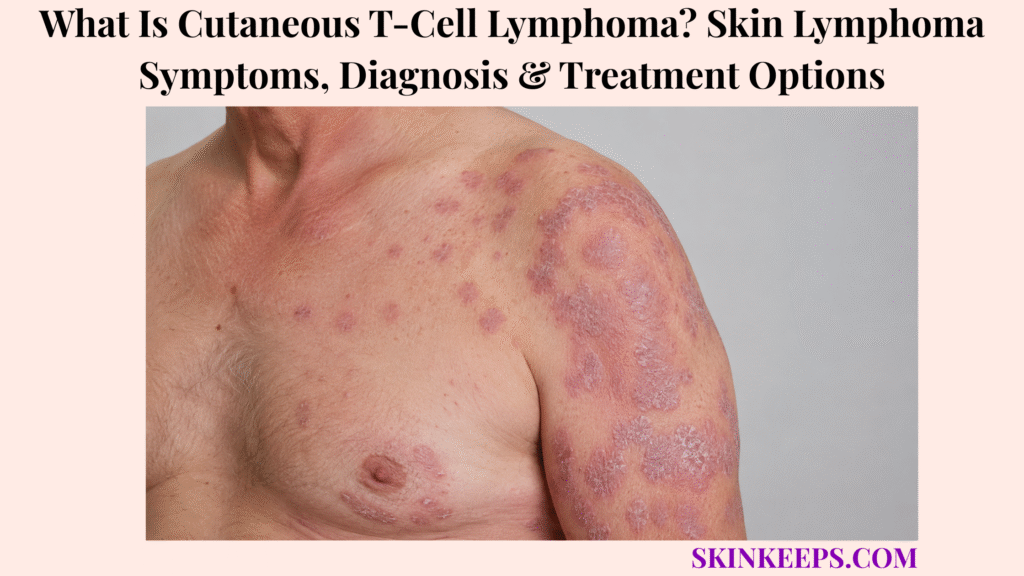
Cutaneous T-cell lymphoma is a group of lymphomas in which abnormal T-cells affect the skin, often causing long-lasting patches, plaques, tumors, itching, or widespread skin redness.
CTCL can mimic eczema, psoriasis, or fungal rash, but it cannot be diagnosed from appearance alone. This page covers symptoms, body sites, subtypes, causes, mimics, diagnosis, biopsy, staging, treatment, symptom relief, follow-up, mistakes, and urgent signs.
What Is Cutaneous T-Cell Lymphoma and How Does It Affect the Skin?
Cutaneous T-cell lymphoma is a group of lymphomas in which abnormal T-cells affect the skin, often causing long-lasting patches, plaques, tumors, itching, or widespread skin redness.
It is often shortened to CTCL. It is a skin-involving lymphoma, not an ordinary rash, not a fungal infection, and not something that can be confirmed from a photo.
Diagnosis usually depends on a dermatology exam, skin biopsy, pathology review, subtype identification, and staging.
Why Is CTCL Called a Skin Lymphoma?
CTCL is called a skin lymphoma because it involves abnormal T lymphocytes that affect the skin, rather than ordinary skin cells alone.
T-cells are immune cells. In CTCL, abnormal or malignant T-cells collect in the skin and can create patches, plaques, tumors, itch, pain, or redness.
Mycosis fungoides is the most common subtype, while Sézary syndrome is a more aggressive leukemic form involving skin, blood, and often lymph nodes.
Why Can CTCL Be Missed Early?
CTCL can be missed early because its patches and plaques can resemble eczema, psoriasis, chronic dermatitis, or fungal rash.
Symptoms may come and go, and early lesions may look subtle or inflammatory.
A persistent rash that does not behave like typical eczema or psoriasis deserves reassessment, especially when it grows, spreads, thickens, resists treatment, or appears in unusual covered areas.
Practical rule: A chronic, changing, treatment-resistant rash should be reassessed, but not every chronic rash is CTCL.
What Cutaneous T-Cell Lymphoma Symptoms Appear on Skin?
CTCL symptoms can include persistent itchy patches, scaly plaques, thicker raised lesions, tumors, skin pain, color changes, or widespread redness depending on subtype and stage.
Symptoms can look different across skin tones. Patches may appear red, pink, brown, purple, lighter, darker, or hypopigmented.
What Do Early CTCL Patches Look Like?
Early CTCL patches may look like flat scaly areas that are itchy, persistent, recurrent, or mistaken for eczema or psoriasis.
Patches may appear on the buttocks, hips, thighs, lower trunk, breasts, or other covered areas, although CTCL can appear elsewhere.
Some presentations on darker skin may show lighter or hypopigmented patches, persistent discoloration, or subtle scale rather than bright redness.
What Do Plaques and Tumors Suggest?
CTCL plaques are thicker raised lesions, while tumors are larger nodules or masses that need specialist assessment and staging.
Plaques can feel raised, firm, scaly, itchy, painful, or persistent.
Tumors, ulceration, bleeding, pain, infection, or rapid growth should be checked quickly because they can change staging and treatment planning.
What Symptoms Can Happen With Sézary Syndrome?
Sézary syndrome can cause widespread red or inflamed skin, severe itching, peeling or scaling, thickened palms or soles, swollen lymph nodes, and blood involvement.
Some people may also develop hair loss, skin pain, fatigue, infection-prone skin, or feeling unwell.
Widespread redness, severe itch, swollen lymph nodes, fever, night sweats, or unexplained weight loss should prompt faster evaluation.
| Symptom Pattern | What User May Notice | Why It Matters |
|---|---|---|
| Patch | Flat scaly persistent rash. | Early mycosis fungoides can mimic eczema. |
| Plaque | Thicker raised lesion. | More established skin disease. |
| Tumor | Nodule or mass. | Needs specialist staging. |
| Erythroderma | Widespread redness or inflammation. | Sézary or advanced disease concern. |
| Itch | Chronic or severe itch. | Common and quality-of-life limiting. |
| Skin pain / ulcers | Painful or open lesions. | Infection and advanced-disease concern. |
| Lymph nodes | Swollen glands. | Staging concern. |
Where Does Cutaneous T-Cell Lymphoma Usually Appear?
CTCL can appear anywhere, but mycosis fungoides often starts on areas that are not heavily sun-exposed, such as the buttocks, hips, thighs, lower trunk, breasts, or covered body areas.
Location is only one clue. Duration, shape, scale, itch, treatment response, biopsy findings, lymph node findings, and staging matter more than location alone.
Sézary syndrome may involve widespread skin redness rather than one small patch.
| Site | Possible CTCL Clue | Mimic to Rule Out |
|---|---|---|
| Buttocks / hips | Persistent scaly patches in covered areas. | Eczema, psoriasis, fungal rash. |
| Thighs | Recurrent patches or plaques. | Tinea, dermatitis, drug rash. |
| Lower trunk / abdomen | Slow-changing patch/plaque pattern. | Eczema, psoriasis, parapsoriasis. |
| Breasts / chest | Covered-area rash that persists. | Dermatitis, fungal rash. |
| Arms / legs | Plaques, patches, tumors. | Psoriasis, eczema, drug eruption. |
| Skin folds | Persistent unusual fold rash. | Candida, inverse psoriasis, intertrigo. |
| Palms / soles | Thickening in selected cases. | Eczema, psoriasis, tinea. |
| Widespread skin | Redness, peeling, severe itch. | Sézary syndrome, erythroderma, drug eruption. |
What Types of Cutaneous T-Cell Lymphoma Are Important to Know?
CTCL is not one single disease; treatment and outlook depend on the subtype, with mycosis fungoides and Sézary syndrome being the most important types for most patient-facing education.
Subtype matters because a patch-stage mycosis fungoides plan is different from blood-involved Sézary syndrome or a rare aggressive CTCL variant.
What Is Mycosis Fungoides?
Mycosis fungoides is the most common type of cutaneous T-cell lymphoma and often follows a slow chronic course.
It can present as patches, plaques, or tumors, and early-stage disease is often skin-limited.
Many treatment plans for early mycosis fungoides focus on skin-directed therapy, symptom control, and long-term monitoring.
What Is Sézary Syndrome?
Sézary syndrome is a rarer, more aggressive CTCL subtype with widespread skin disease and abnormal lymphoma cells in the blood.
It may involve severe itch, widespread redness, peeling, thickened palms or soles, swollen lymph nodes, and blood involvement.
It needs specialist staging, pathology confirmation, and systemic treatment planning.
What Other CTCL Subtypes May Be Mentioned?
Other CTCL subtypes may include primary cutaneous anaplastic large-cell lymphoma, lymphomatoid papulosis, subcutaneous panniculitis-like T-cell lymphoma, and rare aggressive CTCL variants.
Some are CD30-positive lymphoproliferative conditions, while others are rare aggressive variants that need specialist care.
These subtypes are better handled in separate subtype pages because treatment and prognosis can differ widely.
| CTCL Subtype | Main Clue | Why It Matters |
|---|---|---|
| Mycosis fungoides | Patches, plaques, tumors. | Most common; often skin-limited early. |
| Sézary syndrome | Widespread redness + blood involvement. | More aggressive; systemic evaluation. |
| Primary cutaneous ALCL | Nodules/tumors, CD30 often relevant. | Different treatment pathway. |
| Lymphomatoid papulosis | Recurrent papules/nodules. | Related CD30+ lymphoproliferative condition. |
| Rare aggressive CTCL | Rapid plaques, tumors, ulcers, systemic risk. | Specialist oncology care. |
What Causes Cutaneous T-Cell Lymphoma?
The exact cause of most cutaneous T-cell lymphomas is not known, and CTCL is not caused by poor hygiene, ordinary eczema, or a simple skin infection.
Most cases do not have one clear preventable trigger. Care focuses on diagnosis, staging, treatment selection, symptom control, and follow-up.
What Happens to T-Cells in CTCL?
In CTCL, abnormal T-cells accumulate in the skin and can create patches, plaques, tumors, itching, or widespread inflammation.
T-cells are lymphocytes, which are immune-system cells.
Disease behavior varies by subtype and stage, which is why pathology and staging guide care.
Is CTCL Contagious?
CTCL is not contagious and does not spread by touch, towels, clothing, or ordinary skin contact.
It is not a fungal infection, bacterial infection, or hygiene problem.
Skin infections can occur secondarily if skin is broken, ulcerated, scratched, or affected by treatment, but that is different from CTCL being contagious.
Are There Clear Preventable Triggers?
Most CTCL cases do not have one clear preventable trigger, so care focuses on diagnosis, staging, treatment selection, symptom control, and follow-up.
Research continues into immune, genetic, and environmental factors.
Patients should not be blamed for CTCL, and prevention should not be reduced to one simple lifestyle change.
Who Is More Likely to Develop Cutaneous T-Cell Lymphoma?
CTCL is uncommon, and risk patterns vary by subtype, but mycosis fungoides is generally seen more often in adults and is rare in children.
Persistent unexplained dermatitis-like patches deserve review at any age when they enlarge, multiply, thicken, ulcerate, resist treatment, or appear with lymph nodes or whole-body symptoms.
- Adult with persistent unexplained rash.
- Treatment-resistant eczema-like or psoriasis-like patches.
- Slowly enlarging or multiplying patches.
- Unusual covered-area distribution.
- Hypopigmented or lighter patches, especially if persistent.
- Thick plaques.
- Skin tumors or nodules.
- Severe chronic itch.
- Widespread redness or peeling.
- Swollen lymph nodes.
- Fever, night sweats, or unexplained weight loss.
How Is Cutaneous T-Cell Lymphoma Different From Other Skin Conditions?
CTCL can resemble eczema, psoriasis, fungal rash, drug eruption, parapsoriasis, pityriasis lichenoides, lupus, or other skin cancers, so persistence, pattern, response to treatment, and biopsy findings matter.
The goal is not to make every chronic rash feel frightening. The goal is to identify rashes that need reassessment instead of endless repeated treatment without diagnosis review.
How Is CTCL Different From Eczema?
Dermatitis / eczema is common and inflammatory, while CTCL may look eczema-like but persists, recurs, progresses, or fails appropriate eczema treatment.
Long-standing eczema-like patches in unusual covered areas, or a rash that changes into plaques or tumors, should be reassessed.
A history of atopic dermatitis does not automatically mean every persistent patch is eczema forever.
How Is CTCL Different From Psoriasis?
Psoriasis often has more recognizable plaque patterns, while CTCL plaques may be asymmetric, persistent, atypical, or treatment-resistant.
Phototherapy can be used in both conditions, so diagnosis should be clear before long-term treatment planning.
Biopsy may be needed when a “psoriasis” pattern behaves unusually or fails appropriate treatment.
How Is CTCL Different From Fungal Rash?
Fungal rash may form ring-shaped scale or improve with appropriate antifungal treatment, while CTCL can remain scaly and persistent despite antifungal therapy.
Repeated antifungal failure should prompt reconsideration, especially if scraping or clinical pattern does not support fungus.
Foot or groin scaling may fit athlete’s foot or tinea in the right pattern, but persistent atypical plaques need a different workup.
How Is CTCL Different From Drug Rash?
A drug rash often follows medication timing, while CTCL usually follows a more persistent or progressive skin-lymphoma pattern.
Drug rash can be widespread, itchy, red, purple, brown, or peeling, so medication history still matters.
A persistent rash should be reassessed if it does not match medication timing or continues after appropriate medication review.
How Is CTCL Different From Common Skin Cancer?
Common skin cancers usually arise from epidermal cells or melanocytes, while CTCL arises from lymphocytes affecting the skin.
A single changing mole may point toward melanoma evaluation, while a non-healing pearly lesion may point toward basal cell carcinoma.
A solitary thick ulcerated tumor may also need squamous cell carcinoma evaluation, but multiple persistent patches or plaques follow a different diagnostic path.
| Condition | Main Clue | Why Confusion Happens | Safer Next Step |
|---|---|---|---|
| CTCL | Persistent patches, plaques, tumors, severe itch, or erythroderma. | Mimics eczema/psoriasis. | Dermatology exam + biopsy if suspicious. |
| Eczema | Itchy inflammatory rash. | Scaling/itch overlap. | Reassess if persistent or atypical. |
| Psoriasis | Plaques with scale. | Plaque overlap. | Biopsy if unusual or resistant. |
| Fungal rash | Ring/scaly border or positive fungal test. | Scaly rash overlap. | Scraping/treatment-response review. |
| Drug eruption | New medicine timing. | Widespread rash overlap. | Medication review. |
| Common skin cancer | Solitary changing lesion, ulcer, or mole. | Tumor/ulcer overlap. | Lesion-specific biopsy. |
| Cutaneous B-cell lymphoma | B-cell skin lymphoma pattern. | Skin lymphoma overlap. | Specialist subtype diagnosis. |
How Is Cutaneous T-Cell Lymphoma Diagnosed?
CTCL diagnosis usually requires skin examination, skin biopsy, pathology review, immunostaining, and sometimes repeat biopsies because early CTCL can look like ordinary inflammatory skin disease.
Diagnosis should not be made from online photos or one symptom. It depends on the full clinical pattern and tissue evaluation.
What Does a Dermatologist Check With Suspected CTCL?
A dermatologist checks suspected CTCL by reviewing rash duration, treatment response, lesion pattern, body distribution, itch, pain, lymph nodes, whole-body symptoms, medication history, and prior biopsy results.
The review may include whether patches enlarge, multiply, thicken, ulcerate, bleed, hurt, or appear in covered areas.
The clinician may also check for swollen lymph nodes, fever, night sweats, unexplained weight loss, severe fatigue, widespread redness, or blood-related concerns.
Why Might More Than One Skin Biopsy Be Needed?
More than one skin biopsy may be needed because early CTCL can be subtle and a single biopsy may not capture enough diagnostic features.
Biopsies from active, representative lesions are often more useful.
If the rash progresses, becomes treatment-resistant, or remains unexplained, repeat biopsy or specialist dermatopathology review may be needed.
What Lab or Pathology Tests May Support Diagnosis?
CTCL diagnosis may use histology, immunohistochemistry, T-cell receptor testing, blood tests, flow cytometry, lymph node evaluation, and imaging when advanced disease is suspected.
Immunohistochemistry may look at T-cell markers such as CD3, CD4, CD8, CD30, or related patterns depending on suspected subtype.
Flow cytometry and blood testing may be important when Sézary syndrome or blood involvement is suspected.
- Photos showing rash changes over time.
- Date the rash first appeared.
- Locations involved.
- Whether patches enlarge, multiply, thicken, or ulcerate.
- Itch severity and sleep disruption.
- Pain, burning, bleeding, or open sores.
- Treatments tried: steroids, eczema creams, psoriasis treatment, antifungals, antibiotics, phototherapy.
- Which treatments helped or failed.
- Prior biopsy reports.
- Swollen lymph nodes.
- Fever, night sweats, unexplained weight loss, or severe fatigue.
- Medication list.
- Immune suppression, prior cancer, or lymphoma history.
How Is Cutaneous T-Cell Lymphoma Staged?
CTCL staging looks at how much skin is involved, whether lymph nodes are affected, whether disease has spread to organs, and whether abnormal lymphoma cells are present in blood.
Staging helps the care team choose treatment, monitor risk, and decide how closely skin, blood, lymph nodes, and symptoms need follow-up.
What Does TNMB Staging Mean in CTCL?
TNMB staging means the care team checks skin involvement, lymph node involvement, organ involvement, and blood involvement.
T refers to skin tumor burden, including patches, plaques, tumors, or erythroderma. N refers to lymph nodes. M refers to visceral organs. B refers to blood involvement.
TNMB is especially central for mycosis fungoides and Sézary syndrome staging.
Why Does Stage Change Treatment Choices?
Stage changes treatment choices because early skin-limited disease may be treated mainly with skin-directed therapies, while tumor-stage, blood-involved, lymph-node-involved, or organ-involved disease may need systemic treatment.
Treatment goals may include skin control, symptom relief, remission, preventing progression, and quality of life.
Specialist team decisions matter because subtype, stage, symptoms, prior treatment, blood involvement, and patient health all affect the plan.
| Staging Area | What Is Checked | Why It Matters |
|---|---|---|
| Skin | Patches, plaques, tumors, erythroderma, body-surface burden. | Defines skin burden. |
| Nodes | Enlarged or involved lymph nodes. | Shows spread beyond skin. |
| Organs | Internal organ involvement. | Advanced disease planning. |
| Blood | Sézary cells or abnormal T-cells. | Systemic/blood involvement. |
What Treatment Options Are Used for Cutaneous T-Cell Lymphoma?
CTCL treatment depends on subtype, stage, skin burden, symptoms, blood or lymph-node involvement, prior treatments, and the patient’s overall health.
There is no single cream, light treatment, or chemotherapy plan for everyone. Treatment should be specialist-led and matched to diagnosis.
Which Treatments Are Used for Early Skin-Limited CTCL?
Early skin-limited CTCL is often treated with skin-directed therapy, which may include topical medicines, phototherapy, or localized radiation depending on the case.
Options may include topical corticosteroids, topical chemotherapy such as mechlorethamine, topical retinoids, narrowband UVB, PUVA, local radiation, or other skin-directed strategies.
Skin-directed treatment still needs confirmed diagnosis, follow-up, and monitoring for side effects and response.
Which Treatments Are Used for Tumor-Stage or Advanced CTCL?
Tumor-stage or advanced CTCL may need radiation, systemic medicines, targeted therapy, blood-directed treatment, chemotherapy, transplant evaluation, or clinical-trial consideration.
Systemic options may include retinoids, interferon, histone deacetylase inhibitors, monoclonal antibodies, extracorporeal photopheresis, chemotherapy in selected cases, or other oncology-directed treatments.
Advanced, blood-involved, relapsed, refractory, or aggressive disease should be managed by clinicians experienced with cutaneous lymphoma.
Where Do Newer Targeted Treatments Fit?
Targeted treatments fit selected CTCL cases based on subtype, marker testing, prior treatment, disease stage, and oncology guidance.
Mogamulizumab may fit selected adults with relapsed or refractory mycosis fungoides or Sézary syndrome after prior therapy. Brentuximab vedotin may fit selected CD30-positive disease.
These treatments are not first-line for every patient, and marker testing plus specialist judgment matter.
| CTCL Situation | Treatment Direction | Key Caution |
|---|---|---|
| Early patches/plaques | Skin-directed therapy. | Needs confirmed diagnosis. |
| Local tumor/lesion | Local radiation or selected procedure. | Stage still matters. |
| Widespread skin disease | Phototherapy and/or systemic options. | Monitor skin and blood. |
| Sézary syndrome | Systemic + blood-directed planning. | Specialist oncology care. |
| CD30+ disease | Targeted therapy may fit. | Marker testing needed. |
| Aggressive subtype | Systemic therapy. | Rapid specialist care. |
| Relapsed/refractory disease | Targeted therapy or clinical trial may fit. | Individualized oncology plan. |
How Can Itching, Skin Pain, and Infection Risk Be Managed in CTCL?
CTCL care includes treating the lymphoma and also managing itch, pain, dry skin, sleep disruption, open sores, and infection risk.
Supportive care can improve comfort and quality of life while disease-directed treatment is planned or continued.
Use gentle skin care, moisturizers, fragrance avoidance, clinician-directed itch treatment, wound care for open lesions, infection treatment when needed, and support for sleep or emotional burden.
- Track itch severity.
- Moisturize as directed.
- Avoid harsh soaps and fragrance.
- Ask about itch-directed treatment.
- Protect open or ulcerated areas.
- Watch for infection signs.
- Report sleep disruption.
- Ask for mental health or support resources if disease burden is high.
- Keep follow-up appointments for skin, blood, nodes, and treatment side effects.
Can Cutaneous T-Cell Lymphoma Come Back or Progress?
CTCL often behaves like a chronic condition, especially early mycosis fungoides, but recurrence and progression can occur, so long-term follow-up is important.
Treatments can control lesions and symptoms, but lesions may relapse after response.
Progression risk depends on subtype, stage, blood involvement, tumor formation, lymph nodes, and treatment response.
Course map: Diagnosis → subtype confirmation → staging → skin-directed or systemic treatment → response monitoring → maintenance / follow-up → relapse or progression check.
What Cutaneous T-Cell Lymphoma Mistakes Should You Avoid?
The biggest CTCL mistake is assuming a persistent, changing, treatment-resistant rash is always eczema or psoriasis without reassessing the diagnosis.
Do not self-diagnose CTCL from online images, and do not assume one normal biopsy rules everything out forever if symptoms keep progressing.
Do not ignore tumors, ulceration, lymph nodes, widespread redness, fever, night sweats, unexplained weight loss, severe fatigue, non-healing wounds, or recurrent infections.
| Mistake | Why It Is Risky | Better Action |
|---|---|---|
| Calling it eczema forever | Delays CTCL diagnosis. | Reassess persistent rash. |
| Avoiding biopsy | Misses lymphoma subtype/stage. | Biopsy active suspicious lesions. |
| Relying on one biopsy forever | Early disease can be subtle. | Repeat if progression continues. |
| Ignoring lymph nodes | May affect staging. | Prompt evaluation. |
| Using random creams | Delays correct therapy. | Specialist-led plan. |
| Skipping follow-up | Relapse/progression may be missed. | Long-term monitoring. |
| Stopping treatment alone | Loss of disease control or flare. | Oncology/dermatology guidance. |
When Should a Possible CTCL Rash Be Checked by a Doctor?
A CTCL-like rash should be checked when it is persistent, progressive, treatment-resistant, unusually located, repeatedly diagnosed as eczema or psoriasis without improvement, or associated with tumors, swollen lymph nodes, widespread redness, fever, night sweats, or weight loss.
A chronic rash should not be ignored just because it temporarily improves with steroid cream or returns after stopping treatment.
Which Skin Signs Need Dermatology Review?
Dermatology review is needed when a rash lasts for months despite appropriate care, slowly enlarges or multiplies, forms thick plaques, develops tumors, ulcerates, causes severe itch, or appears in unusual covered areas.
Persistent hypopigmented or unusual patches in darker skin should also be reassessed when they do not behave like typical eczema, psoriasis, or fungus.
Recurrent “eczema” in the same unusual sites deserves a second look if standard treatment keeps failing.
Which Whole-Body Signs Need Faster Evaluation?
Faster evaluation is needed when a chronic rash appears with swollen lymph nodes, fever without clear infection, night sweats, unexplained weight loss, severe fatigue, widespread redness, thickened palms or soles, or recurrent infections.
These signs can affect staging and may suggest blood, lymph node, or systemic involvement.
Severe erythroderma, suspected Sézary syndrome, rapidly growing tumors, ulceration, or non-healing wounds should not wait.
Seek medical or dermatology review if there is:
- Rash lasting months despite appropriate care.
- Patches that slowly enlarge or multiply.
- Thick plaques.
- Skin tumors or nodules.
- Ulcerated or painful lesions.
- Severe persistent itch.
- Hypopigmented or unusual patches, especially if persistent.
- Widespread redness or peeling.
- Rash in covered or bathing-trunk areas.
- Recurrent “eczema” or “psoriasis” that fails treatment.
- Swollen lymph nodes.
- Fever without clear infection.
- Night sweats.
- Unexplained weight loss.
- Severe fatigue.
- Recurrent infections or non-healing wounds.
What Should You Remember About Cutaneous T-Cell Lymphoma?
The most important thing to remember about cutaneous T-cell lymphoma is that it is a skin lymphoma, so the safest approach is to recognize persistent suspicious patterns, confirm the diagnosis with biopsy, stage the disease properly, and match treatment to subtype and stage.
CTCL needs calm, careful evaluation: neither panic from a photo nor endless dismissal of a persistent changing rash.
- CTCL is a group of T-cell lymphomas that affect the skin.
- Mycosis fungoides is the most common subtype.
- Sézary syndrome involves widespread skin disease and blood involvement.
- Early CTCL can look like eczema, psoriasis, or fungal rash.
- Diagnosis often requires biopsy and sometimes repeat biopsy.
- Staging checks skin, lymph nodes, organs, and blood.
- Treatment ranges from skin-directed therapy to systemic oncology treatment.
- Itch, pain, sleep, wound care, and infection prevention matter.
- Long-term follow-up matters because CTCL can relapse or progress.
- Persistent, progressive, or treatment-resistant rash deserves dermatology review.
Frequently Asked Questions About Cutaneous T-Cell Lymphoma
Is cutaneous T-cell lymphoma cancer?
Yes. CTCL is a type of non-Hodgkin lymphoma involving abnormal T-cells that affect the skin, but many early mycosis fungoides cases behave slowly and can be managed for long periods.
What does cutaneous T-cell lymphoma look like?
It may look like persistent scaly patches, plaques, itchy rash, tumors, widespread redness, skin pain, peeling, or skin color changes depending on subtype and stage.
Is CTCL the same as eczema?
No. CTCL can look like eczema or psoriasis, especially early, but it is a lymphoma and requires biopsy-based diagnosis when suspected.
How is cutaneous T-cell lymphoma diagnosed?
Diagnosis may include skin exam, skin biopsy, pathology review, immunostains, possible repeat biopsies, blood tests, lymph node evaluation, and staging when needed.
What is the most common type of CTCL?
Mycosis fungoides is the most common type of cutaneous T-cell lymphoma.
What is Sézary syndrome?
Sézary syndrome is a rare, more aggressive CTCL subtype involving skin and blood, often with widespread redness and severe symptoms, requiring specialist diagnosis and treatment.
What is the best treatment for CTCL?
There is no one best treatment for every case. Treatment depends on subtype and stage; early skin-limited disease may use topical medicines, phototherapy, or localized radiation, while advanced, blood-involved, tumor-stage, or aggressive disease may need systemic targeted, immune, radiation, chemotherapy, or transplant-based strategies.
When should a chronic rash be checked for CTCL?
A chronic rash should be checked when it lasts months, fails appropriate eczema, psoriasis, or fungal treatment, enlarges, forms thick plaques, develops tumors or ulceration, causes severe itch, appears with swollen lymph nodes, widespread redness, night sweats, fever, or unexplained weight loss.
Sources & Evidence About Cutaneous T-Cell Lymphoma
DermNet — Cutaneous T-cell Lymphoma was used for CTCL definition, symptom patterns, classification, multiple-biopsy context, treatment categories, and quality-of-life burden.
DermNet — Mycosis Fungoides was used for mycosis fungoides as a common primary CTCL subtype and the patch-plaque-tumor progression framework.
American Academy of Dermatology — CTCL Symptoms was used for CTCL symptom patterns including itchy skin, rash-like changes, hair loss, sleep-disrupting itch, and Sézary-related widespread skin findings.
American Academy of Dermatology — CTCL Diagnosis and Treatment was used for diagnosis/treatment overview, stage/type-led treatment, skin-directed therapies, symptom control, topical chemotherapy context, and targeted therapy context.
American Academy of Dermatology — Relief for Skin Problems Related to CTCL was used for gentle skin care, itch/pain support, open wound and infection guidance, and dermatology follow-up for CTCL-related skin problems.
Cutaneous Lymphoma Foundation — Cutaneous T-cell Lymphoma was used for CTCL subtype framing and the distinction between skin lymphomas and common skin cancers arising from epidermal cells or melanocytes.
Cutaneous Lymphoma Foundation — Mycosis Fungoides was used for mycosis fungoides as the most common CTCL subtype, eczema/psoriasis mimicry, and slow chronic course context.
Cutaneous Lymphoma Foundation — Sézary Syndrome was used for Sézary syndrome as a rare leukemic CTCL form with blood involvement and need for expert pathology confirmation.
Cutaneous Lymphoma Foundation — Staging Cutaneous T-cell Lymphoma was used for skin exam, skin biopsy, blood tests, lymph node assessment, and TNMB staging.
NCI PDQ — Mycosis Fungoides and Other Cutaneous T-cell Lymphomas Treatment was used for evidence-based treatment overview and stage/type-led CTCL treatment planning.
American Cancer Society — Treatment for Specific Types of Skin Lymphoma was used for the principle that treatment differs by skin lymphoma subtype, location, and stage.
Leukemia & Lymphoma Society — T-cell Lymphomas was used for CTCL as a T-cell lymphoma subset with mycosis fungoides and Sézary syndrome as main subtypes.
Educational Disclaimer: This SkinKeeps article is for educational purposes only and does not diagnose or replace medical care. A persistent, progressive, treatment-resistant, unusual, ulcerated, painful, tumor-forming, widespread, peeling, severely itchy, lymph-node-associated, fever-associated, night-sweat-associated, weight-loss-associated, fatigue-associated, non-healing, or repeatedly misdiagnosed rash should be checked by a qualified healthcare professional or dermatologist. Cutaneous T-cell lymphoma cannot be diagnosed from appearance alone and may require skin biopsy, repeat biopsy, pathology review, blood tests, lymph node evaluation, staging, and specialist-led treatment.