Dermatitis herpetiformis is an intensely itchy autoimmune blistering skin condition linked to celiac disease, where gluten exposure triggers an immune reaction that shows up in the skin.
Dermatitis herpetiformis is not herpes. This page covers symptoms, locations, causes, celiac link, diagnosis, biopsy, testing, gluten-free diet, dapsone, flare care, recurrence, mistakes, and doctor-warning signs.
What Is Dermatitis Herpetiformis and Why Is It Linked to Gluten?
Dermatitis herpetiformis is an intensely itchy autoimmune blistering skin condition linked to celiac disease, where gluten exposure triggers an immune reaction that shows up in the skin.
It is often shortened to DH and is also called Duhring disease.
DH is not an ordinary eczema flare, not a herpes-virus rash, and not diagnosed from appearance alone. Correct diagnosis usually needs dermatology review, perilesional skin biopsy with direct immunofluorescence, and celiac-related testing.
Why Is Dermatitis Herpetiformis Not a Herpes Infection?
Dermatitis herpetiformis is not a herpes infection; the word “herpetiformis” only means that the bumps or blisters can appear grouped like herpes blisters.
It does not mean herpes simplex virus or shingles.
DH is autoimmune and gluten-linked, not usually contagious person-to-person, and antiviral medicines are not the usual treatment unless a separate viral diagnosis is present.
Why Is DH Considered a Skin Manifestation of Celiac Disease?
DH is considered a skin manifestation of celiac disease because the gluten-triggered immune reaction can create IgA deposits in the skin and cause severe itching, bumps, and blisters.
Some people notice the rash before they know they have celiac disease.
Digestive symptoms can be mild or absent, so lack of diarrhea, bloating, or abdominal pain does not rule DH out.
Practical rule: Suspected DH should be tested correctly before long-term gluten-free treatment when medically possible.
What Dermatitis Herpetiformis Symptoms Appear on Skin?
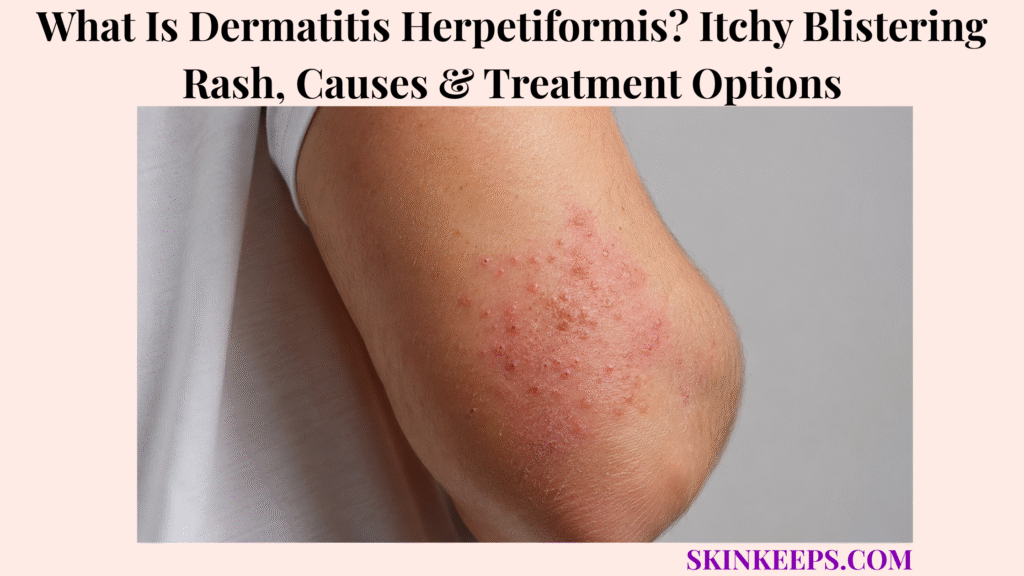
Dermatitis herpetiformis often causes intensely itchy grouped bumps, tiny blisters, erosions, crusts, and scratch marks because the itching can be severe before the blisters are noticed.
The rash can burn, sting, or itch intensely. Because scratching happens quickly, the tiny blisters may be gone by the time the skin is examined.
What Does a DH Rash Look and Feel Like?
A DH rash often feels intensely itchy or burning and may appear as small grouped bumps, tiny blisters, scratched erosions, scabs, or crusts.
The pattern is often symmetric, meaning similar areas on both sides of the body can be involved.
Darker or lighter marks can remain after healing, especially when the skin has been scratched or inflamed repeatedly.
Why Are Blisters Sometimes Hard to See?
DH blisters may be hard to see because the itch is so intense that people often scratch the tiny blisters open before they are examined.
The rash may then look like crusts, erosions, scabs, scratches, or excoriations.
This can make DH look like eczema, scabies, insect bites, folliculitis, or impetigo, so photos before scratching can help clinicians.
What Symptoms Suggest Infection, Complications, or Another Diagnosis?
Pus, spreading warmth, fever, severe pain, widespread blistering, mouth or eye erosions, large tense blisters, or rapidly spreading rash should not be assumed to be simple DH.
Scratched areas can become infected.
Large tense blisters, mucosal erosions, severe medication reactions, or rapidly worsening symptoms can suggest a different blistering disorder, infection, or drug reaction.
| Symptom | DH Clue | Why It Matters |
|---|---|---|
| Intense itch | Often severe and persistent. | Classic DH symptom. |
| Grouped bumps/blisters | Small clustered papules or vesicles. | Explains “herpetiformis” appearance. |
| Scratched erosions | Blisters may be destroyed by scratching. | Can hide diagnosis. |
| Symmetry | Both elbows, knees, buttocks, or extensor sites may be involved. | Helpful pattern clue. |
| Burning/stinging | May appear before bumps. | Supports flare recognition. |
| Crusting/pus | May reflect secondary infection. | Needs review. |
| Large tense blisters | Less classic for DH. | Consider other blistering disorders. |
Where Does Dermatitis Herpetiformis Usually Appear?
Dermatitis herpetiformis commonly appears on the elbows, knees, buttocks, lower back, scalp, shoulders, upper back, forearms, and other extensor or pressure-prone areas.
Classic distribution helps raise suspicion, especially when the rash is symmetrical and intensely itchy.
Location alone does not diagnose DH. The pattern must be combined with itch severity, grouped lesions, symmetry, perilesional biopsy, direct immunofluorescence, and celiac testing.
| Body Site | Classic DH Clue | Mimic to Rule Out |
|---|---|---|
| Elbows | Symmetric itchy grouped bumps/blisters. | Eczema, psoriasis, scabies. |
| Knees | Extensor surface rash. | Psoriasis, eczema, insect bites. |
| Buttocks | Itchy clustered erosions or crusts. | Folliculitis, scabies, herpes. |
| Lower back / back | Symmetric scratched bumps. | Insect bites, eczema, folliculitis. |
| Scalp / hairline | Itchy crusted bumps. | Seborrheic dermatitis, folliculitis, psoriasis. |
| Shoulders / forearms | Extensor or pressure-prone pattern. | Contact dermatitis, bites, scabies. |
What Causes Dermatitis Herpetiformis?
Dermatitis herpetiformis is caused by an immune reaction linked to gluten-sensitive celiac disease, where immune deposits in the skin trigger intensely itchy inflammation and blistering.
The key idea is not “gluten allergy rash.” DH is an autoimmune blistering skin disease connected to celiac disease.
How Does Gluten Trigger DH?
Gluten can trigger DH in people with celiac disease because the immune system reacts to gluten and that immune activity can show up in the skin.
Gluten is found in wheat, barley, and rye.
After diagnosis planning, strict gluten avoidance is the long-term foundation because ongoing gluten exposure can reactivate the disease process.
What Role Does IgA Play in DH?
IgA matters in DH because granular IgA deposits in the skin are a key diagnostic finding on direct immunofluorescence testing.
IgA is an immune antibody. In DH, characteristic granular IgA deposits can be found in skin near a lesion.
This is why the biopsy site matters and why diagnosis should not rely only on symptoms or photos.
Can DH Happen Without Stomach Symptoms?
DH can happen without obvious stomach symptoms because some people mainly notice the skin rash even though the condition is linked to celiac disease.
Digestive symptoms may be mild or absent.
Celiac-related nutritional issues can still need assessment, so lack of obvious gut symptoms should not be used to rule out DH.
| Cause Pathway | What Happens | Care Implication |
|---|---|---|
| Gluten exposure | Triggers celiac immune response. | Gluten-free diet is long-term foundation after diagnosis. |
| IgA deposits | Immune deposits appear in skin. | DIF biopsy supports diagnosis. |
| Skin inflammation | Intense itch, bumps, tiny blisters. | Dapsone may help control symptoms when appropriate. |
| Silent gut disease | Few or no digestive symptoms. | Celiac evaluation still matters. |
| Nutritional effects | Deficiencies may occur in celiac disease. | Blood tests may be needed. |
Who Is More Likely to Get Dermatitis Herpetiformis?
Dermatitis herpetiformis is most likely in people with celiac disease or genetic susceptibility to gluten-sensitive autoimmunity, although some people notice the skin rash before any digestive diagnosis.
Family history of celiac disease or DH, other autoimmune conditions, and chronic unexplained extensor-site itch can raise suspicion.
- Known celiac disease.
- Family history of celiac disease or DH.
- Chronic intensely itchy rash.
- Grouped bumps or tiny blisters.
- Symmetric elbow, knee, buttock, back, or scalp pattern.
- Few or no clear eczema triggers.
- Rash flares after gluten exposure.
- Iron-deficiency anemia, fatigue, mouth ulcers, or other possible celiac clues.
- Other autoimmune disease history.
How Is Dermatitis Herpetiformis Different From Other Itchy Blistering Rashes?
Dermatitis herpetiformis can look like eczema, scabies, insect bites, herpes, shingles, folliculitis, bullous pemphigoid, linear IgA disease, or impetigo, so distribution, itch intensity, symmetry, biopsy, and celiac testing matter.
Wrong treatment can delay diagnosis. Steroid-only treatment, scabies treatment, antibiotics, antifungals, or antivirals do not address confirmed DH unless another diagnosis is also present.
How Is DH Different From Eczema?
Dermatitis / eczema often causes dry itchy patches and barrier inflammation, while DH often causes intensely itchy grouped bumps or tiny blisters on classic extensor sites.
DH is not confirmed by the same pattern as ordinary eczema; it is confirmed by the right clinical pattern plus testing, especially granular IgA on direct immunofluorescence.
Atopic dermatitis can be chronic and itchy, but it does not explain the gluten-linked IgA skin pattern of DH.
How Is DH Different From Scabies?
Scabies often causes nighttime itch and may affect close contacts, while DH is not a mite infestation and is not spread person-to-person.
Scabies may show burrows in finger webs, wrists, waistline, or genital areas.
Scabies treatment will not treat DH, and DH treatment will not treat scabies if mites are present.
How Is DH Different From Herpes or Shingles?
DH has a herpes-like name, but herpes and shingles are viral blistering conditions, while DH is autoimmune and gluten-linked.
Herpes or shingles may cause painful grouped blisters in a nerve pattern or mucosal pattern.
Viral testing may be needed when painful grouped blisters, mouth or genital lesions, or a one-sided nerve-pattern rash suggest herpes simplex, cold sores, or shingles.
How Is DH Different From Bullous Pemphigoid or Linear IgA Disease?
Bullous pemphigoid and linear IgA disease can also blister, so biopsy and immunofluorescence pattern are needed when the diagnosis is unclear.
Bullous pemphigoid often causes larger tense blisters, commonly in older adults.
DH shows characteristic granular IgA deposits, so specialist dermatology and pathology review are important.
How Is DH Different From Impetigo or Folliculitis?
Impetigo can cause honey-colored crust, pus, and contagious bacterial spread, while scratched DH may crust because the skin has been broken by itching.
Folliculitis tends to center on hair follicles and may look like small inflamed bumps or pustules.
Pus, spreading warmth, fever, worsening pain, or rapidly spreading redness should be checked instead of assuming DH alone.
| Condition | Main Clue | Why Confusion Happens | Safer Next Step |
|---|---|---|---|
| Dermatitis herpetiformis | Intense itch + grouped bumps/blisters on extensor sites. | Looks like scratched eczema/scabies. | Perilesional DIF biopsy + celiac testing. |
| Eczema | Dry itchy patches. | Itch/crust overlap. | Reassess if persistent or symmetric. |
| Scabies | Night itch + close contacts. | Severe itch overlap. | Check burrows/contact history. |
| Herpes / shingles | Painful grouped blisters or nerve pattern. | Name confusion. | Viral testing if suspected. |
| Insect bites | Discrete itchy bumps. | Excoriated bumps overlap. | Exposure pattern. |
| Bullous pemphigoid | Larger tense blisters. | Blistering overlap. | Biopsy/DIF. |
| Linear IgA disease | Autoimmune blistering pattern. | IgA-related overlap. | DIF pattern distinguishes. |
| Impetigo | Honey-colored crust or pus. | Scratched DH may crust. | Check infection signs. |
How Is Dermatitis Herpetiformis Diagnosed?
Dermatitis herpetiformis is diagnosed by combining the rash pattern with skin biopsy, direct immunofluorescence, and celiac-related blood tests.
Diagnosis should not rely only on itch, photos, gluten suspicion, or response to a cream.
Why Is Direct Immunofluorescence Biopsy Important?
Direct immunofluorescence biopsy is important because it can show the characteristic granular IgA deposits that confirm the DH pattern.
The biopsy is usually taken from normal-looking skin next to a lesion, called perilesional skin, not only from a scratched blister.
Wrong biopsy site or being gluten-free before testing can make diagnosis harder, so testing should be planned with a clinician.
What Blood Tests May Support Diagnosis?
Blood tests may support DH and celiac evaluation by looking for celiac-related antibodies, total IgA status, and possible nutritional or autoimmune issues.
Tests may include tissue transglutaminase IgA, endomysial antibodies, total IgA, and selected nutritional or autoimmune screening when clinically indicated.
The exact test sequence should come from a clinician because age, diet status, symptoms, local guidance, and prior results matter.
When Is a Gut Biopsy Considered?
A gut biopsy may be considered when celiac disease evaluation requires small-bowel assessment, but the decision depends on serology, symptoms, local guidelines, and specialist judgment.
Some people with DH have few digestive symptoms but still need celiac-related review.
Gastroenterology, dermatology, and dietitian input may work together after diagnosis is suspected or confirmed.
- Photos before scratching.
- Dates of rash flares.
- Body sites involved.
- Whether rash is symmetric.
- Itch severity and sleep disruption.
- Burning or stinging before bumps.
- Blisters, erosions, crusts, or pus.
- Whether rash follows gluten exposure.
- Digestive symptoms, even mild.
- Fatigue, anemia, mouth ulcers, bone pain, weight loss, or bloating.
- Family history of celiac disease or DH.
- Current diet and whether gluten has already been reduced.
- Past eczema, scabies, herpes, antibiotic, antifungal, or steroid treatments.
- Current medicines and allergies.
Should You Stop Eating Gluten Before Testing for Dermatitis Herpetiformis?
You should not start a gluten-free diet before dermatitis herpetiformis or celiac testing unless a clinician specifically advises it, because reducing gluten can make blood tests and biopsies less reliable.
A rash may improve after reducing gluten, but the diagnostic workup can become harder.
If gluten has already been reduced or stopped, ask a specialist whether further testing or a medically supervised gluten challenge is appropriate. Do not start a gluten challenge on your own, especially if symptoms are severe.
Suspect DH?
- Photograph the active rash.
- See a dermatologist or clinician.
- Ask about perilesional DIF biopsy and celiac blood tests.
- Keep eating gluten unless a clinician advises otherwise.
- Start a confirmed gluten-free plan after the diagnostic plan is clear.
What Treatment Options Help Dermatitis Herpetiformis?
Dermatitis herpetiformis treatment usually combines a strict gluten-free diet for long-term control with medication such as dapsone for faster itch and rash control when appropriate.
Medication can reduce symptoms, but it does not replace the need to treat the gluten-sensitive celiac disease process after diagnosis planning.
Why Is a Gluten-Free Diet the Long-Term Foundation?
A strict gluten-free diet is the long-term foundation for confirmed DH because it targets the gluten-triggered celiac immune process behind the rash.
Rash improvement may take time, and hidden gluten or cross-contamination can trigger recurrence.
Dietitian support is useful because the diet needs to be strict, nutritionally safe, and realistic for daily life.
When Is Dapsone Used?
Dapsone may be used when DH itching and rash need faster control while the gluten-free diet gradually takes effect.
Dapsone may help symptoms quickly in selected patients, but it does not treat intestinal gluten sensitivity.
It requires prescription and medical monitoring and may not be suitable for everyone.
What Monitoring Is Needed With Dapsone?
Dapsone requires monitoring because it can affect blood oxygen handling, red blood cells, blood counts, and liver safety in some people.
Clinicians may check baseline blood tests, G6PD status, blood counts, and liver function depending on the patient.
Shortness of breath, blue lips, severe fatigue, rash, fever, jaundice, or feeling suddenly unwell while taking dapsone should be reported promptly.
What Alternatives Are Used if Dapsone Is Not Tolerated?
If dapsone is not tolerated or suitable, specialist alternatives such as sulfasalazine or sulfapyridine may be considered in selected cases.
Choice depends on availability, side-effect profile, medical history, and clinician experience.
Alternative medicines are not DIY substitutions and still do not replace the strict gluten-free diet.
| Situation | Treatment Direction | Key Caution |
|---|---|---|
| Confirmed DH | Strict gluten-free diet. | Needs celiac/dietitian support. |
| Severe itch/rash | Dapsone may control symptoms quickly. | Blood, liver, and G6PD monitoring needed. |
| Dapsone not tolerated | Specialist alternative medication. | Not DIY substitution. |
| Rash returns | Check gluten exposure or cross-contamination. | Reassess diagnosis/adherence. |
| Nutrient deficiency | Blood testing and replacement when indicated. | Celiac-related care. |
| Scratched infected skin | Treat infection if present. | Not routine antibiotics. |
| Unclear rash | Recheck diagnosis. | Biopsy/DIF and mimic review matter. |
How Should Skin Be Cared for During Dermatitis Herpetiformis Flares?
Skin care during DH flares should reduce scratching, protect broken skin, and prevent infection while gluten-free diet and prescribed medicine control the immune trigger.
Comfort measures do not cure DH, but they can reduce skin damage from severe itch.
Use prescribed medicines as directed, and watch scratched areas for infection signs such as pus, spreading warmth, swelling, worsening pain, or fever.
- Keep nails short.
- Use cool compresses for itch.
- Wear soft breathable clothing.
- Avoid fragrance, harsh soaps, and scrubs.
- Cover scratched or open areas if needed.
- Do not pick crusts.
- Photograph active lesions before scratching.
- Watch for pus, warmth, swelling, pain, or fever.
- Use prescribed DH medicines as directed.
Can Dermatitis Herpetiformis Come Back?
Dermatitis herpetiformis can flare again if gluten exposure continues or returns, even after the rash improves.
Hidden gluten and cross-contamination can be enough to restart symptoms in some people.
Persistent flares need review of diagnosis, gluten exposure, diet adherence, medication tolerance, and possible mimics.
What Dermatitis Herpetiformis Mistakes Should You Avoid?
The biggest dermatitis herpetiformis mistake is starting a gluten-free diet or taking random rash medicines before the correct biopsy and celiac testing are completed.
Do not assume DH is herpes because of the name, and do not treat chronic symmetric elbow, knee, buttock, back, or scalp blisters as eczema forever.
Do not take dapsone without prescription monitoring, ignore cross-contamination, ignore anemia-like symptoms, or skip follow-up if rash persists despite treatment.
| Mistake | Why It Fails | Better Action |
|---|---|---|
| Going gluten-free before testing | Can reduce test reliability. | Test first unless advised. |
| Calling it herpes | Wrong cause and treatment. | Explain “herpetiformis” name. |
| Steroid-only approach | Does not treat gluten-linked disease. | Confirm DH/celiac link. |
| Unmonitored dapsone | Blood, liver, and G6PD risks. | Use prescribed monitoring. |
| Ignoring cross-contamination | Flares can return. | Dietitian-supported gluten-free plan. |
| Ignoring infection signs | Scratched skin can become infected. | Medical review. |
| Ignoring persistent rash | Mimics or incomplete control may be present. | Reassess diagnosis and treatment plan. |
When Should Dermatitis Herpetiformis Be Checked by a Doctor?
A possible dermatitis herpetiformis rash should be checked by a doctor or dermatologist when it is intensely itchy, blistering, recurrent, symmetric, located on elbows, knees, buttocks, scalp, or back, or linked with possible celiac symptoms.
Prompt review matters because diagnosis and treatment planning are different from eczema, scabies, herpes, insect bites, bacterial infection, or other blistering diseases.
Which Rash Signs Need Dermatology Review?
Dermatology review is needed when a rash causes intense itch, grouped bumps or blisters, symmetric elbow/knee/buttock/scalp involvement, crusting from scratching, or failure to improve with eczema treatment.
Review is also needed when the rash is confused with scabies, bites, herpes, folliculitis, or eczema.
Large blisters, widespread blistering, pus, warmth, swelling, or fever should be checked promptly.
Which Whole-Body Signs Should Be Mentioned?
Whole-body clues such as digestive symptoms, fatigue, iron-deficiency anemia, mouth ulcers, bone symptoms, fertility concerns, or family history of celiac disease should be mentioned during evaluation.
DH may be skin-first, but celiac-related review still matters.
Tell the clinician about chronic diarrhea or constipation, bloating, weight loss, fatigue, mouth ulcers, bone pain, low bone density, family history, or other autoimmune symptoms.
When Is Urgent Care Needed?
Urgent care is needed when a DH-like rash appears with fever, spreading painful skin, extensive blistering, mucosal erosions, dehydration, severe weakness, or possible serious dapsone side effects.
Shortness of breath, blue lips, severe fatigue, fever, rash, or jaundice while taking dapsone needs prompt medical advice.
Extensive blistering, eye, mouth, or genital erosions, severe weakness, dehydration, or rapidly worsening rash should not wait.
Seek medical review if there is:
- Intense itch.
- Grouped bumps or tiny blisters.
- Symmetric elbows, knees, buttocks, scalp, or back rash.
- Recurrent rash after gluten exposure.
- Crusting from scratching.
- Rash not improving with eczema treatment.
- Rash confused with scabies, bites, herpes, folliculitis, or eczema.
- Pus, warmth, swelling, or fever.
- Large blisters or widespread blistering.
- Mouth, eye, or genital erosions.
- Fatigue, anemia, mouth ulcers, weight loss, bloating, diarrhea, or constipation.
- Possible dapsone side effects: shortness of breath, blue lips, severe fatigue, fever, rash, or jaundice.
What Should You Remember About Dermatitis Herpetiformis?
Dermatitis herpetiformis is an intensely itchy blistering rash linked to celiac disease, so the safest approach is to confirm the diagnosis correctly before starting long-term gluten-free treatment.
DH is manageable, but it needs the right diagnosis pathway, strict gluten-related planning, and medication safety monitoring when dapsone or alternatives are used.
- Dermatitis herpetiformis is not herpes virus.
- It is an autoimmune blistering rash linked to celiac disease.
- It often affects elbows, knees, buttocks, back, and scalp.
- It can cause grouped bumps, tiny blisters, erosions, crusts, and severe itch.
- Digestive symptoms may be mild or absent.
- Diagnosis usually needs perilesional skin biopsy with direct immunofluorescence.
- Celiac blood tests and nutritional screening may be needed.
- Do not start a gluten-free diet before testing unless advised.
- Long-term treatment is a strict gluten-free diet after diagnosis planning.
- Dapsone may control rash quickly but requires prescription monitoring.
- Pus, fever, spreading warmth, mucosal erosions, or dapsone side effects need prompt care.
Frequently Asked Questions About Dermatitis Herpetiformis
Is dermatitis herpetiformis herpes?
No. The name means the blisters can appear grouped like herpes, but dermatitis herpetiformis is not caused by herpes virus; it is an autoimmune blistering rash linked to celiac disease.
What does dermatitis herpetiformis look like?
It can look like intensely itchy grouped bumps, tiny blisters, scratch marks, crusts, and erosions, often symmetrically on elbows, knees, buttocks, back, or scalp.
What causes dermatitis herpetiformis?
DH is linked to gluten-triggered celiac disease and immune deposits in the skin. A gluten-free diet is the long-term treatment foundation after diagnosis planning.
Can dermatitis herpetiformis happen without stomach symptoms?
Yes. Digestive symptoms can be mild or absent, so a skin-first presentation is possible even when the person does not notice diarrhea, bloating, or abdominal pain.
How is dermatitis herpetiformis diagnosed?
Diagnosis usually combines the rash pattern with perilesional skin biopsy using direct immunofluorescence, histology, and celiac-related blood tests.
Should I stop gluten before testing?
No, not unless a clinician advises it. Reducing gluten before testing can affect results, so testing is usually planned while gluten remains in the diet.
What is the best treatment for dermatitis herpetiformis?
There is no one-size treatment for every case. Long-term control usually depends on a strict gluten-free diet, while dapsone may control itch and rash faster in selected patients but requires prescription monitoring and does not replace the diet.
When should a DH-like rash be checked urgently?
Urgent care is needed for fever, spreading warmth, pus, severe pain, widespread blistering, eye, mouth, or genital erosions, dehydration, severe weakness, or possible dapsone side effects such as severe fatigue, shortness of breath, blue lips, fever, rash, or jaundice.
Sources & Evidence About Dermatitis Herpetiformis
DermNet — Dermatitis Herpetiformis was used for DH features, gluten/celiac link, classic distribution, perilesional direct immunofluorescence as the gold-standard test, and treatment framing with gluten-free diet and medication.
NIDDK — Celiac Disease Symptoms & Causes was used for DH as an itchy blistering rash linked to untreated celiac disease, common sites, and rash recurrence after gluten exposure.
NIDDK — Celiac Disease Treatment was used for dapsone as a medicine doctors may prescribe until DH is controlled by a gluten-free diet alone.
NHS — Coeliac Disease Diagnosis was used for not starting a gluten-free diet until specialist confirmation and for skin biopsy as a way to confirm dermatitis herpetiformis.
Coeliac UK — Diagnosis was used for the rule that gluten must remain in the diet before and during testing for coeliac disease.
NICE — Coeliac Disease Recognition, Assessment and Management was used for gluten-containing diet requirements during diagnostic testing and specialist-led diagnostic confirmation.
StatPearls / NCBI Bookshelf — Dermatitis Herpetiformis was used for diagnosis using clinical features, histopathology, direct immunofluorescence, serology, and strict gluten-free diet as long-term management.
British Association of Dermatologists — Dapsone was used for dapsone monitoring, G6PD screening, anemia/heart/lung cautions, and safety-warning context.
Educational Disclaimer: This SkinKeeps article is for educational purposes only and does not diagnose or replace medical care. An intensely itchy, blistering, recurrent, symmetric, elbow-, knee-, buttock-, back-, scalp-, gluten-associated, eczema-resistant, scabies-like, herpes-like, infected-looking, widespread, pus-filled, fever-associated, painful, mucosal, medication-related, anemia-associated, fatigue-associated, weight-loss-associated, digestive-symptom-associated, or celiac-family-history-associated rash should be checked by a qualified healthcare professional. Do not start a gluten-free diet, take dapsone, use strong steroid creams, take antivirals, or treat a suspected dermatitis herpetiformis rash as ordinary eczema, scabies, herpes, or insect bites without appropriate medical guidance. Seek urgent care for fever with spreading painful skin, extensive blistering, eye/mouth/genital erosions, dehydration, severe weakness, shortness of breath, blue lips, severe fatigue, jaundice, or serious medication reaction symptoms.