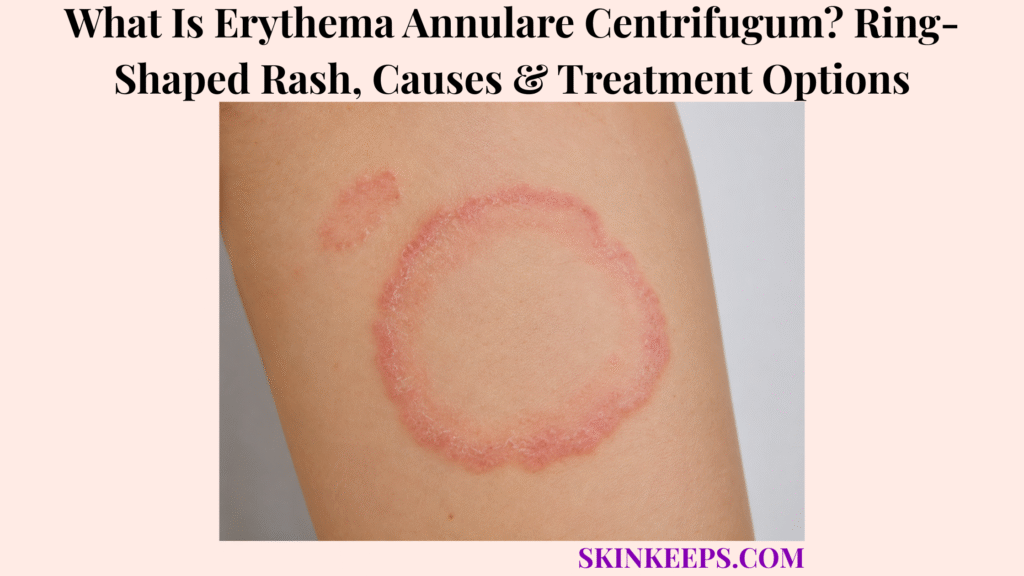
Erythema annulare centrifugum (EAC) is a reactive skin rash that forms expanding ring-shaped, arc-shaped, or connected circular patches, sometimes with central clearing and a fine inner rim of trailing scale.
A ring shape does not identify one disease. This page covers EAC appearance, locations, possible triggers, common mimics, diagnosis, biopsy, treatment options, recurrence, flare care, mistakes, and warning signs that need medical review.
What Is Erythema Annulare Centrifugum?
Erythema annulare centrifugum is a reactive annular rash pattern in which one or more patches slowly enlarge outward and may form rings, arcs, waves, or connected circular shapes.
The center may flatten or clear while the outside edge continues to spread. A delicate scale can remain slightly behind the advancing border, creating the feature called trailing scale.
EAC is part of a broader group called figurate or annular erythemas. “Annular” describes the shape; it does not prove the diagnosis.
What Does the Name Mean?
The name describes redness or inflammation that spreads outward in a ring-shaped pattern.
- Erythema means redness or an inflamed color change.
- Annulare means ring-shaped.
- Centrifugum refers to outward movement from the center.
Why Is EAC Called a Reactive Rash?
EAC is called reactive because it often behaves like the skin’s response to another stimulus rather than a single-cause infection or one fixed disease.
Many cases remain idiopathic, meaning no trigger is found. Other cases occur alongside fungal disease, another infection, a medication, pregnancy, an autoimmune condition, or rarely an internal malignancy.
Practical rule: Do not diagnose EAC, ringworm, or Lyme disease from a circular outline alone.
What Does Erythema Annulare Centrifugum Look Like?
EAC usually starts as a small pink, red, brownish, purple-brown, or darker patch that enlarges outward into a ring, curved arc, or connected group of circles.
The rash may be easier to see as redness on lighter skin and as red-brown, violet-brown, purple-brown, or darker color change on deeper skin tones. Lighting and post-inflammatory color change can affect visibility.
What Are Annular, Arciform, and Polycyclic Lesions?
Annular means ring-shaped, arciform means curved like part of a circle, and polycyclic means several rings or loops join together.
Uneven outward growth can create waves, arcs, or overlapping borders rather than a perfect circle. The central area may look clearer, flatter, or less inflamed than the edge.
What Is Trailing Scale?
Trailing scale is a fine inner rim of dry scale that sits just behind the actively spreading outer border.
This differs from the leading scale often seen at the outer active edge of tinea corporis. Trailing scale can be subtle, absent in deeper EAC, or difficult to see after creams have been applied.
What Symptoms Can Come With EAC?
EAC may cause mild itch, stinging, burning, or irritation, but some people notice only the visible rash.
Gradual spread and recurrence can occur. Blistering, ulcers, pus, severe pain, marked swelling, fever, or rapidly worsening illness are not typical and should broaden the diagnosis.
| Feature | Typical EAC Clue | Why It Matters |
|---|---|---|
| Shape | Ring, arc, wave, or connected rings. | Suggests an annular pattern, not one diagnosis. |
| Growth | Slow outward expansion. | Explains “centrifugum.” |
| Center | May flatten or clear. | Common but not exclusive to EAC. |
| Scale | Fine scale behind the outer edge. | Useful clue for superficial EAC. |
| Sensation | None, mild itch, or irritation. | Severe pain suggests another problem. |
| Surface damage | Usually no pus, ulcers, or blisters. | These signs need medical review. |
Where Does Erythema Annulare Centrifugum Usually Appear?
EAC commonly affects the trunk and limbs, including the back, abdomen, buttocks, thighs, upper arms, and legs.
One lesion or many lesions may appear. The neck or face can be affected less often. Distribution alone cannot separate EAC from fungal infection, eczema, psoriasis, Lyme erythema migrans, or autoimmune annular rashes.
| Body Site | Possible EAC Pattern | Mimic to Consider |
|---|---|---|
| Trunk | Expanding annular or polycyclic plaques. | Pityriasis rosea, tinea, psoriasis. |
| Back | Curved or recurrent plaques. | Tinea, eczema, psoriasis. |
| Abdomen | Rings with possible trailing scale. | Drug eruption, pityriasis rosea. |
| Buttocks | Ring-shaped or arc-shaped lesions. | Tinea or dermatitis. |
| Thighs | Single or multiple expanding rings. | Tinea corporis or erythema migrans. |
| Arms / legs | Annular plaques that persist or recur. | Granuloma annulare, urticaria, lupus. |
What Causes Erythema Annulare Centrifugum?
The exact cause of EAC is often not found, but it may appear as a reaction to fungal infection, another infection, medication exposure, foods, autoimmune disease, pregnancy, or rarely malignancy.
An association does not prove that every listed factor caused the rash. Evaluation should follow the person’s history, exam, rash course, and red flags rather than a universal testing package.
Why Do Many EAC Cases Have No Clear Cause?
Many cases are idiopathic even after reasonable assessment.
Some resolve without a trigger being identified, while others recur. Persistent disease deserves reassessment, but a mild classic eruption does not automatically justify extensive cancer testing or broad laboratory screening.
Which Infections or Skin Conditions Can Be Linked With EAC?
Fungal disease is an important treatable context because EAC has been reported alongside dermatophyte infections.
A clinician may check the body, feet, groin, and nails for tinea. Symptoms of athlete’s foot or nail fungus can matter even when the annular eruption appears elsewhere.
Selected viral, bacterial, parasitic, and Candida-related associations have also been reported, but testing should be guided by symptoms and exposure history.
Can Medications Trigger EAC?
A new medication, dose change, or supplement can coincide with an EAC-like eruption, so the timeline should be reviewed carefully.
A medication-associated drug rash can take many forms. Do not stop prescribed treatment independently; the prescriber should judge whether a safe switch or withdrawal is appropriate.
Can EAC Be Linked With Cancer?
EAC can rarely occur as a paraneoplastic eruption, but most cases are not caused by cancer.
Concern rises when a persistent or unusual rash appears with unexplained weight loss, night sweats, swollen lymph nodes, persistent fever, severe fatigue, or other abnormal findings. Investigation should be targeted rather than automatic for every ring-shaped rash.
| Trigger Category | Examples | Care Implication |
|---|---|---|
| Idiopathic | No trigger identified. | Symptom care and monitoring. |
| Fungal disease | Tinea corporis, foot or nail fungus. | Scraping or culture when unclear. |
| Other infection | History-guided viral, bacterial, or parasitic context. | Test only when clinically supported. |
| Medication | New drug, dose change, or supplement. | Prescriber-led review. |
| Autoimmune / pregnancy | Associated symptoms or timing. | Targeted clinical assessment. |
| Malignancy | Rare paraneoplastic context. | Evaluate when red flags justify it. |
Who Is More Likely to Need a Trigger-Focused EAC Workup?
EAC can affect different ages and skin types, so trigger history is usually more useful than a fixed risk profile.
- Recent ringworm, foot fungus, groin fungus, or nail fungus.
- Recent viral or bacterial illness.
- New medicine, dose change, or supplement.
- Recurrent or persistent annular rashes.
- Autoimmune symptoms or strong photosensitivity.
- Pregnancy context.
- Immune suppression or cancer treatment.
- Older age with a new persistent unusual eruption.
- Fever, weight loss, night sweats, swollen lymph nodes, or unexplained fatigue.
How Is EAC Different From Other Ring-Shaped Rashes?
EAC can resemble ringworm, Lyme erythema migrans, granuloma annulare, pityriasis rosea, hives, psoriasis, eczema, lupus, drug eruption, and rare systemic annular rashes.
The correct comparison uses border scale, lesion duration, movement, symptoms, exposure history, and test results—not ring shape alone.
How Is EAC Different From Ringworm?
Ringworm is a dermatophyte fungal infection, while EAC is a reactive inflammatory pattern.
Tinea often has scale at the active outer border and may be confirmed with a potassium hydroxide scraping or fungal culture. EAC may have trailing scale behind the border. Steroid-only treatment can mask or worsen untreated tinea.
How Is EAC Different From Lyme Erythema Migrans?
Lyme erythema migrans is an expanding rash associated with tick-borne infection, while EAC often follows a more persistent or recurrent annular course.
Erythema migrans does not always form a perfect bull’s-eye. Tick or outdoor exposure, travel, fever, fatigue, headache, muscle or joint symptoms, and neurologic complaints change the urgency and require medical assessment.
How Is EAC Different From Granuloma Annulare?
Granuloma annulare usually forms smooth, firm papules arranged in a ring and typically lacks surface scale.
It often affects hands, feet, elbows, or ankles. Biopsy can separate clinically uncertain smooth papular rings from EAC and other annular diseases.
How Is EAC Different From Pityriasis Rosea?
Pityriasis rosea often begins with one herald patch followed by multiple oval scaly lesions on the trunk.
Later lesions may follow skin cleavage lines. EAC tends to grow outward as rings, arcs, or connected loops and may recur.
How Is EAC Different From Hives, Eczema, or Psoriasis?
Hives usually move or disappear from the same spot within about a day, while EAC lesions persist and enlarge outward.
Annular dermatitis or eczema can be itchy and scaly, while psoriasis often forms thicker, more persistent plaques. Diagnosis should follow the full pattern rather than one feature.
How Is EAC Different From Lupus or Rare Annular Rashes?
Photosensitive lupus-related lesions and rare systemic eruptions can create annular or polycyclic patterns.
Discoid lupus erythematosus usually has a different scarring plaque pattern, while subacute cutaneous lupus can form photosensitive annular lesions. Rapid wood-grain rings, blistering, erosion, ulceration, strong systemic symptoms, or unusual progression need specialist assessment.
| Rash | Main Clue | Safer Next Step |
|---|---|---|
| EAC | Persistent expanding rings or arcs; possible trailing scale. | Pattern review, trigger history, biopsy if unclear. |
| Ringworm | Fungal ring with active scaly border. | KOH scraping or culture when uncertain. |
| Lyme erythema migrans | Expanding rash with credible tick/exposure context. | Prompt medical evaluation. |
| Granuloma annulare | Smooth firm papular ring without scale. | Clinical exam or biopsy. |
| Pityriasis rosea | Herald patch followed by trunk eruption. | Assess distribution and timing. |
| Hives | Raised itchy wheals that move quickly. | Urticaria assessment. |
| Psoriasis / eczema | Persistent scaly plaques with their own pattern. | Diagnosis-led topical care. |
| Lupus / rare systemic rash | Photosensitivity, erosion, rapid spread, or systemic clues. | Specialist evaluation. |
How Is Erythema Annulare Centrifugum Diagnosed?
EAC is suspected from its outward-growing annular pattern and possible trailing scale, but diagnosis may require tests to exclude fungal infection, Lyme disease, drug eruption, autoimmune disease, or other figurate rashes.
What Does a Dermatologist Check?
The examination checks shape, border, scale position, direction of growth, central clearing, lesion duration, recurrence, symptoms, body distribution, and previous treatment response.
The history should cover foot, groin, nail, or body fungus; recent infection; medication and supplement timing; tick or travel exposure; pregnancy; photosensitivity; autoimmune symptoms; immune suppression; and systemic warning signs.
What Tests May Be Used?
A KOH scraping or fungal culture may be used when tinea is possible.
Other infection tests, Lyme evaluation, blood tests, autoimmune studies, or systemic investigations should be selected only when the history and examination support them. Broad screening without a clinical reason can create false leads.
What Does Biopsy Show in EAC?
A skin biopsy can support EAC and help exclude granuloma annulare, lupus, psoriasis, drug eruption, fungal infection, and rare mimics.
A classic finding is a dense lymphocytic infiltrate arranged around superficial or deeper blood vessels, often described as a “coat-sleeve” pattern. Pathology must still be interpreted with the clinical picture.
What Should You Prepare for an Appointment?
- When the rash began and whether it expands outward.
- Photos showing change over days or weeks.
- Whether each lesion moves, persists, fades, or recurs.
- Itch, burning, pain, blisters, ulcers, pus, or crust.
- Fungal symptoms on the feet, groin, nails, or body.
- Tick bite, outdoor exposure, travel, fever, fatigue, headache, or joint symptoms.
- New medicines, dose changes, supplements, or recent vaccines.
- Recent infections or illnesses.
- Photosensitivity, mouth sores, joint swelling, or other autoimmune clues.
- Pregnancy, diabetes, immune suppression, or cancer-treatment context.
- Weight loss, night sweats, swollen nodes, or persistent fever.
- Previous antifungal, steroid, antibiotic, or eczema treatment response.
What Treatment Options Help Erythema Annulare Centrifugum?
EAC treatment focuses on treating an identified trigger, reducing itch or inflammation, and checking whether the eruption resolves, recurs, or changes.
Why Does Treating the Trigger Matter Most?
A trigger-linked eruption may improve when the associated fungal disease, infection, medication issue, or systemic condition is addressed.
If no trigger is found, treatment is mainly supportive. A suspected medicine should be changed only through the prescriber, and an infection should be treated according to its confirmed diagnosis.
What Topical Treatments May Reduce Symptoms?
A clinician may use a topical corticosteroid to reduce itch, redness, or inflammation after fungal and other important mimics have been considered.
Topical calcineurin inhibitors such as tacrolimus or pimecrolimus may be used in selected cases. Moisturizers can improve dryness but do not remove an underlying trigger.
When Are Antifungal Medicines Needed?
Antifungal treatment is appropriate when fungal infection is confirmed or strongly supported—not simply because the rash is circular.
Repeated antifungal treatment without improvement should prompt reassessment. Long-term steroid-antifungal combination creams can alter the rash and delay a clear diagnosis.
What About Recurrent or Persistent EAC?
Persistent or recurrent EAC should trigger a fresh review of the diagnosis, medication timeline, fungal sites, infection history, systemic clues, and whether biopsy is needed.
Specialist-directed treatments may be considered for difficult disease, but there is no universal cure that fits every trigger and morphology.
| Situation | Treatment Direction | Key Caution |
|---|---|---|
| Mild, asymptomatic pattern | Observation and tracking. | Confirm it is not a significant mimic. |
| Itchy or inflamed EAC | Prescribed topical anti-inflammatory care. | Consider fungus first. |
| Confirmed fungal trigger | Appropriate antifungal treatment. | Match treatment to fungal diagnosis. |
| Possible drug trigger | Prescriber-led review or switch. | Do not stop essential medicine alone. |
| Persistent or recurrent disease | Reassess, test, or biopsy. | Rule out mimics and systemic clues. |
| Systemic warning signs | Medical evaluation. | Do not manage as a simple rash. |
Can Erythema Annulare Centrifugum Go Away on Its Own?
EAC can resolve without specific treatment, but it may also persist or return over time.
An individual patch may enlarge and fade while a new lesion appears elsewhere. Treating a genuine trigger can help, but recurrence does not automatically prove cancer, infection, or medication causation.
Course pattern: small patch → outward-growing ring → central flattening or clearing → fading → possible new lesion or trigger-led improvement.
How Should Skin Be Cared for During an EAC Flare?
Flare care should reduce irritation, preserve the skin barrier, and make the rash easier to assess.
- Use a gentle cleanser.
- Moisturize dry or scaly skin.
- Avoid scratching and harsh scrubs.
- Avoid adding many new products at once.
- Use prescribed topical medicine as directed.
- Photograph the rash with dates and consistent lighting.
- Track medicines, infections, travel, tick exposure, foods, and fungal symptoms.
- Avoid strong steroid-only care until fungus and important mimics are considered.
- Watch for pain, blistering, ulceration, pus, fever, or rapid spread.
What EAC Treatment Mistakes Should You Avoid?
The biggest mistake is treating ring shape as proof of either EAC or ringworm.
Random treatment can blur the border, suppress scale, worsen fungus, or delay recognition of Lyme disease, autoimmune disease, infection, medication reaction, or another annular eruption.
| Mistake | Why It Fails | Better Action |
|---|---|---|
| “Every ring is ringworm.” | Many inflammatory and systemic rashes are annular. | Assess pattern and test fungus when unclear. |
| “Every ring is EAC.” | Misses tinea, Lyme, lupus, drug eruption, and other mimics. | Use history, exam, and selected tests. |
| Steroid before fungus check | Can mask or worsen tinea. | Rule out fungal disease first. |
| Stopping medicine independently | May cause harm or miss another cause. | Use prescriber-led review. |
| Ignoring recurrence | The diagnosis or trigger may need revision. | Reassess or biopsy persistent disease. |
| Ignoring systemic symptoms | Can miss infection or rare systemic disease. | Seek medical evaluation. |
When Should a Ring-Shaped Rash Be Checked by a Doctor?
A ring-shaped rash should be checked when it spreads rapidly, persists, recurs, becomes painful, blisters, ulcerates, looks infected, follows tick exposure, fails appropriate care, or appears with systemic symptoms.
Which Rash Signs Need Medical Review?
Medical review is needed for multiple expanding rings, severe itch, pain, tenderness, blistering, ulcers, warmth, swelling, pus, honey-colored crust, or a rash near the eyes or genitals.
Pus or honey-colored crust can suggest bacterial infection such as impetigo rather than uncomplicated EAC.
Which Systemic Clues Should Be Reported?
Tell the clinician about fever, fatigue, weight loss, night sweats, swollen lymph nodes, joint symptoms, photosensitivity, mouth sores, recent infection, tick exposure, and new medicine or supplement timing.
Pregnancy, diabetes, immune suppression, cancer treatment, severe illness, or a rash that worsens after steroid use lowers the threshold for medical assessment.
Seek medical review if a ring-shaped rash is:
- Rapidly spreading, persistent, or recurrent.
- Painful, tender, blistering, or ulcerated.
- Pus-filled, crusted, warm, swollen, or infected-looking.
- Near the eyes or genitals.
- Worsening with steroid cream.
- Not improving with diagnosis-appropriate care.
- Linked with a tick bite, outdoor exposure, fever, fatigue, headache, or joint symptoms.
- Linked with a new medicine, dose change, or supplement.
- Linked with fungus on the feet, groin, nails, or body.
- Linked with weight loss, night sweats, swollen lymph nodes, or persistent fever.
- Present during pregnancy, immune suppression, diabetes, or cancer treatment.
What Should You Remember About Erythema Annulare Centrifugum?
Erythema annulare centrifugum is a reactive annular rash pattern, so safe care depends on recognizing its morphology, ruling out common mimics, and investigating credible triggers.
- EAC can form expanding rings, arcs, or connected circular lesions.
- Trailing scale is a useful clue but may be subtle or absent.
- Many cases have no clear cause.
- Possible associations include fungal disease, other infection, medication, pregnancy, autoimmune disease, and rarely malignancy.
- Ringworm is a key mimic and may need KOH testing or culture.
- Lyme erythema migrans matters when tick exposure and compatible symptoms fit.
- Biopsy may show a coat-sleeve perivascular inflammatory pattern.
- Treatment should match an identified trigger and the person’s symptoms.
- Persistent, recurrent, painful, blistering, infected-looking, or systemic-symptom-linked disease needs medical review.
Frequently Asked Questions About Erythema Annulare Centrifugum
Is erythema annulare centrifugum the same as ringworm?
No. EAC is a reactive annular rash pattern, while ringworm is a fungal infection. They can look similar, so a skin scraping, potassium hydroxide test, or fungal culture may be needed when the diagnosis is unclear.
What does EAC look like?
EAC usually forms expanding ring-shaped, arc-shaped, or connected circular lesions with central clearing. A fine trailing scale may sit just behind the advancing outer edge.
What causes erythema annulare centrifugum?
Many cases have no clear cause. Possible associations include fungal infection, other infections, medications, foods, autoimmune disease, pregnancy, and rarely an underlying malignancy.
How is EAC diagnosed?
Diagnosis uses the rash pattern, trailing scale, history, fungal testing when needed, medication and infection review, tick-exposure context, and skin biopsy when the diagnosis remains uncertain.
What is the best treatment for EAC?
There is no single best treatment for every case. Care focuses on treating an identified trigger, reducing itch or inflammation, and reassessing persistent or recurrent disease.
Can EAC go away by itself?
Yes. Some cases resolve without specific treatment, while others recur or persist. A persistent, changing, or systemic-symptom-linked rash should be reassessed.
Can EAC be caused by cancer?
Rarely. Most cases are idiopathic or linked with benign triggers, but persistent unusual disease with weight loss, night sweats, swollen lymph nodes, fever, or other systemic signs needs medical evaluation.
When should a ring-shaped rash be checked urgently?
Urgent assessment is needed for fever, rapidly spreading rash, tick exposure with illness symptoms, severe pain, blisters, ulcers, pus, warmth, swelling, red streaks, eye involvement, breathing symptoms, or severe illness.
Sources & Evidence About Erythema Annulare Centrifugum
DermNet — Erythema Annulare Centrifugum was used for EAC definition, circular/arciform/polycyclic morphology, trailing scale, common locations, biopsy coat-sleeve pattern, fungal-trigger assessment, treatment options, and recurrence.
DermNet — Annular Erythema was used for annular erythema as a descriptive eruption group, central clearing, trigger categories, differential diagnoses, and cause-led treatment framing.
Primary Care Dermatology Society — Annular Erythema was used for annular erythema as a morphology group rather than a single diagnosis and for the broader figurate-erythema differential.
NCBI Bookshelf / StatPearls — Erythema Annulare Centrifugum was used for reactive-dermatosis framing, idiopathic and associated contexts, trailing scale, coat-sleeve histology, topical corticosteroids, calcineurin inhibitors, recurrence, and rare paraneoplastic association.
American Family Physician — Annular Lesions: Diagnosis and Treatment was used for ring-shaped rash differential diagnosis, tinea evaluation, KOH testing boundaries, erythema migrans comparison, and morphology-led assessment.
CDC — About Lyme Disease and CDC — Lyme Disease Rashes were used for tick-borne erythema migrans context and associated fever, headache, fatigue, and expanding-rash safety guidance.
Educational Disclaimer: This SkinKeeps article is for educational purposes only and does not diagnose or replace medical care. A ring-shaped, spreading, recurrent, painful, blistering, ulcerated, infected-looking, pus-filled, crusted, warm, swollen, eye-related, genital-related, child-related, pregnancy-related, diabetes-related, immune-suppression-related, cancer-treatment-related, tick-exposure-related, fever-associated, joint-symptom-associated, medication-associated, photosensitive, treatment-resistant, rapidly changing, or uncertain rash should be checked by a qualified healthcare professional. Seek urgent care for fever, rapidly spreading rash, severe pain, blisters, ulcers, pus, red streaks, eye involvement, breathing symptoms, severe illness, or suspected Lyme disease after tick exposure. Do not diagnose EAC from ring shape alone, use strong steroid cream on possible fungus without evaluation, stop essential medication without prescriber guidance, or ignore systemic symptoms such as weight loss, night sweats, swollen lymph nodes, or persistent fever.