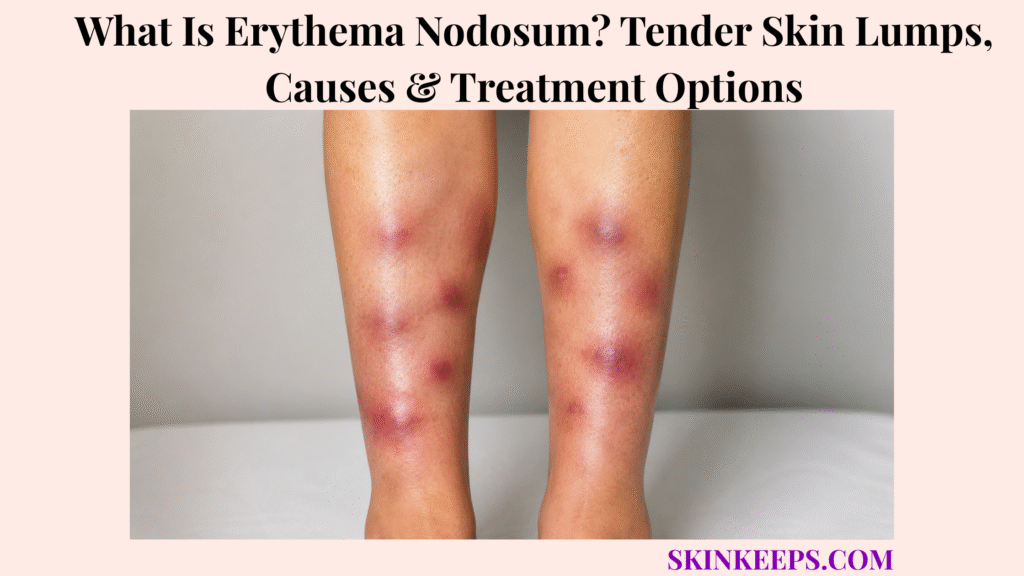
Erythema nodosum is an inflammatory reaction in the fat layer under the skin that causes tender, deep lumps, most often on the front of the lower legs.
Also called EN, it is a form of panniculitis rather than a surface rash. This page covers appearance, locations, triggers, similar painful lumps, diagnosis, cause-focused testing, treatment, home care, duration, recurrence, mistakes, and warning signs that need medical review.
What Is Erythema Nodosum?
Erythema nodosum is a reactive inflammation of subcutaneous fat that usually creates several painful nodules on the shins.
The nodules sit deeper than pimples, ordinary rashes, or surface swelling. They may feel warm and very tender, especially when touched, walking, standing, or clothing presses against them.
EN can be a temporary reaction to infection, inflammatory disease, pregnancy, medicine exposure, or another trigger. A clear cause is not found in every case.
Why Is Erythema Nodosum Called Panniculitis?
Erythema nodosum is called panniculitis because the inflammation occurs in the subcutaneous fat layer beneath the skin.
EN is usually described as septal panniculitis, meaning inflammation mainly affects the connective-tissue partitions between fat lobules. This deeper location explains why the lesions feel like firm or soft-tender lumps rather than a thin surface rash.
Why Is EN Often a Reaction Pattern?
EN is often a reaction pattern because the skin-fat inflammation may be triggered by another infection, disease, medicine, pregnancy, or immune process.
The visible nodules are only one part of the evaluation. Finding a sore-throat history, chest symptoms, digestive symptoms, tuberculosis exposure, pregnancy, or a new medicine can change the diagnosis and treatment plan.
Practical rule: Tender nodules on both shins may fit EN, but one-sided swelling, pus, ulceration, or spreading redness should not be managed as routine panniculitis.
What Do Erythema Nodosum Lumps Look and Feel Like?
Erythema nodosum usually causes tender, warm, deep nodules that may look red, pink, purple, brown, or bruise-like as they heal.
Several nodules may appear over a short period. They are commonly painful with touch or walking and may be difficult to outline because the inflammation lies below the surface.
What Are Common Skin Signs of EN?
Common EN skin signs include deep tender lumps, warmth, pain with pressure, and gradual bruise-like color change.
Typical nodules do not form a central head, drain pus, or become open wounds. As they settle, they may change from red or purple to brown, blue, yellow, or greenish bruise-like shades before flattening.
Healing usually does not leave a scar, although temporary discoloration can remain while inflammation fades.
What Body Symptoms Can Come With EN?
EN can occur with fever, fatigue, malaise, muscle aches, joint pain, and painful or swollen ankles.
A sore throat may point toward streptococcal infection. Cough, chest discomfort, breathing symptoms, or eye irritation can raise sarcoidosis, tuberculosis, or other infection questions.
Abdominal pain, persistent diarrhea, blood in stool, or weight loss can point toward inflammatory bowel disease or a gastrointestinal infection and should be reported during evaluation.
| Feature | Typical EN Clue | Why It Matters |
|---|---|---|
| Depth | Firm or soft-tender lump beneath the skin. | Supports panniculitis rather than a surface rash. |
| Color | Red, violet, purple, brown, or bruise-like. | Color can evolve during healing. |
| Sensation | Tender, warm, painful with pressure or walking. | Helps distinguish EN from painless lumps. |
| Surface | Usually intact without pus or ulceration. | Drainage or open sores suggest another diagnosis. |
| Joint symptoms | Ankle or other joint pain can occur. | May support systemic trigger evaluation. |
| Systemic symptoms | Fever, sore throat, cough, or digestive symptoms. | Guides cause-focused testing. |
Where Does Erythema Nodosum Usually Appear?
Erythema nodosum most often appears on the front of both lower legs, especially over the shins or pretibial areas.
Nodules can also occur around the ankles, calves, thighs, and forearms. Unusual body sites, one-sided disease, ulceration, or a very long-lasting course should make the diagnosis less automatic.
| Body Site | EN Pattern Clue | Mimic to Consider |
|---|---|---|
| Both shins | Classic bilateral pretibial pattern. | Cellulitis if redness spreads or infection signs dominate. |
| Ankles | Pain or swelling can accompany EN. | Arthritis, injury, or infection. |
| Calves | Possible but less classic location. | DVT, thrombophlebitis, nodular vasculitis. |
| Thighs | Possible deeper nodules. | Bruise, other panniculitis, infection. |
| Forearms | Less common distribution. | Vasculitis, medicine reaction, other nodules. |
| One leg only | Requires more caution. | Blood clot, cellulitis, thrombophlebitis. |
| Ulcerated lesion | Not typical EN behavior. | Nodular vasculitis, infection, vasculitis, tumor. |
What Causes Erythema Nodosum?
Erythema nodosum can be triggered by infections, inflammatory diseases, medicines, pregnancy, hormonal exposure, or other conditions, but some cases remain idiopathic.
Idiopathic means no definite cause is found after an appropriate history and examination. This does not make the symptoms imaginary; it means the trigger could not be identified.
Which Infections Can Trigger EN?
Streptococcal infection is a major trigger to consider when EN follows a sore throat, fever, or recent upper-respiratory illness.
Tuberculosis should be considered when exposure, travel, cough, night sweats, weight loss, or local disease patterns make it relevant. Gastrointestinal infections such as Yersinia, Salmonella, or Campylobacter may also be considered when diarrhea preceded the nodules.
Other bacterial, viral, or fungal infections may be relevant in selected clinical or geographic contexts. Testing should follow the history rather than screening randomly for every possible organism.
Which Inflammatory Diseases Can Trigger EN?
Sarcoidosis and inflammatory bowel disease are important inflammatory triggers, especially when EN appears with chest, eye, joint, or digestive symptoms.
Crohn’s disease and ulcerative colitis can be associated with EN during active intestinal inflammation. Behçet disease and other inflammatory disorders enter the differential when mouth ulcers, genital ulcers, eye symptoms, or systemic inflammation are present.
Autoimmune-related deep nodules can also resemble EN. A history suggestive of lupus erythematosus may require a different examination, laboratory plan, or biopsy.
Which Medicines Can Trigger EN?
Medicines can trigger EN in some people, so new prescriptions, dose changes, hormonal therapies, and supplements should be placed on a timeline.
Oral contraceptives, sulfonamide antibiotics, and other medicines have been associated with EN. Medicine-linked panniculitis should be separated from a broader drug rash or a severe medication reaction.
Do not stop an essential medicine independently. A prescriber should assess the timing, alternatives, and risk of continuing or withdrawing the suspected product.
How Do Pregnancy and Hormones Fit?
Pregnancy and hormonal medicines can be associated with EN, and any symptom-treatment plan must be safe for pregnancy.
Pregnancy testing may be appropriate when clinically relevant. Pain medicines, anti-inflammatory medicines, steroids, and other therapies need individual review rather than automatic use.
Who Is More Likely to Get Erythema Nodosum?
EN can occur in many people, but the most useful risk information is the medical context surrounding the tender nodules.
Recent infection, chest symptoms, digestive disease, medicine exposure, pregnancy, recurrent episodes, immune suppression, and geographic or travel-related infection risk can all change the evaluation.
- Recent sore throat, fever, or other infection.
- Recent diarrhea or gastrointestinal infection.
- Tuberculosis exposure, travel, or local TB risk.
- Cough, chest discomfort, shortness of breath, or eye symptoms.
- Chronic diarrhea, abdominal pain, blood in stool, or weight loss.
- Pregnancy possibility or hormonal treatment.
- New medicine, supplement, vaccine, or dose change.
- Repeated episodes of EN-like nodules.
- Immune suppression, cancer treatment, or serious chronic illness.
How Is Erythema Nodosum Different From Other Tender Skin Lumps?
Erythema nodosum can resemble cellulitis, abscesses, bruises, thrombophlebitis, deep vein thrombosis, nodular vasculitis, lipodermatosclerosis, lupus panniculitis, or other subcutaneous lumps.
The safest distinction uses the distribution, surface, presence of pus or ulceration, one-sided swelling, systemic symptoms, and whether the lesion changes like a bruise.
How Is EN Different From Cellulitis?
Cellulitis is a bacterial skin infection that is often one-sided and causes expanding warmth, redness, pain, swelling, and sometimes fever.
EN more often creates several distinct tender nodules on both shins. Fever can occur with either condition, so rapidly spreading redness, severe illness, red streaks, or intense pain needs prompt medical evaluation.
How Is EN Different From an Abscess or Boil?
An abscess or boil contains pus, while typical EN nodules are deep, tender, non-ulcerated, and not pus-filled.
A boil may develop a central point, soften, or drain. EN should not be squeezed, cut, lanced, or treated as a collection of pus.
How Is EN Different From Deep Vein Thrombosis?
Deep vein thrombosis can cause one-sided calf swelling, pain, warmth, or tenderness, while EN usually produces palpable nodules in the skin-fat layer, often on both shins.
A blood clot can be life-threatening. One-sided leg swelling with chest pain, shortness of breath, faintness, or sudden breathing difficulty needs urgent care.
How Is EN Different From Other Panniculitis or Lumps?
Nodular vasculitis and other panniculitis conditions may favor the calves, last longer, recur in unusual patterns, or ulcerate.
A soft, slowly growing, usually painless lipoma behaves differently from a sudden tender inflammatory nodule. A small firm superficial dermatofibroma is also usually more localized and stable than EN.
Atypical location, ulceration, a hard fixed lump, rapid growth, or persistence beyond the expected course may require imaging, biopsy, or specialist review.
| Condition | Main Clue | Why Confusion Happens | Safer Next Step |
|---|---|---|---|
| Erythema nodosum | Multiple tender nodules, often on both shins. | Red painful leg lumps. | Trigger-focused evaluation. |
| Cellulitis | Spreading infection, often one-sided. | Warmth, redness, pain. | Prompt care if spreading or feverish. |
| Abscess / boil | Pus-filled lump or draining center. | Tender lump overlap. | Medical assessment for drainage/culture. |
| DVT | One-sided calf swelling and pain. | Leg tenderness overlap. | Urgent vascular evaluation. |
| Bruise | Trauma history, flatter color change. | EN becomes bruise-like while fading. | History and examination. |
| Nodular vasculitis | Calf nodules that may ulcerate. | Deep inflammatory nodules. | Biopsy if unclear. |
| Lipodermatosclerosis | Chronic venous skin and leg changes. | Lower-leg pain and firmness. | Venous assessment. |
| Lupus panniculitis | Deep nodules with autoimmune context. | Panniculitis overlap. | Biopsy and labs if suspected. |
How Is Erythema Nodosum Diagnosed?
Erythema nodosum is often diagnosed from the typical pattern of tender nodules on the shins, but testing may be needed to identify the trigger or rule out a mimic.
No single universal test panel fits every person. A clinician should use the rash pattern, systemic symptoms, medical history, location, local infection risks, and treatment response to select tests.
What Does a Clinician Check?
A clinician checks where the nodules appear, whether both shins are involved, how deep and tender they feel, and whether they change color like bruises.
The examination also looks for ulceration, drainage, spreading redness, one-sided calf swelling, joint or ankle swelling, and signs that suggest infection, vascular disease, another panniculitis, or a growing mass.
History should include sore throat, fever, cough, chest symptoms, tuberculosis exposure, diarrhea, blood in stool, pregnancy possibility, medicines, supplements, prior episodes, and immune status.
What Tests May Be Used to Find the Cause?
Tests are chosen from the history and examination rather than ordered identically for every case.
Possible tests include a complete blood count, inflammatory markers, throat culture or rapid streptococcal testing, antistreptolysin-O testing, chest X-ray, tuberculosis testing, pregnancy testing, stool studies, or digestive evaluation.
Venous ultrasound may be needed when one-sided swelling raises concern for DVT. Other laboratory or imaging tests should answer a specific clinical question rather than create a broad unfocused workup.
When Is Biopsy Needed?
Biopsy may be needed when EN is uncertain, atypical, ulcerated, persistent, outside its usual locations, or concerning for infection, vasculitis, tumor, or another panniculitis.
Because EN involves subcutaneous fat, a shallow surface sample may miss the important tissue. A clinician may choose a deep incisional or wedge biopsy that includes enough fat for pathology.
What Should You Prepare for an Appointment?
- When the lumps first appeared and whether they affect one or both shins.
- Photos showing how color and size changed over time.
- Pain with touch, walking, standing, or pressure.
- Fever, fatigue, joint pain, ankle swelling, or muscle aches.
- Recent sore throat, infection, antibiotic use, or gastrointestinal illness.
- Cough, chest pain, breathing symptoms, tuberculosis exposure, or travel history.
- Diarrhea, abdominal pain, blood in stool, or unexplained weight loss.
- Pregnancy possibility, hormonal medicines, new prescriptions, supplements, or dose changes.
- Pus, ulceration, red streaks, spreading warmth, or one-sided calf swelling.
- Previous EN episodes and results of throat, blood, chest, TB, stool, or biopsy testing.
What Treatment Options Help Erythema Nodosum?
Erythema nodosum treatment focuses on addressing the underlying trigger when found and relieving pain, tenderness, and inflammation while the nodules heal.
Antibiotics are not an automatic EN treatment. They are appropriate only when a bacterial infection is confirmed or strongly supported and requires treatment.
What Supportive Care Helps EN Pain?
Supportive care may include rest, leg elevation, cool compresses, pressure reduction, comfortable footwear, and less standing or walking during a painful flare.
Compression may help selected people, but it should be used only when tolerated and when a clinician has ruled out reasons it may be unsafe, including concern for a blood clot or significant arterial disease.
When Are NSAIDs Used?
Nonsteroidal anti-inflammatory medicines may reduce EN pain and inflammation, but they are not safe for everyone.
Pregnancy, kidney disease, stomach ulcers, blood-thinner use, certain cardiovascular risks, allergies, and some inflammatory bowel disease flares can change whether an NSAID is appropriate.
No person should assume that a common over-the-counter medicine is automatically safe in their situation.
Why Does Treating the Trigger Matter?
Treating the trigger matters because EN can recur or persist when an infection, inflammatory disease, medicine exposure, or hormonal context remains active.
Confirmed streptococcal infection or tuberculosis needs its own treatment plan. Active sarcoidosis or inflammatory bowel disease may require specialist management, and a suspected medicine trigger needs prescriber-led review.
When Are Corticosteroids or Other Medicines Considered?
Systemic corticosteroids or other specialist medicines may be considered for severe or persistent EN only after hidden infection and serious mimics have been evaluated.
Steroids are not first-line treatment for every case because they can suppress immune responses and worsen an unrecognized infection. Potassium iodide and other therapies have been used in selected specialist-led cases, but they are not routine self-care.
| Clinical Situation | Treatment Direction | Key Caution |
|---|---|---|
| Mild typical EN | Rest, elevation, pressure reduction, monitoring. | Still review trigger clues. |
| Painful EN | Pain and anti-inflammatory care if safe. | NSAIDs are not suitable for everyone. |
| Confirmed strep trigger | Treat the bacterial infection appropriately. | Do not use antibiotics without evidence. |
| Sarcoidosis-related EN | Assess the systemic sarcoidosis context. | Treatment depends on organ involvement. |
| IBD-related EN | Control bowel inflammation. | Coordinate gastrointestinal care. |
| Pregnancy-associated EN | Supportive pregnancy-safe treatment. | Avoid unsafe medicines. |
| Persistent or recurrent EN | Reassess cause, diagnosis, and biopsy need. | Rule out infection and mimics before steroids. |
How Long Does Erythema Nodosum Last?
Erythema nodosum often improves over several weeks, and many typical episodes settle within approximately three to six weeks.
Individual nodules may remain tender while their color changes from red or purple to brown, blue, greenish, or yellow, similar to the evolution of a bruise.
Typical lesions flatten without ulceration or permanent scarring. Persistence, repeated new nodules, or a course that does not match the expected pattern should trigger reassessment.
Healing pattern: Tender red or purple nodule → bruise-like brown, blue, or yellow stage → flattening → no scar in a typical uncomplicated episode.
Can Erythema Nodosum Come Back?
Erythema nodosum can recur when the original trigger returns, remains active, or is never identified.
Repeated sore-throat infections, active inflammatory bowel disease, sarcoidosis, medicine re-exposure, pregnancy or hormonal factors, chronic infection, and idiopathic recurrence can all fit the history.
A simple recurrence diary can record dates, infections, medicines, hormonal changes, chest or digestive symptoms, affected body sites, treatment, and resolution.
How Should Skin and Legs Be Cared for During EN?
During an EN flare, leg care should reduce pain, pressure, swelling, and friction without injuring the nodules.
- Rest when walking or standing increases pain.
- Elevate the legs when comfortable.
- Avoid tight clothing, pressure, and friction over nodules.
- Do not massage, squeeze, cut, puncture, or drain the lumps.
- Use cool compresses if they feel soothing.
- Wear comfortable footwear that does not press on painful areas.
- Use compression only when a clinician confirms it is safe and tolerable.
- Photograph nodules to track color, size, and new lesions.
- Seek care for spreading redness, worsening fever, pus, ulceration, or sudden one-sided swelling.
What Erythema Nodosum Mistakes Should You Avoid?
The biggest EN mistake is treating tender shin lumps as an ordinary bruise, boil, or infection without checking for the underlying trigger and urgent mimics.
| Mistake | Why It Is Risky | Better Action |
|---|---|---|
| Assuming the lumps are only bruises | Misses infection or systemic trigger clues. | Review recent illness, chest, digestive, pregnancy, and medicine history. |
| Cutting, squeezing, or draining | Typical EN is not a pus collection. | Protect the area and obtain an examination. |
| Taking antibiotics blindly | Many EN cases are not bacterial. | Treat only a confirmed bacterial trigger. |
| Starting steroids too early | Can worsen a hidden infection. | Rule out infection and serious mimics first. |
| Ignoring cough or chest symptoms | May miss sarcoidosis, TB, or infection. | Report respiratory symptoms and exposure history. |
| Ignoring digestive symptoms | May miss IBD or GI infection. | Report diarrhea, abdominal pain, blood in stool, or weight loss. |
| Ignoring one-sided swelling | A blood clot may be dangerous. | Seek urgent evaluation. |
When Should Tender Skin Lumps Be Checked by a Doctor?
Tender skin lumps should be medically assessed when they are painful, recurrent, rapidly changing, associated with systemic symptoms, or not following a typical bilateral shin pattern.
Which Skin and Leg Signs Need Medical Review?
Medical review is needed for multiple painful nodules, severe tenderness, spreading warmth or redness, drainage, ulceration, red streaks, unusual body sites, persistence, or recurrence.
A hard fixed lump or one that grows rapidly does not fit routine EN and needs its own evaluation.
Which Systemic Symptoms Should Be Mentioned?
Report fever, sore throat, recent infection, cough, chest pain, breathing difficulty, night sweats, weight loss, tuberculosis exposure, digestive symptoms, joint swelling, eye symptoms, mouth or genital ulcers, pregnancy possibility, and new medicine timing.
These details may identify the trigger or point away from EN toward another inflammatory, infectious, vascular, or systemic condition.
Seek urgent medical care for:
- One-sided calf or whole-leg swelling.
- Chest pain, shortness of breath, faintness, or sudden breathing difficulty.
- Rapidly spreading redness, red streaks, severe warmth, or severe pain.
- High fever, confusion, weakness, or a person appearing seriously unwell.
- Pus, drainage, an open ulcer, or blackening skin.
- A hard fixed or rapidly enlarging lump.
- Severe abdominal pain or significant blood in stool.
- Persistent cough, tuberculosis exposure, night sweats, or unexplained weight loss.
- Painful nodules during immune suppression, cancer treatment, or pregnancy without medical review.
What Should You Remember About Erythema Nodosum?
Erythema nodosum is a tender inflammatory reaction in the fat under the skin, so safe care depends on confirming the pattern and searching for the trigger.
- EN is a form of panniculitis, not a thin surface rash.
- It usually causes several tender nodules on the front of the shins.
- Nodules may look red, purple, brown, or bruise-like as they fade.
- Typical EN does not drain pus, ulcerate, or leave scars.
- Important triggers include strep infection, sarcoidosis, inflammatory bowel disease, tuberculosis, pregnancy, and medicines.
- Some cases remain idiopathic after appropriate evaluation.
- Diagnosis is often clinical, with targeted testing based on symptoms and risk.
- A deep biopsy may be needed for atypical, persistent, ulcerated, or uncertain nodules.
- Treatment combines care for the underlying cause with rest, elevation, pressure reduction, and safe pain control.
- One-sided swelling, chest symptoms, pus, ulceration, severe illness, or persistent atypical lumps need prompt evaluation.
Frequently Asked Questions About Erythema Nodosum
Is erythema nodosum an infection?
No. Erythema nodosum is an inflammatory reaction in the fat beneath the skin. An infection such as streptococcal disease, tuberculosis, or a gastrointestinal infection can trigger it, but the nodules themselves are not usually pus-filled infections.
What does erythema nodosum look like?
It usually causes tender, warm, deep red, purple, brownish, or bruise-like nodules, most often on both shins. Typical nodules do not ulcerate, drain pus, or leave scars.
What causes erythema nodosum?
Possible triggers include streptococcal infection, sarcoidosis, inflammatory bowel disease, tuberculosis, pregnancy, medicines, gastrointestinal or other infections, and less common systemic conditions. In some cases no cause is found.
How is erythema nodosum diagnosed?
Diagnosis is often based on the typical tender shin-nodule pattern and medical history. Depending on the context, clinicians may use throat testing, blood tests, chest imaging, tuberculosis testing, pregnancy testing, stool or digestive evaluation, medication review, or a deep biopsy.
What is the best treatment for erythema nodosum?
There is no single best treatment for every case. Care usually combines treatment of any confirmed trigger with rest, leg elevation, cool compresses, pressure reduction, and pain or inflammation control when medically safe.
How long does erythema nodosum last?
Many typical episodes improve over several weeks, often within about three to six weeks. Nodules may change from red or purple to bruise-like brown, blue, or yellow before flattening.
Can erythema nodosum come back?
Yes. Recurrence can happen when an infection returns, inflammatory bowel disease or sarcoidosis remains active, a trigger medicine is used again, pregnancy or hormonal factors recur, or no trigger is identified.
When should tender leg lumps be checked urgently?
Urgent evaluation is needed for one-sided calf swelling, chest pain, shortness of breath, rapidly spreading redness, severe pain, high fever, pus, red streaks, ulceration, severe illness, or concern for a blood clot or serious infection.
Sources & Evidence About Erythema Nodosum
DermNet — Erythema Nodosum was used for the typical bilateral tender nodules on the anterior shins, panniculitis framing, clinical features, differential diagnosis, and atypical features that require reconsideration.
Merck Manual Professional — Erythema Nodosum was used for pretibial tender subcutaneous nodules, common systemic causes, diagnosis, biopsy boundaries, supportive care, and caution with systemic corticosteroids.
Merck Manual Consumer — Erythema Nodosum was used for patient-friendly cause and duration framing, including the usual several-week course.
NCBI Bookshelf / StatPearls — Erythema Nodosum was used for acute septal panniculitis, deep painful nodules, extensor-leg distribution, systemic symptoms, color evolution, diagnosis, and treatment context.
American Family Physician — Erythema Nodosum: A Sign of Systemic Disease was used for history-led trigger investigation, streptococcal testing, inflammatory markers, chest and tuberculosis evaluation, biopsy, and differential diagnosis.
BMJ Best Practice — Erythema Nodosum was used for non-ulcerated tender shin nodules, associated joint or fever symptoms, supportive care, leg elevation, and selected medicine options.
MedlinePlus — Erythema Nodosum was used for patient-focused recognition, possible infection, medicine, pregnancy, and systemic triggers, and the principle of treating an identified underlying cause.
PMC — Erythema Nodosum: A Practical Approach and Diagnostic Algorithm was used for trigger categories, history-guided testing, diagnostic workflow, treatment boundaries, and the need to distinguish primary EN from underlying disease.
Educational Disclaimer: This SkinKeeps article is for educational purposes only and does not diagnose or replace medical care. Painful, tender, deep, red, purple, brown, bruise-like, spreading, recurrent, one-sided, swollen, ulcerated, pus-filled, draining, fever-associated, sore-throat-associated, cough-associated, chest-pain-associated, shortness-of-breath-associated, tuberculosis-exposure-associated, diarrhea-associated, blood-in-stool-associated, weight-loss-associated, night-sweat-associated, pregnancy-associated, medication-associated, immune-suppression-associated, cancer-history-associated, hard, fixed, rapidly growing, or persistent skin lumps should be checked by a qualified healthcare professional. Seek urgent care for one-sided calf swelling, chest pain, shortness of breath, severe pain, spreading redness, red streaks, pus, ulceration, high fever, severe illness, or a suspected blood clot. Do not squeeze, cut, drain, massage, self-diagnose, take antibiotics without a confirmed bacterial reason, start steroids before infection is considered, or stop essential medicines without medical guidance.