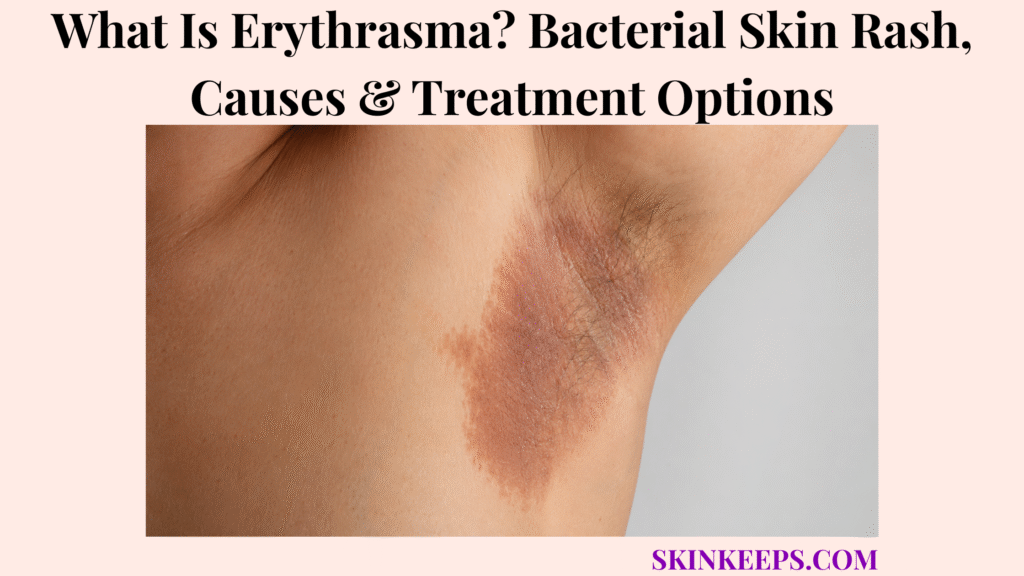
Erythrasma is a superficial bacterial skin infection that usually develops in warm, moist skin folds and causes well-defined brown, red-brown, pink-brown, tan-brown, or darker patches with fine scale.
It is caused by Corynebacterium minutissimum, not fungus by default. This page covers its appearance, common fold locations, moisture-related causes, risk factors, fungal and inflammatory mimics, Wood lamp findings, testing, treatment options, recurrence prevention, mistakes, and warning signs that need medical review.
Erythrasma as a Bacterial Skin-Fold Rash
Erythrasma is a superficial infection of the outer skin layer caused by Corynebacterium minutissimum, a bacterium that can overgrow where skin remains warm, damp, occluded, and rubbed.
The condition mainly affects intertriginous areas—places where skin touches skin—such as the groin, armpits, under the breasts, abdominal folds, buttock folds, and spaces between the toes.
Erythrasma is not the same as a deep bacterial infection such as cellulitis. It is often mild and chronic, but it can return when moisture, friction, toe-web dampness, diabetes, or another risk factor remains.
Because it resembles tinea, Candida, intertrigo, psoriasis, and contact dermatitis, the safest treatment begins with confirming the likely cause rather than repeatedly switching random creams.
Practical rule: A chronic brown-red fold rash is not automatically fungal. Check the pattern, consider Wood lamp examination, and use KOH testing when tinea or Candida remains possible.
What Erythrasma Looks and Feels Like on Skin
Erythrasma usually appears as a well-defined brown, reddish-brown, pink-brown, tan-brown, or darker patch with fine scale.
The surface may look dry, slightly wrinkled, or “cigarette-paper” thin. Symptoms are often mild: some people notice slight itching, burning, odor, or dampness, while others mainly notice discoloration.
Common Patch Features
Common features include a sharply outlined fold patch, fine scale, and mild itch or no itch.
- Brown, red-brown, pink-brown, tan-brown, or darker discoloration.
- Fine, dry scale rather than thick crust.
- Slow or chronic behavior rather than sudden rapid spread.
- Mild itch, irritation, or burning in some people.
- Possible dampness or odor where folds stay moist.
- Peeling, cracking, or maceration between the toes.
- One patch or several affected folds.
Signs That Suggest More Than Simple Erythrasma
Severe pain, rapid spread, fever, pus, open sores, red streaks, major swelling, blisters, or ulceration are not typical of uncomplicated erythrasma.
Those signs can indicate cellulitis, an abscess, another bacterial infection, severe intertrigo, or a different diagnosis that needs medical assessment.
| Feature | Erythrasma Clue | When to Be Cautious |
|---|---|---|
| Color | Brown, red-brown, pink-brown, tan-brown, or darker. | Black, bleeding, ulcerated, or rapidly changing area. |
| Surface | Fine scale or slightly wrinkled texture. | Thick crust, pus, open sores, or large blisters. |
| Sensation | Mild itch, mild burning, or no symptoms. | Severe pain, marked tenderness, or intense burning. |
| Spread | Slow, chronic fold rash. | Rapid spreading redness, warmth, swelling, or red streaks. |
| Location | Moist skin fold or toe web. | Deep fixed swelling or severe one-sided inflammation. |
| Response | Improves with appropriate antibacterial care. | No response, repeated recurrence, or steroid-related worsening. |
Skin Areas Where Erythrasma Commonly Appears
Erythrasma usually appears where skin stays warm, damp, occluded, and rubbed together.
Common sites include groin folds, inner thighs, armpits, under the breasts, abdominal folds, the buttock fold, genital-adjacent creases, and spaces between the toes. Toe-web disease may be missed because it can look like ordinary peeling or athlete’s foot.
More than one site can be involved, especially when sweating, diabetes, obesity, reduced mobility, or persistent moisture affects several folds.
| Site | Why Erythrasma Fits | Main Mimic |
|---|---|---|
| Groin | Heat, sweat, and repeated friction. | Tinea cruris or contact irritation. |
| Armpits | Moist, occluded fold. | Deodorant-related dermatitis or inverse psoriasis. |
| Under breasts | Skin-on-skin moisture. | Cutaneous candidiasis. |
| Between toes | Damp toe webs and occlusive footwear. | Athlete’s foot or mixed infection. |
| Abdominal fold | Trapped sweat and friction. | Intertrigo or Candida. |
| Inner thighs | Rubbing plus warmth. | Fungal rash or irritant dermatitis. |
| Buttock fold | Occlusion and moisture. | Intertrigo, Candida, or psoriasis. |
Why Erythrasma Develops in Warm Moist Folds
Erythrasma develops when Corynebacterium minutissimum overgrows in the outer skin layer under warm, moist, and occluded conditions.
How Corynebacterium Minutissimum Causes the Rash
Corynebacterium minutissimum can live on skin without causing symptoms, but moisture and friction make overgrowth more likely.
The bacteria remain mainly in the stratum corneum, the outermost skin layer. They produce porphyrins, including coproporphyrin III, which can create the characteristic coral-red or coral-pink Wood lamp glow.
Erythrasma can occur alone or coexist with dermatophyte fungus, Candida, or another fold disorder. That is why one treatment may fail when the rash is mixed.
Why Moisture, Heat, Friction, and Occlusion Matter
Dampness softens the skin surface, friction weakens the barrier, and occlusion traps heat and sweat.
Tight clothing, wet socks, poorly dried toe webs, occlusive footwear, deep folds, and humid weather can keep the environment favorable even after medicine clears the visible patch.
| Factor | What It Does | Care Implication |
|---|---|---|
| Moisture | Supports bacterial persistence. | Dry folds gently and completely. |
| Heat | Creates a favorable fold environment. | Use breathable clothing and cooling strategies. |
| Friction | Weakens the surface barrier. | Reduce rubbing and tight garments. |
| Occlusion | Traps sweat against skin. | Change damp clothing and rotate footwear. |
| Toe-web dampness | Maintains an overlooked reservoir. | Dry between toes and assess mixed infection. |
| Diabetes context | Can increase susceptibility and recurrence. | Review recurrent disease and glucose care. |
Risk Factors That Make Erythrasma More Likely
Erythrasma is more likely when folds remain damp, warm, occluded, or repeatedly irritated.
Risk factors do not prove the diagnosis, but they help explain recurrence and guide prevention.
- Heavy sweating or hyperhidrosis.
- Hot or humid climate.
- Diabetes or recurrent high-glucose concerns.
- Obesity or deep skin folds.
- Tight or non-breathable clothing.
- Poor drying after bathing.
- Occlusive shoes or damp socks.
- Persistent toe-web moisture.
- Older age or reduced mobility.
- Immune suppression.
- Repeated intertrigo or mixed bacterial-fungal infection.
A recurrent or widespread fold rash in someone with diabetes, immune suppression, poor circulation, or foot wounds deserves medical review rather than repeated self-treatment.
Conditions That Can Look Like Erythrasma
Erythrasma can resemble fungal rash, Candida, ordinary intertrigo, inverse psoriasis, product-related dermatitis, acanthosis nigricans, and cellulitis.
Erythrasma vs Fungal Rash
Tinea can affect the same warm folds and may cause scale, itching, or discoloration.
A more active scaly border can favor tinea, while erythrasma often has fine scale and brown-red discoloration. KOH microscopy can detect fungal elements when the visual pattern is not enough. Steroid-only cream can alter or worsen untreated fungal infection.
Erythrasma vs Candidal Intertrigo
Candidal intertrigo often looks wetter and brighter red and may have small satellite pustules outside the main rash.
Erythrasma is often drier, browner, and more finely scaly. The two can coexist, especially in moist folds, so mixed signs may require both bacterial and fungal assessment.
Erythrasma vs Inverse Psoriasis or Contact Dermatitis
Inverse psoriasis often creates smooth, shiny, sharply bordered fold plaques and may occur with psoriasis elsewhere or nail changes.
Allergic contact dermatitis or irritant dermatitis may follow deodorants, fragrances, wipes, fabrics, friction, or topical products and is often itchier. Neither diagnosis is confirmed by a coral-red bacterial fluorescence pattern.
Erythrasma vs Acanthosis Nigricans or Cellulitis
Acanthosis nigricans causes thicker, velvety darkening rather than a finely scaly infection.
Cellulitis is deeper, more acute, painful, warm, swollen, and spreading; fever or red streaks can occur. Those signs should not be managed as routine erythrasma.
| Condition | Main Clue | Why Confusion Happens | Safer Next Step |
|---|---|---|---|
| Erythrasma | Brown-red fold patch, fine scale, possible coral-red Wood lamp glow. | Looks fungal or inflammatory. | Wood lamp and KOH when unclear. |
| Tinea cruris / pedis | Active scaly edge or toe-web fungal pattern. | Same warm sites. | KOH or fungal culture. |
| Candida | Moist bright-red rash with possible satellite pustules. | Same skin folds. | Assess yeast or mixed infection. |
| Intertrigo | Friction and moisture irritation without one specific organism. | Same fold environment. | Reduce moisture and identify secondary infection. |
| Inverse psoriasis | Smooth shiny plaques; psoriasis clues elsewhere. | Sharp fold plaques. | Psoriasis-focused examination. |
| Contact dermatitis | Product or friction exposure, often marked itch. | Red or brown fold rash. | Exposure history and product avoidance. |
| Acanthosis nigricans | Velvety thickened fold skin. | Dark discoloration. | Metabolic and clinical review. |
| Cellulitis | Painful spreading warmth, swelling, fever. | Redness overlap. | Urgent medical evaluation. |
Diagnosis Through Exam, Wood Lamp, and Testing
Erythrasma is often suspected from its location, color, fine scale, chronicity, and mild symptoms, but Wood lamp examination and fungal testing can make the diagnosis safer.
Why Wood Lamp Examination Is Useful
A Wood lamp uses long-wave ultraviolet light and may make erythrasma fluoresce coral-red or coral-pink.
The glow comes from bacterial porphyrins, especially coproporphyrin III. Recent washing can remove water-soluble porphyrin from the surface and reduce the glow, so a negative result does not always end the evaluation when the clinical pattern remains suspicious.
Wood lamp examination is painless and helps distinguish the bacterial pattern from many fungal-looking or inflammatory fold rashes.
When KOH, Culture, or Other Tests May Be Needed
KOH scraping is useful when tinea, Candida, athlete’s foot, or mixed infection may be present.
- Fungal microscopy or culture when fungal signs remain uncertain.
- Bacterial culture when pus, secondary infection, or treatment failure changes the picture.
- Diabetes assessment when recurrence, widespread disease, or other risk signs fit.
- Biopsy only rarely, when the rash is atypical or resistant and another condition is suspected.
What to Prepare for an Appointment
- When the rash first appeared and whether it keeps returning.
- Which areas are affected: groin, armpits, under breasts, belly fold, buttock fold, or toe webs.
- Itch, burning, pain, odor, dampness, cracking, peeling, pus, or open sores.
- Recent sweating, heat exposure, tight clothing, wet socks, or occlusive shoes.
- Diabetes history, high-glucose concerns, immune suppression, or repeated infections.
- History of athlete’s foot, toenail fungus, Candida, or intertrigo.
- Products already used, including deodorants, powders, antifungals, steroids, or antibiotics.
- Whether steroid cream made the rash worse or changed its appearance.
- Any prior Wood lamp, KOH, culture, or dermatologist diagnosis.
Treatment Options for Erythrasma
Erythrasma treatment usually combines appropriate antibacterial medicine with fold care that reduces moisture and recurrence.
The exact product, duration, and need for prescription treatment depend on location, extent, previous treatments, pregnancy, allergies, drug interactions, and certainty of diagnosis.
Topical Treatment for Localized Erythrasma
Localized erythrasma is often treated with a topical antibacterial option after the diagnosis is reasonably clear.
Options used in clinical care include topical erythromycin, clindamycin, mupirocin, fusidic acid where available, and benzoyl peroxide washes or gels in selected cases. A clinician or product label should guide the exact application plan.
Leftover antibiotics or repeated topical antibiotics should not be used blindly because a fungal, inflammatory, or mixed rash may require a different plan.
Oral Treatment for Extensive or Recurrent Erythrasma
Extensive, recurrent, or difficult disease may require clinician-directed oral treatment.
Oral macrolides such as erythromycin or clarithromycin may be considered, but pregnancy, allergies, liver disease, heart-rhythm risk, and medication interactions must be reviewed. The page does not provide antibiotic dosing.
When Antifungal Treatment Is Needed
Antifungal treatment is not the main treatment for pure erythrasma.
It may be needed when tinea, Candida, athlete’s foot, or a mixed bacterial-fungal infection is confirmed or strongly suspected. KOH testing helps prevent repeated antifungal use when the bacterial pattern is more likely.
| Situation | Treatment Direction | Key Caution |
|---|---|---|
| Localized erythrasma | Topical antibacterial care. | Confirm diagnosis when appearance is unclear. |
| Toe-web erythrasma | Topical antibacterial plus careful drying. | Rule out athlete’s foot and mixed infection. |
| Extensive disease | Oral treatment may be considered. | Clinician-directed only. |
| Recurrent disease | Retreat plus moisture and risk-factor control. | Review diabetes, toe webs, and diagnosis. |
| Fungal or Candida signs | Add cause-specific antifungal care when supported. | Avoid guessing from location alone. |
| Painful spreading rash | Evaluate for cellulitis or another complication. | Not routine erythrasma self-care. |
Skin-Fold Care That Helps Prevent Recurrence
Erythrasma can return when sweat, friction, damp toe webs, or occlusive clothing recreate the same environment after treatment.
- Dry skin folds gently after bathing.
- Dry carefully between every toe.
- Wear breathable, loose clothing.
- Change sweaty clothing promptly.
- Rotate shoes and allow footwear to dry.
- Use clean moisture-wicking socks.
- Reduce rubbing in deep folds.
- Manage excessive sweating when relevant.
- Support diabetes care when applicable.
- Avoid harsh scrubbing and irritating fragranced products.
- Treat coexisting athlete’s foot or Candida when confirmed.
Prevention rule: Medicine treats the current bacterial patch; drying, friction reduction, toe-web care, and risk-factor control reduce the conditions that allow it to return.
Recurrence and Treatment Failure Patterns
Erythrasma may recur because bacteria remain in damp folds, risk factors continue, treatment was incomplete, or the original rash was fungal, inflammatory, or mixed.
Common reasons include persistent sweating, damp toe webs, tight footwear, deep-fold friction, diabetes context, reinfection from wet clothing or shoes, and repeated steroid or antifungal treatment without confirmation.
When the rash returns quickly or never fully clears, the next step should be diagnostic reassessment—not simply another round of the same cream.
- Recheck all affected folds and toe webs.
- Review Wood lamp findings or repeat the examination when appropriate.
- Use KOH or fungal culture if tinea or Candida remains possible.
- Review adherence, moisture control, and product irritation.
- Assess diabetes, immune suppression, poor circulation, and foot wounds when relevant.
Erythrasma Treatment Mistakes to Avoid
The biggest erythrasma mistake is treating every fold rash as fungus without checking whether the pattern is bacterial, fungal, inflammatory, or mixed.
| Mistake | Why It Fails | Better Action |
|---|---|---|
| Assuming every groin rash is fungal | Erythrasma is bacterial and other mimics exist. | Use fold pattern, Wood lamp, and KOH when needed. |
| Steroid-only treatment | Can mask or worsen infection. | Clarify the cause first. |
| Switching random creams | Delays diagnosis and irritates folds. | Use one diagnosis-led plan. |
| Not drying folds or toe webs | Maintains the recurrence environment. | Build a daily drying routine. |
| Taking oral antibiotics without guidance | Creates side-effect and interaction risks. | Use clinician-directed oral treatment only. |
| Ignoring pain, pus, fever, or spreading warmth | May miss cellulitis or another complication. | Seek prompt medical review. |
Do not over-scrub, bleach, peel, or apply multiple fragranced powders to irritated folds. Do not ignore diabetes, recurrent foot cracking, or repeated toe-web infection.
When a Skin-Fold Rash Needs Medical Review
A skin-fold rash should be checked when it is recurrent, rapidly spreading, painful, draining, cracked, ulcerated, treatment-resistant, or linked with fever, diabetes, immune suppression, pregnancy, poor circulation, or foot wounds.
Rash Signs That Need Evaluation
- Rapid spread or marked worsening.
- Severe pain or tenderness.
- Pus, drainage, open sores, or ulceration.
- Fever, red streaks, major warmth, or swelling.
- Bad odor with severe maceration.
- Cracking or bleeding between the toes.
- No improvement after appropriate treatment.
- Frequent recurrence in the groin, armpits, under breasts, abdominal folds, or toe webs.
- Worsening after steroid cream.
Patient Contexts That Need Extra Caution
Diabetes, immune suppression, poor circulation, recurrent infection, pregnancy, older age with reduced mobility, and foot wounds make a fold rash more important to assess.
Genital-adjacent pain, ulcers, discharge, open sores, or uncertain diagnosis also need clinical evaluation rather than repeated over-the-counter treatment.
Seek urgent care for fever with rapidly spreading redness, severe pain, red streaks, major swelling, open sores, pus, a diabetic foot wound, or signs suggesting cellulitis rather than a superficial fold rash.
Key Takeaways About Erythrasma
Erythrasma is a superficial bacterial rash of skin folds, so safe care depends on confirming the bacterial pattern, treating the actual cause, and reducing the moisture and friction that support recurrence.
- Erythrasma is caused by Corynebacterium minutissimum.
- It commonly affects the groin, armpits, under breasts, abdominal folds, buttock folds, and toe webs.
- Patches may look brown, red-brown, pink-brown, tan-brown, or darker with fine scale.
- A Wood lamp may show coral-red or coral-pink fluorescence.
- Tinea, Candida, intertrigo, psoriasis, dermatitis, and acanthosis nigricans are important mimics.
- Localized disease often uses topical antibacterial treatment.
- Extensive or recurrent disease may need clinician-directed oral treatment.
- Prevention focuses on drying folds, reducing friction, rotating footwear, and addressing sweating or diabetes context.
- Pain, pus, fever, spreading redness, ulcers, cracks, or treatment failure need medical review.
Frequently Asked Questions About Erythrasma
Is erythrasma fungal or bacterial?
Erythrasma is bacterial and is caused by Corynebacterium minutissimum. It can resemble a fungal rash and may coexist with tinea or Candida, so Wood lamp examination and fungal testing can be useful when the pattern is unclear.
What does erythrasma look like?
It usually looks like a well-defined brown, red-brown, pink-brown, tan-brown, or darker patch with fine scale in a warm skin fold such as the groin, armpit, under a breast, abdominal fold, buttock fold, or between the toes.
Why does erythrasma glow under a Wood lamp?
Corynebacterium minutissimum produces porphyrins, including coproporphyrin III, that can create a coral-red or coral-pink glow under Wood lamp examination. Recent washing may reduce the fluorescence.
What causes erythrasma?
Erythrasma develops when Corynebacterium minutissimum overgrows in warm, moist, occluded, or repeatedly rubbed skin folds. Sweating, humid weather, diabetes, obesity, tight clothing, damp toe webs, older age, and immune suppression can increase risk.
How is erythrasma diagnosed?
Diagnosis is based on the fold-rash pattern and clinical examination. A Wood lamp may show coral-red or coral-pink fluorescence, while KOH microscopy or fungal culture can help rule out tinea, Candida, athlete’s foot, or mixed infection.
What is the best treatment for erythrasma?
Treatment depends on the extent and certainty of diagnosis. Localized disease is often treated with topical antibacterial medicine and moisture control. Extensive or recurrent disease may need clinician-directed oral treatment, while antifungal treatment is used only when fungus is present or strongly suspected.
Can erythrasma come back?
Yes. Recurrence is more likely when folds stay damp, toe webs remain moist, sweating and friction continue, diabetes or another risk factor is not addressed, treatment is incomplete, or the rash is actually mixed with a fungal infection.
When should a skin-fold rash be checked?
Medical review is needed for a recurrent, rapidly spreading, painful, draining, cracked, bleeding, ulcerated, fever-associated, steroid-worsened, or treatment-resistant fold rash, especially with diabetes, immune suppression, pregnancy, poor circulation, foot wounds, or genital-adjacent sores.
Sources & Evidence About Erythrasma
DermNet — Erythrasma: Cause, common skin-fold sites, clinical appearance, coinfection, coral-pink Wood lamp fluorescence from coproporphyrin III, and treatment overview. View source.
StatPearls / NCBI Bookshelf — Erythrasma: Updated overview of bacterial cause, risk factors, intertriginous presentation, Wood lamp and KOH evaluation, topical antimicrobials, oral macrolide boundary, recurrence, and prevention. View source.
MSD Manual Professional — Erythrasma: Intertriginous pattern, diabetes and warm-climate risk, differential diagnosis, coral-red fluorescence, topical treatment for localized disease, and oral therapy for extensive disease. View source.
MSD Manual Consumer — Erythrasma: Patient-friendly fold and toe-web presentation, Wood lamp confirmation, topical antibacterial options, oral-treatment context, and recurrence. View source.
DermNet — Wood Lamp Skin Examination: Wood lamp method, fluorescence principles, and coral-pink erythrasma findings. View source.
Erythrasma Revisited — PMC: Review of diagnosis, differential diagnoses, porphyrin-related fluorescence, and treatment options. View source.
Medical disclaimer: This SkinKeeps article is for educational purposes only and does not diagnose or replace medical care. A recurrent, spreading, painful, draining, pus-filled, cracked, bleeding, open, ulcerated, fever-associated, red-streaked, swollen, bad-smelling, genital-adjacent, diabetic, immune-suppression-associated, pregnancy-associated, poor-circulation-associated, foot-wound-associated, steroid-worsened, treatment-resistant, or uncertain skin-fold rash should be checked by a qualified healthcare professional. Seek urgent care for fever, rapidly spreading redness, severe pain, red streaks, open sores, pus, significant swelling, diabetic foot wounds, or signs of cellulitis. Do not self-diagnose from photos, use steroid-only cream on an undiagnosed infection, repeatedly switch random creams, or take oral antibiotics without medical guidance.