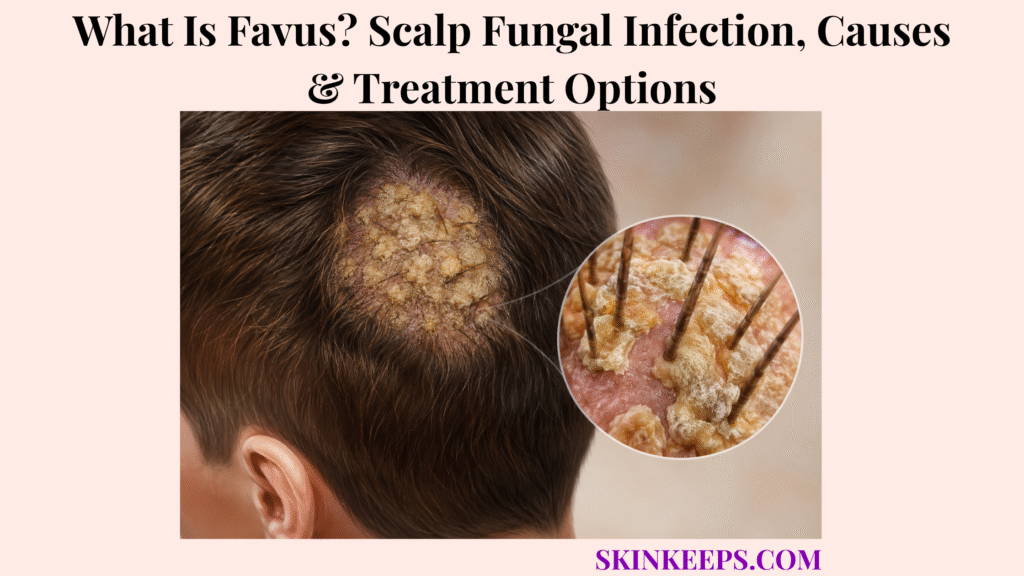
Favus is a chronic fungal infection of the scalp and hair that can form yellow cup-shaped crusts around hairs and cause patchy hair loss. Also called tinea favosa, favus capitis, or tinea capitis favosa, it is most often associated with Trichophyton schoenleinii.
This page covers scutula, scalp and hair changes, progression, causes, spread, diagnosis, oral treatment, shampoo support, reinfection prevention, hair regrowth, common mistakes, and warning signs. Favus is not ordinary dandruff, and delayed care can result in permanent scarring alopecia.
How Does Favus Damage the Scalp and Hair?
Favus is a chronic dermatophyte infection that involves scalp skin and hair shafts, often forming yellow crusts and causing patchy hair loss.
The fungus grows around follicles and within affected hair structures. The infection may begin with mild redness and scale, then form characteristic scutula. As crusts thicken and inflammation persists, hairs can become brittle, matted, loose, or absent.
Favus is more serious than an ordinary flaky scalp because chronic inflammation can atrophy the scalp and destroy follicles. Once a follicle has been replaced by scar tissue, hair regrowth may be limited or impossible.
Core care logic: yellow crusts plus hair loss should lead to fungal sampling and oral treatment—not repeated dandruff products or shampoo-only care.
Figure 1. Favus can move from hair-shaft infection and scutula formation to permanent scarring hair loss. Fungal confirmation and oral treatment should occur before chronic inflammation destroys follicles.
What Scalp Signs Suggest Favus?
The classic favus sign is a yellow cup-shaped crust called a scutulum, with multiple crusts often joining into honeycomb-like plaques around hairs.
What Are Scutula?
Scutula are yellow, saucer-shaped or cup-shaped crusts that commonly surround individual hair shafts.
A hair may pass through the centre of a crust. Closely grouped scutula can form a honeycomb pattern. Under a dense plaque, the scalp may appear red, moist, inflamed, or swollen, and secondary bacterial infection can complicate the picture.
What Other Symptoms Can Appear?
Favus can cause scalp scale, crusting, patchy hair loss, brittle or matted hair, follicular redness, odour, itch, discomfort, scalp thinning, and scarring.
The smell is sometimes described as mousy. Not every case has every feature, and atypical forms may resemble dandruff, seborrheic dermatitis, psoriasis, or bacterial crusting. Appearance should raise suspicion but should not replace fungal testing.
| Scalp Feature | Favus Clue | Why It Matters |
|---|---|---|
| Yellow cup crusts | Scutula around hairs. | Classic pattern. |
| Honeycomb plaques | Grouped scutula. | Strong diagnostic clue. |
| Hair through crust centre | Hair-shaft involvement. | Explains need for oral treatment. |
| Mousy odour | Chronic crusted infection clue. | Supports pattern recognition. |
| Patchy hair loss | Hair and follicle damage. | Scarring risk. |
| Red moist base, pus, or swelling | Inflammation or secondary infection. | Needs medical review. |
How Does Favus Progress if It Is Not Treated?
Untreated favus can progress from inflammation around follicles to scutula, expanding plaques, hair shedding, scalp atrophy, and scarring alopecia.
Early disease may show redness and scale while many hairs remain intact. Yellow scutula then become more obvious, and hairs may loosen or break. In advanced disease, larger scalp areas can become thin, shiny, scarred, and permanently bald.
The course can be prolonged when favus is mistaken for dandruff or another scalp condition. Prompt diagnosis cannot reverse established scar tissue, but it can stop active fungal damage and protect follicles that remain.
| Stage | Typical Change | Main Risk |
|---|---|---|
| Early | Follicular redness and scale. | Diagnosis may be missed. |
| Scutular | Yellow cups form around hairs. | Hair-shaft involvement increases. |
| Plaque | Crusts join and hair becomes brittle or loose. | Secondary infection and wider loss. |
| Late | Scalp atrophy and shiny bald areas. | Permanent scarring alopecia. |
Where Can Favus Appear Besides the Scalp?
Favus most often affects the scalp and hair, while nail, beard, or body-skin involvement is uncommon.
Rare nail disease may resemble fungal nail infection, beard involvement follows a separate tinea barbae pathway, and body lesions can resemble ordinary ringworm. These unusual sites should be evaluated rather than assumed to be scalp favus spreading in the same way.
| Site | Favus Relevance | Main Note |
|---|---|---|
| Scalp | Classic and dominant site. | Scutula and scarring risk. |
| Hair shafts | Central involvement. | Oral treatment is usually required. |
| Nails | Rare. | Separate confirmation and treatment plan. |
| Beard area | Rare. | Consider tinea barbae and bacterial mimics. |
| Body skin | Rare. | Differentiate from ordinary tinea corporis. |
What Causes Favus and How Does It Spread?
Favus is caused by dermatophyte fungi that infect scalp skin and hair, most commonly Trichophyton schoenleinii.
Why Does Trichophyton Schoenleinii Matter?
Trichophyton schoenleinii is the classic organism linked with favus and is adapted to long-term infection of human scalp hair.
The organism can persist when diagnosis is delayed, medication is not completed, or close contacts remain untreated. Culture can help identify the fungus and guide treatment decisions in atypical or resistant cases.
How Can Favus Spread Between People?
Favus can spread through close household contact and shared hair items such as combs, brushes, hats, head coverings, towels, pillowcases, and styling tools.
Several people in a household or school cluster may be affected, and some contacts may have subtle scale rather than classic crusts. Reinfection becomes more likely when the treated person continues sharing contaminated items or when a carrier is missed.
| Spread Route | Example | Prevention Focus |
|---|---|---|
| Close contact | Household or school cluster. | Check symptomatic contacts. |
| Hair tools | Combs, brushes, clips, clippers. | Clean, replace, or avoid sharing. |
| Headwear | Hats and head coverings. | Do not share during evaluation and treatment. |
| Fabrics | Towels, pillowcases, bedding. | Wash appropriately. |
| Carrier pathway | Subtle scale or few symptoms. | Clinician-led contact assessment. |
Who Is More Likely to Get Favus?
Favus can affect children and adults, but infection is often acquired in childhood and may persist when diagnosis or treatment is delayed.
Risk context includes a household case, shared hair items, crowded living conditions, school or family clusters, residence or travel in an endemic setting, and limited access to fungal testing or oral treatment. Adults may present with long-standing disease acquired earlier in life.
- Child or adolescent with chronic scalp crusting.
- Patchy hair loss with yellow or honeycomb-like crusts.
- Household member with scalp scale or hair loss.
- Shared combs, brushes, hats, head coverings, towels, or pillowcases.
- Crowded or close-contact living conditions.
- School or family cluster.
- Residence or travel in an endemic setting.
- Repeated failure of dandruff or shampoo-only treatment.
How Is Favus Different From Other Scalp Conditions?
Favus can resemble dandruff, seborrheic dermatitis, psoriasis, impetigo, kerion, alopecia areata, discoid lupus, and other causes of scarring hair loss.
How Is Favus Different From Dandruff or Seborrheic Dermatitis?
Dandruff usually causes loose flakes, and seborrheic dermatitis often causes greasy scale, while favus forms cup-shaped scutula around hairs and can scar.
Crusted or scaly dermatitis or eczema may look inflamed, but scutula, fungal sampling, hair-shaft damage, and progressive scarring point elsewhere. A dandruff-like favus variant makes testing especially important when hair loss accompanies scale.
How Is Favus Different From Scalp Psoriasis?
Scalp psoriasis often forms thick plaques and may occur with nail changes or plaques elsewhere, while favus is a fungal hair-shaft infection.
A psoriasiform favus pattern can resemble psoriasis. Yellow scutula, odour, hair loss, and positive microscopy or culture support favus, while steroid-only treatment of an unconfirmed fungal eruption can delay care.
How Is Favus Different From Impetigo?
Impetigo causes honey-coloured bacterial crusting, while favus forms fungal scutula around hair shafts and tends to cause chronic hair loss.
Favus can imitate impetigo, and secondary bacterial infection can coexist. Treating bacterial crusting without checking the underlying hair-shaft fungus can leave favus active.
How Is Favus Different From Kerion?
Kerion is a highly inflamed, boggy tinea-capitis reaction, while classic favus forms yellow scutula and honeycomb crusts.
Both need oral antifungal care. A painful abscess-like scalp swelling should not be managed like ordinary boils or blindly drained before fungal scalp disease is considered.
How Is Favus Different From Alopecia Areata or Scarring Disorders?
Alopecia areata usually creates smooth non-scaly patches, while favus causes scale, crusts, odour, and fungal scalp signs.
Smooth patches fit alopecia areata better than classic favus. Scarring diseases such as discoid lupus erythematosus can also destroy follicles, so biopsy or additional testing may be needed when fungal studies are negative or the pattern is atypical.
| Condition | Main Clue | Why Confusion Happens | Safer Next Step |
|---|---|---|---|
| Favus | Scutula, odour, hair loss. | Chronic scale and crust. | KOH/microscopy and culture. |
| Dandruff | Loose flakes without scarring. | Scale overlap. | Check crusts and hair loss. |
| Seborrheic dermatitis | Greasy diffuse scale. | Favus can look pityroid. | Test if hair loss or crusts persist. |
| Psoriasis | Thick plaques and other body/nail signs. | Psoriasiform favus exists. | Examination and mycology. |
| Impetigo | Honey-coloured bacterial crust. | Crusting overlap. | Assess fungus and bacteria. |
| Kerion | Boggy inflamed mass. | Severe tinea overlap. | Oral antifungal; avoid blind drainage. |
| Alopecia areata | Smooth non-scaly patch. | Hair-loss overlap. | Look for scale or scutula. |
How Is Favus Diagnosed?
Favus should be confirmed with fungal testing, usually microscopy or KOH examination and culture from scalp scale, crust material, and hairs pulled from the roots.
What Samples Are Taken?
Testing may use scale scraped from an active edge, material from a scutulum, and affected hairs removed with their roots.
Sampling before a prolonged antifungal course can improve interpretation. If the first sample is negative but clinical suspicion remains high, a clinician may repeat sampling or use another technique.
Why Are Microscopy and Culture Important?
Microscopy can show fungal elements, while culture can confirm growth and help identify the organism.
These tests reduce the chance of months of treatment for dandruff, psoriasis, bacterial crusting, or alopecia when the true problem is a hair-shaft fungus. Culture results may take time, so treatment decisions also consider the clinical pattern and safety risk.
Can Wood Lamp Examination Help?
Wood lamp examination may support the evaluation of selected scalp fungal infections, but it cannot rule favus in or out by itself.
Fluorescence varies by organism and infection pattern. A negative Wood lamp result should not override strong clinical suspicion; microscopy and culture remain the confirmation pathway.
Figure 2. Scalp appearance raises suspicion, but scale, crust, and root-hair samples provide the evidence needed to separate favus from dandruff, psoriasis, bacterial crusting, and other hair-loss disorders.
- When scalp crusting first appeared.
- Whether crusts are yellow, cup-shaped, or honeycomb-like.
- Whether hairs pass through the centre of crusts.
- Patchy hair loss, broken hair, brittleness, or matting.
- Odour, itch, pain, swelling, pus, drainage, or fever.
- Previous dandruff, psoriasis, bacterial, or antifungal treatments.
- Household members with scalp scale or hair loss.
- Shared hair tools, headwear, towels, or pillowcases.
- Travel, residence, or contact in an endemic setting.
- Pregnancy, liver disease, immune suppression, diabetes, allergies, or interacting medicines.
- Previous KOH, microscopy, fungal culture, Wood lamp, or oral antifungal treatment.
What Treatment Options Clear Favus?
Favus usually requires clinician-directed oral antifungal medicine because the fungus infects scalp hair shafts, where creams and shampoos alone cannot reach reliably.
Why Is Oral Antifungal Treatment Needed?
Oral treatment reaches infected hair roots and shafts, while topical products mainly act on the surface.
The prescribed course should be completed as directed even when crusting improves early. Stopping too soon can leave viable fungus and increase the chance of recurrence or continued household spread.
Which Oral Antifungals May Be Used?
Possible clinician-selected treatments include griseofulvin, terbinafine, itraconazole, or fluconazole.
The choice depends on the organism, age, local availability, pregnancy status, liver health, allergies, interactions, and prior response. Oral antifungals should not be started from leftover medicine or borrowed prescriptions, and this page does not provide dosing.
What Role Do Shampoos and Gentle Crust Care Play?
Antifungal shampoos and gentle scalp cleaning can reduce spores, loosen debris, and support oral treatment, but they do not replace it.
Ketoconazole or selenium-sulfide shampoo may be prescribed as an adjunct. Thick crusts should be softened and removed gently according to clinical guidance rather than scraped, picked, or torn from inflamed scalp.
When Is Specialist Care Needed?
Dermatology or specialist care is especially important for extensive disease, severe child hair loss, scarring, treatment failure, recurrent infection, secondary bacterial infection, pregnancy, liver disease, immune suppression, or major interaction risk.
| Favus Situation | Treatment Direction | Key Caution |
|---|---|---|
| Classic scalp favus | Clinician-directed oral antifungal. | Topical-only care is inadequate. |
| Thick scutula | Gentle cleaning plus oral treatment. | Avoid traumatic picking. |
| Household spread | Contact review and targeted treatment. | Prevent reinfection. |
| Extensive or resistant disease | Dermatology-led plan and repeat testing. | Recheck organism and adherence. |
| Secondary infection | Assess and treat bacterial complication. | Do not miss underlying fungus. |
| Scarring hair loss | Early specialist care. | Hair may not fully regrow. |
How Can Favus Spread and Reinfection Be Prevented?
Prevention focuses on completing oral treatment, reducing fungal spores, checking close contacts, and stopping exchange through shared hair items.
Do not share combs, brushes, hats, scarves, head coverings, towels, pillowcases, clippers, or styling tools while infection is being evaluated or treated. Items should be cleaned, disinfected, washed, or replaced as appropriate.
Household members with scale, crusting, or hair loss should be assessed. In a family or school cluster, clinicians or public-health teams may recommend broader contact management. Prescribed shampoo can reduce spores but does not replace treatment of confirmed infection.
Figure 3. Clearing scalp infection requires oral treatment, while shampoo, contact review, and shared-item control reduce spores and reinfection.
- Do not share combs, brushes, hats, or head coverings.
- Clean, disinfect, or replace hair tools as directed.
- Wash towels, pillowcases, bedding, and headwear appropriately.
- Check household members with scalp scale or hair loss.
- Report school or family clusters to the treating clinician.
- Use adjunct antifungal shampoo if prescribed.
- Complete the full oral antifungal course.
- Attend follow-up or repeat testing when recommended.
Can Hair Grow Back After Favus?
Hair regrowth depends on how early favus is treated and whether inflammation has already scarred the follicles.
When infection is controlled before permanent follicle destruction, shedding may stop and some hair can regrow. Long-standing shiny, atrophic, or scarred areas may have permanent alopecia because the follicles are no longer present.
Treatment should not be judged only by immediate hair regrowth. The first goals are to eliminate active fungus, stop spread, heal inflammation, and protect the remaining follicles.
| Hair Outcome | What It Suggests | Expectation |
|---|---|---|
| Broken or shedding hair with limited scarring | Active infection may still be reversible. | Regrowth may occur after clearance. |
| Reduced inflammation after treatment | Fungal activity is settling. | Hair recovery takes time. |
| Shiny atrophic bald patch | Established follicular scarring. | Full regrowth may not occur. |
| Continued loss during treatment | Persistent fungus, inflammation, or another diagnosis. | Prompt reassessment. |
What Favus Mistakes Should You Avoid?
The largest favus mistake is treating chronic crusted scalp disease as dandruff, psoriasis, or impetigo without fungal testing.
| Mistake | Why It Is Risky | Better Action |
|---|---|---|
| Relying on shampoo alone | Hair-shaft infection persists. | Use prescribed oral treatment. |
| Assuming it is dandruff | Diagnosis and treatment are delayed. | Obtain fungal testing. |
| Harsh crust scraping | Creates wounds and secondary infection. | Use gentle guided cleaning. |
| Stopping oral medicine early | Fungus may remain active. | Complete the prescribed course. |
| Using steroid-only treatment | Can mask fungal disease. | Confirm diagnosis first. |
| Ignoring close contacts | Reinfection and spread continue. | Check household or cluster cases. |
| Draining a boggy scalp swelling blindly | Kerion or fungal disease may be missed. | Seek scalp evaluation. |
| Ignoring hair loss or shiny patches | Scarring can become permanent. | Arrange early specialist care. |
Children with scalp crusts and hair loss should not cycle through repeated over-the-counter products without assessment. The same applies when a rash worsens, spreads to contacts, or returns after apparently correct treatment.
When Should a Scalp Fungal Infection Be Checked by a Doctor?
A scalp fungal infection should be checked when there are yellow crusts, patchy hair loss, scarring signs, painful swelling, pus, fever, household spread, or failure to improve with treatment.
Which Scalp Signs Need Medical Review?
Yellow cup-shaped crusts, honeycomb plaques, broken or brittle hair, thick scale, odour, patchy hair loss, a red moist base, pus, drainage, swelling, or shiny bald areas need evaluation.
Fever, rapidly spreading redness, severe scalp pain, and boggy swelling raise concern for severe inflammation or secondary bacterial infection and may require urgent care.
Which Patient Contexts Need Extra Caution?
Children, pregnancy, liver disease, immune suppression, diabetes, extensive disease, household clusters, treatment failure, and medication-interaction risk need extra caution before oral treatment.
A clinician should review current prescriptions, supplements, allergies, prior antifungal use, and relevant blood or liver history before selecting treatment.
Seek urgent care for fever, painful scalp swelling, pus, spreading redness, severe pain, rapidly worsening infection, or signs of a serious secondary bacterial complication.
- Yellow cup-shaped crusts or honeycomb plaques.
- Patchy hair loss or broken, brittle hair.
- Thick scaling, chronic crusting, or mousy odour.
- Painful or swollen scalp.
- Pus, drainage, fever, red moist areas, or spreading redness.
- Shiny bald patches or scarring signs.
- Child scalp involvement.
- Household or school spread.
- Failure to improve with dandruff or antifungal shampoo.
- Pregnancy, liver disease, immune suppression, diabetes, or interacting medicines.
What Should You Remember About Favus?
Favus is a chronic scalp fungal infection, so the safest approach is early recognition, fungal confirmation, oral antifungal treatment, and prevention of household spread.
- Favus is also called tinea favosa, favus capitis, or tinea capitis favosa.
- Trichophyton schoenleinii is the classic cause.
- Yellow cup-shaped scutula around hairs are the key clue.
- Grouped crusts can create honeycomb-like plaques.
- Odour, brittle hair, patchy hair loss, and scalp scarring may occur.
- Favus can mimic dandruff, psoriasis, impetigo, and other scalp disorders.
- Diagnosis should use microscopy or KOH examination and fungal culture.
- Oral antifungal medicine is the main treatment; shampoo is adjunct support.
- Household contacts and shared hair items affect reinfection risk.
- Untreated favus can cause permanent scarring alopecia.
What Questions Do People Ask About Favus?
Is favus the same as scalp ringworm?
Favus is usually a severe chronic form of tinea capitis, also called scalp ringworm. It is commonly associated with Trichophyton schoenleinii and has the distinctive scutula pattern.
What do favus crusts look like?
Classic favus crusts are yellow, cup-shaped scutula that form around hair shafts. Multiple scutula may join into honeycomb-like plaques, sometimes with a characteristic odour and patchy hair loss.
Is favus contagious?
Favus can spread through close contact and shared combs, brushes, hats, head coverings, towels, pillowcases, or hair tools. Household clusters can occur even though favus is not usually described as highly contagious.
How is favus diagnosed?
Diagnosis should be confirmed with microscopy or KOH examination and fungal culture using scalp scale, crust material, and hairs pulled from the roots. Wood lamp examination may support selected cases but is not enough by itself.
Can favus be treated with shampoo only?
No. Shampoo may reduce spores and support scalp hygiene, but hair-shaft infection usually requires clinician-directed oral antifungal medicine. Shampoo does not reliably reach the base of infected hairs.
Which medicines treat favus?
Clinicians may use oral antifungals such as griseofulvin, terbinafine, itraconazole, or fluconazole. The choice depends on the organism, age, pregnancy, liver health, interactions, availability, and other safety factors.
Can favus cause permanent hair loss?
Yes. Long-standing favus can scar and destroy follicles, causing scarring alopecia. Hair may not fully return in shiny or scarred areas, which is why early diagnosis and treatment matter.
When should scalp crusts and hair loss be checked urgently?
Prompt care is needed for painful swelling, pus, drainage, fever, rapidly worsening redness, severe scalp pain, shiny bald patches, scarring signs, child scalp disease, household spread, or failure to improve with prior treatment.
Sources & Evidence
DermNet — Favus — Favus names, Trichophyton schoenleinii, scutula, progression, oral treatment, shampoo support, spread, and scarring risk.
DermNet — Tinea Capitis — Scalp fungal signs, microscopy and culture, differential diagnosis, oral-treatment principle, and shampoo support.
DermNet CME — Tinea Capitis — Hair and scalp sampling, oral treatment because topical agents do not reach the hair root, and measures that reduce infectivity.
DermNet — Laboratory Tests for Fungal Infection — Skin, hair, and nail sampling for microscopy and culture, plus the supportive role and limitations of Wood lamp examination.
American Academy of Dermatology — Ringworm Diagnosis and Treatment — Scalp ringworm diagnosis, prescription oral medicine, antifungal shampoo, and spread reduction.
Mayo Clinic — Scalp Ringworm Diagnosis and Treatment — Hair or skin sampling, prescription oral antifungal treatment, and shampoo used to reduce spores and spread.
This SkinKeeps article is for educational purposes only and does not diagnose or replace medical care. Yellow cup-shaped scalp crusts, honeycomb-like plaques, patchy hair loss, broken hairs, brittle hair, thick scalp scale, mousy odour, painful scalp swelling, pus, drainage, fever, red moist scalp areas, shiny bald patches, scarring signs, child scalp involvement, household spread, recurrent scalp fungus, pregnancy-related treatment concerns, liver disease, immune suppression, diabetes, medication-interaction risk, or scalp symptoms that fail dandruff or antifungal shampoo treatment should be checked by a qualified healthcare professional. Seek urgent care for fever, painful swelling, pus, spreading redness, severe scalp pain, rapidly worsening scalp infection, or signs of secondary bacterial infection. Do not self-diagnose favus from photos, rely on shampoo alone, scrape crusts harshly, drain scalp swelling, use steroid cream on an undiagnosed fungal scalp rash, stop oral antifungal treatment early, share combs or hats during suspected infection, or delay care when scalp crusting is linked with hair loss.