
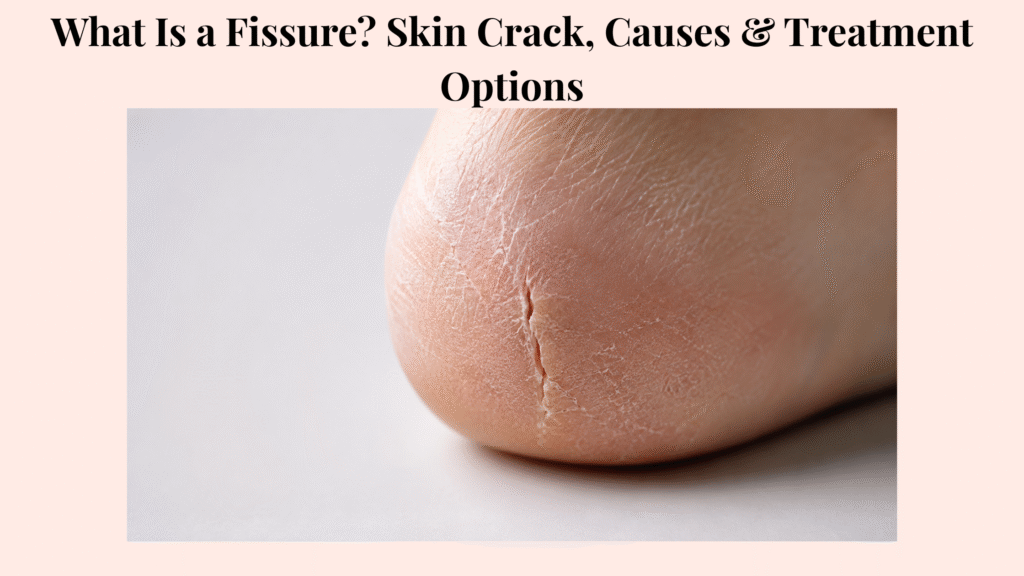
A skin fissure is a crack or split in the skin that forms when the outer barrier becomes too dry, thick, inflamed, stretched, softened by moisture, or damaged. The crack may be shallow or deep, painful, stinging, and sometimes bleeding.
A fissure is a lesion type rather than one disease. This page covers appearance, locations, causes, risk factors, mimics, diagnosis, treatment, prevention, recurrence, mistakes, and warning signs. Deep, infected-looking, bleeding, diabetic-foot-related, or non-healing fissures need medical review.
How Does a Skin Fissure Form?
A skin fissure forms when the outer barrier loses flexibility and splits under movement, pressure, friction, stretching, washing, or moisture damage.
Dry or thick skin can become rigid, while inflamed skin can become fragile. Skin that stays wet may soften and separate, especially between toes or inside folds. The result is a narrow line-shaped break that can extend from the surface into deeper tissue.
Fissure describes the shape of the lesion, not its cause. The same crack pattern can result from dryness, eczema, callus pressure, fungus, psoriasis, contact irritation, or poor healing.
Core care logic: identify the location and driver, protect the split, reduce movement or pressure, restore the barrier, and treat fungus, inflammation, infection, or foot-risk factors when present.
Figure 1. A fissure forms when vulnerable skin cannot flex under pressure, friction, washing, or movement. Healing requires both crack protection and treatment of the driver.
What Does a Skin Fissure Look and Feel Like?
A skin fissure usually looks like a narrow split, line-shaped crack, or groove that may sting, burn, hurt, bleed, or reopen with movement.
Which Appearance Clues Are Typical?
Typical clues include dry or thick edges, a red, pink, brown, purple, or darker base, and pain when the surrounding skin stretches.
The crack may reopen after handwashing, gripping, bending a knuckle, walking, or standing. Surrounding skin may show scale, callus, redness, maceration, or an eczema plaque that explains why the surface split.
Which Symptoms Suggest a Deeper Problem?
Severe pain, deep bleeding, pus, warmth, swelling, spreading redness, red streaks, fever, bad smell, numbness, or failure to heal suggests a more serious problem.
An open crack can become an entry point for bacteria. A high-risk foot crack may be more dangerous than it looks when diabetes or neuropathy reduces pain sensation.
| Feature | Fissure Clue | When to Be Cautious |
|---|---|---|
| Shape | Narrow line-like split. | Wide open sore, deep tissue loss, or ulcer. |
| Sensation | Stinging, burning, or pain with movement. | Severe or increasing pain, or numbness around a wound. |
| Edges | Dry, thick, callused, inflamed, or softened. | Pus, warmth, swelling, or foul smell. |
| Depth | Shallow to deep crack. | Exposed tissue or repeated bleeding. |
| Course | Reopens with pressure or bending. | No healing despite protection and cause treatment. |
| Context | Heel, fingertip, hand, toe web, lip, or fold. | Diabetes, poor circulation, or immune suppression. |
Where Do Skin Fissures Usually Appear?
Skin fissures commonly appear where skin dries out, bends, rubs, stays moist, or carries pressure, including heels, soles, fingertips, palms, knuckles, toe webs, lips, mouth corners, folds, and nail edges.
Heel cracks are usually linked with dry thick rim skin and pressure. Fingertip and knuckle cracks often follow frequent washing, cold weather, irritants, or eczema. Toe-web fissures are more likely to involve moisture, maceration, or fungus.
Cracks at the corners of the mouth may fit angular cheilitis, while cracks inside folds may involve friction, sweat, inflammation, or infection. Nipple or nail-edge fissures belong to their own clinical context and should be assessed when persistent.
| Site | Why Fissures Happen There | Main Cause to Consider |
|---|---|---|
| Heels and soles | Pressure acts on dry thick skin. | Callus, xerosis, footwear, or loading. |
| Fingertips and palms | Washing, friction, chemicals, and cold. | Hand eczema or irritant dermatitis. |
| Knuckles | Repeated bending plus dryness. | Dermatitis or cold exposure. |
| Between toes | Moisture, sweat, and skin softening. | Athlete’s foot or mixed infection. |
| Lips and mouth corners | Dryness, saliva, stretching, and irritation. | Cheilitis or angular cheilitis. |
| Skin folds | Friction and retained moisture. | Intertrigo, eczema, or infection. |
| Around nails and cuticles | Wet work, picking, and irritants. | Dermatitis or nail-fold inflammation. |
What Causes Skin Fissures?
Skin fissures develop when dryness, inflammation, pressure, fungus, moisture imbalance, or repeated irritation weakens the barrier enough for the surface to split.
How Does Dry Skin Cause Fissures?
Very dry skin or xerosis loses flexibility and can crack when stretched, rubbed, washed, or loaded.
Cold weather, low humidity, hot water, harsh cleansers, sanitiser, and frequent washing remove water and lipids from the barrier. Thick cream or ointment helps reduce water loss, but recurrent cracking still requires a cause review.
How Do Eczema and Dermatitis Cause Fissures?
Dermatitis or eczema inflames and weakens the barrier, allowing deep painful cracks to develop.
Hand fissures may follow wet work, detergents, solvents, frequent washing, gloves that trap sweat, or allergic contact. Moisturiser alone may not control an active inflammatory flare.
How Do Callus and Pressure Cause Heel Fissures?
Thick corns and calluses can become rigid and split when heel pressure pushes the skin outward.
Long periods of standing, barefoot walking, open-back footwear, friction, and poor load distribution can worsen the crack. Pressure reduction and safe callus care are therefore part of treatment.
How Can Fungal Infection Cause Fissures?
Athlete’s foot can cause peeling, scale, itching, burning, and fissures between toes or along the sole.
Toe-web cracks should not automatically be labelled fungal, but steroid-only treatment can mask or worsen tinea when fungus is present. A clinical examination or KOH scraping may help when the pattern is uncertain.
How Can Psoriasis and Other Conditions Contribute?
Psoriasis can produce thick plaques that split at palms, soles, heels, or other high-movement sites.
Diabetes, poor circulation, neuropathy, immune suppression, older age, and some cancer treatments may reduce healing or make dry thick skin more vulnerable. Mixed causes are common—for example, callus pressure plus fungus or eczema plus wet work.
| Cause Pathway | What Happens | Treatment Implication |
|---|---|---|
| Dry skin or xerosis | Skin loses water and flexibility. | Thick moisturiser plus protection. |
| Eczema or dermatitis | Inflamed barrier splits. | Barrier care plus inflammation control. |
| Callus and pressure | Rigid skin separates under load. | Soften safely and reduce pressure. |
| Athlete’s foot | Fungus damages toe or sole skin. | Antifungal treatment and moisture control. |
| Psoriasis | Thick plaques crack under movement. | Psoriasis-directed care. |
| Irritants and wet work | Repeated exposure strips the barrier. | Gloves, routine changes, and skin protection. |
| Diabetes or poor circulation | Sensation or healing may be impaired. | Prompt foot-risk review. |
Who Is More Likely to Develop Skin Fissures?
Skin fissures are more likely when skin is very dry, inflamed, thickened, repeatedly washed, exposed to chemicals, under pressure, infected, or slow to heal.
Risk rises with hand eczema, frequent sanitiser use, cleaning or healthcare work, cold dry weather, heel callus, prolonged standing, open-back shoes, barefoot walking, athlete’s foot, psoriasis, diabetes, poor circulation, neuropathy, older age, and immune suppression.
A person with numb feet may not feel an enlarging crack. Daily inspection and regular foot assessment are therefore important when diabetes or neuropathy is present.
- Very dry or thickened skin.
- Eczema, dermatitis, or psoriasis.
- Frequent handwashing, sanitiser, detergents, chemicals, or wet work.
- Cold weather or low humidity.
- Heel callus, prolonged standing, or heavy pressure.
- Open-back shoes or barefoot walking.
- Athlete’s foot or chronic toe-web moisture.
- Diabetes, poor circulation, or numb feet.
- Older age, immune suppression, or cancer-treatment-related skin changes.
- Recurrent cracks or previous foot wounds.
How Is a Fissure Different From a Cut, Ulcer, or Rash?
A fissure is a crack created by splitting skin, while a cut, ulcer, infection, and inflammatory rash have different primary causes and may need different treatment.
How Is a Fissure Different From a Cut?
A cut usually follows outside trauma from a sharp edge, while a fissure often opens because dry, thick, inflamed, softened, or pressure-loaded skin separates.
Both can bleed and require protection. Recurrent cracks in the same site point toward an ongoing barrier, pressure, moisture, or inflammatory problem rather than repeated accidental trauma.
How Is a Fissure Different From an Ulcer?
An ulcer is a broader area of tissue loss, while a fissure is usually narrow and line-shaped.
A deep fissure can progress into an open wound, especially on a foot with poor circulation or neuropathy. A non-healing foot lesion should not be managed as a routine dry crack.
How Is a Fissure Different From Athlete’s Foot?
Athlete’s foot is a fungal infection that may create fissures; the crack is one feature of the infection rather than the full diagnosis.
Itching, peeling, scaling, burning, moisture between toes, and recurrence in enclosed footwear support fungal involvement. Testing may be needed because eczema and maceration can look similar.
How Is a Fissure Different From Cellulitis?
A fissure is the break in the barrier, while cellulitis is a spreading bacterial infection in deeper skin.
Warmth, expanding redness, swelling, tenderness, fever, or red streaks extending away from a crack are warning signs and need prompt medical review.
How Is an External Skin Fissure Different From an Anal Fissure?
An external skin fissure affects ordinary skin, while an anal fissure is a tear in the lining of the anal canal.
The word is shared, but the causes, examination, and treatment differ. This page remains focused on external skin cracks.
| Problem | Main Clue | Why Confusion Happens | Safer Next Step |
|---|---|---|---|
| Skin fissure | Narrow split in vulnerable skin. | Can resemble a cut. | Protect and treat the driver. |
| Cut | Clear external injury. | Both may bleed. | Clean, protect, and assess depth. |
| Ulcer | Broader open sore or tissue loss. | Deep fissures can progress. | Medical wound review. |
| Athlete’s foot | Itchy peeling toe-web or sole rash. | Fungus can cause cracks. | Consider antifungal diagnosis. |
| Eczema crack | Inflamed itchy dry surrounding skin. | Fissures form during flares. | Treat dermatitis and barrier. |
| Cellulitis | Spreading warm painful redness. | A crack can be the entry site. | Prompt medical care. |
| Anal fissure | Painful tear inside the anal canal. | Same terminology. | Separate anorectal evaluation. |
How Are Skin Fissures Diagnosed?
Skin fissures are usually diagnosed by examining the crack, its location, depth, surrounding skin, trigger pattern, and healing risk.
What Does a Clinician Check?
A clinician checks dryness, callus, scale, redness, swelling, maceration, bleeding, depth, pain, and whether walking or hand use keeps the crack open.
The history may include wet work, cleansers, sanitiser, chemicals, weather, footwear, standing, barefoot walking, eczema, psoriasis, athlete’s foot, diabetes, circulation problems, numbness, infection, and prior treatment.
Which Tests May Be Needed?
Tests are not required for every fissure, but selected testing can clarify fungus, bacterial infection, allergy, diabetes risk, or an unusual persistent lesion.
Possible tests include KOH microscopy for suspected fungus, bacterial culture when pus or infection is present, patch testing for allergic contact dermatitis, blood-glucose or diabetes review, circulation and sensation checks, and podiatry assessment for a painful or high-risk foot.
Biopsy is uncommon but may be considered when a recurrent fissure sits within an unexplained plaque, does not respond to appropriate treatment, or has features suggesting another skin disorder.
Figure 2. Fissure evaluation is cause-led. Location and surrounding skin guide the workup, while infection, diabetes, circulation, and sensation determine urgency.
- When the crack appeared and whether it keeps reopening.
- Exact site: heel, sole, fingertip, palm, knuckle, toe web, lip, mouth corner, fold, or nail edge.
- Pain, stinging, burning, bleeding, or reduced function.
- Surrounding dryness, callus, scale, itch, redness, swelling, peeling, or maceration.
- Cold weather, hot water, frequent washing, sanitiser, detergents, chemicals, or wet work.
- Footwear, prolonged standing, barefoot walking, friction, or pressure.
- Athlete’s-foot symptoms or recurrent fungal infection.
- Eczema, psoriasis, allergy, or contact-dermatitis history.
- Diabetes, poor circulation, numbness, immune suppression, or slow healing.
- Pus, warmth, spreading redness, fever, red streaks, or bad smell.
- Moisturiser, steroid, antifungal, antibiotic, peroxide, alcohol, acid, or dressing already tried.
What Treatment Options Help Skin Fissures Heal?
Skin fissure treatment combines barrier repair, crack protection, pressure or friction reduction, and therapy for the underlying cause.
How Are Mild Dry Fissures Treated?
Mild dry fissures are usually managed with a thick fragrance-free cream or ointment, protection from movement, and avoidance of products that keep stripping the barrier.
Ointment can be applied after bathing or handwashing while skin is slightly damp. A suitable plaster, bandage, hydrocolloid dressing, or other protective covering may reduce friction and reopening, provided the crack is clean and not showing infection.
How Are Cracked Heels Treated?
Cracked heels need softening of dry thick skin, gentle callus care, pressure reduction, and protection of the split.
A short warm soak, gentle use of a clean foot file or scrubber on intact thick skin, heavy moisturiser or petrolatum, socks, and better-fitting closed-back footwear may help. Deep callus should not be cut at home, and painful or resistant fissures may need podiatry.
How Are Eczema-Related Fissures Treated?
Eczema-related fissures require both frequent barrier care and control of inflammation.
Reducing wet work, using protective gloves correctly, avoiding allergens and irritants, and treating itch can stop reopening. A clinician may prescribe a topical corticosteroid or nonsteroid anti-inflammatory treatment based on site and severity.
How Are Fungal Fissures Treated?
Fungal fissures need antifungal treatment and moisture control, especially when toe-web cracks occur with peeling, itch, burning, or scale.
Treatment may use a topical antifungal, while extensive or resistant disease may require a clinician-directed oral option. Toe webs should be dried carefully, socks changed, and footwear allowed to dry. Steroid-only treatment should be avoided when tinea has not been excluded.
How Are Infected or High-Risk Fissures Treated?
Pus, spreading redness, warmth, swelling, fever, red streaks, or worsening pain requires medical assessment.
Antibiotics are used only when bacterial infection is present or strongly suspected. A culture may guide therapy. People with diabetes, poor circulation, numb feet, or immune suppression need earlier review and structured wound care.
| Fissure Situation | Treatment Direction | Key Caution |
|---|---|---|
| Mild dry crack | Thick ointment, protection, and irritant reduction. | Do not over-wash or pick. |
| Heel fissure | Heel balm, gentle callus care, and pressure reduction. | Do not cut callus at home. |
| Hand eczema crack | Barrier care, gloves, and anti-inflammatory treatment. | Moisturiser alone may be insufficient. |
| Toe-web crack | Assess for fungus and control moisture. | Avoid steroid-only treatment before evaluation. |
| Infected crack | Medical review, possible culture and antibiotics. | Watch for cellulitis or systemic illness. |
| Diabetes-related foot crack | Prompt foot-care assessment. | Reduced sensation may hide severity. |
| Non-healing crack | Reassess diagnosis, circulation, pressure, and mixed causes. | Do not keep repeating the same home treatment. |
How Can Skin Fissures Be Prevented From Returning?
Preventing fissures means keeping the barrier flexible, reducing irritants, controlling moisture, and lowering pressure or friction at vulnerable sites.
Use thick cream or ointment after washing and before bed, choose a gentle fragrance-free cleanser, limit hot water, and wear task-appropriate gloves for cleaning, healthcare work, hairdressing, food preparation, or chemical exposure.
Dry carefully between toes, choose breathable socks and well-fitting footwear, avoid barefoot walking when heels are cracked, and manage callus without blades. Treat eczema, psoriasis, and athlete’s foot early.
People with diabetes should inspect both feet daily, including soles and toe webs, and obtain regular foot checks. Lotion is generally used on dry tops and bottoms of feet rather than between moist toe spaces.
- Moisturise daily with a thick cream or ointment.
- Apply after washing and before bed.
- Use a gentle fragrance-free cleanser.
- Limit hot water and harsh soap.
- Wear protective gloves for wet work, detergents, or chemicals.
- Dry carefully between toes after bathing.
- Wear breathable socks and properly fitting shoes.
- Reduce heel pressure and avoid barefoot walking with painful cracks.
- Manage callus gently and seek podiatry for thick or high-risk callus.
- Treat eczema, psoriasis, and athlete’s foot early.
- Inspect feet daily when diabetes or neuropathy is present.
Why Do Skin Fissures Keep Reopening?
Fissures keep reopening when the surface closes but the underlying dryness, inflammation, pressure, fungus, irritation, or poor healing remains.
Common reasons include infrequent moisturising, ongoing sanitiser or detergent exposure, wet work, thick callus, continued heel loading, untreated athlete’s foot, uncontrolled eczema, psoriasis plaques, repeated picking, and footwear that keeps rubbing the site.
Diabetes, poor circulation, neuropathy, and immune suppression can slow closure. A mixed cause or incorrect diagnosis should be considered when reasonable care repeatedly fails.
Figure 3. A crack may close temporarily yet reopen when callus pressure, wet work, eczema, fungus, dryness, or poor healing remains untreated.
Which Skin Fissure Mistakes Should You Avoid?
The main fissure mistake is treating every crack as ordinary dryness while missing eczema, fungus, infection, pressure damage, or a high-risk foot.
| Mistake | Why It Is Risky | Better Action |
|---|---|---|
| Assuming dryness is the only cause | Eczema, fungus, pressure, or poor healing may be missed. | Check the location and surrounding skin. |
| Cutting heel callus | Bleeding, infection, and deeper injury. | Use gentle care or podiatry. |
| Using steroid alone on a toe-web crack | Tinea may worsen or become masked. | Assess for fungus. |
| Harsh scrubbing | Creates more barrier damage. | Use gentle softening and protection. |
| Repeated alcohol, peroxide, or strong acid | Irritates healing tissue. | Use appropriate wound and barrier care. |
| Walking barefoot on a painful heel crack | Adds pressure and contamination. | Protect the heel and use supportive footwear. |
| Ignoring a diabetes-related foot crack | Neuropathy and poor flow increase risk. | Arrange prompt foot assessment. |
| Sealing a pus-filled or spreading wound | May delay infection care. | Seek medical review. |
Do not keep using a product that burns or worsens the crack. Do not assume a lack of pain means a diabetic or numb foot wound is safe.
When Should a Skin Crack Be Checked by a Doctor?
A skin crack should be checked when it is deep, bleeding, severely painful, infected-looking, recurrent, non-healing, function-limiting, or located on a high-risk foot.
Which Fissure Signs Need Medical Review?
Medical review is needed for pus, increasing redness, warmth, swelling, red streaks, fever, bad smell, exposed tissue, hard-to-stop bleeding, severe pain, or failure to improve.
A crack between toes with persistent peeling or itch needs assessment for fungus. A heel or hand crack that prevents walking, gripping, work, or sleep also deserves review.
Which People Need Extra Caution?
Diabetes, poor circulation, numb feet, immune suppression, older age, previous ulcers, previous amputation, or cancer-treatment-related skin changes lower the threshold for care.
A foot crack in a person who cannot feel heat, cold, pressure, or pain should be checked promptly, even when it looks small. Regular foot examination can identify circulation, sensation, callus, footwear, and wound risks.
Seek urgent care for rapidly spreading redness, fever, red streaks, pus, severe or escalating pain, rapidly worsening swelling, a deep diabetic-foot wound, or a crack associated with systemic illness.
- Deep or widening crack.
- Bleeding that is heavy, repeated, or hard to stop.
- Pus, warmth, swelling, or increasing redness.
- Red streaks, fever, or bad smell.
- Severe pain or an open sore.
- Crack that repeatedly reopens or does not heal.
- Toe-web crack with persistent peeling, itch, or burning.
- Crack that prevents walking, gripping, work, or sleep.
- Diabetes, poor circulation, numbness, or neuropathy.
- Immune suppression, cancer treatment, older age, or previous foot wound.
- Concern for an ulcer or spreading infection.
What Should You Remember About Skin Fissures?
A skin fissure is a crack in the skin, so safe treatment depends on why the skin split and whether infection or poor healing risk is present.
- Fissure means a split or crack in the skin.
- It is a lesion pattern, not one single disease.
- Common sites include heels, soles, fingertips, hands, toe webs, lips, mouth corners, folds, and nail edges.
- Dryness, eczema, callus pressure, athlete’s foot, psoriasis, irritants, diabetes, and poor circulation can contribute.
- Mild dry fissures often benefit from thick moisturiser, ointment, protection, and reduced irritation.
- Heel fissures need pressure and callus management as well as moisturising.
- Toe-web fissures may require fungal assessment and antifungal treatment.
- Eczema-related fissures may need anti-inflammatory care.
- Diabetes-related foot cracks require extra caution and regular inspection.
- Deep, bleeding, infected, severely painful, recurrent, or non-healing fissures need medical review.
What Questions Do People Ask About Skin Fissures?
Is a fissure the same as a skin crack?
Yes. In dermatology, a fissure is a split or crack in the skin and may appear as a narrow erosion or ulceration. It describes a lesion pattern rather than one single disease.
What causes skin fissures?
Common causes include very dry skin, eczema, irritants, frequent washing, cold weather, callus pressure, athlete’s foot, psoriasis, friction, diabetes, poor circulation, and skin that repeatedly bends or remains wet.
Why do cracked heels happen?
Heel skin can become dry, thick, and rigid. Pressure during standing or walking then pushes the heel outward and splits the thick rim, especially when callus, barefoot walking, or open-back footwear adds stress.
Can eczema cause fissures?
Yes. Eczema weakens and inflames the skin barrier. Hand eczema can produce deep painful cracks that bleed, so treatment may require trigger control and anti-inflammatory care as well as moisturiser.
Can athlete’s foot cause cracks between toes?
Yes. Athlete’s foot can cause itchy, peeling, scaly, burning, or cracked skin between the toes. A toe-web fissure is not always fungal, so examination or a skin scraping may be useful when the cause is unclear.
What treatment is used for a skin fissure?
Treatment depends on cause and location. Dry cracks need thick moisturiser or ointment and protection; eczema cracks may need anti-inflammatory treatment; fungal cracks need antifungal care; heel fissures need pressure and callus management; infected or high-risk foot cracks need medical review.
Should I cover a skin fissure?
Covering can protect selected clean fissures from friction, dirt, and reopening. A pus-filled, spreading, worsening, or diabetes-related foot wound should be checked before it is sealed or managed only at home.
When is a skin fissure serious?
A deep, bleeding, severely painful, pus-filled, warm, swollen, spreading, bad-smelling, red-streaked, fever-associated, recurrent, or non-healing crack is concerning. Diabetes, poor circulation, numbness, immune suppression, or impaired walking or hand use lowers the threshold for medical care.
Which Sources Support This Skin Fissure Guidance?
DermNet — Terminology in Dermatology — Definition of a fissure as a split, crack, erosion, or narrow ulceration of skin.
American Academy of Dermatology — Tips for Relieving Dry Skin — Dry skin can crack and bleed; gentle cleansing and cream or ointment moisturisers support barrier recovery.
American Academy of Dermatology — Hand Eczema — Hand eczema can cause deep painful cracks, bleeding, weeping, crusting, pus, and pain.
American Academy of Dermatology — Atopic Dermatitis Treatment — Moisturising helps prevent cracks and fissures that may worsen rash, itching, or infection.
Mayo Clinic — How to Heal Cracked Heels — Cracked heels are fissures; thick moisturisers, gentle dead-skin care, protection, and review when self-care fails.
Mayo Clinic — Athlete’s Foot Symptoms and Causes — Athlete’s foot can cause peeling, scaling, burning, stinging, and cracked skin between toes.
Mayo Clinic — Athlete’s Foot Diagnosis and Treatment — Skin sampling when needed, antifungal treatment, toe-web drying, socks, and footwear measures.
CDC — Your Feet and Diabetes — Diabetes-related nerve damage and poor blood flow can make wounds easier to miss, more likely to become infected, and harder to heal.
This SkinKeeps article is for educational purposes only and does not diagnose or replace medical care. A deep, bleeding, pus-filled, warm, swollen, spreading, red-streaked, fever-associated, bad-smelling, severely painful, open, recurrent, non-healing, toe-web-related, diabetic-foot-related, poor-circulation-related, numb-foot-related, immune-suppression-related, cancer-treatment-related, or work-limiting skin crack should be checked by a qualified healthcare professional. Seek urgent care for spreading redness, fever, red streaks, pus, severe pain, rapidly worsening swelling, foot wounds in diabetes, poor circulation, numb feet with wounds, or cracks that do not heal. Do not self-diagnose serious fissures from photos, cut deep callus at home, use steroid-only cream on possible athlete’s foot, repeatedly apply alcohol, peroxide, or harsh acids to open cracks, seal infected cracks without medical advice, or delay assessment of diabetes-related foot cracks.