Erythema multiforme is an immune-mediated skin reaction that causes target-like lesions and can sometimes involve the lips, mouth, eyes, or genital skin.
Often shortened to EM, it may follow herpes simplex infection, another infection, or a medicine exposure. This page covers appearance, locations, EM minor and major, triggers, diagnosis, treatment options, recurrence, mucosal care, common mistakes, and urgent warning signs.
What Is Erythema Multiforme?
Erythema multiforme is an immune-mediated mucocutaneous reaction that creates fixed target-like or iris-shaped lesions on the skin.
The condition is usually a reaction to a trigger rather than a contagious infection in the rash itself. Many episodes improve, but mouth, eye, genital, painful, blistering, peeling, or dehydrating disease changes the safety picture.
Why Is It Called “Multiforme”?
The word “erythema” refers to redness or inflammation, while “multiforme” means that the eruption can appear in several forms.
Lesions may begin as spots or raised bumps and then develop rings, blisters, crusts, or classic target patterns. The true target lesion remains the strongest visual clue.
Why Is EM a Reaction Pattern Rather Than a Skin Infection?
EM is usually the immune system’s response to an infection, medicine, or another trigger rather than an infection growing inside each target lesion.
The rash itself is not usually contagious. A trigger such as herpes simplex virus may still be transmissible depending on the infection stage and contact involved.
Practical rule: A target-like rash should not be labelled mild EM until the mouth, eyes, genital skin, hydration, skin pain, blistering, peeling, and medicine timeline have been checked.
What Does an Erythema Multiforme Rash Look Like?
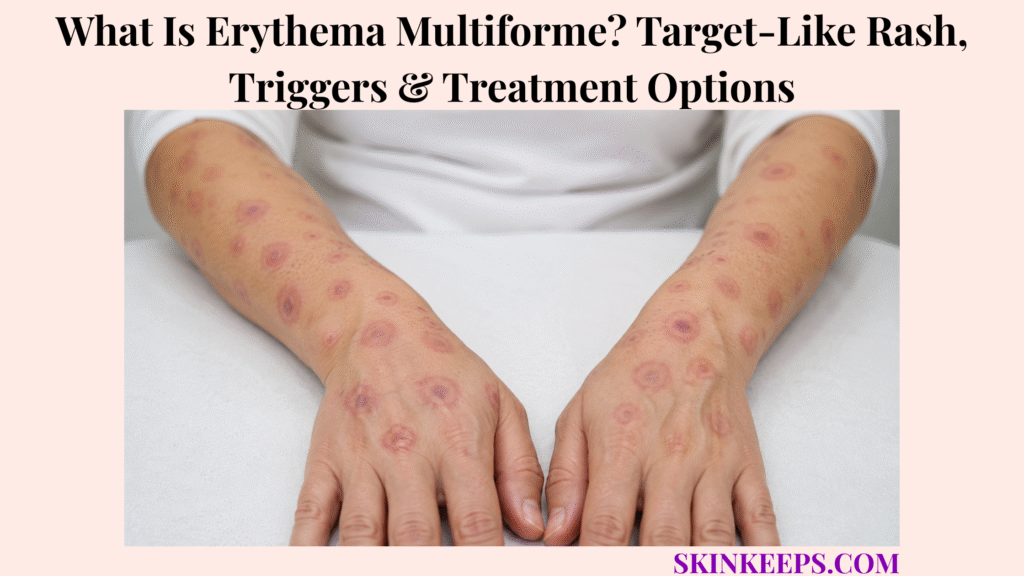
Erythema multiforme often causes round, fixed target-like spots with rings of different color, sometimes called iris or bull’s-eye lesions.
The lesions usually stay in the same location for days. This fixed behavior helps separate them from hives, which commonly move or fade more quickly.
What Is a Target Lesion?
A true target lesion has different color zones, often including a darker or dusky center, a paler middle ring, and an outer inflammatory rim.
The center may blister, crust, or look darker. The outer ring may look red, pink, purple, brown, gray-brown, or darker depending on skin tone and inflammation.
How Can EM Look on Darker Skin?
On darker skin, EM may look purple, brown, gray-brown, or dusky rather than bright red.
Target rings may be subtle, so the fixed pattern, darker center, distribution, tenderness, blisters, and mucosal symptoms can be more useful than redness alone.
What Symptoms Can Come With EM Lesions?
EM lesions may itch, burn, swell, feel tender, blister, crust, or become painful, especially when lips or mucous membranes are involved.
Mouth erosions can make eating or drinking difficult. Eye irritation, genital soreness, fever, malaise, cough, or other illness symptoms may reflect severity or the underlying trigger.
| Feature | Typical EM Clue | Why It Matters |
|---|---|---|
| Shape | Round or target-like lesion. | Classic pattern clue. |
| Center | Dusky, blistered, or crusted. | Helps separate EM from moving wheals. |
| Rings | Two or three color zones. | Creates the target appearance. |
| Duration | Stays fixed for days. | Hives usually change faster. |
| Symptoms | Itch, burning, tenderness, or pain. | Guides symptom care. |
| Mucosa | Mouth, eye, or genital erosions. | Changes urgency and severity. |
Where Does Erythema Multiforme Usually Appear?
Erythema multiforme commonly appears on the backs of the hands, palms, soles, feet, arms, legs, elbows, knees, face, lips, and mouth, often in a fairly symmetric pattern.
The extremities are especially important. Eye or genital involvement is less common but requires prompt assessment because mucosal injury can cause serious complications.
| Body Site | EM Pattern Clue | Safety Note |
|---|---|---|
| Hands / palms | Fixed target lesions on acral skin. | Compare with hives, HFMD, and drug eruption. |
| Feet / soles | Target lesions or tender spots. | Check viral and medicine history. |
| Arms / legs | Symmetric target lesions. | Common EM distribution. |
| Face / lips | Targetoid lesions or lip crusting. | Check HSV and severe-reaction signs. |
| Mouth | Painful erosions or blisters. | Hydration risk. |
| Eyes / genital skin | Mucosal irritation or erosions. | Prompt medical review. |
What Is the Difference Between Erythema Multiforme Minor and Major?
Erythema multiforme minor mainly affects the skin, while erythema multiforme major includes significant mucosal involvement.
The distinction is practical, not cosmetic. Mouth, lip, eye, or genital disease can increase pain, dehydration risk, and the need for specialist or hospital care.
| Category | Main Pattern | Care Concern |
|---|---|---|
| EM minor | Target lesions with little or no mucosal disease. | Supportive care and monitoring may be enough. |
| EM major | Target lesions plus painful mucosal erosions. | Hydration, mouth, eye, or genital care. |
| Severe mimic | Skin pain, widespread blisters, peeling, major illness. | Urgent SJS/TEN or severe drug-reaction evaluation. |
What Triggers Erythema Multiforme?
Erythema multiforme is most often triggered by infection, especially herpes simplex virus, although respiratory infections, medicines, and other triggers can be involved.
Trigger review matters because recurrence prevention and treatment depend on what happened before the rash, not the target pattern alone.
How Does Herpes Simplex Virus Trigger EM?
Herpes simplex virus can trigger EM after a cold sore or genital herpes flare, even when the herpes lesion is small, healed, or not obvious.
HSV-1 is the leading infectious trigger, while HSV-2 can also be involved. Repeated EM episodes should prompt an HSV-focused history and testing plan.
How Does Mycoplasma Pneumoniae Fit?
Mycoplasma pneumoniae and other respiratory infections can produce EM or EM-like mucocutaneous illness, especially when rash follows cough, fever, sore throat, or pneumonia-like symptoms.
The respiratory illness needs its own assessment. Mouth-predominant disease in children or young people may fall into a related infection-driven mucocutaneous pattern rather than classic HSV-associated EM.
Can Medications Trigger EM?
Medicines can trigger EM less often than infections, but a precise medication timeline is essential because a drug rash or severe cutaneous reaction can look targetoid.
New prescriptions, dose changes, over-the-counter medicines, and supplements should be recorded. Essential medicine should not be stopped casually; severe symptoms require urgent medical guidance.
| Trigger Category | Examples | Care Implication |
|---|---|---|
| HSV | Cold sores or genital herpes. | HSV evaluation; recurrence prevention if needed. |
| Respiratory infection | Mycoplasma or pneumonia-like illness. | Assess cough, fever, and breathing symptoms. |
| Other infections | Selected viral or bacterial illnesses. | History-guided testing and treatment. |
| Medication | New drug, dose change, or supplement. | Severity screen and prescriber review. |
| Unknown | No clear trigger found. | Supportive care and follow-up. |
| Recurrent EM | Repeated target-lesion episodes. | Prioritize HSV-focused evaluation. |
How Is Erythema Multiforme Different From Other Target-Like or Ring-Like Rashes?
Erythema multiforme can resemble hives, common drug eruptions, SJS/TEN, hand-foot-mouth disease, Lyme erythema migrans, fixed drug eruption, vasculitis, lupus, ringworm, or blistering disorders.
The decisive questions are whether lesions stay fixed, whether there are true target zones, where the rash appears, what happened before it, and whether mucosal or systemic red flags are present.
How Is EM Different From Hives?
Hives usually form raised itchy wheals that move or fade within a day, while EM target lesions tend to remain fixed for days.
Facial, tongue, or throat swelling may represent angioedema and needs urgent care when breathing or swallowing is affected.
How Is EM Different From Stevens-Johnson Syndrome?
EM is distinct from SJS/TEN, but painful widespread blistering, skin peeling, fever, and major mouth, eye, or genital disease should be treated as urgent warning signs.
Classic EM has fixed target lesions, often on the extremities. SJS/TEN more often causes widespread painful dusky patches, blisters, skin detachment, and severe mucosal injury, commonly in a medicine-reaction context.
How Is EM Different From a Common Drug Rash?
A common medication eruption is often a widespread maculopapular rash, while EM has fixed target-like lesions.
Fever, facial swelling, organ symptoms, skin pain, blisters, peeling, or mucosal erosions require evaluation for a severe drug reaction rather than reassurance based on shape.
How Is EM Different From Lyme Erythema Migrans?
Lyme erythema migrans is usually an expanding patch linked with tick exposure, while EM often causes several fixed target lesions on hands, feet, or limbs.
A Lyme rash does not always form a perfect bull’s-eye. Tick exposure, travel, fever, headache, fatigue, joint symptoms, or neurologic symptoms require medical evaluation.
How Is EM Different From Hand-Foot-Mouth Disease?
Hand-foot-mouth disease often affects children and causes fever, mouth sores, and hand or foot lesions, creating overlap with mucosal EM.
Outbreak exposure, vesicle pattern, age, and viral symptoms help. Any child who cannot drink normally or shows dehydration needs prompt care.
Which Other Conditions Can Look Target-Like?
Fixed drug eruption can return in the same location after a medicine, vasculitis can produce palpable purple lesions, and autoimmune blistering disorders such as bullous pemphigoid can produce tense blisters.
Some forms of dermatitis or eczema can also form round inflamed plaques, but they do not usually create classic fixed three-zone targets.
| Condition | Main Clue | Why Confusion Happens | Safer Next Step |
|---|---|---|---|
| EM | Fixed target lesions, often acral. | Bull’s-eye appearance. | Trigger and mucosal review. |
| Hives | Moving wheals that fade quickly. | Ring-like itchy lesions. | Urticaria and airway assessment. |
| SJS/TEN | Skin pain, blisters, peeling, major mucosa. | Targetoid lesions can overlap. | Emergency care. |
| Drug rash | Medicine timing and widespread eruption. | Inflammatory rash overlap. | Severe-reaction screen. |
| Lyme erythema migrans | Tick exposure and expanding patch. | Bull’s-eye wording. | Medical evaluation. |
| Hand-foot-mouth disease | Child, viral illness, mouth/hand/foot lesions. | Same body sites. | Hydration and pediatric review. |
| Fixed drug eruption | Same spot recurs after a drug. | Dusky target-like patch. | Medication review. |
| Vasculitis | Palpable purple lesions or systemic symptoms. | Targetoid or purpuric appearance. | Labs or biopsy if suspected. |
How Is Erythema Multiforme Diagnosed?
Erythema multiforme is usually diagnosed by examining the target-lesion pattern, checking mucosal involvement, and reviewing recent infections, HSV history, respiratory symptoms, medicines, and recurrence.
Diagnosis is not based on one online image. A clinician must separate ordinary EM from hives, infection-associated mucocutaneous disease, fixed drug eruption, autoimmune disease, and severe medication reactions.
What Does a Clinician Check?
A clinician checks whether lesions have true target zones, remain fixed, appear symmetrically on extremities, and involve the mouth, eyes, lips, or genital skin.
The history should include itch, pain, fever, cold sores, genital herpes, cough, pneumonia symptoms, new medicines, supplements, prior EM episodes, and the ability to drink normally.
What Tests May Be Used?
Tests may be used when EM is recurrent, severe, atypical, trigger-linked, or difficult to distinguish from a dangerous mimic.
Options may include HSV PCR or lesion swab, respiratory or Mycoplasma testing when symptoms fit, blood tests for systemic illness or dehydration, medicine review, and urgent eye examination for ocular symptoms.
When Is Biopsy Helpful?
Skin biopsy can help when targetoid lesions are atypical, persistent, recurrent, widespread, or difficult to distinguish from SJS/TEN, vasculitis, lupus, fixed drug eruption, or an autoimmune blistering disease.
Biopsy supports the diagnosis but does not replace an urgent clinical severity assessment when the skin is painful, blistering, peeling, or associated with major mucosal disease.
- Record when the rash first appeared.
- Photograph clear target-like lesions.
- Note whether each lesion stays fixed or moves.
- List all affected skin and mucosal sites.
- Record pain, blisters, crusting, or peeling.
- Report cold sores, genital herpes, cough, fever, or pneumonia symptoms.
- List new medicines, dose changes, supplements, and vaccines.
- Report previous EM episodes and their triggers.
- Explain whether drinking and hydration are normal.
- Bring prior HSV, respiratory, biopsy, or dermatologist results.
What Treatment Options Help Erythema Multiforme?
Erythema multiforme treatment depends on severity, trigger, mucosal involvement, recurrence, hydration, pain, and whether SJS/TEN or another severe mimic has been ruled out.
Mild skin-only EM often needs supportive care. Trigger-specific and hospital-level treatment becomes more important when disease is recurrent, mucosal, painful, dehydrating, or medicine-linked.
How Is Mild EM Treated?
Mild skin-only EM may improve with cool compresses, moisturizers, prescribed topical anti-inflammatory care, itch relief, pain relief, and protection from scratching or trauma.
Symptoms should be monitored for spread or new mouth, eye, genital, blistering, peeling, or systemic signs.
How Is Mouth or Lip Involvement Treated?
Painful mouth or lip involvement needs oral pain care, soft foods, fluids, and close hydration monitoring.
Clinicians may prescribe mouth rinses or topical pain treatments. Inability to drink, swallow, or maintain hydration needs urgent assessment rather than home care alone.
How Are HSV-Triggered or Recurrent Cases Treated?
Recurrent HSV-associated EM may require HSV testing and clinician-directed suppressive antiviral therapy.
Treating a cold sore late may not shorten an established EM episode, but continuous prevention can be considered when recurrent HSV-linked attacks are frequent or disruptive.
How Is Medication-Triggered EM Handled?
A possible medicine-triggered EM episode requires a careful severity screen and prescriber-guided decision about stopping or replacing the suspected medicine.
Severe pain, fever, blisters, peeling, facial swelling, organ symptoms, or mucosal erosions raise concern for a severe cutaneous adverse reaction and require urgent care.
When Is Hospital Care Needed?
Hospital care may be needed for dehydration, major mouth involvement, eye disease, extensive blistering, skin peeling, severe pain, genital erosions, systemic illness, or an unclear SJS/TEN boundary.
Children and other high-risk patients who cannot drink normally should be assessed promptly.
| EM Situation | Treatment Direction | Key Caution |
|---|---|---|
| Mild skin-only EM | Supportive care and symptom control. | Watch for mucosal disease. |
| Itchy lesions | Prescribed topical or antihistamine care. | Confirm diagnosis. |
| Painful mouth lesions | Oral pain care and hydration support. | Dehydration risk. |
| Recurrent HSV-associated EM | Suppressive antiviral therapy may fit. | Clinician-directed. |
| Respiratory-infection-linked disease | Treat confirmed infection. | Assess breathing and systemic illness. |
| Medicine-linked rash | Prescriber-led stop or switch if appropriate. | Rule out severe drug reaction. |
| Severe mucosal or eye disease | Urgent or hospital care. | Prevent dehydration and complications. |
Can Erythema Multiforme Come Back?
Erythema multiforme can recur, especially when herpes simplex virus repeatedly triggers immune flares.
A person may have no obvious cold sore when the target lesions appear, so recurrent episodes still need HSV-focused evaluation. Frequent, severe, or treatment-resistant recurrence deserves dermatology review.
Recurrence tracker: Record the episode date, cold sore or genital herpes symptoms, cough or illness, medicine changes, lesion locations, mouth or eye symptoms, treatment used, and resolution pattern.
How Should Skin and Mucous Membranes Be Cared for During EM?
During an EM flare, skin and mouth care should reduce pain, protect erosions, maintain hydration, and make worsening signs easier to recognize.
- Use gentle cleansing and avoid harsh scrubbing.
- Do not pick blisters or crusts.
- Use prescribed topical treatments as directed.
- Photograph rash progression.
- Monitor lips, mouth, eyes, and genital skin.
- Maintain fluids when mouth lesions are present.
- Choose soft foods during mouth pain.
- Avoid spicy, acidic, or rough foods over painful erosions.
- Seek care for eye symptoms, severe pain, peeling, or dehydration.
What Erythema Multiforme Mistakes Should You Avoid?
The biggest EM mistake is assuming every target-like rash is mild while missing mucosal disease, HSV-linked recurrence, or a severe medication reaction.
| Mistake | Why It Is Risky | Better Action |
|---|---|---|
| Diagnosing from a photo alone | Targetoid mimics can look similar. | Check lesion behavior, triggers, and mucosa. |
| Ignoring mouth sores | Pain and dehydration can worsen. | Seek care if intake falls. |
| Ignoring eye symptoms | Vision complications are possible. | Prompt eye or medical review. |
| Calling fixed lesions hives | Misses EM and drug-reaction context. | Track duration of each lesion. |
| Skipping HSV review | Recurrent attacks may continue. | Use HSV testing and recurrence planning. |
| Poor medicine timeline | Misses a severe drug reaction. | List every medicine and timing change. |
| Waiting through peeling or severe pain | May delay SJS/TEN care. | Seek emergency assessment. |
When Should a Target-Like Rash Be Checked by a Doctor?
A target-like rash should be checked when it is widespread, painful, blistering, recurrent, linked with mouth or eye symptoms, or appears after a new medicine or infection.
Which Signs Need Same-Day Medical Advice?
Same-day medical advice is needed for mouth sores, lip crusting, genital erosions, eye redness or pain, fever, blisters, rapid spread, new medicine timing, recurrent disease, or dehydration risk.
Which Signs Need Emergency Care?
Emergency care is needed for peeling skin, widespread blistering, severe skin pain, mucosal erosions with fever, trouble breathing, facial or throat swelling, confusion, fainting, severe dehydration, or rapidly worsening rash after a medicine.
Seek urgent or emergency assessment if there is:
- Mouth sores that prevent normal drinking.
- Eye redness, pain, light sensitivity, or vision change.
- Genital erosions.
- Fever with mucosal disease.
- Severe skin pain.
- Widespread blisters.
- Peeling or shedding skin.
- Rapid rash spread.
- Rash after a new medicine or dose change.
- Child unable to drink normally.
- Dehydration signs.
- Facial, tongue, or throat swelling.
- Breathing difficulty, dizziness, confusion, or fainting.
What Should You Remember About Erythema Multiforme?
Erythema multiforme is a target-like immune rash, so safe care depends on recognizing the lesion pattern, finding the trigger, checking mucosal involvement, and ruling out severe drug reactions.
- EM is immune-mediated rather than a contagious rash infection.
- Target or iris lesions are the classic clue.
- HSV is a major trigger, especially in recurrent EM.
- Respiratory infections and medicines can also be involved.
- EM minor is mainly skin-limited.
- EM major includes significant mucosal involvement.
- EM is distinct from SJS/TEN.
- Severe pain, widespread blisters, peeling, eye symptoms, or dehydration require urgent care.
- Diagnosis is usually clinical, but tests or biopsy may be needed.
- Treatment is supportive unless a trigger needs specific management.
- Recurrent HSV-associated EM may need suppressive antiviral therapy.
Frequently Asked Questions About Erythema Multiforme
Is erythema multiforme contagious?
The EM rash itself is not usually contagious because it is an immune reaction. An underlying trigger such as herpes simplex virus may be contagious depending on the infection and stage.
What does erythema multiforme look like?
Erythema multiforme often forms fixed target-like or iris-shaped lesions with a dusky center, a paler middle ring, and an outer red, pink, brown, purple, or darker rim. The hands, feet, arms, and legs are common sites.
What causes erythema multiforme?
Infections are the most common triggers, especially herpes simplex virus. Mycoplasma pneumoniae, other infections, medicines, and sometimes an unidentified trigger may also be involved.
What is the difference between EM minor and EM major?
EM minor mainly affects the skin with little or no mucosal disease. EM major includes significant mouth, lip, eye, or genital involvement and may cause pain or dehydration.
Is erythema multiforme the same as Stevens-Johnson syndrome?
No. EM and SJS or TEN are generally treated as separate conditions. Painful widespread blistering, peeling skin, major mucosal disease, fever, or a rapidly worsening medicine-linked rash needs urgent evaluation.
How is erythema multiforme diagnosed?
Diagnosis is based on the target-lesion pattern, whether lesions stay fixed, body distribution, mucosal examination, HSV and respiratory-infection history, medicine timing, and selected tests or biopsy when the diagnosis is uncertain.
What is the best treatment for erythema multiforme?
There is no single treatment for every case. Mild EM often needs supportive symptom care, identified triggers should be managed, and recurrent HSV-associated EM may require clinician-directed suppressive antiviral therapy.
When should erythema multiforme be checked urgently?
Urgent assessment is needed for inability to drink, eye pain or redness, genital erosions, fever, severe skin pain, widespread blisters, peeling skin, dehydration, breathing difficulty, facial or throat swelling, or a rapidly worsening rash after a medicine.
Sources & Evidence About Erythema Multiforme
DermNet — Erythema Multiforme was used for EM as an immune-mediated target-lesion condition, HSV as the predominant trigger, EM minor versus major, acral distribution, recurrent HSV testing, symptom care, and ocular-referral boundaries.
StatPearls / NCBI Bookshelf — Erythema Multiforme was used for skin and mucosal involvement, target lesions, HSV and respiratory-infection triggers, diagnosis, biopsy context, dehydration risk, and severe-disease hospitalization framing.
Merck Manual Professional — Erythema Multiforme was used for classic target-zone morphology, HSV and medicine triggers, symptom treatment, and suppressive antiviral therapy for frequent or symptomatic HSV-related recurrence.
American Family Physician — Erythema Multiforme: Recognition and Management was used for fixed EM lesions versus short-lived hives, EM as distinct from SJS/TEN, symptomatic treatment, underlying-cause management, severe mucosal hydration support, and recurrent HSV prophylaxis.
Mayo Clinic — Stevens-Johnson Syndrome Symptoms & Causes was used for the emergency boundary of flu-like illness followed by painful spreading rash, blisters, mucosal injury, and skin shedding.
Cleveland Clinic — Erythema Multiforme was used for patient-friendly trigger, symptom, diagnostic, and treatment framing.
Educational Disclaimer: This SkinKeeps article is for educational purposes only and does not diagnose or replace medical care. A target-like, bull’s-eye-like, blistering, painful, widespread, recurrent, mouth-related, lip-related, eye-related, genital-related, fever-associated, cough-associated, cold-sore-associated, medication-associated, child-related, pregnancy-related, immune-suppression-related, dehydration-related, peeling, rapidly spreading, or uncertain rash should be checked by a qualified healthcare professional. Seek urgent care for severe skin pain, widespread blisters, peeling skin, mouth sores that prevent drinking, eye pain, eye redness, light sensitivity, vision changes, genital erosions, fever with mucosal disease, dehydration, trouble breathing, facial, tongue, or throat swelling, dizziness, confusion, fainting, or a rapidly worsening rash after a new medication. Do not self-diagnose EM from photos, ignore mucosal symptoms, stop essential medicines without medical guidance unless emergency symptoms require immediate care, or start long-term antiviral treatment without clinician diagnosis.