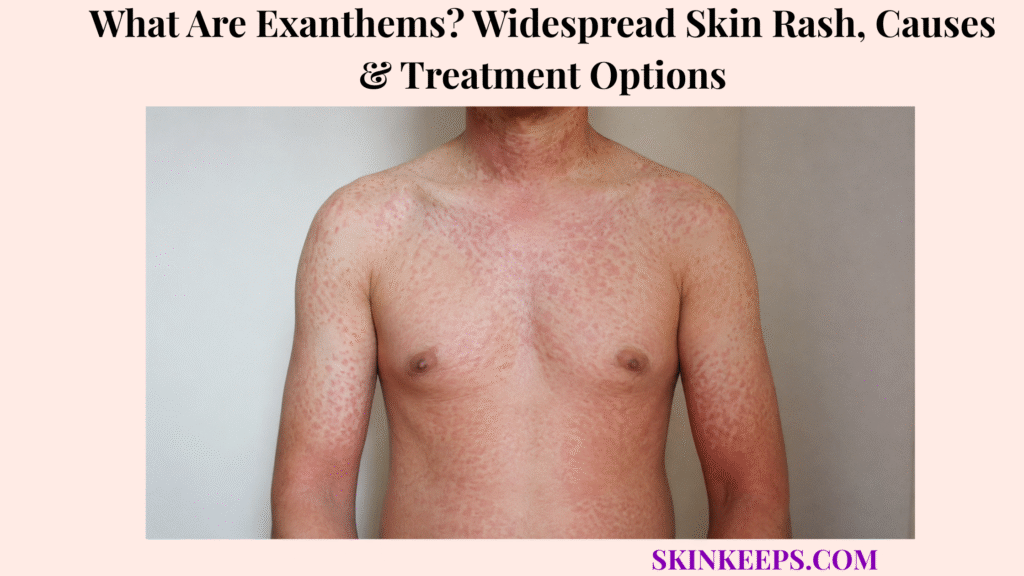
Exanthems are widespread skin eruptions that often appear with body symptoms such as fever, tiredness, headache, sore throat, cough, or general illness.
Exanthem is the singular term. It describes a rash pattern rather than one disease: viral infections are common causes, but bacterial illness, medicines, vaccines, immune reactions, and systemic disease can look similar. This guide covers appearance, spread, causes, mimics, diagnosis, testing, treatment, contagiousness, duration, common mistakes, and urgent warning signs.
How Do Exanthems Cause a Widespread Skin Rash?
An exanthem is a widespread skin eruption that often appears with body symptoms such as fever, tiredness, headache, sore throat, cough, or general illness.
The word identifies the distribution of the rash, not its cause. A virus may provoke an immune response, a bacterium may release a toxin, a medicine may trigger hypersensitivity, or an inflammatory illness may affect the skin and other organs at the same time.
Core distinction: “Exanthem” answers what pattern is present. Diagnosis must still answer what caused it, whether it can spread, and how sick the person is.
What Does an Exanthem Rash Look and Feel Like?
An exanthem can appear as flat spots, raised bumps, blotches, tiny red or purple dots, blisters, or widespread patches, depending on the cause.
What Skin Patterns Are Common in Exanthems?
Common patterns include macules (flat spots), papules (raised bumps), and maculopapular eruptions that combine both. Some causes form confluent blotches, small vesicles, larger blisters, a fine sandpaper texture, target-like areas, petechiae, or purpura.
On darker skin, inflammation may look purple, brown, gray-brown, or darker instead of bright red. Texture, tenderness, blanching, blistering, and mucosal involvement may be more informative than redness alone.
What Body Symptoms Can Appear With an Exanthem?
Fever, headache, malaise, tiredness, sore throat, cough, runny nose, diarrhea, vomiting, muscle aches, joint pain, swollen lymph nodes, mouth sores, or eye redness may occur. The sequence matters: in some illnesses fever comes before the rash, while in others the rash appears during or after systemic symptoms.
| Feature | Exanthem Clue | Why It Matters |
|---|---|---|
| Widespread spots or bumps | Macular, papular, or mixed pattern. | Helps separate generalized illness from a localized rash. |
| Fever or malaise | Infectious or inflammatory clue. | Changes urgency and testing. |
| Blisters | Specific viral or drug causes possible. | Needs pattern and mucosal review. |
| Purple non-blanching spots | Blood does not fade with pressure. | Serious infection or bleeding concern. |
| Mouth, eye, or genital sores | Mucosal involvement. | Severe reaction or specific infection boundary. |
| Skin pain or peeling | Not a routine mild viral clue. | Urgent severe-reaction assessment. |
Where Can Exanthems Appear on the Body?
Exanthems can appear on the face, trunk, arms, legs, hands, feet, palms, soles, mouth, or almost the whole body, depending on the cause.
Clinicians note where the rash began, whether it spread from face to trunk or from trunk outward, and whether palms, soles, mouth, eyes, or genital skin are involved. The distribution may narrow the possibilities, but it should never replace exposure and illness history.
| Spread Pattern | Possible Clue | Why It Matters |
|---|---|---|
| Face to body | Some viral illnesses, including measles-like patterns. | Vaccination, contact, and outbreak history become central. |
| Trunk first | Many viral and medicine-related eruptions. | Fever and medicine timing help separate causes. |
| Palms or soles | Selected infections, immune rashes, or drug reactions. | Higher diagnostic value than trunk-only rash. |
| Mouth plus skin | Viral disease or severe drug reaction. | Pain, hydration, and mucosal severity matter. |
| Eyes or genital skin | Mucosal disease. | Requires prompt assessment. |
| Widespread peeling | Severe reaction concern. | Emergency evaluation. |
Which Viral Infections Can Cause Exanthems?
Viral infections are among the most common causes of exanthems, especially in children, but adults can develop viral exanthems too.
Which Classic Childhood Viral Exanthems Matter?
Classic examples include measles, rubella, roseola, fifth disease, chickenpox, hand-foot-mouth disease, and nonspecific viral exanthem. Fever timing, vaccine status, contact with an ill person, the direction of rash spread, and whether lesions are spots or vesicles help distinguish them.
A measles-like illness deserves prompt clinical and public-health advice rather than a waiting-room visit without warning, because exposure management and testing may be needed.
Which Modern Viral Illnesses Can Cause Exanthem-Like Rashes?
Respiratory viruses, enteroviruses, Epstein-Barr virus, adenovirus, COVID-19, viral hepatitis, acute HIV infection, and travel-related viral infections can cause generalized eruptions in selected contexts. A rash photograph cannot identify the exact virus reliably.
| Viral Group | Rash Clue | Extra History to Ask |
|---|---|---|
| Measles-like illness | Fever, cough, eye redness, spreading rash. | Vaccination, exposure, and outbreak alerts. |
| Varicella | Vesicles in different stages. | Contact and vaccination history. |
| Roseola | High fever followed by rash in a young child. | Age and fever-rash sequence. |
| Fifth disease | Cheek or lacy-body pattern. | Pregnancy exposure and blood-disorder context. |
| Hand-foot-mouth | Mouth sores with hand and foot lesions. | Childcare or outbreak exposure. |
| Nonspecific viral exanthem | Generalized maculopapular rash. | Recent respiratory or gastrointestinal illness. |
Which Bacterial or Toxin-Related Illnesses Can Cause Exanthems?
Some bacterial infections can cause widespread rashes, and a few require urgent treatment because fever plus rash can signal serious illness.
Which Bacterial Causes Should Be Considered?
Possible causes include scarlet fever after streptococcal infection, meningococcal disease, rickettsial infections in a relevant location or travel setting, toxic shock syndrome, secondary syphilis, disseminated gonococcal infection, and bacterial sepsis with petechiae or purpura.
The right questions include sore throat, travel, tick or insect exposure, sexual history when relevant, severe pain, tampon or wound context, and rapid systemic deterioration.
Which Fever-Rash Signs Are Dangerous?
Non-blanching purple spots, neck stiffness, severe headache, confusion, cold hands or feet, rapid breathing, severe muscle or joint pain, fainting, or a very sick appearance are emergency clues. Meningococcal illness can initially resemble influenza and worsen within hours.
| Pattern | Concern | Safer Action |
|---|---|---|
| Fever plus purple non-blanching spots | Meningococcal disease, sepsis, or bleeding disorder. | Emergency care. |
| Fever plus sandpaper-like rash | Scarlet fever possible. | Prompt strep evaluation. |
| Fever plus shock symptoms | Toxic shock or sepsis concern. | Emergency care. |
| Travel plus fever and rash | Rickettsial or travel-related infection. | Urgent evaluation. |
| Sexual exposure plus generalized rash | Secondary syphilis or disseminated infection. | Clinical examination and testing. |
Which Non-Infectious Causes Can Trigger an Exanthem-Like Rash?
Not every exanthem-like rash is viral; medicines, vaccines, immune reactions, inflammatory disease, and allergic reactions can also cause widespread eruptions.
How Do Medication Reactions Fit?
A widespread drug rash can resemble a viral exanthem. Record every new prescription, dose change, supplement, over-the-counter medicine, and recent course of antibiotics or pain medicine. The rash may begin during treatment or after exposure has ended.
Fever, facial swelling, swollen lymph nodes, organ symptoms, mouth sores, skin pain, blisters, or peeling raise concern for a severe cutaneous adverse reaction rather than a simple morbilliform eruption.
How Do Vaccine-Related Rashes Fit?
Some mild rashes can follow vaccination. Timing, severity, exposure history, breathing symptoms, swelling, and whether the person is otherwise well help determine whether observation or medical assessment is appropriate. A mild post-vaccine rash should not be used to dismiss a separate infection or medicine reaction.
How Do Immune or Inflammatory Conditions Fit?
Kawasaki disease, MIS-C-like illness, vasculitis, lupus, Still’s disease, and other systemic inflammatory conditions can produce fever with widespread rash. Eye redness, mouth changes, swelling of hands or feet, prolonged fever, joint symptoms, abdominal pain, or organ findings guide evaluation.
| Cause Group | Examples | Care Implication |
|---|---|---|
| Medication | Antibiotics, anti-seizure medicines, NSAIDs, supplements. | Build a precise timeline and screen severity. |
| Vaccine-related | Mild immune rash in selected cases. | Monitor symptoms; urgent care for severe allergy or skin injury signs. |
| Allergy | Hives or angioedema. | Breathing and swelling safety first. |
| Autoimmune or inflammatory | Kawasaki disease, vasculitis, lupus, Still’s disease. | Systemic examination and targeted tests. |
| Unknown or mixed | No immediate single cause. | Reassess if persistent, recurrent, or worsening. |
How Are Exanthems Different From Other Widespread Rashes?
Exanthems can resemble hives, eczema flares, heat rash, drug eruptions, psoriasis, scabies, meningococcal rash, SJS/TEN, and other generalized rashes.
How Is an Exanthem Different From Hives?
Hives form raised wheals that usually move, change shape, or fade within hours. Many exanthems stay in the same areas longer and follow a clearer illness, medicine, or exposure timeline. Face, tongue, or throat swelling may represent angioedema and requires emergency care when breathing or swallowing is affected.
How Is an Exanthem Different From a Drug Rash?
Viral and medicine-related maculopapular eruptions can be visually indistinguishable. Recent infection, timing after a new medicine, recurrence with the same drug, facial swelling, organ symptoms, and mucosal involvement carry more diagnostic weight than appearance alone.
How Is an Exanthem Different From SJS/TEN?
SJS/TEN is a severe mucocutaneous reaction, often medicine-related. Widespread skin pain, blisters, detachment or peeling, and painful erosions of the mouth, eyes, or genital skin are emergency warning signs. A painful peeling rash should never be reassured as an ordinary viral exanthem.
How Is an Exanthem Different From Scabies?
Scabies typically causes intense night-time itch and may affect household contacts, finger webs, wrists, waistline, and genital skin. Exanthems more often follow fever, infection, medicine exposure, or systemic illness. Chronic itchy plaques may instead reflect dermatitis or eczema, while persistent thick scaly plaques may fit psoriasis.
Fixed target-like lesions point toward erythema multiforme rather than a nonspecific exanthem, especially when they favor the hands and feet.
| Condition | Main Clue | Why Confusion Happens | Safer Next Step |
|---|---|---|---|
| Viral exanthem | Illness symptoms plus widespread rash. | Can resemble medicine eruption. | History and examination. |
| Drug exanthem | New medicine or dose-change timeline. | Similar maculopapular pattern. | Medication and severity review. |
| Hives | Moving raised wheals. | Widespread itch. | Allergy or urticaria assessment. |
| Scabies | Night itch, burrows, itchy contacts. | Generalized itch. | Check contacts and typical sites. |
| SJS/TEN | Skin pain, blisters, peeling, mucosal sores. | Early rash may appear nonspecific. | Emergency care. |
| Meningococcal rash | Fever with non-blanching purple spots. | Fever-rash overlap. | Emergency care. |
How Are Exanthems Diagnosed?
Exanthems are diagnosed by combining rash appearance, fever timing, exposure history, medication timeline, vaccination history, travel, and overall illness severity.
What History Should a Clinician Ask?
Useful details include when and where the rash began, how it spread, whether fever came before or after the rash, respiratory or digestive symptoms, mouth or eye changes, ill contacts, school or daycare outbreaks, travel, insect or tick exposure, medicines, supplements, recent vaccines, pregnancy, immune suppression, and sexual exposure when relevant.
What Rash Features Should Be Examined?
The examination checks flat versus raised lesions, blanching versus non-blanching spots, vesicles, pustules, crusting, scale, target lesions, palms and soles, mucous membranes, lymph nodes, eye redness, tenderness, skin pain, and any peeling or detachment.
Appointment preparation: photograph the rash in natural light, list all medicines and supplements with start dates, record fever and rash timing, and note sick contacts, travel, vaccination status, pregnancy, and immune conditions.
- When the rash first appeared and where it began
- How it spread and whether lesions remain fixed or move
- Fever timing compared with rash timing
- Cough, sore throat, runny nose, headache, diarrhea, vomiting, or body aches
- Mouth sores, eye redness, genital sores, skin pain, blisters, or peeling
- Whether spots blanch or look purple and non-blanching
- Sick contacts, school or daycare exposure, and outbreak alerts
- Travel, camping, tick, insect, or animal exposure
- New medicines, supplements, vaccines, or dose changes
- Pregnancy, newborn age, immune suppression, or chronic illness
- Photos showing progression and any previous similar episode
Which Tests May Be Needed for an Exanthem?
Many mild exanthems are diagnosed clinically, but tests may be needed when the rash is severe, contagious, unclear, recurrent, medicine-related, or linked with systemic symptoms.
Selected tests may include viral PCR or swabs, a throat test for streptococcal infection, blood counts and inflammatory markers, liver or kidney tests when severe drug reaction is possible, serology, urine testing, bacterial culture, or skin biopsy. Measles-like illness, outbreak exposure, or certain travel infections may require public-health-directed testing.
| Situation | Possible Test | Why |
|---|---|---|
| Sore throat with rash | Rapid strep test or throat culture. | Scarlet fever assessment. |
| Vesicles or grouped blisters | Viral swab or PCR. | Identify selected viral causes. |
| Severe medicine-reaction signs | Blood count, liver, kidney, and inflammatory tests. | Check systemic involvement. |
| Non-blanching rash or severe illness | Urgent blood tests and cultures. | Sepsis, meningococcal, or bleeding concern. |
| Unclear persistent eruption | Skin biopsy. | Rule out inflammatory and drug-related mimics. |
| Measles-like or outbreak illness | Public-health testing. | Diagnosis, isolation, and contact management. |
What Treatment Options Help Exanthems?
Exanthem treatment depends on the cause, because a mild viral exanthem, bacterial illness, drug reaction, and severe inflammatory rash need different care.
How Are Mild Viral Exanthems Treated?
Many nonspecific viral exanthems improve with rest, fluids, appropriate fever care, cool compresses, gentle moisturizer, and itch relief. Antibiotics do not shorten viral illness. Monitor the person’s alertness, breathing, hydration, fever course, and whether the rash becomes painful, purple, blistering, or peeling.
When Are Antibiotics or Antivirals Needed?
Antibiotics are reserved for confirmed or strongly suspected bacterial causes. Antivirals are used for selected viral infections or high-risk patients, not simply because a rash is widespread. Measles-like or chickenpox-like illness may require isolation, clinician contact before arrival, and public-health guidance.
How Are Drug-Related Exanthems Treated?
Treatment begins by identifying the likely medicine and assessing severity. A prescriber may stop or switch a suspected drug. Severe skin pain, mucosal sores, facial swelling, organ symptoms, blisters, or peeling require urgent care; the suspected medicine and reaction should be clearly documented.
| Exanthem Type | Treatment Direction | Key Caution |
|---|---|---|
| Mild viral | Supportive care and monitoring. | Watch for red flags and contagion advice. |
| Bacterial | Targeted antibiotics when indicated. | Diagnosis first; no leftover antibiotics. |
| Drug-related | Prescriber-led stop or switch. | Rule out severe cutaneous reaction. |
| Itchy stable rash | Selected antihistamine or soothing care. | Do not mask severe signs. |
| Blistering or mucosal | Urgent evaluation. | SJS/TEN and serious infection boundary. |
| Immune-suppressed patient | Lower threshold for testing and treatment. | Higher risk of complications. |
How Should Fever, Itch, and Skin Comfort Be Managed?
Comfort care for an exanthem should reduce fever, itch, dehydration risk, and skin irritation while monitoring for signs that the illness is becoming more serious.
- Encourage frequent fluids and watch urine output
- Rest and reduce overheating
- Use fever medicine only in an age-appropriate, medically safe way
- Avoid aspirin in children unless specifically prescribed
- Keep fingernails short to reduce scratching injury
- Use cool compresses for comfort
- Use a gentle cleanser and fragrance-free moisturizer
- Avoid hot showers, harsh soaps, and abrasive scrubbing
- Do not pick or break blisters
- Seek care for worsening fever, lethargy, dehydration, neck stiffness, breathing trouble, or purple spots
Can Exanthems Spread to Other People?
The rash itself is not always contagious, but many infectious causes of exanthems can spread from person to person.
Viral and bacterial infections may spread before, during, or after rash onset depending on the organism. Drug, allergic, and immune-mediated exanthems are not infectious. Return to school, daycare, or work depends on the diagnosis, fever, contagious period, treatment, and local public-health rules.
| Cause | Contagious? | Practical Point |
|---|---|---|
| Viral exanthem | Often, depending on the virus. | Follow diagnosis-specific isolation advice. |
| Drug eruption | No. | Focus on medication safety. |
| Allergy or hives | No. | Assess trigger and airway symptoms. |
| Bacterial toxin rash | The source infection may spread. | Treat the bacterial cause and follow contact guidance. |
| Immune or inflammatory rash | No. | Investigate the systemic cause. |
How Long Do Exanthems Usually Last?
The duration of an exanthem depends on the cause; many mild viral exanthems are short-lived, while drug reactions, bacterial illnesses, or inflammatory causes may need specific treatment and follow-up.
The fever may improve before or after the rash appears. Some eruptions fade gradually, peel, or leave temporary darker marks after inflammation. Persistent, worsening, recurrent, painful, blistering, or peeling rashes need reassessment rather than an assumed viral timeline.
Course pattern: prodrome or fever → rash appears → rash spreads or fades → possible peeling or pigment change → recovery, or reassessment if symptoms worsen.
Which Exanthem Mistakes Should You Avoid?
The biggest exanthem mistake is assuming a widespread rash is harmless without checking fever, medication history, mucous membranes, purple spots, and overall illness severity.
| Mistake | Why It Is Risky | Better Action |
|---|---|---|
| “It is just viral” | Misses severe infection or drug reaction. | Screen fever, mucosa, pain, purple spots, and alertness. |
| Ignoring the medicine timeline | Misses a drug exanthem or severe reaction. | List every prescription, supplement, and recent dose change. |
| Ignoring purple rash | Serious infection or bleeding may be present. | Seek emergency care. |
| Using random antibiotics | Does not treat viral disease and may cause harm. | Treat only a supported bacterial cause. |
| Using steroid cream to hide the rash | May mask infection or delay diagnosis. | Confirm cause and severity first. |
| Returning to school without advice | May expose others during contagious illness. | Follow diagnosis and public-health guidance. |
When Should a Widespread Rash Be Checked Urgently?
A widespread rash should be checked urgently when it appears with severe illness, high or persistent fever, purple non-blanching spots, breathing symptoms, mucosal sores, skin pain, blisters, peeling, or dehydration.
Which Rash Signs Need Urgent Care?
Purple or non-blanching spots, rapidly spreading rash, severe skin pain, widespread blisters, peeling, face or throat swelling, and painful mouth, eye, or genital erosions require urgent assessment. Pus, significant swelling, warmth, or open sores may indicate secondary infection.
Which Body Symptoms Are Red Flags?
High or persistent fever, neck stiffness, severe headache, confusion, lethargy, breathing difficulty, chest pain, fainting, dehydration, severe abdominal pain, joint swelling, or a very sick appearance are red flags. Newborns, pregnant patients, and immunosuppressed people need a lower threshold for medical care.
Seek emergency care now for fever with purple non-blanching spots, neck stiffness, confusion, breathing trouble, facial or throat swelling, severe skin pain, widespread blisters, peeling skin, mucosal sores, fainting, or inability to drink.
- Purple or non-blanching spots
- High or persistent fever
- Neck stiffness or severe headache
- Confusion, fainting, or unusual lethargy
- Trouble breathing, chest pain, or throat swelling
- Mouth, eye, or genital sores
- Severe skin pain
- Widespread blisters or peeling skin
- Rapid rash spread
- Dehydration or inability to drink
- Rash after a new medicine with severe symptoms
- Newborn or very young infant with fever and rash
- Pregnancy or immune suppression with systemic illness
- Recent travel, outbreak exposure, or very sick appearance
What Should You Remember About Exanthems?
Exanthems are widespread rashes, so safe care depends on identifying the cause, checking severity, and watching for red flags rather than treating every rash the same way.
- Exanthem means a widespread rash pattern, not one disease
- Viral infections are common causes, but not the only causes
- Bacterial illness, medicines, vaccines, and inflammatory disease can look similar
- Rash and fever timing, exposure, travel, vaccines, and medicine history guide diagnosis
- Many mild viral exanthems improve with supportive care
- Antibiotics and antivirals are used only for specific supported causes
- Contagiousness depends on the underlying infection
- Purple spots, neck stiffness, confusion, mucosal sores, skin pain, blisters, peeling, dehydration, or breathing trouble require urgent care
What Questions Do People Ask About Exanthems?
Are exanthems always viral?
No. Viral infections are common causes, especially in children, but bacterial infections, medicines, vaccines, immune reactions, and systemic inflammatory illnesses can also produce exanthem-like rashes.
What does an exanthem look like?
An exanthem may appear as widespread flat spots, raised bumps, mixed maculopapular patches, blotches, tiny purple dots, or blisters. Its color and distribution vary with the cause and skin tone.
Are exanthems contagious?
Some are contagious because the underlying viral or bacterial infection can spread. Drug-related, allergic, and immune-related exanthems are not contagious by themselves.
How are exanthems diagnosed?
Diagnosis combines rash appearance and spread with fever timing, illness symptoms, sick contacts, travel, vaccination history, medication timing, pregnancy or immune status, and selected tests when needed.
What is the best treatment for an exanthem?
There is no single best treatment. Many mild viral exanthems need supportive care, while bacterial, drug-related, or severe inflammatory causes require cause-specific medical management.
Can adults get exanthems?
Yes. Adults can develop viral, bacterial, medication-related, travel-related, immune, or systemic exanthem-like rashes. A complete medicine timeline is especially useful in adults.
When is a widespread rash dangerous?
A widespread rash is dangerous when it comes with purple non-blanching spots, severe fever, neck stiffness, confusion, breathing trouble, mouth or eye sores, skin pain, blisters, peeling, dehydration, or a very sick appearance.
Should antibiotics be used for exanthems?
Antibiotics are used only when a bacterial cause is confirmed or strongly suspected. They do not treat viral exanthems and should not be taken from leftover supplies or used without diagnosis.
Which Sources Support This Exanthem Guide?
DermNet — Exanthems: definition, systemic symptoms, causes, diagnosis, and cause-led treatment. Source page
DermNet — Nonspecific Viral Exanthems: childhood patterns, immune or toxin mechanisms, short-lived course, and supportive care. Source page
Cleveland Clinic — Viral Exanthem Rash: spots, bumps, blotches, viral symptoms, contagiousness, diagnosis, and symptom relief. Source page
American Family Physician — Generalized Rash Diagnostic Approach: travel, exposure, medicine, ill-contact, sexual-history, morphology, and systemic-symptom evaluation. Source page
CDC — Measles Symptoms and Complications: fever, cough, runny nose, conjunctivitis, rash spread, contagiousness, and public-health urgency. Source page
CDC — Meningococcal Disease Symptoms: rapid worsening, fever, stiff neck, headache, severe aches, confusion, and dark purple rash. Source page
Mayo Clinic — Stevens-Johnson Syndrome: painful spreading rash, blisters, skin shedding, mucosal involvement, and emergency-care boundary. Source page
American Academy of Dermatology — Rash 101: widespread, painful, blistering, rapidly spreading, mucosal, infected, or breathing-related rash warning signs. Source page
Medical disclaimer: This SkinKeeps article is for educational purposes only and does not diagnose or replace medical care. A widespread, fever-associated, purple, non-blanching, blistering, peeling, painful, rapidly spreading, mouth-related, eye-related, genital-related, breathing-related, swelling-related, medication-associated, vaccine-timing-associated, travel-associated, outbreak-associated, newborn-related, pregnancy-related, immune-suppression-related, dehydration-related, confusion-related, neck-stiffness-related, severe-headache-related, fainting-related, chest-pain-related, pus-filled, infected-looking, or uncertain rash should be checked by a qualified healthcare professional. Seek urgent care for fever with purple or non-blanching spots, neck stiffness, severe headache, confusion, lethargy, trouble breathing, facial, tongue, or throat swelling, skin pain, widespread blisters, peeling skin, mouth, eye, or genital sores, dehydration, fainting, very sick appearance, newborn fever-rash, or rash after a new medicine with severe symptoms. Do not self-diagnose exanthems from photos, use leftover antibiotics, use steroid cream to hide an undiagnosed infectious rash, continue a suspected medicine after severe reaction signs, or send a child with fever-rash illness to school or daycare without diagnosis guidance.