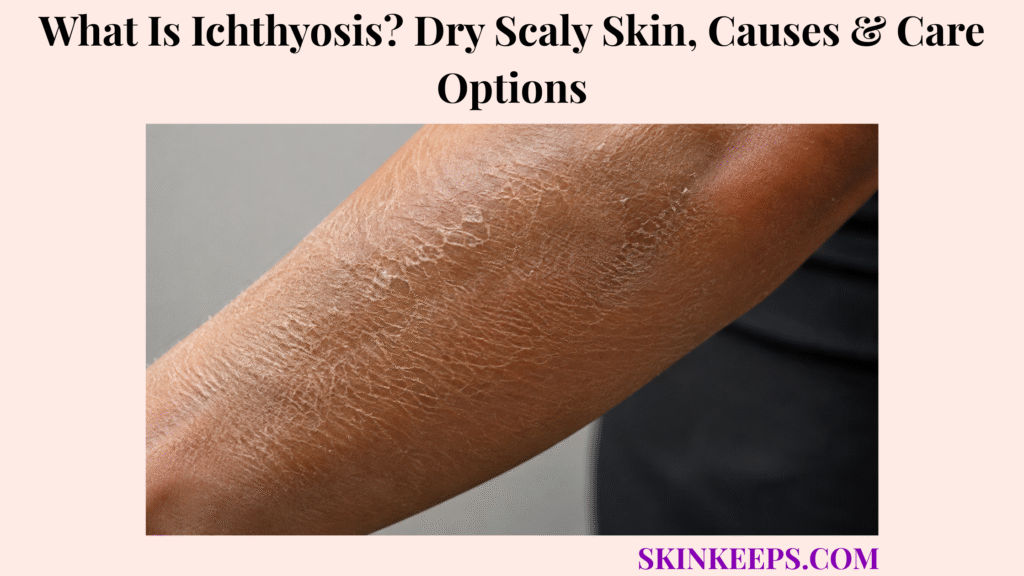
Ichthyosis is a group of skin disorders in which the outer skin layer forms or sheds abnormally, causing persistent dryness and visible scale. Scale may be fine and pale, large and dark, thick and plate-like, or accompanied by red fragile skin.
Most ichthyoses are inherited and begin at birth or in childhood, while acquired ichthyosis begins later and may reflect a medicine or underlying illness. The disorders are not contagious; consistent barrier care can improve flexibility, comfort and scale even when an inherited subtype requires lifelong maintenance.
How Can You Recognize Ichthyosis on the Skin?
Ichthyosis usually causes persistent dry scaling that follows a repeated pattern and does not clear like ordinary environmental dryness.
- Fine white, grey, light-brown or darker adherent scale.
- Polygonal or plate-like surface changes.
- Thick rough skin across characteristic body areas.
- Generalized scale in congenital forms.
- Deep cracks or painful fissures.
- Tightness that restricts movement.
- Red or inflamed skin beneath scale.
- Prominent palm lines or follicular bumps.
- Scale around the scalp, ears or folds.
- Worsening in cold dry weather and partial improvement in humidity.
Symptoms may include itch, burning, stinging, fissure pain, tightness, heat intolerance or little discomfort despite visible scale.
Figure 1. Ichthyosis can range from fine shin scale to whole-body congenital disease, so onset, distribution, blistering, fissures and systemic complications matter more than “fish-scale” wording alone.
Where Does Ichthyosis Usually Affect the Body?
Ichthyosis may involve the limbs, trunk, scalp, ears, palms, soles or the entire body depending on subtype and severity.
| Body Site | Useful Pattern Clue |
|---|---|
| Shins and extensor limbs | Fine scale with relatively spared folds can suggest ichthyosis vulgaris |
| Neck, trunk and limbs | Larger darker adherent scale can suggest X-linked ichthyosis |
| Whole body at birth | ARCI, collodion presentation or harlequin pattern |
| Red blistering areas | Keratinopathic ichthyosis consideration |
| Palms and soles | Subtype-specific thickening and fissures |
| Scalp and ear canals | Scale burden may affect hair care or hearing |
How Does Ichthyosis Affect the Skin Barrier?
Ichthyosis disrupts how the stratum corneum forms, holds water and sheds.
- Keratinocytes may mature or connect abnormally.
- Surface cells may accumulate because shedding is too slow.
- Some subtypes produce excess thickening.
- Abnormal lipids increase transepidermal water loss.
- Skin becomes stiff and less flexible.
- Fissures allow irritants and microorganisms to enter.
- Severe barrier loss raises fluid, heat and energy needs.
Figure 2. Ichthyosis develops when the outer barrier forms or sheds abnormally; modern classification separates common inherited, congenital, keratinopathic, syndromic and acquired disease.
How Is Ichthyosis Different From Ordinary Dry Skin?
Ordinary dry skin is often temporary or environment-related, while ichthyosis is more persistent, patterned and frequently begins early.
Ordinary dry skin / xerosis often improves substantially with environmental changes and moisturizer, while ichthyosis usually produces a persistent patterned scale.
| Feature | Ordinary Xerosis | Ichthyosis |
|---|---|---|
| Onset | Any age after weather, ageing or cleansing changes | Often birth, infancy or childhood |
| Pattern | Selected dry areas | Repeated subtype-related distribution |
| Moisturizer response | Often substantial | Partial and maintenance-dependent |
| Complications | Usually limited | Fissures, heat, eye, ear or systemic burden possible |
| Testing | Usually unnecessary | Genetic or systemic evaluation may be needed |
How Is Ichthyosis Different From Eczema or Psoriasis?
Ichthyosis is primarily a cornification and barrier disorder, while eczema and psoriasis are primarily inflammatory diseases.
Active dermatitis / eczema can coexist with ichthyosis and may add itch, redness, weeping or flare-based inflammation.
| Feature | Ichthyosis | Eczema | Psoriasis |
|---|---|---|---|
| Main pattern | Persistent patterned scale | Itchy inflamed flares | Sharply defined plaques |
| Onset | Often early | Any age | Any age |
| Surface | Fine to plate-like scale | Dry, red or weeping | Thick inflammatory scale |
| Folds | May be spared in vulgaris | Commonly affected | Can involve folds |
| Associated clues | Family pattern, palm lines, heat issues | Atopy and itch | Nail or joint signs |
Which Main Types of Ichthyosis Can Occur?
Ichthyoses are grouped into common inherited, congenital nonsyndromic, keratinopathic, syndromic and acquired forms.
| Group | Examples | Key Distinction |
|---|---|---|
| Common inherited | Ichthyosis vulgaris and X-linked ichthyosis | Childhood or early-life patterned scale |
| ARCI | Lamellar, CIE, harlequin and related forms | Usually present at birth |
| Keratinopathic | Epidermolytic ichthyosis | Fragility or blistering before thickening |
| Syndromic | Netherton and multisystem ichthyoses | Hair, immune, neurologic or organ signs |
| Acquired | Illness- or medicine-associated scale | Begins after previously normal adult skin |
What Pattern Suggests Ichthyosis Vulgaris?
Ichthyosis vulgaris usually causes fine persistent scale that begins after early infancy and is most visible on the shins and limbs.
Ichthyosis vulgaris is frequently associated with atopic dermatitis, so care may need both barrier repair and inflammation control.
- Fine white, grey or light-brown scale.
- Prominent shin involvement.
- Scaling on arms and trunk.
- Relative sparing of flexural creases.
- Increased palm lines.
- Keratosis-pilaris-like bumps.
- Cold-season worsening.
- Frequent atopic disease association.
- Possible reduction in severity with age.
What Pattern Suggests X-Linked Ichthyosis?
X-linked ichthyosis usually affects boys and men and tends to produce darker, larger, more adherent scale from birth or early infancy.
- Male-predominant inherited pattern.
- Neck, trunk and limb involvement.
- Possible flexural scale.
- Palms and soles often less affected.
- Steroid-sulfatase deficiency linked to STS alteration.
- Possible corneal opacity, usually without visual impairment.
- Undescended testes or other associated findings in selected patients.
- Female relatives may be carriers.
What Are Autosomal Recessive Congenital Ichthyoses?
Autosomal recessive congenital ichthyoses are inherited disorders that usually present at birth with generalized scale, redness, collodion membrane or severe barrier dysfunction.
| Clinical Pattern | Typical Features |
|---|---|
| Lamellar ichthyosis | Larger plate-like scale, often less redness |
| Congenital ichthyosiform erythroderma | Finer generalized scale with more redness |
| Harlequin ichthyosis | Very thick plates and severe neonatal barrier failure |
| Self-improving collodion ichthyosis | Marked newborn presentation followed by substantial improvement |
Several genes can create overlapping newborn appearances, so the final phenotype and molecular diagnosis may become clearer over time.
What Is a Collodion Baby?
A collodion baby is a newborn presentation with a tight shiny membrane over the skin, not a final diagnosis by itself.
- Taut membrane covering much of the body.
- Cracking and peeling during the first days or weeks.
- Eyelids or lips pulled outward.
- Restricted movement.
- Difficulty closing the eyes.
- Feeding or sucking difficulty.
- Excess fluid and heat loss.
- Infection and breathing risk.
The newborn may later be classified as lamellar ichthyosis, CIE, a self-improving form or another inherited disorder. Humidified neonatal care, fluid and temperature monitoring, bland emollients and eye, feeding and infection assessment are required.
Why Is Harlequin Ichthyosis a Neonatal Emergency?
Harlequin ichthyosis is a neonatal emergency because thick plates can disrupt breathing, feeding, fluids, temperature, circulation and infection defence.
Severe newborn plate-like scaling requires urgent care because harlequin ichthyosis can disrupt breathing, feeding, fluids, temperature and infection defence.
- Armour-like plates with deep fissures.
- Eyelids and lips turned outward.
- Restricted chest and limb movement.
- Feeding and respiratory difficulty.
- Rapid dehydration and electrolyte imbalance.
- Temperature instability.
- High infection risk.
- Reduced blood flow to fingers or toes.
The condition is usually linked to severe ABCA12 dysfunction and requires neonatal intensive care, barrier support, nutrition, infection management and carefully selected specialist treatment.
What Is Epidermolytic Ichthyosis?
Epidermolytic ichthyosis often begins with red fragile blistering skin and later develops thick ridged or warty scale.
- Blistering or raw skin at birth.
- Blisters after minor friction.
- Later ridged or warty hyperkeratosis.
- Possible bacterial odour or colonization.
- Palm-and-sole thickening in selected gene patterns.
- Less blistering but more thickening with age.
- Treatment balance between scale reduction and fragility.
KRT1 or KRT10 variants are common causes; strong keratolytics or retinoids can reduce thickening but may increase fragility.
What Are Syndromic Ichthyoses?
Syndromic ichthyoses are scaling disorders that also affect organs or systems beyond the skin.
- Hair-shaft abnormalities.
- Severe allergy or high immunoglobulin E.
- Immune dysfunction and recurrent infection.
- Neurologic or developmental differences.
- Hearing or eye abnormalities.
- Liver, metabolic or muscle disease.
- Growth and nutrition concerns.
Netherton syndrome is a key example, with red migratory scale, fragile bamboo hair, atopy, food allergy and increased absorption of topical medicines through an impaired barrier.
What Causes Inherited Ichthyosis?
Inherited ichthyosis results from genetic changes affecting barrier formation, lipid transport, cell structure or normal shedding.
- Autosomal-dominant inheritance in selected types.
- Autosomal-recessive inheritance in many congenital forms.
- X-linked inheritance in steroid-sulfatase deficiency.
- New variants without a known family history.
- Similar clinical appearances from different genes.
- Different severity among relatives.
Parents do not cause inherited ichthyosis through pregnancy behaviour, food choices or skin-care practices.
What Causes Acquired Ichthyosis in Adults?
Acquired ichthyosis begins after previously normal skin and may signal an underlying illness, nutritional problem or medicine exposure.
- Lymphoma or another malignancy.
- Chronic kidney disease.
- HIV or selected infection.
- Sarcoidosis.
- Endocrine or metabolic disease.
- Nutritional deficiency or malabsorption.
- Autoimmune or inflammatory disease.
- Cancer therapy, hydroxyurea, clofazimine or other medicines.
Adult-onset generalized scaling requires a clinical review rather than being attributed automatically to ageing or climate.
Which Features Suggest Acquired Rather Than Inherited Ichthyosis?
Adult onset, rapid progression, systemic symptoms or a new medicine point toward acquired disease.
| Feature | Inherited Pattern | Acquired Pattern |
|---|---|---|
| Onset | Birth, infancy or childhood | After previously normal adult skin |
| Family history | May be present | Usually absent |
| Progression | Long-standing pattern | New or relatively rapid |
| Systemic clues | Subtype-specific congenital findings | Weight loss, fever, nodes or organ symptoms |
| Medicine link | Not primary | Possible |
| Response | Needs lifelong maintenance | May improve when cause is treated |
How Can Ichthyosis Affect Sweating and Body Temperature?
Ichthyosis can impair cooling when scale blocks sweat release or the subtype reduces sweat-gland function.
- Reduced sweating despite hot skin.
- Exercise and hot weather increase risk.
- Children can overheat quickly.
- Fever and protective clothing add heat burden.
- Warning signs include headache, dizziness, weakness, nausea, cramps, confusion or fainting.
- Cooling plans can include shade, air conditioning, water, misting and activity adjustment.
How Can Ichthyosis Affect the Eyes?
Tight facial skin can pull eyelids outward or prevent complete closure, exposing the eye surface.
- Ectropion or incomplete eyelid closure.
- Dryness, tearing or irritation.
- Light sensitivity.
- Recurrent inflammation.
- Corneal exposure and vision risk.
- Need for lubrication, moisture protection and ophthalmology review.
Eye pain, marked redness, light sensitivity or reduced vision requires urgent eye assessment.
How Can Ichthyosis Affect the Ears and Hearing?
Scale can collect inside the external ear canal and reduce sound transmission.
- Ear blockage or discomfort.
- Fluctuating hearing reduction.
- Recurrent canal infection.
- Difficulty using hearing devices.
- Need for professional softening and scale removal.
Cotton swabs, sharp tools and unsupervised deep cleaning can injure the canal or push scale farther inward.
How Can Ichthyosis Affect Growth and Nutrition?
Severe ichthyosis can increase fluid, energy and nutrition needs because the impaired barrier loses water and heat.
- High transepidermal water loss.
- Increased energy expenditure.
- Feeding difficulty from tight lips or pain.
- Recurrent infection.
- Slow weight gain or reduced growth.
- Protein, micronutrient or vitamin-D concerns in selected cases.
- Need for hydration, dietary and bone-health monitoring.
Why Are Skin Infections More Common in Ichthyosis?
Fissures and barrier defects create entry points for bacteria, fungi and viruses.
Rapidly spreading warmth, redness, swelling or pain around cracked skin may suggest cellulitis rather than ordinary scaling.
- Cracks and scratching damage the barrier.
- Scale can retain moisture and bacteria.
- Syndromic disease may include immune dysfunction.
- Thick crust can conceal infection.
- Warning signs include warmth, swelling, pus, crust, new blisters, fever or unusual tiredness.
Antimicrobial treatment and clinician-directed dilute bleach baths are used only when clinically indicated.
How Is Ichthyosis Diagnosed?
Diagnosis combines age of onset, morphology, distribution, family pattern, complications and targeted testing.
- Skin appearance at birth or collodion history.
- Age when scale began.
- Family and sex-linked pattern.
- Seasonal change.
- Blistering, infection and fissures.
- Heat intolerance.
- Eye, ear, hair, nail or growth findings.
- Medicine timeline and adult systemic symptoms.
A dermatologist can often recognize ichthyosis vulgaris clinically, while congenital, blistering or syndromic forms need more detailed evaluation.
When Is Genetic Testing Used for Ichthyosis?
Genetic testing is used when confirming a subtype would change counselling, complication screening, treatment planning or family planning.
- Disease present at birth.
- Collodion membrane history.
- Widespread or severe disease.
- Blistering or fragility.
- Overlapping possible subtypes.
- Hair, immune, neurologic or metabolic signs.
- Family-planning, prenatal or preimplantation questions.
- Treatment monitoring depends on subtype.
A negative panel does not exclude every genetic form because disease genes and variant interpretation continue to evolve.
When Are Skin Biopsy and Blood Tests Needed?
When Is a Skin Biopsy Useful?
Biopsy can help when the pattern is atypical, inflammatory or malignant disease is possible, or acquired ichthyosis remains unexplained.
Several subtypes share similar microscopic findings, so biopsy may not identify the exact molecular diagnosis.
Which Tests May Be Used for Adult-Onset Ichthyosis?
Targeted testing may include blood count, kidney, liver, thyroid, metabolic, HIV, nutritional or protein studies, imaging, lymph-node assessment and medicine review.
How Should Ichthyosis Skin Be Bathed?
Bathing is therapeutic when water softens scale and moisturizer is applied immediately afterward.
- Soak in lukewarm water as advised.
- Use a gentle non-soap cleanser.
- Protect painful open fissures when advised.
- Loosen only softened scale with a soft cloth or suitable tool.
- Avoid forceful scrubbing.
- Pat rather than rub dry.
- Apply emollient while skin remains damp.
- Use salt, bicarbonate or antimicrobial additives only under an individualized plan.
Which Moisturizers Work Best for Ichthyosis?
Thick fragrance-free products that reduce water loss are usually most useful.
| Product Type | Role | Practical Limitation |
|---|---|---|
| Petrolatum ointment | Strongest occlusion | Greasy and fire-risk residue |
| High-lipid or ceramide cream | Barrier support with easier daytime use | Less occlusive than ointment |
| Humectant cream | Draws water into outer skin | May sting fissures |
| Lotion | Easy to spread | Often insufficient for severe dryness |
Paraffin-containing emollient residue on clothing or bedding increases fire risk near cigarettes, candles or open flames.
How Do Keratolytic Ingredients Reduce Ichthyosis Scale?
How Does Urea Help?
Urea hydrates and softens compact scale, becoming more keratolytic at higher strength but potentially stinging open fissures.
How Does Lactic Acid or Ammonium Lactate Help?
Lactic acid and ammonium lactate hydrate the stratum corneum and loosen retained cells but may burn inflamed skin.
How Does Salicylic Acid Help?
Salicylic acid breaks surface-cell connections and can reduce resistant scale, but large-area use can irritate skin and cause systemic toxicity.
How Do Glycolic Acid and Other Alpha-Hydroxy Acids Help?
Alpha-hydroxy acids increase surface shedding and smooth texture but need gradual introduction to avoid redness and burning.
Keratolytics soften compact outer-layer thickening, but broader hyperkeratosis still requires cause-specific treatment and age- and body-area safety limits.
Strong acids and broad salicylic-acid application are generally avoided or tightly limited in infants, young children and fragile skin.
How Can Scalp and Hair Scaling Be Managed?
Scalp scale should be softened before gentle removal to avoid hair breakage, bleeding and inflammation.
- Apply a suitable softening emollient before washing.
- Loosen scale during or after a lukewarm soak.
- Use a wide-tooth comb or soft brush gently.
- Wash with a mild shampoo or prescribed product.
- Avoid forceful scraping and picking.
- Assess odour, pus, pain or hair fragility.
- Arrange ear-canal review when nearby scale affects hearing.
When Are Topical Retinoids Used for Ichthyosis?
Topical retinoids may be used on selected localized areas where thick scale causes functional or structural problems.
- Localized palm-and-sole thickening.
- Tight facial scale contributing to eyelid problems.
- Restricted movement or contracture-prone areas.
- Selected resistant plaques.
- Careful low-frequency introduction.
- Monitoring for burning, redness, fragility and fissures.
- Pregnancy avoidance and reproductive counselling.
When Are Oral Retinoids Used for Severe Ichthyosis?
Oral retinoids are reserved for severe generalized hyperkeratosis or major functional burden under specialist monitoring.
- Severe scale limiting movement or daily care.
- Ectropion or tightness threatening function.
- Marked palm-and-sole thickening.
- Selected severe congenital or keratinopathic subtypes.
- Lowest effective dose and regular review.
- Liver and lipid monitoring.
- Assessment for bone, mucosal and medicine effects.
- Strict fetal-harm prevention and preconception planning.
Retinoids can increase fragility in blistering subtypes and are not routine treatment for every patient.
Can Biologic or Immune-Targeted Medicines Treat Ichthyosis?
Biologic and immune-targeted therapies are emerging, subtype-dependent options rather than universal standard care.
- Most evidence applies to selected inflammatory or syndromic phenotypes.
- Response depends on the molecular and immune pathway.
- Barrier bathing and emollients remain necessary.
- Infection screening and laboratory monitoring may be required.
- Use belongs in specialist care or clinical trials.
- Evidence and long-term safety continue to develop.
How Should Painful Cracks and Fissures Be Managed?
Painful fissures are managed by protecting the crack, restoring flexibility and reducing the force that pulls it open.
A painful skin fissure can deepen when rigid scale keeps pulling the skin apart during movement.
- Clean gently and pat dry.
- Apply petrolatum or a prescribed barrier ointment.
- Use a non-adherent dressing when needed.
- Reduce pressure, friction or repetitive movement.
- Avoid strong acids inside open cracks.
- Assess warmth, swelling, pus or fever.
- Seek professional care for deep, recurrent or bleeding fissures.
Which Ichthyosis Care Mistakes Should Be Avoided?
Care mistakes can produce raw skin, toxicity, infection, heat illness or fire injury.
| Mistake | Possible Harm | Safer Direction |
|---|---|---|
| Forceful scrubbing | Raw skin and infection | Soften first and remove gently |
| Very hot water | Dryness and burning | Use lukewarm water |
| Strong acids over large areas | Burn or systemic toxicity | Age- and area-limited plan |
| Broad salicylic acid in infants | Toxicity | Avoid unless specialist-directed |
| Objects in ear canals | Trauma and blockage | Professional clearance |
| Ignoring reduced sweating | Heat illness | Cooling plan |
| Paraffin residue near flame | Serious fire injury | Keep away from ignition |
| Oral retinoid without monitoring | Fetal and organ harm | Specialist prescribing |
How Is Ichthyosis Managed in Babies and Children?
Babies and children need age-specific barrier care plus monitoring for temperature, hydration, eyes, hearing, infection, feeding and growth.
- Urgent neonatal care for collodion or plate-like skin.
- Humidified environment when clinically indicated.
- Frequent bland emollient use.
- Careful fluid and temperature monitoring.
- Eye lubrication and ophthalmology review.
- Ear and hearing assessment.
- Nutrition and growth support.
- Age-limited keratolytic use.
- Genetic testing and counselling.
- School and psychosocial support.
How Is Ichthyosis Managed During Pregnancy?
Pregnancy management emphasizes safe barrier care, preconception medication review and genetic counselling when relevant.
- Continue bland moisturizers and gentle bathing.
- Review keratolytic body area and strength.
- Avoid oral retinoids during pregnancy.
- Follow the exact pregnancy-prevention interval for the specific retinoid.
- Review topical retinoids before conception.
- Do not stop essential medicine without the prescriber.
- Discuss inheritance, prenatal or preimplantation options when desired.
How Does Ichthyosis Affect Daily Life and Mental Health?
Ichthyosis can create a substantial daily burden through lengthy care, visible scale, heat limitations and repeated medical needs.
- Time spent bathing, moisturizing and removing scale.
- Cost and storage of large product quantities.
- Clothing and bedding residue.
- Itch, pain and sleep disturbance.
- Heat-related limits on exercise, school or work.
- Stigma, staring or bullying.
- Caregiver exhaustion.
- Need for workplace, school or mental-health support.
How Long Does Ichthyosis Last?
Inherited ichthyoses are usually lifelong, although severity can change with age, climate and treatment.
| Pattern | Expected Course |
|---|---|
| Ichthyosis vulgaris | Often lifelong with possible improvement over time |
| X-linked ichthyosis | Usually lifelong |
| Congenital ichthyosis | Lifelong, with phenotype evolving after birth |
| Epidermolytic ichthyosis | Fragility may decrease while thickening increases |
| Acquired ichthyosis | May improve when illness or medicine trigger is treated |
Can Ichthyosis Be Cured Permanently?
Most inherited ichthyoses do not currently have a permanent cure, but lifelong maintenance can reduce scale, fissures and complications.
- Barrier care improves hydration and flexibility.
- Keratolytics reduce retained scale.
- Retinoids can reduce severe thickening.
- Infection, heat, eye and ear complications can be prevented or treated.
- Acquired ichthyosis may improve when its trigger is controlled.
- Gene and pathway-directed therapies remain areas of active research.
When Should Ichthyosis Be Checked by a Clinician?
Clinical assessment is recommended for early-onset, widespread, blistering, fissured or adult-onset scaling and whenever complications appear.
- Scaling present at birth or soon afterward.
- Collodion membrane history.
- Widespread or worsening scale.
- Blistering, raw areas or deep fissures.
- Reduced sweating or heat intolerance.
- Eye, lip, hearing or ear-canal problems.
- Recurrent infection or odour.
- Hair, nail, neurologic or immune clues.
- Feeding, hydration or growth concerns.
- New adult-onset generalized scale.
- Weight loss, fever, night sweats or swollen lymph nodes.
- Family-planning questions.
Which Ichthyosis Symptoms Require Urgent Medical Care?
Urgent care is required for newborn barrier failure, severe infection, dehydration, heat illness, eye exposure, poor perfusion or systemic adult-onset warning signs.
- Newborn thick plates, collodion membrane or widespread cracks.
- Breathing difficulty or feeding failure.
- Reduced urine or signs of dehydration.
- Fever, pus or rapidly spreading redness.
- Unusual sleepiness, confusion or fainting.
- Hot-weather illness with little sweating.
- Eye pain, inability to close the eyes, light sensitivity or reduced vision.
- Black, cold or poorly perfused fingers or toes.
- Sudden hearing reduction.
- Extensive blistering or raw skin.
- Adult-onset scale with weight loss, fever, night sweats or nodes.
Urgent route: severe newborn scaling, breathing or feeding difficulty, dehydration, infection, confusion from heat, eye exposure or poor finger/toe perfusion should be treated as an emergency.
Figure 3. Safe ichthyosis care combines subtype diagnosis, daily barrier restoration, age-appropriate scale reduction, complication prevention and immediate escalation for newborn barrier failure, infection, heat illness, eye exposure or systemic adult-onset signs.
What Should You Remember About Ichthyosis?
Ichthyosis is a group of inherited or acquired disorders in which the outer barrier forms or sheds abnormally.
- Persistent patterned scale differs from ordinary dryness.
- Subtype clues include onset, scale type, distribution and blistering.
- A collodion baby is a presentation, not the final diagnosis.
- Harlequin ichthyosis is a neonatal emergency.
- Adult-onset generalized scaling requires systemic and medicine review.
- Bathing plus immediate emollient supports the barrier.
- Keratolytics require age, body-area and fragility limits.
- Oral retinoids require reproductive and laboratory monitoring.
- Reduced sweating can cause overheating.
- Eyes, ears, growth and infection need active monitoring.
- Most inherited types require lifelong maintenance.
Frequently Asked Questions About Ichthyosis?
Is ichthyosis contagious?
No. Inherited ichthyosis comes from genetic changes, and acquired ichthyosis is linked to another illness or medicine rather than person-to-person spread.
What causes inherited and acquired ichthyosis?
Inherited forms result from genetic changes affecting barrier proteins, lipids, keratins or shedding. Acquired ichthyosis begins later and may be linked to medicines, malignancy, kidney disease, infection, nutritional problems or another systemic illness.
Which skin-care routine best controls ichthyosis scale?
Routine care usually includes lukewarm soaking, gentle loosening of softened scale, patting dry, immediate thick moisturizer, repeat emollient use and carefully selected keratolytics when needed.
Can ichthyosis cause overheating or skin infections?
Yes. Thick scale and reduced sweating can impair cooling, while fissures and barrier defects can allow bacteria, fungi or viruses to enter.
Can ichthyosis be permanently cured?
Most inherited forms do not currently have a permanent cure, but consistent care can reduce scale, fissures, discomfort and complications. Acquired ichthyosis may improve when its cause is treated.
Which Sources Support This Ichthyosis Guidance?
American Academy of Dermatology — Ichthyosis Vulgaris: Diagnosis and Treatment — Clinical diagnosis, bathing, immediate moisturization, scale-softening treatment, fissure care and acquired-cause management.
NHS — Ichthyosis — Symptoms, emollients, keratolytics, overheating, eye/hearing complications, scalp care and paraffin fire safety.
DermNet — Ichthyosis — Classification of inherited, syndromic and acquired ichthyoses.
DermNet — Ichthyosis Vulgaris — Fine-scale distribution, palm hyperlinearity, keratosis pilaris, atopic association and acquired patterns.
DermNet — Epidermolytic Ichthyosis — Blistering-to-hyperkeratosis evolution, keratin-associated fragility and symptom-management limits.
PubMed — Congenital Ichthyosis Guidelines, Part One: 2024 Update — Topical and systemic therapies, biologics, JAK inhibitors, psychosocial care, genetic counselling and reproductive planning.
PubMed — Congenital Ichthyosis Guidelines, Part Two: 2024 Update — Eye, ear, infection, growth, nutrition, climate, physical and neonatal complications.
Great Ormond Street Hospital — Ichthyosis — Pediatric inherited disease, lifelong care, family counselling and specialist support.
This SkinKeeps article is educational and does not diagnose or replace dermatology, neonatal, pediatric, genetics, eye, hearing, nutrition, pregnancy, oncology or emergency care. Seek urgent care for severe newborn scaling, breathing or feeding difficulty, dehydration, fever, spreading redness, pus, confusion, fainting, heat illness with little sweating, eye pain or incomplete closure, reduced vision, poor finger or toe circulation, sudden hearing loss, or extensive blistering. Do not scrub scale raw, use broad strong acids or infant salicylic acid, insert ear tools, use retinoids without monitoring, or place paraffin-soaked materials near flames.