
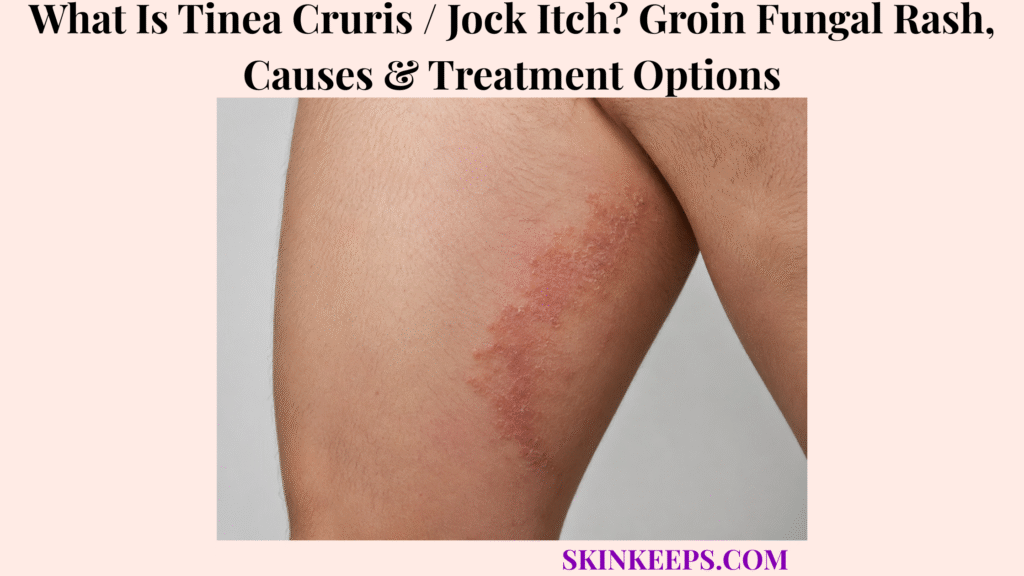
Tinea cruris, commonly called jock itch, is a dermatophyte fungal infection of the groin folds, pubic region and adjacent inner thighs. It usually causes an itchy, scaly rash with an active advancing border, and it should not be used as a generic label for every itchy groin eruption.
The fungus is the cause; warmth, sweating and occlusion simply create conditions that favor persistence. Athlete’s foot, fungal nails, shared items and steroid-modified tinea can help explain recurrence, so effective management combines accurate diagnosis, antifungal treatment and control of reservoirs that can reintroduce infection.
Medical disclaimer: This article is for educational purposes only. Severe, spreading, painful, recurrent or treatment-resistant groin rashes—or rashes with pus, extensive cracking or systemic illness—should be medically evaluated.
What Is Tinea Cruris and What Does Jock Itch Look and Feel Like?
Tinea cruris is a dermatophyte infection of groin skin that typically causes an itchy, scaly, spreading rash with a more active outer border.
Which Areas Does Tinea Cruris Affect?
Tinea cruris typically begins in the groin fold and extends across the pubic region or upper inner thigh, sometimes reaching the buttocks or lower abdomen. The distribution is often asymmetrical, especially early in the course.
Which Fungi Cause Tinea Cruris?
Dermatophyte fungi cause tinea cruris, with organisms such as Trichophyton rubrum and Epidermophyton floccosum among recognized causes. Species identification is not required for every straightforward localized case.
Is Jock Itch a Type of Ringworm?
Yes. Jock itch is ringworm of the groin because “ringworm” refers to dermatophyte fungal infection rather than a literal worm. The broader Ringworm page explains the dermatophyte family of infections across body sites.
What Does the Typical Jock-Itch Rash Look Like?
The classic rash is itchy and scaly, with a well-defined or slightly raised advancing edge. It may spread from the groin crease onto the inner thigh and can show partial central clearing, although a perfect ring is not required.
Does Tinea Cruris Usually Affect the Scrotum?
Marked scrotal involvement is less typical for classic tinea cruris, which more often favors the groin folds and adjacent thighs. Scrotal involvement does not absolutely exclude tinea, but it should increase consideration of Candida, dermatitis or another fold disorder.
How Does Jock Itch Look on Darker Skin?
On darker skin, tinea cruris may appear brown, gray or simply darker than the surrounding skin rather than bright red. Scale, itch, a more active border and progressive spread are more dependable clues than color alone.
Can Tinea Cruris Crack or Become Painful?
Yes. Persistent inflammation, moisture and friction can lead to flaking, peeling, soreness and fissuring. Severe pain, drainage or rapidly worsening swelling should prompt reassessment for secondary infection or a different diagnosis.
What Causes Tinea Cruris and Why Does Jock Itch Keep Spreading or Returning?
Tinea cruris occurs when dermatophytes infect groin skin, while warmth, sweating, occlusion, fungal infection elsewhere and contaminated items can promote persistence, spread or reinfection.
How Do Warmth, Moisture and Sweating Increase Risk?
Warm, moist and occluded skin gives dermatophytes a favorable environment in which to persist. Sweat does not create the fungus; it changes the local environment in ways that can make established or newly introduced infection easier to maintain.
Can Athlete’s Foot Spread to the Groin?
Yes. Dermatophytes from an untreated foot infection can be transferred by hands, clothing or towels and inoculate groin skin. Treating Athlete’s Foot / Tinea Pedis can therefore be important when jock itch repeatedly returns.
Can Nail Fungus Contribute to Recurring Jock Itch?
Yes. Dermatophyte infection in toenails can act as a persistent reservoir even after the groin improves. The Nail Fungus page covers the better-owner details for fungal nail disease.
Can Jock Itch Spread From Another Person?
Yes. Dermatophytes can spread through direct skin contact and indirectly through contaminated towels, underwear, sports clothing, bedding or other items that carry infected skin material.
Which Factors Make Tinea Cruris More Likely?
Risk increases with heavy sweating, occlusive clothing, prolonged dampness, skin-fold friction, dermatophyte infection at another site and selected conditions that impair normal host defense. None of these factors alone proves that a groin rash is fungal.
Can Steroid Cream Make Jock Itch Worse?
Yes. Corticosteroids can suppress redness and itching without killing dermatophytes, allowing the infection to expand or change appearance. This steroid-modified pattern is called tinea incognito and can delay correct diagnosis.
How Is Tinea Cruris Diagnosed and Distinguished From Other Groin Rashes?
Tinea cruris is often recognized from its distribution and active scaly border, while microscopy or fungal culture becomes useful when the rash is atypical, recurrent, steroid-modified or unresponsive to appropriate treatment.
How Does a Clinician Diagnose Tinea Cruris?
Clinical assessment looks at the site, symmetry, scale, advancing border, degree of itch and whether athlete’s foot or fungal nails are present. A typical unilateral or asymmetrical scaly groin plaque extending to the inner thigh strongly supports the diagnosis.
When Is Skin Scraping or Fungal Testing Useful?
Skin scraping with KOH microscopy or fungal culture is useful when the diagnosis is uncertain, treatment repeatedly fails, disease keeps returning or prior steroid use has distorted the usual appearance. Testing helps prevent endless treatment of a non-fungal rash.
How Is Tinea Cruris Different From Candidal Intertrigo?
Tinea cruris more often has an active scaling outer edge and spread onto the inner thigh, whereas candidal fold disease tends to be more uniformly inflamed, may involve the scrotum more prominently and can show satellite papules or pustules. Intertrigo is the better-owner page for broader body-fold inflammation.
How Is Tinea Cruris Different From Inverse Psoriasis?
Inverse psoriasis is an inflammatory disorder rather than a fungal infection and is usually smoother, more symmetrical and less defined by a spreading scaly edge. The broader Psoriasis page covers psoriatic disease outside this differential role.
How Is Tinea Cruris Different From Contact or Irritant Dermatitis?
Contact or irritant dermatitis is more closely related to friction, sweat, cleansing products, fragrances or another exposure and usually lacks the characteristic active fungal border. Burning can be more prominent than itch in some irritant eruptions.
What Is Erythrasma and Why Can It Resemble Jock Itch?
Erythrasma is a bacterial fold infection that can produce chronic brownish or reddish patches in the groin. Because its cause is bacterial rather than dermatophyte, persistent atypical lesions should be reassessed instead of repeatedly treated as tinea by appearance alone.
How Is Tinea Cruris Treated?
Localized uncomplicated tinea cruris is usually treated with a topical antifungal, while extensive, inflammatory, recurrent or refractory disease may require clinician assessment and sometimes oral antifungal therapy.
Which Topical Antifungal Medicines Are Used?
Common topical antifungal options include allylamine and azole agents such as terbinafine or clotrimazole. The best choice depends on the product, skin tolerance, local availability and whether the diagnosis is reasonably secure.
How Long Does Jock-Itch Treatment Take?
Treatment duration varies by antifungal and product formulation. The important rule is to use the medicine for the full directed course rather than stopping as soon as itching improves, because premature discontinuation can allow persistent infection.
When Are Oral Antifungals Needed?
Oral antifungals may be considered for extensive, severe, recurrent or treatment-resistant tinea cruris and in selected immunocompromised patients. Systemic therapy should be clinician-directed because drug interactions, liver disease and other individual factors can affect selection.
Should Steroid-Antifungal Combination Creams Be Used Routinely?
No. Routine unsupervised steroid-containing treatment can mask dermatophyte infection and promote tinea incognito. If inflammation is unusually severe, the diagnosis and any anti-inflammatory treatment should be clinician-directed rather than based on a generic combination cream.
Why Should Athlete’s Foot and Nail Fungus Be Treated Too?
Clearing only the groin leaves an ongoing source of dermatophytes if the feet or nails remain infected. Long-term control therefore includes treating active tinea at other body sites and reducing transfer from those reservoirs.
How Can Jock Itch Be Prevented From Returning, and When Should It Be Medically Evaluated?
Recurrence is reduced by controlling moisture, preventing contaminated-item spread, treating fungal reservoirs on the feet or nails and reassessing rashes that persist despite correctly used antifungal therapy.
How Can Moisture and Friction Be Reduced?
Dry the groin carefully after washing, change damp clothing promptly, choose breathable garments and avoid prolonged moisture or friction where possible. These measures make the environment less favorable for fungi but do not replace antifungal treatment once infection is established.
How Can Spread Through Towels or Clothes Be Reduced?
Avoid sharing towels, underwear and sports clothing while infection is active, and launder or replace contaminated items appropriately. Hand washing after touching affected skin can also reduce transfer to other body sites.
Why Should Athlete’s Foot Be Controlled Long Term?
Tinea pedis is a common dermatophyte reservoir and can repeatedly reseed the groin. If jock itch keeps returning, feet and nails should be examined rather than repeatedly treating only the groin.
When Should Tinea Cruris Be Checked by a Doctor or Dermatologist?
Medical assessment is appropriate for widespread, severe, painful, recurrent, draining or extensively cracked rashes; for disease in an immunocompromised person; and for a rash that fails an appropriate antifungal course.
When Should Antifungal Resistance Be Considered?
Resistance becomes relevant after basic causes of treatment failure have been reviewed. The diagnosis should first be confirmed, adherence assessed, fungal reservoirs addressed and testing considered before resistant dermatophytes are assumed.
When Should Another Diagnosis Be Considered Instead of Jock Itch?
Reconsider the diagnosis when the rash lacks an active scaly border, prominently involves the scrotum, is highly symmetrical, has strong product-exposure clues, or repeatedly fails correctly used antifungal treatment. Persistent groin itch is not proof of tinea cruris.
What Should You Remember About Tinea Cruris / Jock Itch?
Tinea cruris is a dermatophyte fungal infection—not simply a sweat rash—and successful management requires recognizing the fungal pattern, treating the infection and controlling sources that can repeatedly reinfect the groin.
- Jock itch and tinea cruris are the same dermatophyte infection.
- The fungus is the cause; moisture and sweating create a favorable environment.
- Groin folds and adjacent inner thighs are the classic distribution.
- An active scaly border is more useful diagnostically than redness alone.
- Central clearing can occur but is not required.
- The eruption is often asymmetrical.
- Brown or gray discoloration may be more visible than redness on darker skin.
- Prominent scrotal involvement should widen the differential diagnosis.
- Athlete’s foot and fungal nails can act as recurrence reservoirs.
- Dermatophytes can spread by direct contact and contaminated items.
- Steroid creams can disguise or worsen ringworm.
- Fungal testing is useful for recurrent, atypical or treatment-resistant disease.
- Candida, inverse psoriasis, dermatitis and erythrasma can mimic jock itch.
- Localized uncomplicated disease usually uses topical antifungal therapy.
- Oral therapy is reserved for selected extensive or difficult disease.
- Treatment duration depends on the antifungal used.
- Feet and nails should be addressed when they remain infected.
- Moisture and shared-item control help reduce recurrence.
- Persistent treatment failure should trigger reassessment rather than endless empiric therapy.
- Resistance is considered after diagnosis, adherence and reinfection sources are reviewed.
Frequently Asked Questions About Tinea Cruris / Jock Itch
The main tinea cruris questions concern terminology, contagiousness, athlete’s-foot spread, steroid use and recurrent infection.
Is Tinea Cruris the Same as Jock Itch?
Yes. Jock itch is the common name for tinea cruris, a dermatophyte fungal infection of the groin and adjacent inner thigh.
Is Jock Itch Contagious?
Yes. Dermatophytes can spread through direct skin contact or indirectly through contaminated towels, clothing, sports gear and other shared items.
Can Athlete’s Foot Spread to the Groin and Cause Tinea Cruris?
Yes. Dermatophytes from an infected foot can be transferred to groin skin, making untreated athlete’s foot an important reservoir for recurrent jock itch.
Can Steroid Cream Make Tinea Cruris Worse?
Yes. Corticosteroids can suppress visible inflammation while the fungus persists or spreads, producing steroid-modified tinea and making the diagnosis harder to recognize.
Why Does Jock Itch Keep Coming Back After Treatment?
Recurrence can occur when treatment is incomplete, moisture and friction persist, athlete’s foot or nail fungus remains untreated, contaminated items reintroduce fungus, or the original diagnosis was incorrect.
DermNet — Tinea Cruris. Supports the dermatophyte cause, groin and inner-thigh distribution, active scaling border, scrotal-sparing tendency, foot/nail reservoirs, mycologic confirmation, differential diagnosis and topical-versus-oral treatment hierarchy.
CDC — Treatment of Ringworm. Supports topical antifungal treatment for skin ringworm including jock itch, completion of the directed treatment course, and the warning that corticosteroid creams can worsen or disguise ringworm.
CDC — Clinical Overview of Ringworm. Supports darker-skin color variation, diagnostic testing, steroid caution and the need to consider emerging severe or resistant dermatophyte infection only in the appropriate clinical context.
American Academy of Dermatology — Ringworm Diagnosis and Treatment. Supports clinical diagnosis, skin scraping when needed, topical treatment for jock itch, full-course adherence and treating ringworm at all infected body sites.
MSD Manual Professional — Tinea Cruris. Supports the dermatophyte mechanism, KOH-based confirmation, important groin-rash differentials and oral therapy for refractory, inflammatory or widespread infection.