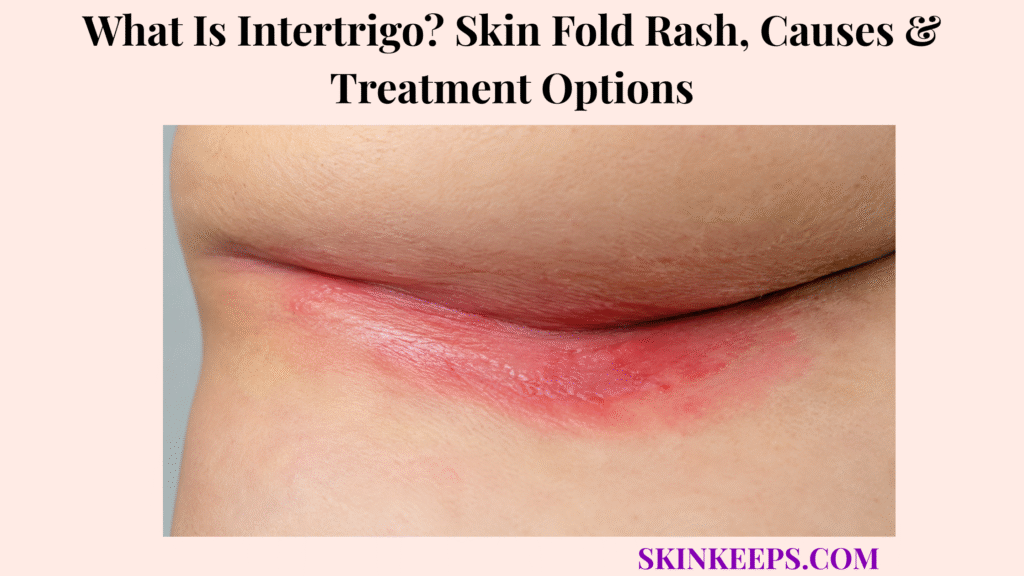
Intertrigo, also called intertriginous dermatitis, is an inflammatory rash that develops where two skin surfaces rub together in a warm, moist and poorly ventilated fold. Affected skin may become sore, itchy, burning, peeling, cracked, macerated or raw.
It begins through trapped moisture, heat, occlusion and friction rather than one specific germ. Candida, dermatophytes or bacteria can secondarily infect damaged fold skin, so treatment must reduce moisture and rubbing while matching any confirmed infection or inflammatory mimic.
How Can You Recognize Intertrigo in a Skin Fold?
Intertrigo usually appears as a sore, moist or inflamed rash centred where two skin surfaces touch.
- Pink, red, red-brown, purple-brown, grey-brown or darker inflammation.
- Moist, shiny or softened skin.
- Pale soggy maceration.
- Peeling, shallow erosion or weeping.
- Itching, burning, stinging or tenderness.
- Cracks that worsen with movement.
- Odour, pus or discharge when infection develops.
- Worsening with heat, sweating or friction.
A painful skin fissure can form when macerated fold skin repeatedly splits during movement.
Figure 1. Intertrigo is centred where skin surfaces touch and may appear moist, macerated, peeling, fissured or raw. It can affect many folds, and inflammation may be pink, red, purple-brown, grey-brown or mainly visible through surface change.
Where Does Intertrigo Usually Develop?
Intertrigo develops in folds where heat, sweat and friction become trapped.
| Common Fold | Typical Contributor |
|---|---|
| Under the breasts | Skin contact, sweat and limited ventilation |
| Abdominal fold or skin apron | Deep fold contact and retained moisture |
| Armpits | Sweat, deodorants and friction |
| Groin and inner thighs | Movement, clothing and incontinence |
| Buttock cleft and perineal folds | Moisture, pressure and cleansing irritation |
| Neck and behind ears | Infant folds, drooling or occlusion |
| Finger and toe webs | Water exposure or enclosed footwear |
| Beneath braces or prostheses | Pressure, rubbing and poor ventilation |
How Can Intertrigo Look Across Different Skin Tones?
Intertrigo does not always look bright red; moisture, tenderness and surface change may be stronger clues.
- Bright pink or red inflammation on lighter skin.
- Red-brown, purple-brown, grey-brown or deeper-brown change on darker skin.
- Pale maceration within the wet centre.
- Shiny or raw texture.
- Fissures more visible than colour change.
- Residual darkening after healing.
How Do Moisture and Friction Cause Intertrigo?
Moisture softens the fold barrier, and repeated friction then breaks the surface down.
- Opposing skin surfaces remain in contact.
- Sweat and normal water loss cannot evaporate.
- The outer layer absorbs water and macerates.
- Movement creates repeated rubbing.
- Inflammation, peeling and fissures develop.
- Normal microorganisms can overgrow in the damaged fold.
Figure 2. Occlusion traps moisture, friction damages the softened barrier and secondary infection may follow. Candida, tinea, bacterial infection, erythrasma, inverse psoriasis and contact dermatitis have different clues and require different treatment.
Is Intertrigo Always a Fungal Infection?
No. Intertrigo is first a moisture-and-friction inflammatory rash and may remain uninfected.
- Candida can infect a warm damaged fold.
- Dermatophytes can cause tinea that resembles intertrigo.
- Bacteria can overgrow alone or with fungi.
- Inverse psoriasis can mimic infection.
- Antifungal treatment should match likely or confirmed infection.
- Persistent failure requires diagnostic reassessment.
Who Is More Likely to Develop Intertrigo?
Risk rises when moisture remains trapped and folds repeatedly rub.
- People with deep or closely opposed folds.
- Infants and older adults.
- People with limited mobility or dependent care.
- People who sweat heavily or work in humidity.
- Athletes.
- People with diabetes or reduced immunity.
- People with urinary or faecal incontinence.
- People using absorbent garments, braces, splints or prostheses.
- People wearing tight or non-breathable clothing.
Intertrigo is not a personal-cleanliness failure.
How Do Sweating and Hot Weather Worsen Intertrigo?
Heat and sweating keep folds wet and increase friction during movement.
- High temperatures increase sweating.
- Humidity slows evaporation.
- Damp clothing increases occlusion.
- Exercise creates repeated movement.
- Hyperhidrosis can produce recurrent flares.
- Cooling, drying and changing clothing reduce moisture accumulation.
How Do Diabetes and Reduced Immunity Affect Intertrigo?
Diabetes and reduced immunity can make intertrigo more persistent and infection-prone.
- Higher glucose can support yeast growth.
- Immune responses may be impaired.
- Neuropathy can delay recognition of injury.
- Poor circulation can slow healing.
- Immunosuppressive medicines increase susceptibility.
- Recurrent, extensive or resistant Candida may justify metabolic or immune review.
One small episode does not prove diabetes.
How Can Incontinence Cause or Worsen Intertrigo?
Incontinence adds prolonged moisture, irritant enzymes and occlusion to groin, perineal and buttock folds.
- Urine and stool keep the barrier wet.
- Digestive enzymes irritate skin.
- Absorbent garments trap heat.
- Frequent wiping can add friction.
- Incontinence-associated dermatitis can coexist with intertrigo and Candida.
- Care includes prompt cleansing, drying, garment changes and barrier protection.
What Does Candidal Intertrigo Look Like?
Candidal intertrigo often forms a moist inflamed plaque with peripheral scale and satellite papules or pustules.
- Bright or deep-red moist plaque.
- Macerated surface.
- Peripheral peeling or scale.
- Small satellite papules or pustules.
- Extension beyond the main fold.
- Itch, burning or soreness.
Satellite papules or pustules around a moist fold rash may suggest cutaneous candidiasis, especially when the area remains warm and macerated.
How Is Candidal Intertrigo Different From Uninfected Intertrigo?
Uninfected intertrigo is mainly symmetrical frictional inflammation, while Candida adds yeast overgrowth.
| Feature | Uninfected Intertrigo | Candidal Intertrigo |
|---|---|---|
| Pattern | Often mirrors both opposing surfaces | May extend beyond the fold |
| Maceration | Variable | Often more marked |
| Satellite lesions | Absent | Papules or pustules may occur |
| Scale | Limited | Peripheral scale may occur |
| Response | Drying and friction control may be enough | Needs antifungal plus moisture control |
How Is Intertrigo Different From Tinea Cruris?
Tinea cruris often has an asymmetrical advancing scaly border, while intertrigo centres more directly within the fold.
| Feature | Intertrigo / Candida | Tinea Cruris |
|---|---|---|
| Symmetry | Often affects both opposing surfaces | Often asymmetrical |
| Border | No expanding ring required | Raised or scaly advancing edge |
| Centre | Moist fold-centred inflammation | Partial central clearing possible |
| Genital involvement | Candida can involve scrotal or vulval skin | Scrotum often relatively spared |
| Foot reservoir | Not required | Athlete’s foot commonly coexists |
Groin dermatophyte infection may recur when untreated athlete’s foot reseeds the area through clothing, towels or scratching.
What Does Bacterial Intertrigo Look Like?
Bacterial infection is more likely when a fold rash develops odour, pus, worsening pain, crusting or spread.
- Increasing pain or tenderness.
- Foul odour.
- Pus or purulent discharge.
- Crusting or rapid erosion.
- Green colour in some gram-negative toe-web infections.
- Redness extending beyond the fold.
- Fever in more serious disease.
What Is Erythrasma—and How Does It Resemble Intertrigo?
Erythrasma is a superficial Corynebacterium fold infection that can resemble fungal intertrigo.
- Well-defined pink, red-brown or brown patch.
- Fine scale and superficial fissures.
- Mild itch or no symptoms.
- Armpit, groin, under-breast or toe-web involvement.
- Coral-pink fluorescence under a Wood lamp.
A defined brown fold patch with fine scale may suggest erythrasma, especially when Wood-lamp examination shows coral-pink fluorescence.
How Is Intertrigo Different From Inverse Psoriasis?
Inverse psoriasis is a chronic inflammatory fold disease rather than a moisture infection.
| Feature | Intertrigo | Inverse Psoriasis |
|---|---|---|
| Surface | Macerated, chafed or fissured | Smooth or shiny |
| Border | Often less sharply defined | Clearly defined |
| Symmetry | Can be symmetrical | Frequently bilateral and symmetrical |
| Other clues | Heat and moisture relationship | Scalp, nail, elbow or knee psoriasis |
| Response | Improves with drying if uncomplicated | Persists without psoriasis-directed care |
How Is Intertrigo Different From Contact Dermatitis?
Contact dermatitis is more likely when the rash repeatedly follows the same product exposure.
- Deodorants, wipes, soaps or laundry products.
- Adhesives, sanitary products or incontinence products.
- Topical medicines or preservatives.
- Intense itch.
- Rash matching the contact area.
- Improvement after the exposure stops.
- Patch testing when allergy remains possible.
A rash that repeatedly follows deodorants, wipes, adhesives or fragranced products may reflect allergic contact dermatitis rather than infection.
Which Other Skin-Fold Conditions Can Mimic Intertrigo?
Treatment failure should trigger reassessment for other fold disorders.
| Clue | Possible Mimic |
|---|---|
| Recurrent painful nodules, abscesses or tunnels | Hidradenitis suppurativa |
| Fragile recurrent erosions with family history | Hailey–Hailey disease |
| Grouped painful blisters | Herpes simplex |
| Intense night itch and burrows | Scabies |
| Greasy scale involving scalp and folds | Seborrhoeic dermatitis |
| Persistent unilateral genital or fold plaque | Paget disease or another biopsy diagnosis |
Recurrent painful nodules, abscesses or tunnels in folds may suggest hidradenitis suppurativa, not a simple moisture rash.
How Do Clinicians Diagnose Intertrigo?
Diagnosis combines the fold location, moisture-friction pattern and signs of infection or mimics.
- Onset and recurrence.
- Heat, sweating, clothing and friction.
- Incontinence, diabetes and immune status.
- Product and medicine exposure.
- Symmetry and degree of maceration.
- Fissures, scale, satellite lesions, odour or discharge.
- Advancing border or psoriasis clues.
- Signs of cellulitis.
When Are Fungal Scrapings or Cultures Needed?
Fungal testing is useful when Candida, tinea or mixed infection cannot be separated confidently.
- Peripheral scale or advancing border.
- Unclear Candida-versus-tinea pattern.
- Failed or recurrent antifungal treatment.
- Immune suppression.
- Possible mixed infection.
- Oral antifungal consideration.
Options include KOH microscopy, fungal scraping and fungal culture.
When Are Bacterial Culture, Wood Lamp or Biopsy Needed?
Additional testing is chosen when it can change treatment or exclude a mimic.
| Test | Useful Clues |
|---|---|
| Bacterial culture | Pus, strong odour, green toe web, spread, recurrence or failure |
| Wood lamp | Persistent defined brown patch suggesting erythrasma |
| Biopsy | Persistent unilateral, thickened, ulcerated or treatment-resistant plaque |
| Patch testing | Repeated product-contact pattern suggesting allergy |
Does Every Case of Intertrigo Require Medication?
No. Mild uninfected intertrigo may improve when moisture, contact and friction are controlled.
- Drying and fold separation may control uncomplicated disease.
- Barrier products protect injured skin.
- Antifungal treatment is used for likely Candida or dermatophytes.
- Antibacterial treatment is selected for bacterial disease.
- Inflammatory mimics need diagnosis-specific care.
- Deep or spreading infection may need oral medicine.
How Should an Intertrigo-Affected Fold Be Cleaned and Dried?
Clean gently and dry completely without rubbing raw skin.
- Use lukewarm water.
- Use a mild fragrance-free cleanser when needed.
- Rinse away residue.
- Pat dry with a soft clean cloth.
- Use a cool hairdryer on a low setting when touching hurts.
- Dry after bathing, exercise or sweating.
- Change damp clothing promptly.
- Apply prescribed treatment only after drying.
How Can Skin-to-Skin Friction Be Reduced?
Separate, ventilate and protect opposing fold surfaces.
- Wear loose breathable clothing.
- Avoid tight elastic over the fold.
- Use a properly fitted bra.
- Change wet sports clothing.
- Use a soft moisture-wicking fold textile.
- Replace the textile when damp.
- Refit braces or prostheses that rub.
- Avoid bulky wet material packed into a fold.
Which Barrier Products Can Protect Intertrigo-Prone Skin?
Barrier products reduce rubbing, moisture injury and irritant exposure when applied to clean dry skin.
| Barrier Option | Main Role |
|---|---|
| Petrolatum | Reduces friction and water exposure |
| Zinc oxide paste | Protects against moisture and irritants |
| Dimethicone or silicone barrier | Forms a lighter protective layer |
| Polymer barrier film | Protects selected high-risk areas |
| Clinician-selected protectant | Matches wound, incontinence or equipment needs |
Barrier care does not replace antifungal or antibacterial treatment when infection is present.
How Should Moisture Be Controlled Without Irritating the Fold?
Use ventilation, drying and breathable materials rather than irritating raw skin.
- Change damp garments promptly.
- Use breathable clothing and wicking textiles.
- Improve room ventilation.
- Use a cool hairdryer after cleansing.
- Keep toe webs ventilated.
- Rotate shoes and let them dry.
- Consider site-appropriate drying or antiperspirant products with professional advice.
Powders can clump when wet and increase friction. Avoid cornstarch when Candida is suspected and keep loose powders away from an infant’s face.
How Is Candidal Intertrigo Treated?
Candidal intertrigo treatment combines fold-environment correction with Candida-directed therapy.
- Keep the fold cool and dry.
- Reduce direct skin contact.
- Address sweating, incontinence or occlusion.
- Review glucose control when relevant.
- Use a topical azole or nystatin when appropriate.
- Complete the recommended course.
- Reserve oral antifungal treatment for extensive, severe or resistant disease under supervision.
How Is Bacterial Intertrigo Treated?
Bacterial intertrigo receives targeted antimicrobial treatment only when infection is clinically supported.
- Culture purulent, recurrent or resistant infection.
- Clean and dry gently.
- Use a selected topical antiseptic or antibiotic for limited disease.
- Use oral treatment when infection is extensive, spreading or systemic.
- Treat erythrasma with appropriate antibacterial care.
- Assess for abscess or cellulitis.
When Can a Topical Corticosteroid Be Used in Intertrigo?
A mild topical corticosteroid has a narrow, short, clinician-directed role when significant inflammation remains and infection is treated or excluded.
- Folds absorb medicine readily.
- Occlusion increases penetration.
- Potent or prolonged use can cause thinning.
- Stretch marks and visible vessels can develop.
- Steroid monotherapy can mask fungal infection.
- Calcineurin inhibitors may be steroid-sparing for selected chronic inflammatory fold disease.
How Is Intertrigo Managed Beneath the Breasts?
Under-breast care combines support, ventilation, drying, separation and cause-specific treatment.
- Wash gently and dry completely.
- Use a supportive breathable bra.
- Change damp bras or garments.
- Use a soft wicking liner and replace it when damp.
- Use barrier treatment on uninfected friction sites.
- Look for Candida satellite lesions or erythrasma.
- Reassess a persistent one-sided plaque.
How Is Intertrigo Managed in the Groin?
Groin care requires separating frictional inflammation from Candida, tinea, psoriasis and genital dermatoses.
- Use loose breathable underwear.
- Change sweaty clothing.
- Dry after bathing and exercise.
- Avoid fragranced wipes and harsh cleansers.
- Look for satellite pustules or an advancing scaly border.
- Treat athlete’s foot that reseeds groin tinea.
- Avoid prolonged potent steroid use.
- Assess genital pain, ulceration, blisters or a persistent unilateral plaque.
How Is Toe-Web Intertrigo Managed?
Toe-web intertrigo needs complete drying and infection assessment because fungal and bacterial disease can coexist.
- Dry between every toe.
- Use ventilated footwear.
- Change socks after sweating.
- Rotate shoes.
- Check for athlete’s foot.
- Look for severe maceration, discharge, green colour or strong odour.
- Use fungal scraping or bacterial culture when severe.
- Assess walking difficulty and cellulitis risk.
How Is Intertrigo Managed in Babies?
Babies need gentle fold care and prompt assessment when infection signs appear.
- Check neck, groin and thigh folds.
- Clean after feeding, drooling or diaper changes.
- Dry folds carefully.
- Change wet diapers promptly.
- Use an infant-appropriate barrier.
- Avoid fragranced wipes on irritated skin.
- Avoid loose powder near the face.
- Seek care for fever, poor feeding, rapid spread, blisters, pus or illness.
How Is Intertrigo Managed During Pregnancy?
Pregnancy does not change mechanical fold care, but medicine safety must be reviewed.
- Confirm whether infection is present.
- Clean gently and dry carefully.
- Use breathable clothing and suitable barrier care.
- Review topical antifungal choice.
- Do not begin oral antifungal therapy without pregnancy-specific assessment.
- Use topical corticosteroids only at appropriate potency and duration.
- Review gestational-diabetes risk when infection is recurrent.
Why Does Intertrigo Keep Returning?
Recurrence occurs when moisture, friction, infection reservoirs or the wrong diagnosis remain unresolved.
- Persistent skin contact and sweating.
- Hot humid weather.
- Tight clothing or damp liners.
- Incontinence.
- Poorly fitting equipment.
- Diabetes.
- Repeated Candida overgrowth.
- Athlete’s foot reseeding another site.
- Incomplete treatment.
- Mixed infection.
- Inverse psoriasis or contact dermatitis mistaken for infection.
How Can Recurrent Intertrigo Be Prevented?
Prevention follows a clean, dry, separate, ventilate and protect routine.
- Inspect high-risk folds regularly.
- Clean gently and dry completely.
- Change damp clothing quickly.
- Use breathable garments and wicking fold material.
- Prevent direct rubbing.
- Manage sweating and incontinence.
- Treat athlete’s foot and other reservoirs.
- Maintain glucose control.
- Review mobility and equipment needs.
- Use a preventive barrier on recurrent friction sites.
Which Intertrigo Treatment Mistakes Should Be Avoided?
Incorrect products or technique can prolong maceration, mask infection or injure fold skin.
| Mistake | Why It Fails | Possible Harm | Safer Action |
|---|---|---|---|
| Assume every rash is Candida | Misses bacteria or inflammatory disease | Persistent rash | Reassess the pattern |
| Use antifungal indefinitely | Wrong diagnosis may remain | Delay in care | Review nonresponse |
| Repeat potent steroid | Fold absorption is high | Atrophy and striae | Use mild brief therapy only when selected |
| Scrub raw skin | Adds barrier injury | Pain and infection | Clean gently |
| Pack damp cloth in fold | Maintains pressure and moisture | Maceration | Use dry wicking material |
| Use cornstarch with suspected Candida | May support fungal growth | Persistent infection | Use site-appropriate drying strategy |
| Apply many products together | Increases irritation and occlusion | Contact dermatitis | Use a defined plan |
| Dismiss pus or spread | May miss deeper infection | Abscess or cellulitis | Seek assessment |
How Long Does Intertrigo Take to Improve?
Improvement depends on the cause and whether the moisture-friction cycle is controlled.
- Frictional disease may improve after drying and separation.
- Candida requires completion of the advised antifungal course.
- Bacterial infection should respond to targeted therapy.
- Fissures can remain tender after infection settles.
- Residual dark or light marks may persist.
- Ongoing sweating or incontinence delays healing.
- Failure to improve requires reassessment.
Success includes less pain, a dry surface, closed fissures and no new satellite lesions—not colour change alone.
Which Complications Can Intertrigo Cause?
Maceration can form fissures that allow microorganisms to enter deeper tissue.
- Painful fissures and bleeding.
- Candida, dermatophyte or erythrasma infection.
- Staphylococcal, streptococcal or gram-negative infection.
- Abscess.
- Cellulitis.
- Chronic thickening and post-inflammatory pigmentation.
- Reduced mobility and recurrent infection.
Rapidly spreading warmth, swelling and pain beyond the fold may suggest cellulitis, which is deeper than uncomplicated intertrigo.
When Should Intertrigo Be Checked by a Clinician?
Assessment is appropriate when moisture control is insufficient or infection, recurrence or a mimic is possible.
- Painful, cracked, raw or bleeding skin.
- Satellite pustules, pus or strong odour.
- Several affected folds.
- Repeated recurrence or treatment failure.
- Diabetes or immune suppression.
- A baby or dependent older adult.
- Toe-web disease that interferes with walking.
- A persistent unilateral plaque.
- Possible need for oral treatment.
Which Intertrigo Symptoms Require Urgent Medical Care?
Urgent care is needed when symptoms suggest deeper infection, tissue damage or systemic illness.
- Fever.
- Rapidly spreading redness or dark inflammation.
- Severe or escalating pain.
- Marked warmth and swelling.
- Pus, red streaking or a fluctuant lump.
- Black, grey or dying skin.
- Confusion, dizziness or fainting.
- Rapid deterioration in a baby.
- Spreading infection with diabetes or immune suppression.
- Inability to walk from severe toe-web disease.
- Face or neck-fold swelling affecting breathing or swallowing.
Urgent route: fever, spreading redness, severe pain, pus, red streaking, blackened skin, confusion, fainting, rapid infant deterioration or breathing/swallowing difficulty requires urgent or emergency care.
Figure 3. Intertrigo care starts by cleaning gently, drying completely, separating the fold and protecting the barrier. Antifungal, antibacterial or anti-inflammatory treatment is added only when the cause supports it, while spreading or systemic symptoms need prompt care.
What Should You Remember About Intertrigo?
Intertrigo is inflammation where opposing skin surfaces trap heat and moisture and rub together.
- It is not automatically a fungal infection.
- Candida may create satellite papules or pustules.
- Tinea often has an asymmetrical advancing scaly border.
- Erythrasma may fluoresce coral-pink under a Wood lamp.
- Inverse psoriasis and contact dermatitis can mimic infection.
- Diagnosis is usually clinical, with testing used selectively.
- Treatment starts with gentle cleansing, complete drying and friction reduction.
- Barrier products protect vulnerable skin.
- Antifungal and antibacterial treatment should match the cause.
- Potent prolonged fold steroid use can damage skin.
- Recurrence prevention requires moisture, friction and contributor control.
- Fever, pus, spread or systemic illness requires prompt care.
Frequently Asked Questions About Intertrigo?
Is intertrigo always caused by a fungal infection?
No. Intertrigo begins as inflammation from moisture, heat and friction. Candida, dermatophytes or bacteria can secondarily infect the damaged fold, so antifungal treatment should match likely or confirmed infection.
What does intertrigo look and feel like?
It may cause a sore, itchy, burning, moist or raw fold rash. Skin can look red, red-brown, purple-brown, grey-brown, darker, shiny, macerated, cracked, peeling or weepy.
How is intertrigo treated in skin folds?
Treatment starts with gentle cleansing, complete drying, friction reduction, breathable clothing, fold separation and barrier protection. Antifungal, antibacterial or anti-inflammatory medicines are added only when the cause supports them.
Why does intertrigo keep returning?
Recurrence can reflect sweating, heat, skin-to-skin rubbing, incontinence, tight clothing, diabetes, untreated athlete’s foot, mixed infection, incomplete treatment or a mimic such as inverse psoriasis or contact dermatitis.
When can intertrigo become a serious infection?
Urgent care is needed for fever, rapidly spreading redness, severe pain, pus, red streaking, marked swelling, blackened skin, systemic illness, spreading infection with diabetes or immune suppression, or rapid deterioration in a baby.
Which Sources Support This Intertrigo Guidance?
DermNet — Intertrigo — Definition, fold locations, moisture-friction mechanism, microorganisms, differential diagnosis and cause-directed treatment.
Merck Manual Professional — Intertrigo — Friction and trapped moisture, maceration, clinical diagnosis, KOH testing, cultures and drying or infection-directed treatment.
DermNet — Candidal Intertrigo — Candida risk factors, moist fold pattern, satellite lesions, cooling, drying and antifungal treatment.
DermNet — Tinea Cruris — Asymmetrical groin rash, raised scaly border, central clearing, athlete’s-foot association and mycology confirmation.
DermNet — Erythrasma — Corynebacterium minutissimum, defined pink or brown fold patches and coral-pink Wood-lamp fluorescence.
Primary Care Dermatology Society — Intertrigo — Risk factors, fold distribution, differential diagnosis, scraping, bacterial swab and prevention through friction and moisture control.
University Hospitals of Liverpool — Under-Breast Soreness — Intertriginous dermatitis terminology, trapped moisture, reduced circulation, skin rubbing and secondary microbial irritation.
DermNet — Topical Steroids — Greater absorption in skin creases, occlusion effects, atrophy, striae, visible vessels and infection masking.
This SkinKeeps article is educational and does not replace dermatology, primary-care, pediatric, pregnancy, diabetes, infectious-disease, wound-care, podiatry or emergency care. Seek prompt care for fever, spreading redness, severe pain, swelling, pus, red streaks, blackened skin, confusion, fainting, breathing or swallowing difficulty, rapid illness in a baby, or infection spreading with diabetes or immune suppression. Do not assume every fold rash is Candida, use antifungal cream indefinitely, repeatedly apply potent steroids, scrub raw skin, leave folds wet, pack damp material into them, use cornstarch on suspected Candida, place loose powder near an infant’s face, or take saved oral medicines.