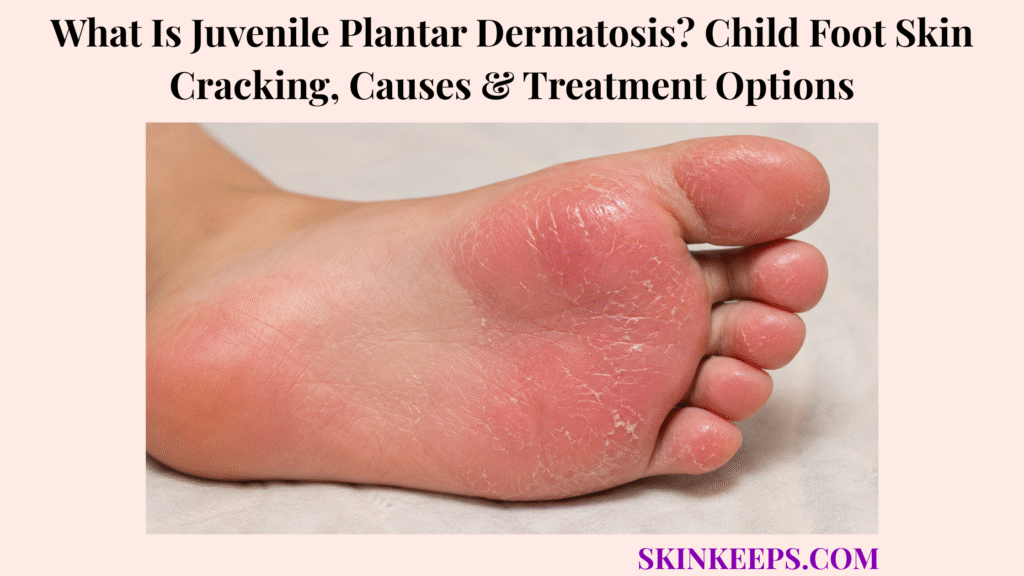
Juvenile plantar dermatosis, abbreviated JPD, is a recurring childhood foot dermatitis that causes shiny, dry, scaly and sometimes painfully cracked skin on weight-bearing soles. It most often affects children approximately 3–14 years old and commonly begins on the great-toe pad, ball of the great toe and forefoot.
Both feet are usually affected symmetrically, while toe webs and the instep are commonly spared. Friction, sweating, rapid drying and non-breathable footwear weaken the barrier; treatment focuses on better shoe fit, dry socks, emollients and fissure protection, and many children improve during adolescence.
How Can Juvenile Plantar Dermatosis Be Recognized?
JPD is recognized by shiny, glazed, dry and fissured skin on a child’s weight-bearing forefoot.
- Smooth, shiny or glazed surface.
- Pink, red, red-brown, purple-brown or darker inflammation.
- Dry scale or superficial peeling.
- Blurred or lost sole ridge markings.
- Painful linear cracks.
- Tenderness during walking.
- Itching, burning or stinging in some children.
- Repeated improvement and recurrence.
- Similar involvement of both feet.
- Worsening after long periods in shoes.
Figure 1. Juvenile plantar dermatosis usually produces symmetrical shiny, scaly and fissured skin on the great-toe pads and weight-bearing forefoot while sparing the toe webs and instep. Colour varies across skin tones, so distribution and surface texture matter.
Which Parts of the Foot Does JPD Usually Affect?
JPD usually affects the weight-bearing forefoot, especially the great-toe pad.
| Commonly Affected | Commonly Spared |
|---|---|
| Plantar surface of the great toe | Spaces between toes |
| Ball beneath the great toe | Instep or arch |
| Other toe pads and forefoot | Top of the foot |
| Other weight-bearing sole areas | Many non-weight-bearing central areas |
| Heel in some children | Dorsal foot unless another diagnosis coexists |
How Can JPD Look Across Different Skin Tones?
JPD does not always look bright red; shine, scale, fissuring and location may be more reliable.
- Pink or red glazed skin on lighter tones.
- Red-brown, purple-brown, grey-brown or darker change on deeper tones.
- Pale superficial scale.
- Light-coloured fissure edges.
- Dark residual pigmentation after inflammation settles.
- Tenderness despite subtle colour change.
Which Children Are Most Likely to Develop Juvenile Plantar Dermatosis?
JPD most often affects children in early school years, especially those with sweaty feet, sensitive skin or long periods in occlusive footwear.
- Children approximately 3–14 years old.
- Children with sweaty feet.
- Children wearing occlusive shoes for long periods.
- Children with repeated forefoot friction from walking or sport.
- Children with sensitive skin.
- Children with personal or family atopic background.
Children with atopic dermatitis may have more sensitive skin, although JPD can occur without atopy.
How Do Friction and Footwear Cause JPD?
Repeated movement and pressure damage sweat-softened weight-bearing skin inside the shoe.
- The foot moves inside the shoe.
- Forefoot skin experiences rubbing and shear.
- Tight or synthetic footwear limits ventilation.
- Sweat softens the outer layer.
- Continued movement damages the barrier.
- Rapid drying follows shoe removal.
- The weakened surface becomes glazed, scaly and fissured.
Figure 2. JPD develops through a wet–rub–dry cycle: occlusive footwear traps sweat, softened plantar skin is injured by movement and pressure, and rapid drying produces glazed scale and fissures. Distribution and lesion type help separate fungal, allergic, psoriatic and vesicular mimics.
Why Can Sweating Produce Dry, Cracked Feet?
Sweaty feet become dry and cracked through repeated wetting, rubbing and rapid drying.
- Sweat initially hydrates and softens the outer skin.
- Occlusive shoes delay evaporation.
- Softened skin becomes vulnerable to shear.
- Movement injures the pressure-bearing surface.
- Moisture evaporates after shoes are removed.
- The damaged layer contracts and fissures.
Does JPD Have a Predictable Seasonal Pattern?
No single season applies because different weather and footwear patterns can trigger the same cycle.
| Context | Possible Trigger |
|---|---|
| Warm weather | More sweating |
| Sandals | Greater foot sliding and friction |
| Sports or outdoor play | Higher mechanical stress |
| Cold weather | Heavy boots and occlusion |
| Indoor heating | Faster surface drying |
| Any season | Poor shoe fit or damp socks |
Is Juvenile Plantar Dermatosis a Form of Eczema?
JPD is a localized inflammatory dermatitis, but its symmetrical mechanical forefoot pattern is more specific than general eczema.
It belongs within the broader dermatitis / eczema family, yet friction, sweating and footwear are central to its distribution.
- Barrier impairment contributes.
- Atopic children may have sensitive plantar skin.
- JPD can coexist with eczema elsewhere.
- Mechanical and barrier care remains foundational.
- Anti-inflammatory medicine alone does not remove friction or sweat trapping.
How Is JPD Different From Ordinary Dry or Cracked Feet?
JPD has a child-specific, symmetrical and glazed forefoot pattern.
Ordinary dry skin / xerosis may affect heels or the whole sole at any age, while JPD centres on pressure-bearing forefoot skin.
| Feature | JPD | Ordinary Dry Feet |
|---|---|---|
| Age pattern | Childhood | Any age |
| Main site | Forefoot and great-toe pads | Heels or whole sole |
| Surface | Shiny or glazed | Generally rough or flaky |
| Symmetry | Usually marked | Variable |
| Toe webs | Usually spared | May be unaffected but not diagnostic |
| Friction link | Strong | Less specific |
How Is JPD Different From Tinea Pedis?
JPD usually spares toe webs and instep, while tinea pedis often begins between toes or extends along the instep or side.
Classic athlete’s foot often begins between the toes, while JPD usually has a symmetrical great-toe and forefoot pattern.
| Feature | JPD | Tinea Pedis |
|---|---|---|
| Symmetry | Usually both feet similarly | Can be asymmetrical |
| Toe webs | Usually spared | Commonly involved |
| Instep or lateral sole | Usually spared | Can be involved |
| Surface | Shiny forefoot with fissures | Maceration, scale or advancing border |
| Toenails | Not fungal | Fungal nails may coexist |
| Testing | Fungal scraping negative | Microscopy or culture may be positive |
How Is JPD Different From Footwear Contact Dermatitis?
Footwear contact dermatitis follows a shoe-component exposure rather than pressure-bearing anatomy.
A rash matching straps, adhesives, dyes or shoe materials may suggest allergic contact dermatitis rather than JPD.
| Feature | JPD | Footwear Contact Dermatitis |
|---|---|---|
| Distribution | Weight-bearing plantar forefoot | Dorsal, side or component-shaped |
| Borders | Pressure pattern | May sharply match strap or insole |
| Symptoms | Pain and fissuring | Strong itch, burning or weeping |
| Exposure | General footwear friction | Specific shoe material |
| Test | Usually clinical | Patch testing may identify allergen |
How Is JPD Different From Plantar Psoriasis?
Plantar psoriasis tends to form thicker sharply defined plaques and may have psoriasis clues elsewhere.
| Feature | JPD | Plantar Psoriasis |
|---|---|---|
| Surface | Shiny glazed dermatitis | Thick plaque |
| Border | Pressure-related | Sharper and more defined |
| Scale | Fine or moderate | Often substantial |
| Other sites | Usually feet only | Palms, scalp, elbows or knees may be involved |
| Nails | No psoriatic changes | Pitting, thickening or separation possible |
| Course | Often improves in adolescence | May persist |
How Is JPD Different From Keratolysis Exfoliativa?
Keratolysis exfoliativa causes superficial circular peeling, while JPD emphasizes inflamed glazed forefoot skin and painful fissures.
| Feature | JPD | Keratolysis Exfoliativa |
|---|---|---|
| Peeling | Associated with shine and fissures | Circular peeling with collarettes |
| Inflammation | More visible or tender | Often limited |
| Itch | Possible | Usually little |
| Fissures | Central complication | Less dominant |
| Hands | Rare | Palms often involved |
How Is JPD Different From Dyshidrotic Eczema?
Dyshidrotic eczema starts with deep intensely itchy vesicles rather than a primary glazed forefoot surface.
A crop of deep itchy foot blisters suggests dyshidrotic eczema rather than the primary fissuring pattern of JPD.
| Feature | JPD | Dyshidrotic Eczema |
|---|---|---|
| Primary lesion | Shiny scale and fissures | Deep small vesicles |
| Itch | Variable | Often intense |
| Sites | Pressure-bearing forefoot | Toe sides, instep or soles |
| Sequence | Glaze then crack | Blister then peel |
| Hands | Rare | May occur simultaneously |
Can JPD Develop a Secondary Infection?
Bacterial infection is uncommon but can enter through deep fissures.
- Increasing redness or dark inflammation.
- New warmth or swelling.
- Increasing pain.
- Pus or yellow crust.
- Unpleasant odour.
- Red streaking.
- Fever or rapid deterioration.
How Do Clinicians Diagnose Juvenile Plantar Dermatosis?
Diagnosis is usually clinical and uses age, symmetry, pressure-site distribution, shine, fissures and spared toe webs.
- Age and recurrence.
- Pain, itching and sweating.
- Shoe, sock, sport and seasonal history.
- Atopic background.
- Previous antifungal or steroid response.
- Symmetry and great-toe-pad involvement.
- Toe-web and instep sparing.
- Fissure depth, nail changes and rashes elsewhere.
When Is a Fungal Scraping Needed?
Scraping is useful when tinea remains possible because the rash is atypical or involves fungal-pattern sites.
- Toe-web involvement.
- Marked asymmetry.
- Advancing scaly border.
- Possible fungal toenails.
- Communal changing-area exposure.
- Failed antifungal treatment.
- Uncertain diagnosis before long-term therapy.
Testing may include potassium-hydroxide microscopy, fungal culture and nail sampling.
When Is Patch Testing Useful?
Patch testing is useful when the pattern suggests shoe-material allergy.
- Dorsal or side-of-foot involvement.
- Pattern matching straps, adhesives or insoles.
- New footwear onset.
- Prominent itch, blistering or weeping.
- Repeated reactions to similar shoe materials.
- Failure of classic JPD care.
When Is a Skin Biopsy Considered?
Biopsy is uncommon and reserved for atypical, persistent or treatment-resistant disease.
- Unusual distribution.
- Persistence beyond the expected age.
- Possible plantar psoriasis.
- Possible inherited peeling or keratoderma disorder.
- Progressive thickening or ulceration.
- Failure of an appropriate care plan.
Does Every Child With JPD Need Prescription Treatment?
No. Footwear, sock control, emollients and fissure protection are the foundation.
- Mild disease may respond without prescription medicine.
- Painful cracks need wound protection.
- Inflamed itchy flares may need a brief anti-inflammatory course.
- Antifungals require fungal evidence.
- Antibiotics require bacterial infection.
- Persistent nonresponse requires diagnostic review.
Which Shoes Are Best for Juvenile Plantar Dermatosis?
The best shoes are well fitted, breathable and stable enough to reduce forefoot sliding.
- Correct length and width.
- Room at the toes.
- Stable fit with low sliding.
- Breathable upper.
- Soft interior without rough seams.
- Dry insole.
- Rotation between pairs.
- Replacement when worn or poorly fitting.
Loose sandals can worsen friction when the foot repeatedly slides, while tight synthetic shoes trap sweat and pressure.
Which Socks Help Reduce JPD Flares?
Socks help when they absorb moisture and cushion friction without making shoes tight.
- Cotton or wool socks.
- Soft seamless construction.
- Comfortable moisture-wicking material.
- Correct size.
- Change whenever damp.
- Spare pair for school or sport.
- Two thin pairs in selected children if shoe space remains adequate.
How Should the Feet Be Washed and Dried?
Wash gently, dry carefully and moisturize without stripping or scrubbing.
- Use lukewarm water.
- Use mild fragrance-free cleanser or soap substitute.
- Avoid prolonged hot soaking.
- Do not scrub or file glazed skin.
- Rinse fully and pat dry.
- Dry gently between toes.
- Apply emollient to affected plantar sites.
- Change damp socks after bathing or exercise.
Which Moisturizers Work Best for JPD?
Thick fragrance-free products restore flexibility and reduce cracking.
| Product | Best Use |
|---|---|
| Petrolatum or white soft paraffin | After bathing and before bed |
| Thick fragrance-free ointment | Very dry or fissure-prone skin |
| Rich emollient cream | Daytime use |
| Urea cream | Intact dry scaly skin when tolerated |
| Dimethicone barrier | Daytime friction protection |
How Should Urea Be Used on a Child’s Cracked Feet?
Use an age-appropriate urea product cautiously because inflamed or open skin may sting.
- Start on intact dry skin.
- Use a thin layer.
- Begin once daily if sensitive.
- Add a bland moisturizer when needed.
- Reduce or stop if persistent burning develops.
- Do not place into open fissures.
- Avoid adult-strength callus products.
How Should Painful JPD Fissures Be Protected?
Fissures need protection so walking does not repeatedly pull them open.
A painful skin fissure should be cleaned gently, moisturized, covered and monitored for infection.
- Apply petrolatum or prescribed ointment.
- Bring edges together gently without force.
- Cover with a suitable dressing.
- Replace wet or dirty coverings.
- Use cushioned footwear.
- Reduce running and high-impact activity temporarily.
- Avoid strong acids and unapproved household glue.
Why Can Rest Help Painful Foot Cracks Heal?
Every step stretches the fissure, while reduced activity gives the new surface time to close.
- Walking pulls healing edges apart.
- Running increases forefoot pressure.
- Sweat keeps the surface vulnerable.
- Short low-activity periods support closure.
- Return to full activity should be gradual.
- Temporary school accommodation may be needed.
When Can a Topical Corticosteroid Be Used?
A mild or moderate prescribed corticosteroid has a limited role during distinctly inflamed or itchy flares.
- Use the prescribed potency.
- Apply a thin layer.
- Use for a short course.
- Continue emollients and mechanical care.
- Do not use indefinitely.
- Do not use alone when fungal infection remains possible.
When Can Tacrolimus Be Considered?
Tacrolimus is a dermatologist-directed steroid-sparing adjunct for selected persistent inflammatory cases.
- Used when repeated steroid exposure is undesirable.
- May cause temporary burning or warmth.
- Evidence is limited mainly to case reports.
- Does not replace emollients.
- Does not correct friction, sweat or footwear occlusion.
Should Antifungal or Antibiotic Cream Be Used?
Use antimicrobial treatment only when signs support fungal or bacterial infection.
| Medicine | When It Fits | When It Does Not |
|---|---|---|
| Antifungal | Toe-web disease, fungal border or positive testing | Typical symmetrical JPD with spared webs |
| Antibiotic | Pus, crust, warmth, spread or culture-supported infection | Clean uncomplicated fissures |
| Neither | Classic friction-barrier JPD | They do not correct shoe friction or rapid drying |
How Can JPD Be Managed During School and Sports?
School and sports plans should reduce moisture and friction while keeping the child involved whenever possible.
- Pack spare dry socks.
- Change socks after sport.
- Use breathable fitted school shoes.
- Rotate footwear.
- Apply a daytime barrier before shoes.
- Cover painful fissures.
- Reduce running temporarily during severe cracking.
- Tell teachers or coaches when walking hurts.
- Resume full activity gradually.
Which JPD Care Mistakes Should Be Avoided?
Repeated wrong treatment can deepen fissures or delay the correct diagnosis.
| Mistake | Why It Fails | Possible Harm | Safer Action |
|---|---|---|---|
| Repeat antifungal without evidence | JPD is not automatically fungal | Delay and irritation | Test or reassess |
| Scrub with pumice | Adds friction | Deeper cracks | Gentle washing only |
| Cut or peel fissure edges | Removes protective skin | Bleeding and infection | Moisturize and cover |
| Use strong acid or adult callus remover | Child skin may be inflamed | Chemical injury | Use age-appropriate care |
| Leave damp socks on | Maintains wet-rub cycle | Maceration | Change promptly |
| Use tight shoes plus thick socks | Raises pressure | More fissuring | Preserve shoe space |
| Use potent steroid indefinitely | Does not solve mechanics | Skin damage and masked tinea | Short prescribed course |
| Dismiss pus or fever | May miss infection | Spread or systemic illness | Seek care |
How Long Does Juvenile Plantar Dermatosis Take to Improve?
Surface soreness may improve before deep fissures close.
- Less friction and moisture can reduce soreness first.
- Dryness requires regular emollient use.
- Deep fissures may take several weeks.
- Some cracks take months when repeatedly reopened.
- Flares may recur after sweating or footwear change.
- Nonresponse should trigger mimic reassessment.
Does Juvenile Plantar Dermatosis Resolve With Age?
JPD usually improves during adolescence, but resolution is not tied to one exact birthday.
- Many children improve during puberty.
- Some guidance places typical resolution around ages 12–16.
- Flares may continue for several years.
- Some cases persist into adulthood.
- Persistence beyond adolescence warrants diagnosis review.
Which Complications Can JPD Cause?
Painful fissuring is the main complication and can disrupt walking, sport and daily comfort.
- Painful cracks and bleeding.
- Difficulty walking.
- Reduced sport participation.
- Sleep or school disruption.
- Secondary bacterial infection.
- Post-inflammatory colour change.
- Irritant dermatitis from excessive products.
- Contact allergy to footwear or topical materials.
When Should JPD Be Checked by a Clinician?
Assessment is recommended for deep pain, atypical distribution or failure of consistent mechanical and barrier care.
- Diagnosis uncertainty.
- Deep or repeatedly bleeding fissures.
- Painful walking.
- One foot much more affected.
- Toe-web or dorsal-foot involvement.
- Blisters or pustules.
- Failed fungal treatment.
- Persistent rash despite footwear and emollient changes.
- Possible contact allergy, psoriasis or inherited disorder.
- Persistence beyond puberty.
- Diabetes, reduced sensation, immune suppression or poor circulation.
Which Foot Changes Require Prompt Medical Care?
Prompt care is needed when findings suggest infection, deeper injury or impaired function.
- Rapidly spreading redness or dark inflammation.
- Marked warmth or swelling.
- Pus, yellow crust or strong odour with worsening pain.
- Fever or red streaking.
- Black or grey skin.
- Deep open or puncture wound.
- Inability to bear weight.
- New numbness.
- Rapid deterioration with diabetes or immune suppression.
Prompt route: spreading redness, pus, fever, black or grey skin, deep injury, numbness or inability to walk is not typical uncomplicated JPD and needs medical assessment.
Figure 3. JPD treatment starts with stable breathable footwear, dry socks, gentle washing, regular emollients and fissure protection. Urea, anti-inflammatory medicine or antimicrobial treatment has a defined role, while infection, deep injury or inability to walk requires prompt assessment.
What Should You Remember About Juvenile Plantar Dermatosis?
JPD is a recurring childhood forefoot dermatitis driven by friction, sweating, rapid drying and occlusive footwear.
- It commonly affects children approximately 3–14 years old.
- Both feet are usually involved symmetrically.
- Great-toe pads and the weight-bearing forefoot are common sites.
- Skin becomes shiny, glazed, scaly and fissured.
- Toe webs and the instep are usually spared.
- It is not automatically athlete’s foot.
- Diagnosis is usually clinical.
- Scraping, patch testing or biopsy is selective.
- Breathable fitted shoes and dry socks are treatment.
- Petrolatum, urea and barrier creams support repair.
- Painful fissures need covering and temporary impact reduction.
- Antifungals and antibiotics require infection evidence.
- Many children improve during adolescence.
Frequently Asked Questions About Juvenile Plantar Dermatosis?
What causes juvenile plantar dermatosis in children?
JPD is driven by repeated movement inside shoes, friction on weight-bearing forefoot skin, sweating, occlusive footwear and rapid drying that weakens the plantar skin barrier.
How is juvenile plantar dermatosis different from athlete’s foot?
JPD usually affects both feet symmetrically, centres on the great-toe pads and forefoot, and usually spares the toe webs and instep. Athlete’s foot often begins between the toes, may be asymmetrical and can test positive on fungal scraping.
Which footwear and socks help juvenile plantar dermatosis?
Well-fitting breathable shoes, dry insoles, shoe rotation, cotton or wool socks, seamless socks, spare school or sports socks and changing damp socks can reduce friction and sweat trapping.
How are painful juvenile plantar dermatosis cracks treated?
Fissures need gentle cleaning, petrolatum or prescribed ointment, suitable covering, reduced high-impact activity, cushioned footwear and infection monitoring. Strong acids and adult callus removers should not be placed into open cracks.
Does juvenile plantar dermatosis disappear after puberty?
JPD often improves or resolves during adolescence, although flares may recur for years and some cases persist into adulthood. Continued symptoms beyond adolescence should prompt review of the diagnosis.
Which Sources Support This Juvenile Plantar Dermatosis Guidance?
DermNet — Juvenile Plantar Dermatosis — Synonyms, age range, mechanisms, shiny forefoot pattern, spared toe webs and instep, diagnosis, care and outcome.
Australasian College of Dermatologists — Juvenile Plantar Dermatosis — Clinical features, friction and footwear factors, investigations, shoe and sock choices, emollients and prognosis.
PMC — Dry, Red, Shiny Lesions on the Feet — Classic child case with dry shiny weight-bearing forefoot lesions and spared toe webs.
Rady Children’s Health — Juvenile Palmar-Plantar Dermatosis — Pediatric symmetry, scaling, fissuring, discomfort, sweating, occlusive footwear and puberty course.
DermNet — Tinea Pedis — Fungal foot patterns, toenail review and confirmation through potassium-hydroxide microscopy and culture.
DermNet — Shoe Contact Dermatitis — Footwear exposure patterns, itch, blistering, cracking and patch-testing role.
DermNet — Dyshidrotic Eczema — Deep intensely itchy vesicles on hands or feet followed by peeling.
DermNet — Keratolysis Exfoliativa — Superficial focal peeling, collarettes of scale, limited itch and palm-predominant pattern.
This SkinKeeps article is educational and does not replace pediatric, dermatology, podiatry, allergy, diabetes, wound or emergency care. Seek assessment for deep or bleeding fissures, painful walking, one-sided disease, toe-web involvement, failed treatment, or diabetes, reduced sensation, immune suppression or poor circulation. Seek prompt care for spreading redness, warmth, swelling, pus, fever, red streaks, black or grey skin, a deep wound, numbness or inability to bear weight. Do not repeatedly use antifungal cream without evidence, scrub with pumice, cut fissures, apply strong acids or adult callus removers, leave damp socks on, use tight footwear or dismiss infection signs.