Lichen nitidus is a benign inflammatory skin condition that produces very small, usually 1–2 mm, shiny and flat-topped papules. It occurs most often in children and young adults and commonly affects the forearms, hands, trunk, abdomen, buttocks and genital skin.
Most lichen nitidus causes little or no discomfort and can resolve spontaneously, so treatment is often unnecessary. Therapy becomes more reasonable when lesions itch, persist, spread widely, affect cosmetically sensitive areas or create meaningful distress.
Clinical assessment is appropriate for a rapidly changing eruption, painful lesions, extensive blistering, significant nail destruction, persistent oral lesions, widespread atypical disease or papules accompanied by systemic illness. Ordinary localized lichen nitidus is usually benign and is not an emergency, but a clinician should reassess lesions that look unlike the classic tiny shiny papules or fail to follow the expected course.
How Can You Recognize Lichen Nitidus?
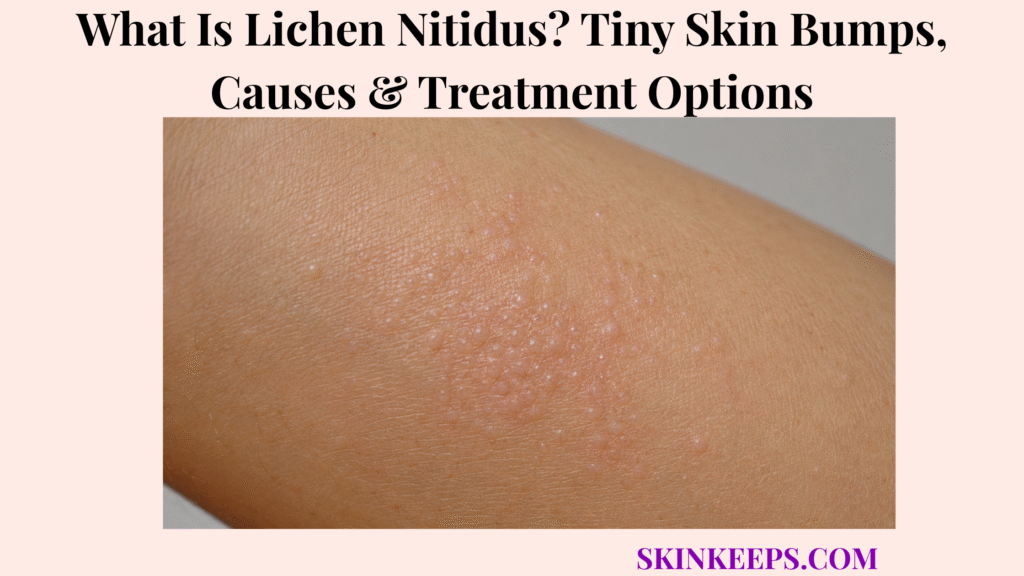
Lichen nitidus is usually recognized by clusters of extremely small, smooth, shiny and flat-topped papules with little surrounding inflammation.
What Do Lichen Nitidus Bumps Look Like?
Lichen nitidus typically produces discrete 1–2 mm, flat-topped, smooth or shiny papules that may be skin-coloured, pink, red-brown or violet.
The papules are round or polygonal and often gather in close groups without forming the large inflamed plaques typical of many eczematous eruptions. In darker skin tones they may appear lighter or darker than surrounding skin, and facial hypopigmentation is an atypical presentation.
Where Does Lichen Nitidus Usually Develop?
Lichen nitidus most commonly affects the forearms, hands, trunk, abdomen, buttocks and genital skin.
Flexor forearms, backs of the hands, chest, abdomen and penile shaft are typical sites. Most disease remains localized, while generalized lichen nitidus produces much broader involvement and is less common.
Does Lichen Nitidus Itch?
Most lichen nitidus lesions do not itch, although mild or intermittent itching can occur, particularly in more extensive eruptions.
An asymptomatic eruption therefore fits the classic pattern, while itch does not exclude the diagnosis. Itching becomes more relevant when disease is widespread or when another papular disorder is being considered.
What Is the Koebner Pattern in Lichen Nitidus?
The Koebner phenomenon in lichen nitidus causes new papules to appear along lines of scratching, friction or skin trauma.
This creates linear clusters of otherwise typical papules along a scratch or trauma line and can make the eruption appear unusually geometric.
Can Lichen Nitidus Affect the Palms, Nails or Mouth?
Yes; lichen nitidus can occasionally involve the palms, soles, nails or oral mucosa, although these sites are much less common than ordinary cutaneous disease.
Nail findings can include pitting, longitudinal ridging, splitting or other nail-plate abnormalities and are reported more often with generalized disease. Oral disease can produce tiny pale papules or plaques and should remain a secondary feature rather than the defining presentation.
Figure 1. Classic lichen nitidus produces discrete 1–2 mm smooth, shiny, flat-topped papules. Flexor forearms, hands, trunk, abdomen, buttocks and genital skin are typical sites, while Koebner lines can follow scratching or friction.
Why Does Lichen Nitidus Develop, and Which Forms Can Occur?
The exact cause of lichen nitidus is unknown, but the condition reflects a localized cell-mediated inflammatory reaction within the skin.
What Causes Lichen Nitidus?
The exact cause of lichen nitidus remains unknown.
The established biological pattern is a localized inflammatory collection of lymphocytes and histiocytes beneath each papule. Immune signalling is thought to be involved, but ordinary lichen nitidus is not a contagious infection and no single trigger explains all cases.
Is Lichen Nitidus Inherited?
Lichen nitidus usually does not follow a clear inherited pattern.
Occasional familial cases suggest possible susceptibility in some families, but ordinary lichen nitidus does not justify routine genetic testing.
Is Lichen Nitidus Associated With Other Conditions?
Lichen nitidus has been reported alongside several inflammatory and systemic conditions, but these associations do not mean that it usually signals an underlying disease.
Reported associations include lichen planus, Crohn disease, Down syndrome and selected immune-related disorders. Lichen nitidus remains a distinct clinicopathologic entity rather than a miniature form of lichen planus.
It has also been reported alongside atopic dermatitis. Association does not establish causation or justify broad systemic screening in every otherwise healthy patient.
What Is Generalized Lichen Nitidus?
Generalized lichen nitidus produces large numbers of papules across broad body areas rather than remaining confined to a few localized sites.
Generalized disease can persist longer, produce more itch or cosmetic burden and make dermatologist-directed treatment more relevant than it is for ordinary localized disease.
Which Other Lichen Nitidus Variants Can Occur?
Less common lichen nitidus variants include linear, actinic, purpuric, perforating and palmoplantar forms.
Actinic lichen nitidus occurs on sun-exposed skin and has been reported particularly in darker phototypes, while purpuric disease produces haemorrhagic colour change. These variants are uncommon and should remain subordinate to the classic localized presentation.
Figure 2. The exact cause of lichen nitidus remains unknown. The established pattern is a localized cell-mediated inflammatory reaction that creates characteristic papules, most often in localized disease but occasionally in generalized or uncommon variants.
How Is Lichen Nitidus Distinguished and Diagnosed?
Lichen nitidus is often recognized clinically from its tiny shiny papules, while dermoscopy or biopsy can support diagnosis when the eruption is atypical or uncertain.
How Is Lichen Nitidus Different From Keratosis Pilaris?
Keratosis pilaris produces rough follicular plugs, whereas lichen nitidus produces smoother, shiny, flat-topped papules that are not primarily follicular.
Typical keratosis pilaris clusters around hair follicles on the upper arms, thighs, cheeks or buttocks and feels rough, while lichen nitidus papules are smoother and more discrete.
How Is Lichen Nitidus Different From Lichen Planus?
Lichen planus usually produces larger, itchier and more violaceous papules or plaques, whereas lichen nitidus produces much smaller shiny papules.
Lichen planus can show more obvious surface markings and broader plaques. The two disorders can coexist, but lichen nitidus has its own characteristic clinical and histopathologic pattern.
Which Other Conditions Can Resemble Lichen Nitidus?
Follicular eczema, lichen spinulosus, lichen sclerosus and selected purpuric eruptions can resemble lichen nitidus when they produce small clustered papules.
Follicular distribution, itch, scale, pigment change, body location and associated findings help separate these conditions. Lichen sclerosus usually has a different white atrophic or genital-pattern context rather than classic tiny shiny papules.
Can Lichen Nitidus Be Diagnosed by Appearance Alone?
Yes; a classic lichen nitidus eruption can often be diagnosed clinically by an experienced clinician.
The combination of tiny size, shiny flat surface, clustering and typical distribution is highly suggestive. Dermoscopy can support diagnosis by revealing well-circumscribed pale or white structures, while atypical morphology makes visual diagnosis less reliable.
When Is a Skin Biopsy Needed for Lichen Nitidus?
A skin biopsy is most useful when lichen nitidus looks atypical, remains diagnostically uncertain or behaves differently from the expected localized pattern.
- Atypical morphology.
- Uncertain diagnosis.
- Unusual persistence.
- Generalized eruption.
- Concern for another inflammatory dermatosis.
- Unexpected nail, oral, palm or sole disease when the diagnosis remains unclear.
Biopsy should support diagnostic uncertainty rather than become routine for every classic eruption.
What Does Lichen Nitidus Look Like Under the Microscope?
Lichen nitidus classically shows a sharply localized inflammatory infiltrate in the papillary dermis enclosed by elongated epidermal rete ridges.
The infiltrate contains lymphocytes and histiocytes and may include giant cells. The surrounding rete ridges appear to hold the inflammatory focus, creating the traditional ball-in-clutch or claw-and-ball description.
| Condition | Surface | Follicular? | Typical Pattern | Useful Distinguishing Clue |
|---|---|---|---|---|
| Lichen nitidus | Smooth, shiny, flat-topped | No | Discrete 1–2 mm clustered papules | Very small uniform shiny papules. |
| Keratosis pilaris | Rough, keratotic | Yes | Upper arms, thighs, cheeks, buttocks | Follicular plugs and sandpaper texture. |
| Lichen planus | Flat-topped, often with surface markings | No | Larger violaceous itchy papules or plaques | Larger, itchier lesions with different histology. |
| Lichen sclerosus | White, atrophic or fragile | No | Often genital or localized plaques | Atrophy, whitening and tissue change rather than tiny shiny papules. |
Figure 3. Classic lichen nitidus can often be recognized clinically. Dermoscopy supports uncertain cases, while biopsy is most useful when morphology or behaviour is atypical and can demonstrate the characteristic ball-in-clutch pattern.
Does Lichen Nitidus Need Treatment, and Which Options Can Help?
Most localized lichen nitidus does not require treatment, but therapy can be considered when lesions itch, persist, spread widely or cause significant concern.
When Is No Treatment Needed?
No treatment is usually needed for localized, asymptomatic lichen nitidus because the condition is benign and often resolves spontaneously.
Observation and reassurance are appropriate when symptoms and disease burden are low. Treatment risk and inconvenience should not exceed the burden of a harmless self-limited eruption.
When Is Treatment Reasonable?
Treatment is reasonable when lichen nitidus is itchy, widespread, persistent, cosmetically distressing or otherwise significantly bothersome.
The decision should reflect symptom burden, distribution, duration, psychosocial impact and whether cosmetically sensitive sites are involved. Cosmetic concern can matter without implying medical danger.
How Are Localized Itchy Lichen Nitidus Lesions Treated?
Localized itchy lichen nitidus can be treated with topical anti-inflammatory therapy when symptom relief is needed.
Topical corticosteroids can reduce itch and inflammation, while tacrolimus or pimecrolimus may provide steroid-sparing topical options in selected areas. Treatment reduces inflammation rather than guaranteeing permanent clearance.
When Is Phototherapy Considered for Lichen Nitidus?
Narrowband UVB phototherapy can be considered for generalized, persistent or treatment-resistant lichen nitidus.
Phototherapy can treat many lesions at once more practically than repeated topical application over a broad body area. PUVA remains an alternative or historical option, while narrowband UVB is generally favoured when appropriate because of a more favourable long-term safety profile.
Are Oral Medicines Used for Lichen Nitidus?
Systemic medicines are rarely used for lichen nitidus and are generally reserved for severe or refractory disease under dermatologist supervision.
Reported options include systemic corticosteroids, retinoids and ciclosporin, but evidence is limited and often comes from small reports or case experience. Systemic treatment is not routine for ordinary localized disease.
What Should Be Avoided During Lichen Nitidus Treatment?
Aggressive scrubbing, picking and repeated skin trauma should be avoided because irritation can worsen symptoms and may trigger additional Koebner-pattern papules.
Repeated scratching, friction and unnecessary product switching can also increase irritation and pigment change. Overtreatment is especially unhelpful when the disease is benign and minimally symptomatic.
| Disease Pattern | Treatment Decision |
|---|---|
| Localized + asymptomatic | Observe and reassure; treatment is usually unnecessary. |
| Localized + itchy | Consider symptom-directed topical anti-inflammatory therapy. |
| Persistent or generalized | Dermatology review; narrowband UVB may be considered. |
| Severe refractory disease | Selected specialist systemic therapy may be considered; this is uncommon. |
| Any atypical pattern | Reassess the diagnosis before escalating treatment. |
How Long Does Lichen Nitidus Last, and When Should It Be Rechecked?
Lichen nitidus often resolves spontaneously within months to about a year, although generalized and unusual variants can persist longer.
Does Lichen Nitidus Go Away on Its Own?
Yes; many cases of lichen nitidus disappear spontaneously without treatment.
DermNet reports that about two-thirds of cases resolve within 12 months. Generalized and palmoplantar disease can persist longer, so one timeline should not be guaranteed for every patient.
Can Marks Remain After Lichen Nitidus Bumps Disappear?
Yes; temporary post-inflammatory pigmentation can remain after active lichen nitidus papules have flattened.
Residual hyperpigmentation can last for months and may be more visible in darker skin tones. Persistent colour alone does not necessarily mean active inflammation remains.
Does Lichen Nitidus Leave Scars?
Ordinary uncomplicated lichen nitidus usually resolves without permanent scarring.
Temporary pigment change should not be mistaken for a scar. Repeated scratching or trauma can create additional skin injury, while unusual variants should be assessed according to their actual morphology.
When Should a Dermatologist Recheck Lichen Nitidus?
Lichen nitidus should be reassessed when it becomes unusually widespread, persistent, very itchy, atypical or involves the palms, soles, nails or mouth.
Reassessment is also reasonable after repeated treatment failure, a diagnostic change or an eruption that no longer follows the expected course. Biopsy can be reconsidered when another papular disorder remains possible.
What Should You Remember About Lichen Nitidus?
Lichen nitidus is a benign inflammatory eruption of tiny shiny flat-topped papules that usually requires reassurance rather than aggressive treatment.
- Lichen nitidus commonly affects children and young adults.
- Papules are usually 1–2 mm, smooth, shiny and flat-topped.
- Forearms, hands, trunk, abdomen, buttocks and genital skin are common sites.
- The exact cause remains unknown.
- Lichen nitidus is not contagious.
- It is a distinct disorder rather than a miniature form of lichen planus.
- Typical disease can often be diagnosed clinically.
- Biopsy can demonstrate ball-in-clutch histology when diagnosis is uncertain.
- Most localized asymptomatic disease needs no treatment.
- Generalized or symptomatic disease may justify topical therapy or narrowband UVB.
- Many cases resolve spontaneously.
The practical pathway is recognize → differentiate → confirm if uncertain → observe if mild → treat if necessary → reassess persistent disease.
Frequently Asked Questions About Lichen Nitidus?
The most common lichen nitidus questions concern its unknown cause, contagiousness, diagnosis, spontaneous resolution and treatment.
What Causes Lichen Nitidus?
The exact cause of lichen nitidus is unknown. The condition reflects a localized cell-mediated inflammatory process in which lymphocytes and histiocytes collect beneath each papule. It is not caused by a known transmissible infection.
Is Lichen Nitidus Contagious?
No; lichen nitidus is an inflammatory skin condition and is not contagious. It cannot be spread through touching, shared clothing, sexual contact or casual household exposure, and ordinary cases do not require infection-control measures.
How Is Lichen Nitidus Diagnosed?
Lichen nitidus is often diagnosed clinically from its characteristic tiny shiny papules, with biopsy used when the appearance is uncertain. Histology can show a localized lymphohistiocytic infiltrate surrounded by elongated epidermal rete ridges, producing the classic ball-in-clutch pattern.
Does Lichen Nitidus Go Away Without Treatment?
Yes; many localized lichen nitidus eruptions resolve spontaneously within months to about a year. Generalized, palmoplantar or unusual variants can persist longer, so the same resolution timeline should not be promised for every patient.
Which Treatments Can Help Persistent or Itchy Lichen Nitidus?
Persistent or itchy lichen nitidus can be treated with topical anti-inflammatory therapy, while generalized disease may justify dermatologist-directed narrowband UVB phototherapy. Systemic medicines are uncommon and are generally reserved for severe or refractory disease.
Which Sources Support This Lichen Nitidus Guidance?
StatPearls / NCBI Bookshelf — Lichen Nitidus — Definition, 1–2 mm papule morphology, age group, unknown cause, distinctness from lichen planus, dermoscopy, biopsy, ball-in-clutch histology, treatment escalation, narrowband UVB and prognosis.
DermNet — Lichen Nitidus — Distribution, Koebner phenomenon, palm/sole/nail/oral involvement, variants, reported associations, natural history and residual pigmentation.
DermNet — Lichen Nitidus Pathology — Papillary dermal lymphohistiocytic infiltrate, surrounding epidermal acanthosis/rete ridges and characteristic microscopic architecture.