
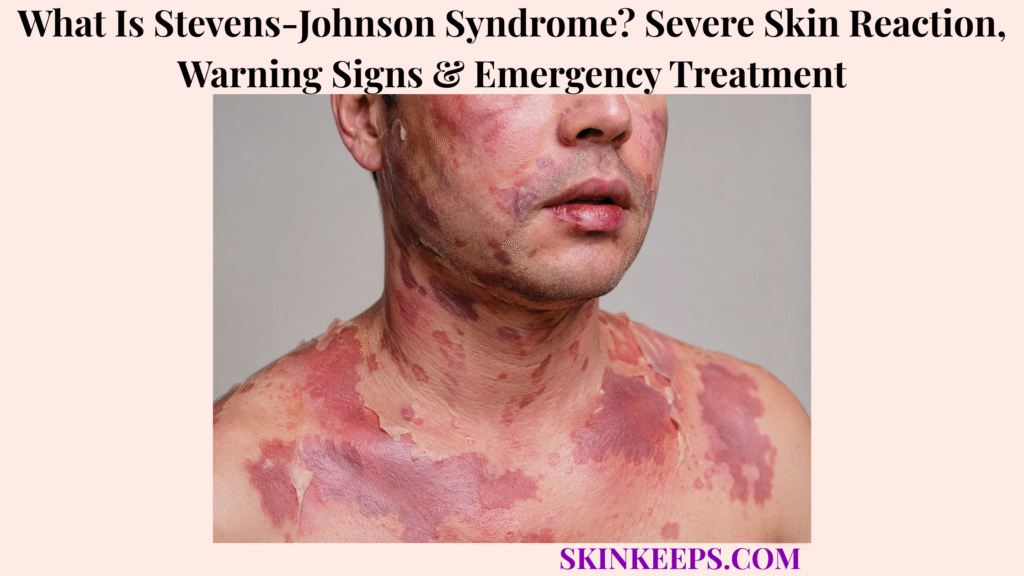
Stevens–Johnson syndrome (SJS) is a rare, life-threatening mucocutaneous reaction in which immune-mediated keratinocyte death causes painful skin injury, erosions and prominent damage to mucous membranes. It belongs to the same epidermal-necrolysis spectrum as toxic epidermal necrolysis (TEN), with the categories separated mainly by the extent of epidermal detachment.
Most classic SJS/TEN cases are medication-associated, but the reaction remains rare even among people taking medicines known to be linked with it. Fever, sore throat, painful eyes, marked skin tenderness, rapidly spreading dusky lesions, mouth or genital sores, blistering or peeling require emergency assessment; hospital care centers on stopping suspected culprit drugs, intensive supportive treatment and prevention of future re-exposure.
This article is for educational purposes only. A rapidly spreading painful or blistering rash—especially after a new medication or with mouth, eye, genital, facial or throat involvement—requires emergency medical assessment.
What Is Stevens–Johnson Syndrome and What Are Its Early Warning Signs?
Stevens–Johnson syndrome is a severe immune-mediated epidermal-necrolysis disorder that typically progresses from systemic symptoms and painful skin changes to mucosal erosions, blistering and skin detachment.
What Happens to the Skin in Stevens–Johnson Syndrome?
SJS causes cytotoxic immune injury to keratinocytes, producing widespread epidermal cell death, blister formation, erosions and eventual skin detachment.
Drug-specific immune cells and cytotoxic mediators such as granulysin, perforin and granzymes are implicated in the damage. The practical disease model is trigger → cytotoxic immune response → keratinocyte death → epidermal necrosis → painful erosion and detachment, not a superficial allergic rash alone.
How Is SJS Related to Toxic Epidermal Necrolysis?
SJS and TEN belong to the same epidermal-necrolysis spectrum and are classified largely by the percentage of skin that becomes detached.
SJS involves less than 10% detached body-surface area, SJS/TEN overlap involves 10–30%, and TEN involves more than 30%. The category may evolve during the first days of illness as additional epidermis detaches, so the first label is not always the final severity classification.
Which Symptoms Can Appear Before the Rash?
SJS can begin with fever, sore throat, cough, malaise, body aches, painful eyes or difficulty swallowing before extensive skin lesions develop.
These prodromal symptoms are not diagnostic by themselves. Their importance rises when they occur near the start of a potentially relevant medication and are followed by marked skin pain, mucosal symptoms or rapidly progressive lesions.
How Does the SJS Rash Progress?
The eruption may progress from painful tender skin and dusky or atypical target-like patches to flaccid blisters, erosions and epidermal detachment over hours to days.
Skin pain and rapid change are high-value warning features. Bright redness is not required, particularly in darker skin tones, where dusky, violaceous, gray-brown or otherwise abnormal color change may be more useful than expecting a vivid red eruption.
Why Are Mouth, Eye and Genital Symptoms So Important?
Painful mucosal erosions affecting the lips, mouth, eyes, throat or genitals are major clinical features of SJS/TEN and strongly distinguish it from many ordinary drug eruptions.
Crusted lips, painful oral erosions, difficulty swallowing, red or painful light-sensitive eyes, visual change, genital erosions and painful urination all increase concern. Ocular disease is especially important because acute inflammation can later cause ocular-surface scarring and lasting visual problems.
Skin allergy is a broad umbrella concept and should not be used as a substitute label for SJS. The combination of severe pain, epidermal necrosis and prominent mucosal injury places SJS in a much more dangerous clinical category than a routine allergic skin reaction.
What Causes Stevens–Johnson Syndrome and Who Is at Higher Risk?
Classic SJS/TEN is most often associated with medications, while individual susceptibility, drug timing and selected genetic or immune factors influence who develops the reaction.
Which Medicines Are Commonly Associated With SJS?
Recognized medication associations include selected anticonvulsants, sulfonamide antibiotics, allopurinol, oxicam-type NSAIDs and certain other medicines.
Examples often cited in specialist references include carbamazepine, lamotrigine, phenytoin, phenobarbital, sulfonamide antibiotics and allopurinol. These are associations rather than predictions: SJS/TEN remains rare, and most people taking these medicines do not develop epidermal necrolysis.
How Soon After Starting a Medicine Can SJS Develop?
SJS/TEN often develops within days to several weeks after starting the causative medication, but timing varies enough that one rigid latency rule should not be used.
The timing can differ by drug and by whether the person has been exposed previously. Clinicians therefore reconstruct a medication timeline rather than relying on one universal day cutoff.
Can Infections Trigger SJS-Like Mucocutaneous Disease?
Infections can be associated with severe mucocutaneous eruptions, particularly in children, but not every infection-related syndrome should be classified as classic medication-associated SJS.
Reactive infectious mucocutaneous eruption (RIME) and other infection-associated syndromes can resemble portions of the SJS picture. The trigger context and clinical pattern need to be interpreted together instead of automatically labeling every severe infectious mucositis as SJS.
Who Has a Higher Risk of Developing SJS?
Risk is higher in people with a previous SJS/TEN reaction to the same or related medicine and in selected drug–genetic susceptibility settings or states of immune vulnerability.
Certain HLA variants are associated with severe reactions to particular drugs in specific ancestry groups, and immune suppression can alter risk. Genetic associations are drug- and population-specific and should not be generalized into a universal consumer genetic rule.
Does Taking a High-Risk Drug Mean SJS Will Develop?
No; SJS/TEN remains rare, so medication association increases risk but does not mean the reaction is inevitable.
The correct causal model is probabilistic: a potential culprit medication, individual susceptibility, immune response and timing combine to raise or lower risk. A medicine appearing on an association list does not by itself diagnose the cause of a rash.
How Is Stevens–Johnson Syndrome Diagnosed and Distinguished From Other Blistering Reactions?
SJS is diagnosed from the combination of recent exposure history, systemic prodrome, painful mucocutaneous disease, epidermal detachment and supportive biopsy findings while serious mimics are excluded.
How Do Doctors Diagnose SJS?
Diagnosis begins with medication and illness history, followed by examination of the painful skin and mucosal eruption, assessment of detached body-surface area and laboratory evaluation, with biopsy used when needed.
The diagnosis is clinical but high stakes. Doctors assess how rapidly the lesions are progressing, which mucosal surfaces are involved, how much epidermis has detached and whether organs such as the eyes, lungs, kidneys or liver are affected.
What Does a Skin Biopsy Show in SJS?
Skin biopsy can show widespread keratinocyte death and full-thickness epidermal necrosis, supporting epidermal necrolysis and helping exclude competing blistering disorders.
Biopsy is not a home diagnostic procedure and should not delay emergency supportive care when the clinical picture is highly concerning. Histopathology complements the clinical pattern rather than replacing it.
How Is SJS Different From Staphylococcal Scalded Skin Syndrome?
SJS/TEN usually produces full-thickness epidermal necrosis with prominent mucosal involvement, while staphylococcal scalded skin syndrome produces very superficial toxin-mediated epidermal splitting and usually spares mucous membranes.
The age and trigger context also differ. SSSS is especially associated with infants and young children and exfoliative staphylococcal toxin, whereas classic SJS/TEN is commonly medication-associated and centered on immune-mediated keratinocyte death.
How Is SJS Different From Erythema Multiforme?
Erythema multiforme is now considered distinct from classic SJS/TEN and more typically features characteristic target lesions rather than the same pattern of widespread epidermal necrosis.
Erythema multiforme has its own trigger patterns and morphology. Target-like lesions alone should not be used to collapse EM and SJS/TEN into one diagnosis.
What Autoimmune Blistering Diseases Can Mimic Severe SJS-Like Disease?
Autoimmune blistering disorders can produce erosions and mucosal lesions, but their chronicity, blister level, immunopathology and trigger context differ from acute SJS/TEN.
Pemphigus vulgaris is an autoimmune blistering disease that can cause prominent mucosal erosions, but its mechanism and usual course are different from acute medication-associated epidermal necrolysis.
Bullous pemphigoid provides another contrast because it usually affects an older population and characteristically produces a different blistering pattern and level of skin separation.
How Is SJS/TEN Severity Assessed?
Severity assessment considers the percentage of detached skin, vital signs, renal and metabolic function, mucosal and organ involvement and hospital prognostic tools such as SCORTEN.
SCORTEN is a clinician-used prognostic tool, not a consumer self-calculator. Body-surface area helps classify SJS, overlap and TEN, while the broader physiologic assessment helps the hospital team estimate illness severity and required level of care.
How Is Stevens–Johnson Syndrome Treated as a Medical Emergency?
SJS requires immediate hospital treatment centered on withdrawal of the suspected causative medication, intensive supportive care and specialist management of skin, mucosal and organ complications.
Why Must the Suspected Culprit Medication Be Stopped Quickly?
In suspected drug-induced SJS/TEN, the medical team promptly withdraws suspected culprit medicines because earlier withdrawal is associated with better outcomes.
This action belongs inside emergency medical management. A person should not interpret “stop the culprit” as permission to remain at home with a painful blistering rash or mucosal erosions while waiting to see whether the condition improves.
Where Is SJS Treated?
SJS/TEN requires hospital admission, with extensive disease sometimes needing intensive care, specialized dermatology support or burn-unit-level nursing and multidisciplinary management.
The exact care setting depends on severity and local resources. What does not change is the need for hospital assessment, monitoring and coordinated management when SJS/TEN is suspected.
How Are Fluids, Nutrition, Pain and Skin Wounds Managed?
Supportive care replaces fluid and electrolyte losses, supports nutrition, controls severe pain, protects damaged skin and regulates temperature while clinicians monitor for infection and organ dysfunction.
Wound care is deliberately non-traumatic, and dressings are selected to protect denuded surfaces without causing additional shear injury. Fluid formulas, wound-debridement choices and dressing protocols belong to specialist inpatient care rather than consumer instructions.
Why Do the Eyes Need Early Specialist Assessment?
Early ophthalmologic assessment is important because acute SJS/TEN eye disease can lead to corneal injury, ocular-surface scarring and permanent visual problems.
Eye involvement is not limited to visible redness. Pain, photophobia, discharge, difficulty opening the eyes or visual change can signal significant ocular-surface disease that may need urgent ophthalmology-led treatment.
Are Antibiotics Automatically Given in SJS?
No; SJS/TEN is not itself a bacterial infection, so antibiotics are used when bacterial infection is identified or strongly suspected rather than routinely for detached skin.
Loss of the skin barrier does increase infection risk, so hospitals monitor carefully for secondary infection and sepsis. That risk does not justify describing antibiotics as treatment for the immune-mediated epidermal necrolysis itself.
Are Steroids, IVIG, Cyclosporine or Biologic Treatments Used?
Specialist teams may use systemic therapies such as corticosteroids, cyclosporine, IVIG or targeted biologic treatment, but no single regimen is universally established as best for every SJS/TEN patient.
Recent evidence reviews continue to show variation in guideline recommendations and uncertainty about comparative benefit for many immunomodulating therapies. Severity, timing, comorbidities, local protocol and specialist judgment therefore shape adjunctive treatment while supportive care remains foundational.
What Complications Can SJS Cause, How Does Recovery Occur, and How Is Another Episode Prevented?
SJS can cause acute fluid, infection, ocular and organ complications plus long-term mucosal, visual and skin effects, so recovery requires multidisciplinary follow-up and permanent avoidance of the causative medication.
What Acute Complications Can SJS Cause?
Acute SJS/TEN complications can include dehydration, electrolyte disturbance, malnutrition, secondary infection, sepsis, respiratory complications, kidney or liver injury, shock and multiorgan dysfunction.
These complications arise from both the systemic illness and loss of skin and mucosal barrier function. The danger therefore extends well beyond the visible rash.
What Long-Term Eye Problems Can Occur?
Survivors can develop chronic dry eye, ocular inflammation, scarring, corneal injury and visual impairment after acute SJS/TEN.
Ocular recovery can follow a different timeline from skin healing, which is why specialist follow-up may continue after the epidermis has re-formed.
Can SJS Cause Long-Term Mouth, Genital or Respiratory Problems?
Yes; mucosal injury can leave long-term scarring or functional problems involving oral, genital, urinary, respiratory or other affected mucosal surfaces.
Persistent swallowing difficulty, genital scarring, urinary symptoms or respiratory problems require follow-up with the relevant specialists rather than being treated as routine post-rash symptoms.
Can SJS Leave Scars or Pigment Changes?
Healing can leave hyperpigmentation, hypopigmentation, scarring, nail changes or persistent skin sensitivity after the acute disease resolves.
Persistent dark post-inflammatory discoloration may fit the broader pattern described in hyperpigmentation, but pigment change is only one possible long-term effect and should remain subordinate to the wider SJS recovery picture.
How Long Can Recovery From SJS Take?
Skin healing may begin within weeks, but full recovery can take weeks to months or longer when fatigue, eye disease, mucosal injury or organ complications persist.
Recovery time is therefore individualized. A visually healed skin surface does not guarantee that ocular, mucosal, respiratory or systemic effects have fully resolved.
Why Must the Culprit Medication Be Avoided Permanently?
Re-exposure to a causative medicine can trigger another severe reaction, so confirmed or strongly suspected culprit drugs generally require long-term avoidance under medical guidance.
Clinicians may also advise avoidance of related medicines when cross-reactivity is clinically relevant. The exact avoidance list should come from the treating team rather than self-expansion to unrelated drug classes.
How Should a History of SJS Be Documented?
The culprit or strongly suspected medication, reaction date and clinician-advised related drugs should be permanently documented across medical and medication records.
Clear documentation helps prevent accidental re-exposure during future prescribing, emergency treatment, surgery or care across different health systems.
Should Someone Re-Try the Suspected Medicine to Confirm the Diagnosis?
No routine self-rechallenge should be attempted because another exposure can cause a severe recurrent reaction.
Culprit assessment is specialist-directed and may involve structured review of exposure timing and alternative explanations. Deliberately taking the suspected medicine again at home is not an appropriate diagnostic test.
When Is a New Medication-Associated Rash an Emergency?
A rapidly spreading painful rash with blistering, peeling, mouth sores, painful eyes, facial or throat swelling, breathing difficulty or systemic illness after a recent medication requires emergency medical assessment.
Painful spreading rash + mucosal disease + blistering or peeling after a recent medication = emergency assessment, not home observation.
What Should You Remember About Stevens–Johnson Syndrome?
Stevens–Johnson syndrome is a rare but potentially fatal medication-associated mucocutaneous emergency in which immune-mediated keratinocyte death causes painful epidermal necrosis, mucosal erosions and skin detachment.
- SJS is a medical emergency, not simply an itchy or severe “allergy rash.”
- SJS and TEN form one epidermal-necrolysis spectrum.
- SJS involves less than 10% epidermal detachment, overlap 10–30%, and TEN more than 30%.
- The classification can evolve as detachment progresses.
- Fever, sore throat, malaise and painful eyes can precede the skin eruption.
- Marked skin pain and rapid progression are major warning features.
- Prominent mouth, eye, throat or genital mucosal disease is central to recognition.
- Bright redness is not required, especially in darker skin tones.
- Medications are the dominant classic trigger, but taking an associated medicine does not make SJS inevitable.
- Medication latency varies, so one universal onset interval should not be used.
- Diagnosis combines exposure history, painful mucocutaneous morphology, detached body-surface area and biopsy when needed.
- Full-thickness epidermal necrosis on histology supports SJS/TEN.
- SSSS differs because its epidermal split is very superficial and mucous membranes are usually spared.
- Erythema multiforme is distinct from classic SJS/TEN.
- Hospitalization and rapid withdrawal of suspected culprit medicines are central to management.
- Fluids, electrolytes, nutrition, pain control, temperature support and non-traumatic wound care are foundational.
- Early ophthalmology involvement can be crucial when the eyes are affected.
- Antibiotics are not routine treatment for the immune-mediated syndrome itself.
- No single systemic drug regimen is universally established as best for every patient.
- Acute complications can include sepsis, dehydration, respiratory disease and organ injury.
- Long-term eye, mucosal, pigment and scar changes can persist after skin healing.
- Recovery may take weeks to months or longer.
- The culprit medicine should not be casually reintroduced.
- Permanent adverse-reaction documentation helps prevent accidental re-exposure.
Frequently Asked Questions About Stevens–Johnson Syndrome
The main SJS questions concern early symptoms, its relationship to TEN, medication triggers, recurrence and recovery.
What Is Usually the First Sign of Stevens–Johnson Syndrome?
SJS often begins with systemic symptoms such as fever, malaise, sore throat or painful eyes before a painful spreading rash and mucosal sores become obvious.
What Is the Difference Between SJS and Toxic Epidermal Necrolysis?
They are part of the same disease spectrum: SJS involves less than 10% epidermal detachment, overlap involves 10–30%, and TEN involves more than 30%.
Which Medicines Are Commonly Linked to SJS?
Recognized associations include selected anticonvulsants, sulfonamide antibiotics, allopurinol, oxicam-type NSAIDs and several other medicines, although the reaction remains rare.
Can Stevens–Johnson Syndrome Happen Again?
Yes; re-exposure to the causative or a clinically related medication can trigger another severe reaction, which is why long-term avoidance is essential.
How Long Does Recovery From Stevens–Johnson Syndrome Take?
Skin healing may begin over several weeks, while complete recovery from fatigue, eye disease, mucosal injury and other complications may take weeks to months or longer.
DermNet — Stevens–Johnson syndrome / toxic epidermal necrolysis. Supports the SJS/TEN spectrum, body-surface classification, mucosal disease, medication timing, biopsy findings, differential diagnosis, hospital treatment and long-term complications.
NHS — Stevens-Johnson syndrome. Supports emergency recognition, prodromal symptoms, hospital care, suspected culprit-drug withdrawal, wound and fluid support, recovery time and long-term medicine avoidance.
MSD Manual Professional — Stevens-Johnson Syndrome and Toxic Epidermal Necrolysis. Supports spectrum classification, keratinocyte injury, mucosal involvement, biopsy, SSSS differentiation, inpatient supportive care and selective systemic therapy.
Systematic review and meta-analysis of systemic immunomodulating therapies for epidermal necrolysis. Supports the continuing uncertainty around a universally superior immunomodulating regimen and the need to keep supportive care central.
Systematic review of pediatric SJS/TEN clinical guidelines and consensus statements. Supports immediate culprit withdrawal, specialist-unit referral, multidisciplinary supportive care and variability in recommendations for systemic therapies.