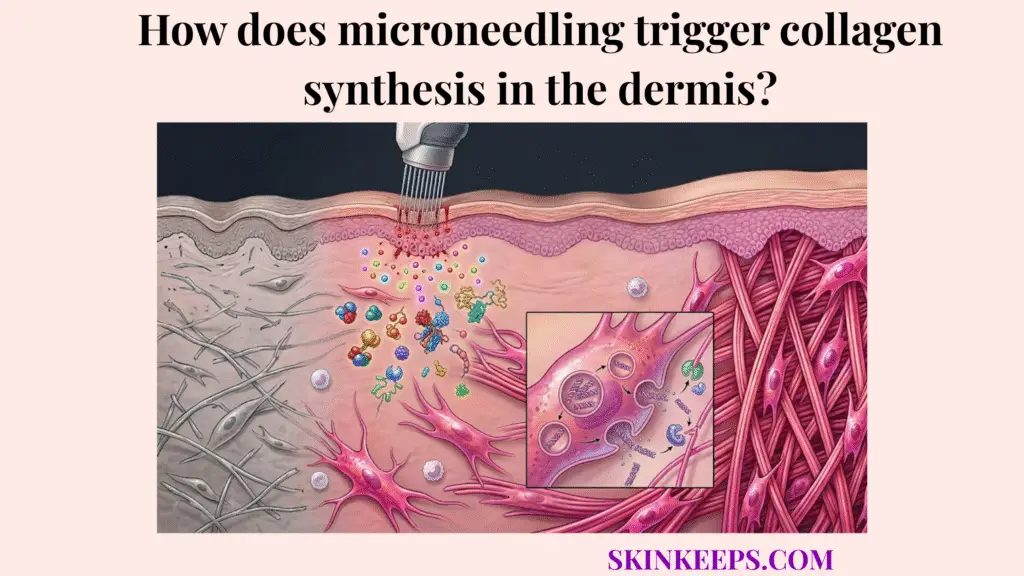
Microneedling triggers collagen synthesis in the dermis by creating controlled micro-injury that activates the skin’s wound-healing response. Once the dermis detects this targeted injury, fibroblast signaling increases, repair mediators are released, and new collagen formation begins as part of the remodeling process.
The goal is not simple exfoliation, but deeper dermal remodeling. Many superficial treatments only remove dead skin cells. Microneedling bypasses the surface to mechanically strike the deep connective tissue, forcing the skin into an emergency regenerative state that replaces damaged scaffolding with a tighter, fresher matrix.
Understanding how microneedling triggers dermal collagen synthesis requires tracing the biological baseline, tracking the wound-healing cascade from inflammation to remodeling, measuring the effects of needle depth, comparing it to other modalities like RF microneedling, and deploying the exact protective habits required to lock in the structural gains.
What is the biological baseline for how microneedling triggers dermal collagen synthesis?
The biological baseline is that dermal collagen is produced mainly by fibroblasts, and microneedling works by activating repair biology in the dermis without causing the same degree of surface destruction seen in more aggressive procedures.
To fundamentally rebuild the skin, you must stimulate the exact layer responsible for structural strength: the dermis. Fibroblasts are the specialized cellular factories within this layer tasked with churning out fresh collagen and elastin. Microneedling serves exclusively as the mechanical alarm bell to wake these cells up.
Reviews describe microneedling as a minimally invasive collagen induction therapy that stimulates collagen and elastin through controlled puncture-based repair signaling, deliberately avoiding the massive thermal burns of fully ablative lasers.
Histology literature explicitly confirms this mechanism. El-Domyati et al. (2015) reported that microneedling can significantly increase collagen types I, III, and VII, as well as newly synthesized collagen, providing the clearest tissue-level anchor for why the procedure successfully induces real dermal remodeling (PMC).
How does controlled micro-injury initiate how microneedling triggers dermal collagen synthesis?
Controlled micro-injury initiates the process because microneedling creates precise vertical microchannels that the skin interprets as a repair event rather than chaotic tissue destruction. This distinction is what lets microneedling activate remodeling while remaining less destructive than ablative resurfacing.
When the sterile needles penetrate the skin, they do not tear or burn away massive blocks of tissue. Instead, they part the cells, creating thousands of microscopic punctures known as microchannels.
The skin’s defense systems detect these microchannels instantly. Because the surrounding tissue remains healthy and completely intact, the skin can rapidly deploy its resources to fill these tiny gaps with fresh structural proteins, avoiding the overwhelming scar-tissue response associated with massive burns or deep lacerations.
How does inflammatory signaling drive how microneedling triggers dermal collagen synthesis?
Inflammatory signaling drives this process because the skin releases early mediators after micro-injury, and those mediators initiate the broader wound-healing cascade that eventually leads to fibroblast activation and collagen formation. The inflammatory phase is not just redness; it is the vital start signal for repair.
Within seconds of the puncture, local immune cells and damaged tissue release a flood of cytokines and growth factors. This biochemical alarm summons white blood cells to clear microscopic debris and signals the deep dermal builders that reconstruction must begin.
This early inflammation is entirely productive. Suppressing it artificially (with potent anti-inflammatories) immediately post-procedure can actively sabotage the very collagen induction you are trying to achieve.
How does fibroblast activation explain how microneedling triggers dermal collagen synthesis?
Fibroblast activation explains the collagen effect because fibroblasts are the cells that actually synthesize new extracellular matrix proteins during repair. When microneedling-induced repair signals rise, fibroblast activity shifts into a remodeling-oriented state that supports new collagen deposition.
As the inflammatory cytokines reach the deeper dermal layers, they bind to fibroblast receptors. The fibroblasts respond by proliferating and moving toward the microchannels.
Once positioned, these cells begin furiously producing collagen types I, III, and VII, replacing the tiny voids with a dense, fresh matrix. The El-Domyati histology study confirms statistically significant increases in these exact collagen types, proving that microneedling stimulates genuine fibroblast-driven matrix rebuilding rather than merely causing a transient plumping effect (PMC).
How does wound healing progress through how microneedling triggers dermal collagen synthesis?
Wound healing progresses through this mechanism by moving from an inflammatory phase into a proliferative phase and then into a remodeling phase, with collagen becoming more organized and useful over time rather than immediately after treatment. General wound-healing literature and microneedling reviews align precisely on that phased logic.
The skin does not skip steps. The inflammatory phase clears the site. The proliferative phase brings in the fibroblasts to aggressively lay down new tissue. Finally, the remodeling phase begins the long work of converting that hasty repair job into strong, permanent architecture.
This biological timeline demands patience. You cannot force the remodeling phase to finish in three days.
How do collagen deposition and remodeling complete how microneedling triggers dermal collagen synthesis?
Collagen deposition and remodeling complete the process because new collagen is not fully useful the moment it is produced. It must be laid down, reorganized, and integrated into the dermal matrix over time before structural firmness improves meaningfully.
In the early proliferative phase, fibroblasts quickly deposit Type III collagen—a hasty, somewhat disorganized emergency patch. During the long remodeling phase, enzymes slowly replace this patch with much stronger, tightly cross-linked Type I collagen.
This slow maturation is why the final clinical result of a microneedling session is not visible until the matrix has finished reorganizing itself.
How does needle depth influence how microneedling triggers dermal collagen synthesis?
Needle depth influences the response because collagen-building results depend on whether the treatment reaches the dermis effectively without creating unnecessary tissue burden. More superficial settings may improve texture or delivery effects, while appropriately deeper settings produce stronger dermal signaling, but excessive depth can add inflammation and risk without proportionally better remodeling.
The skin is not a uniform block. Striking the superficial papillary dermis triggers a different healing response than severely punching into the deep reticular dermis.
FDA-cleared device materials explicitly indicate that depth must be indication- and location-specific. Suggested depths often range from 0.25–1.0 mm on the forehead, 0.25–0.75 mm on the nose, and up to 1.5 mm for facial acne scars on the cheeks (FDA Access Data).
Driving needles 2.5 mm deep into thin forehead tissue does not build more collagen; it simply causes excessive bleeding, severe inflammation, and a high risk of scarring. Depth must match the anatomical thickness of the specific treatment zone.
How does microneedling compare with other treatments in how microneedling triggers dermal collagen synthesis?
Microneedling compares as a moderate collagen-stimulating treatment: stronger than purely topical support, but usually less aggressive than deeper resurfacing procedures. Fractional lasers tend to create stronger remodeling by ablating tissue columns, while radiofrequency microneedling combines needling with heat and can intensify both the structural effect and the clinical risk.
Topical retinoids provide continuous, signaling-based repair without physical injury. Standard microneedling provides physical mechanical injury to force repair. Lasers use intense thermal energy to vaporize and shrink tissue for a more dramatic result.
Radiofrequency (RF) microneedling fires heat directly off the needles while they sit inside the dermis. The current FDA safety communication from October 2025 warns of serious complications reported with certain RF microneedling uses, including burns, scarring, fat loss, disfigurement, and nerve damage, so RF microneedling must absolutely be framed as a medical procedure with higher consequence if misused (U.S. Food and Drug Administration).
| Treatment type | Main mechanism | Relative collagen stimulation strength | Downtime level | Main limitation |
|---|---|---|---|---|
| Retinoids | Signaling support | Mild to moderate | Low | Slower and less procedural intensity |
| Microneedling | Controlled micro-injury | Moderate | Mild | Results are gradual and depth-dependent |
| Fractional lasers | Stronger resurfacing / remodeling | Higher | Moderate to higher | More downtime and irritation burden |
| RF microneedling | Needle injury plus heat | Moderate to higher | Variable | Greater intensity, operator/device dependence, and safety risk |
How long does it take before how microneedling triggers dermal collagen synthesis becomes visible?
Visible collagen remodeling after microneedling is delayed because true dermal remodeling takes weeks to months, not days. Early redness, plumpness, or transient smoothness may reflect inflammation or hydration rather than durable new collagen.
When skin looks immediately “plumped” 48 hours after a session, that is primarily post-inflammatory edema (micro-swelling) stretching the epidermis. The actual new collagen fibers take nearly a month to form and several more months to cross-link into a mature, firm matrix.
This is why which treatments stimulate collagen production in the dermis are typically evaluated over a 3-to-6-month window.
What limits how microneedling triggers dermal collagen synthesis?
Microneedling-triggered collagen synthesis is limited by fibroblast responsiveness, chronic UV exposure, smoking-related vascular stress, baseline tissue quality, inflammation burden, and poor recovery conditions. Over-treatment or insufficient recovery time can increase irritation without improving true remodeling.
Fibroblasts in severely aged or heavily sun-damaged skin simply do not produce collagen as efficiently as younger cells. If the biological factory is sluggish, triggering the alarm with needles will yield a smaller harvest of new protein.
Likewise, if you needle the skin every single week, the tissue remains trapped in a state of chaotic inflammation, utterly failing to reach the slow, quiet remodeling phase required to finalize the collagen architecture.
What supportive habits improve how microneedling triggers dermal collagen synthesis?
Supportive habits improve the collagen response because new matrix remains vulnerable to UV damage, unnecessary inflammation, smoking-related vascular stress, and poor recovery timing. Daily broad-spectrum sunscreen and barrier-aware aftercare are especially important to lock in the procedural gains.
Without strict photoprotection, ambient UV radiation will activate MMP enzymes that instantly begin chopping up the delicate new collagen fibers you just paid to stimulate.
Post-Microneedling Support Checklist
What steps can you take today if you want how microneedling triggers dermal collagen synthesis to work better?
The best day-to-day way to improve microneedling-driven dermal collagen synthesis is to combine appropriate treatment depth, enough recovery time, strict broad-spectrum sun protection, and gentle barrier-focused aftercare. Progress should be judged over months, not against immediate post-treatment appearance.
Final Execution Checklist
What are the key summary facts about how microneedling triggers dermal collagen synthesis?
The key summary facts are that microneedling triggers dermal collagen synthesis by creating controlled micro-injury, activating wound-healing signaling, increasing fibroblast-driven matrix production, and allowing new collagen to mature over time. The response is real but delayed, cumulative, and heavily limited by tissue quality and recovery conditions.
Summary Checklist
Quick Answers About How Microneedling Triggers Dermal Collagen Synthesis
How does microneedling trigger collagen synthesis in the dermis?
Microneedling triggers dermal collagen synthesis by creating controlled microchannels that activate the wound-healing cascade. That repair response increases fibroblast activity and supports gradual collagen deposition and remodeling over time.
Is microneedling really more than a surface treatment?
Yes. Its main biologic target is deeper than the epidermis because the goal is to activate dermal repair signaling, not just surface exfoliation. That is why it is called collagen induction therapy.
What cells actually make the new collagen after microneedling?
The main cells are fibroblasts. Once the dermis receives wound-healing signals after controlled injury, fibroblasts increase extracellular-matrix production and help generate new collagen.
How long does it take to see real collagen gain after microneedling?
True remodeling usually becomes meaningful over weeks to months, not immediately after treatment. Early plumpness or redness does not necessarily equal durable collagen gain.
Does microneedling increase real collagen types in the skin?
Yes. Histology studies report statistically significant increases in collagen types I, III, and VII, along with newly synthesized collagen, after microneedling treatment courses.
Is deeper microneedling always better for collagen stimulation?
No. Appropriate dermal depth matters, but excessive depth can increase inflammation and risk without guaranteeing better remodeling. Treatment depth should match the indication and the skin site.
Is microneedling stronger than retinoids?
Usually yes in terms of procedural collagen stimulation, but not necessarily in convenience or maintenance value. Retinoids work more gradually through signaling support, while microneedling uses controlled injury to activate repair.
Is RF microneedling just a stronger version of regular microneedling?
It can be stronger because it combines needling with heat, but it is also more intensity-dependent and risk-dependent. The FDA warned in October 2025 about serious reported complications with certain RF microneedling uses, so it should be treated as a medical procedure, not casual cosmetic care.
What habits help preserve microneedling collagen results?
Daily broad-spectrum SPF, gentle aftercare, avoiding over-treatment, and allowing full recovery between sessions are the most useful habits. These steps reduce unnecessary inflammation and protect newly remodeling collagen.
What usually weakens microneedling results the most?
Ongoing UV exposure, poor recovery habits, smoking-related vascular stress, excessive treatment frequency, and unrealistic depth/intensity choices can all reduce the quality of remodeling.
Conclusion
In conclusion, microneedling triggers dermal collagen synthesis through a controlled biologic repair response: micro-injury starts the wound-healing cascade, fibroblasts become more active, new collagen is deposited, and remodeling gradually organizes that collagen into more useful dermal support. It is neither magic nor simple surface exfoliation; it is a structured remodeling process that works best when treatment intensity, recovery time, and collagen-protective habits are all aligned.
Controlled injury plus wound-healing activation plus protected recovery ensures that dermal collagen remodeling becomes more achievable, allowing a visibly tighter, fresher, and better-supported long-term skin structure to emerge over time.