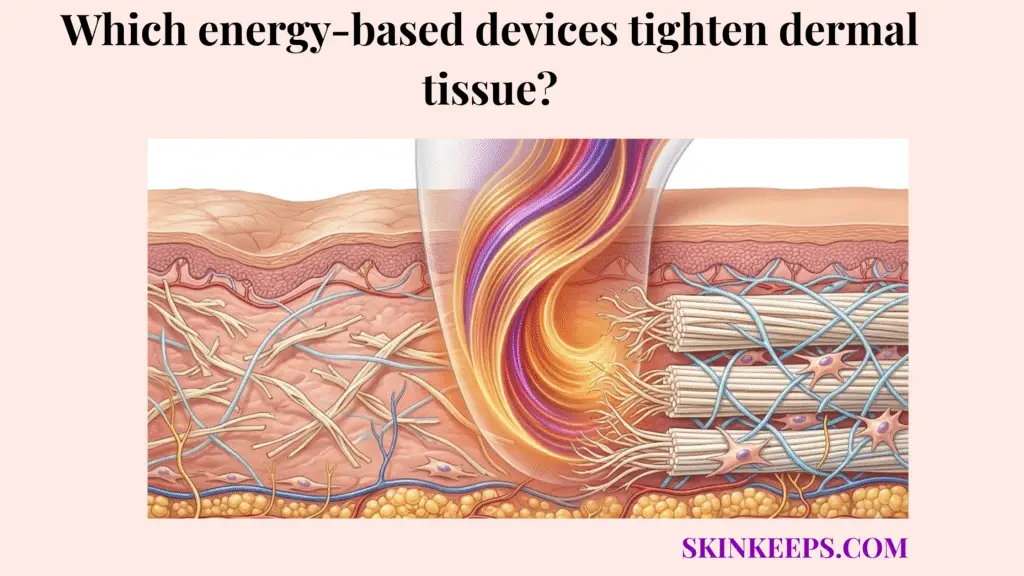
The main energy-based devices that tighten dermal tissue include radiofrequency devices, microfocused ultrasound devices, fractional laser devices, and radiofrequency microneedling systems. These technologies tighten dermal tissue by delivering controlled energy into the skin, which triggers collagen remodeling, contraction, or longer-term structural repair.
Not every smoothing device truly tightens the dermis. Superficial peels and mild lasers can dramatically improve surface texture, pore appearance, and pigmentation without substantially altering the skin’s structural tension. To achieve authentic tightening, a device must penetrate the epidermal barrier and force the deep connective tissue to physically reconstruct itself.
Understanding which energy-based devices tighten dermal tissue requires examining the biological baseline of collagen remodeling, dissecting the distinct device classes (RF, MFU, Lasers), mapping depth logic, differentiating true tightening from simple resurfacing, matching the device to laxity severity, and maintaining strict supportive habits.
What is the biological baseline for how energy-based devices tighten dermal tissue?
The biological baseline is that dermal tightening happens when collagen fibers contract, fibroblast signaling increases, or new matrix remodeling develops after controlled energy exposure. Most energy-based tightening devices work by creating targeted thermal or injury signals inside the dermis, after which visible firming appears gradually rather than immediately.
The skin’s structural integrity relies heavily on the dermal collagen matrix. When this matrix is subjected to precise thermal stress (typically between 60°C and 70°C), the existing collagen triple helix physically denatures and shrinks, providing an initial, temporary tightness.
More importantly, the body interprets this thermal or mechanical disruption as a wound. This activates fibroblasts—the primary cells responsible for building the extracellular matrix—to clear the damaged proteins and synthesize fresh, tightly organized collagen, a process called neocollagenesis.
Semantic Profile
- 1. Controlled energy reaches the dermis.
- 2. Collagen and fibroblast biology respond.
- 3. Gradual tightening develops through remodeling.
How do radiofrequency devices tighten dermal tissue?
Radiofrequency devices tighten dermal tissue by delivering electromagnetic heat into the dermis in a controlled way. That heating can create immediate collagen contraction and later dermal remodeling, which is why RF is one of the core non-surgical tightening categories.
Unlike lasers, which use light energy that can be blocked or scattered by skin pigment, radiofrequency utilizes electrical current. As this current passes through the skin’s natural resistance, it generates bulk heat within the deeper layers without incinerating the superficial epidermis.
Zhang et al. (2025) note in recent RF review literature that RF works by generating heat within dermal layers that stimulates collagen production and remodeling, while modern clinical studies support benefit in mild-to-moderate facial laxity rather than unlimited tightening across all severity levels [PMC].
How do microfocused ultrasound devices tighten dermal tissue?
Microfocused ultrasound (MFU) devices tighten dermal tissue by concentrating acoustic energy at specific selected depths, where they create small thermal coagulation points below the surface while leaving much of the epidermis intact. That makes them especially relevant when the goal is deeper tightening or lifting support rather than mainly superficial resurfacing.
MFU devices use sound waves converging on a microscopic focal point to instantly heat the tissue to structural remodeling temperatures (roughly 60–70°C). By adjusting the transducer, clinicians can place these tiny heat columns securely in the deep dermis or even down to the superficial muscular aponeurotic system (SMAS).
A 2023 systematic review of MFU literature supports usefulness in mild-to-moderate skin laxity, and clinical protocols commonly use depth-specific transducers rather than one uniform treatment depth [PMC].
How do fractional laser devices tighten dermal tissue?
Fractional laser devices tighten dermal tissue when their energy reaches the dermis strongly enough to create fractional columns of thermal or ablative injury that trigger wound-healing activation and later collagen remodeling. Their tightening effect is real, but many fractional lasers also sit partly in the resurfacing category, so not every visible result is true tightening.
Instead of burning away the entire skin surface, a fractional laser divides its beam into thousands of microscopic treatment zones. These tiny columns of damage (either non-ablative heat or ablative vaporization) are surrounded by healthy, untouched tissue, which speeds up recovery.
Borges et al. (2020) emphasize that fractional resurfacing promotes neocollagenesis and can improve photoaging and laxity when dermal remodeling is substantial enough [PMC].
How do radiofrequency microneedling devices tighten dermal tissue?
Radiofrequency microneedling devices tighten dermal tissue by placing needles into the skin and delivering radiofrequency energy below the surface, which combines mechanical micro-injury with direct thermal stimulation. That hybrid mechanism can generate a stronger dermal remodeling signal than surface-only treatment alone.
By physically bypassing the epidermis with insulated or semi-insulated needles, RF microneedling ensures that the bulk of the thermal energy is deposited directly into the deep dermis, right where the collagen-producing fibroblasts reside. Shauly et al. (2023) highlight that this makes it a highly potent tool for addressing deeper structural laxity and acne scarring simultaneously [PMC].
However, the FDA safety communication from October 2025 warns that certain RF microneedling uses have been associated with serious complications, including burns, scarring, fat loss, nerve damage, and disfigurement. The FDA (October 2025) advises that the category should be framed as effective but meaningfully more consequential if misused [U.S. Food and Drug Administration].
How do energy-delivery depth and mechanism affect how energy-based devices tighten dermal tissue?
Energy-delivery depth and mechanism matter because different devices stimulate different dermal planes, create different injury patterns, and therefore produce different types of tightening. A device that heats the deep dermis or fibroseptal framework behaves differently from one that mainly resurfacing-treats the superficial skin.
| Device type | Main energy form | Main depth logic | Tightening style | Main limitation |
|---|---|---|---|---|
| Radiofrequency | Bulk thermal energy | Dermal heating | Gradual firming | Depends on device design and dose |
| Microfocused ultrasound | Focused acoustic heat | Deeper focal targets | Deeper lifting/tightening support | Less surface change |
| Fractional laser | Thermal or ablative columns | Surface plus dermal remodeling | Texture + tightening | More downtime possible |
| RF microneedling | Needle-delivered RF heat | Direct dermal targeting | Combined tightening and remodeling | Technique and depth dependent |
Semantic Profile
- 1. Different energy forms reach different tissue depths.
- 2. Remodeling patterns diverge based on injury style.
- 3. Tightening strength and clinical trade-offs change accordingly.
How do energy-based devices tighten dermal tissue differently from surface resurfacing treatments?
Energy-based devices tighten dermal tissue differently from surface resurfacing treatments because true tightening requires meaningful dermal stimulation, while surface resurfacing can improve texture, pigment, or roughness without producing much real firmness change. A treatment may make skin look smoother or brighter without significantly changing laxity.
Superficial chemical peels, microdermabrasion, and low-energy non-ablative lasers focus almost entirely on the epidermis. They polish the surface but lack the deep thermal penetration required to physically contract existing collagen or force fibroblasts to generate a massive new matrix.
Which energy-based devices tighten dermal tissue best for mild versus advanced laxity?
The best device class depends on laxity severity. Mild laxity may respond to radiofrequency, gentler fractional approaches, or RF microneedling, while moderate laxity may benefit more from stronger RF microneedling, deeper RF, or microfocused ultrasound. More advanced laxity often requires layered planning, realistic expectations, or procedures beyond device-only tightening.
If a patient possesses severe, redundant skin folds, no amount of dermal heating will shrink the tissue back to a tight contour. Device-based tightening is highly effective for structural reinforcement and modest lifting, but it cannot defy the biological limits of heavily degraded, stretched tissue.
How long does it take before energy-based devices tighten dermal tissue visibly?
Visible dermal tightening is usually delayed because real firmness depends on collagen remodeling over weeks to months, not only on the immediate post-treatment effect. Early tightness can reflect swelling or temporary tissue contraction rather than durable structural change.
While the immediate heat-induced denaturation of the collagen triple helix creates a “quick snap” that patients notice upon leaving the clinic, this effect softens as the initial swelling subsides. The true, long-lasting firming is orchestrated by the fibroblasts slowly laying down new neocollagenesis over the subsequent 3 to 6 months.
What limits how energy-based devices tighten dermal tissue?
Tightening results are limited by baseline collagen depletion, age, chronic UV damage, smoking-related vascular stress, treatment intensity, device design, and laxity severity. Very advanced laxity may exceed what dermal-tightening devices alone can realistically correct, and overtreatment can add inflammation without proportional gain.
The biological ceiling is dictated by the patient’s fibroblasts. If the cells are highly aged or metabolically sluggish, they will generate a weaker remodeling response to the device’s thermal injury.
What supportive habits improve how energy-based devices tighten dermal tissue?
Supportive habits improve device results because newly remodeling collagen remains vulnerable to UV damage, unnecessary inflammation, poor recovery, and smoking-related vascular stress. Daily broad-spectrum sunscreen and sensible recovery care are especially important after tightening procedures.
Applying expensive thermal energy to stimulate new collagen is futile if you permit ultraviolet radiation to immediately deploy destructive MMP enzymes to break that fresh collagen down.
Device-Support Checklist
What steps can you take today if you want energy-based devices that tighten dermal tissue to work better?
The best practical approach is to choose the device based on depth target and laxity severity, then protect the remodeling phase with daily broad-spectrum sunscreen, gentle post-procedure care, and enough time between sessions for collagen change to occur. Results should be judged over months rather than by immediate post-treatment appearance.
Final Execution Checklist
What are the key summary facts about how energy-based devices tighten dermal tissue?
The key summary facts are that the main tightening-oriented device families are radiofrequency, microfocused ultrasound, fractional laser, and RF microneedling; that these devices work by delivering controlled energy into the dermis to trigger collagen contraction or remodeling; and that results are delayed because true firming depends on biologic change rather than instant appearance shifts.
Summary Points
Quick Answers About Which Energy-Based Devices Tighten Dermal Tissue
Which device family tightens the dermis most directly?
There is no single universal winner, but the strongest tightening-oriented families are radiofrequency, microfocused ultrasound, fractional laser, and RF microneedling. The best choice depends on target depth, laxity severity, and downtime tolerance.
Does radiofrequency really tighten skin or just make it look smoother?
It can genuinely tighten dermal tissue when enough controlled heat reaches the dermis to trigger contraction and later remodeling. Results are usually gradual, not instant.
What makes ultrasound different from radiofrequency for tightening?
Microfocused ultrasound creates small focal thermal zones at selected depths, while radiofrequency more often creates broader dermal heating patterns. Ultrasound is therefore often positioned for deeper tightening support rather than surface change.
Do fractional lasers tighten the dermis or mainly resurface the surface?
They can do both, depending on the device and settings. Their tightening effect comes from dermal remodeling, while their resurfacing effect comes from the fractional injury pattern that also improves texture.
Is RF microneedling stronger than regular microneedling for tightening?
Usually yes, because it combines needle injury with heat delivery beneath the surface. But it is also more device-dependent, operator-dependent, and risk-dependent.
Can RF microneedling be risky?
Yes. The FDA issued a safety communication in October 2025 about serious reported complications with certain RF microneedling uses, including burns, scarring, fat loss, nerve damage, and disfigurement.
How long does true tightening take to show?
Real tightening usually becomes more visible over weeks to months, because true firming depends on collagen remodeling rather than just immediate swelling or temporary contraction.
What is the biggest mistake after a tightening procedure?
One of the biggest mistakes is neglecting daily broad-spectrum UV protection, because UV exposure breaks down collagen and can undermine the remodeling you are trying to build.
Can these devices fix severe laxity completely?
Not usually. Advanced laxity often exceeds what device-only dermal tightening can fully correct, which is why layered treatment planning and realistic expectations matter.
Which category is usually best for mild laxity?
Mild laxity often fits RF, gentler fractional approaches, or sometimes RF microneedling, depending on the target depth and the person’s downtime tolerance.
Conclusion
In conclusion, energy-based devices tighten dermal tissue not by magic, but by controlled dermal stimulation. Radiofrequency, microfocused ultrasound, fractional laser, and RF microneedling all create tightening through different combinations of depth, heat, coagulation, or remodeling, and that is why they are not interchangeable. The better the energy is matched to laxity severity and the more carefully the remodeling phase is protected, the more meaningful the final tightening can become.