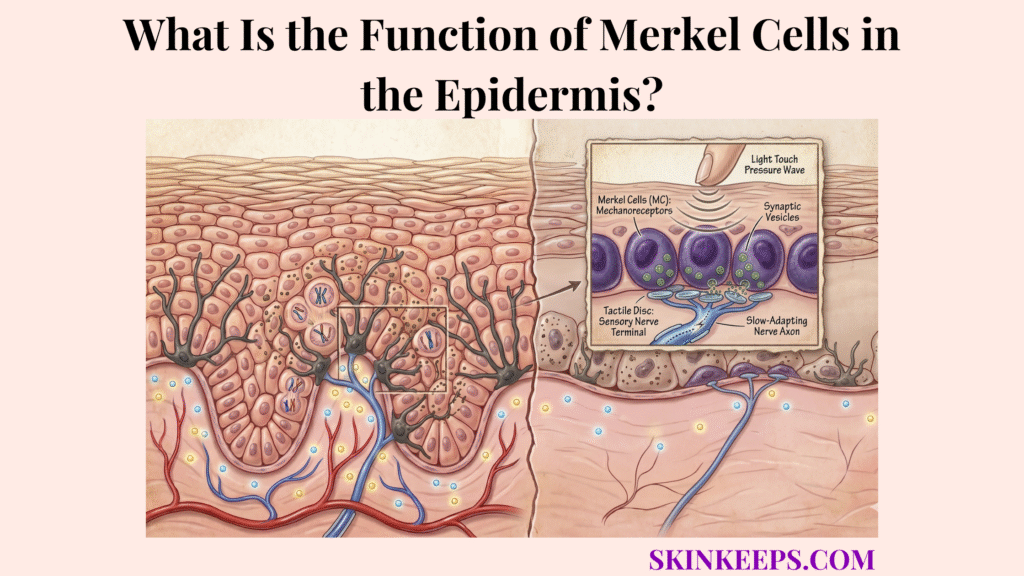
The function of Merkel cells in the epidermis is to help the skin detect light touch, sustained pressure, and fine tactile detail. These specialized cells work with sensory nerve endings to convert gentle mechanical contact into signals the nervous system can interpret. Merkel cells are described in modern reviews as rare epidermal sensory cells that partner with slowly adapting type I afferents to support light-touch sensation.
Although the epidermis is often described as a protective barrier, it is also part of the body’s sensory interface with the outside world. Merkel cells matter because they help the skin do more than block the environment; they help it feel and interpret it. Reviews of tactile receptors describe Merkel-cell systems as part of the main tactile terminal apparatus for discriminative light touch.
Understanding Merkel cell function makes it easier to explain how the epidermis contributes to touch sensation, why some skin areas are better at detecting fine detail than others, and how sensory function differs from barrier or pigment roles in the skin.
Why does Merkel cell function matter in the epidermis?
Merkel cell function matters because the epidermis is not only a barrier — it is also part of the body’s touch-sensing system.
Fine-touch detection helps the body respond to pressure, texture, and contact with much greater precision than crude contact awareness alone.
Merkel cell function contributes to precise sensory awareness at the skin surface, which is why these cells are discussed in skin neurobiology rather than only in epidermal histology. Reviews describe Merkel cells as specialized mechanosensory epidermal cells rather than structural barrier cells.
Where are Merkel cells located in the epidermis, and how does that support Merkel cell function?
Merkel cell function depends strongly on epidermal location because these cells are positioned where they can interface effectively with sensory nerve endings. They reside in the basal epidermis, the deepest layer of the skin that sits just above the dermal boundary.
Merkel cells are found in this basal region of the epidermis, close to the nerve structures they work with.
Merkel cells are a rare epidermal population, described as less than 5% of total epidermal cells in Abraham et al., 2019 and measured at about 1.5% ± 0.5% of epidermal cells in (Fradette et al., 2003), which fits their specialized sensory role rather than a bulk structural role.
They are especially important in highly touch-sensitive skin areas, such as the fingertips and lips, where precise tactile performance matters more. Reviews consistently place Merkel cells in the basal epidermis of both hairy and glabrous skin and emphasize their enrichment in touch-sensitive regions.
What is the primary sensory role of Merkel cell function in the epidermis?
The primary sensory role of Merkel cell function is to help the epidermis detect fine, localized mechanical touch with high precision.
Merkel cells are especially important for light touch, sustained pressure, and fine tactile detail. They excel at fine tactile discrimination, the ability to distinguish small details like shape, edge, and texture across the skin surface.
Their function supports discrimination of shape, edge, and texture at the skin surface. Studies and reviews of Merkel-cell afferent systems describe them as high-spatial-resolution touch receptors important for form and texture discrimination.
How does Merkel cell function help the skin detect light touch and pressure?
Merkel cell function helps the skin detect light touch and pressure by converting gentle mechanical contact into precise tactile information.
Merkel cells are activated when the skin is lightly deformed by touch or steady pressure, which makes them especially useful for subtle contact rather than painful stimulation.
Mechanotransduction studies link this function to Piezo2-dependent signaling and to slowly adapting type I touch responses—a specific nerve signal that fires continuously as long as pressure is applied—which are especially suited to sustained pressure and fine tactile detail.
How does Merkel cell function respond to gentle mechanical contact?
Merkel cell function responds to gentle mechanical contact when light deformation of the skin activates the Merkel cell–neurite complex, the combined tactile signaling unit of a Merkel cell and its associated nerve ending.
This makes Merkel cells important for sensing subtle touch rather than broad force or pain.
Their response is especially useful when the pressure is steady rather than momentary, because the Merkel-cell system is closely linked to slowly adapting type I tactile responses.
How does Merkel cell function improve tactile detail?
Merkel cell function improves tactile detail by helping the skin distinguish fine differences in touched surfaces.
This supports better awareness of texture, edges, and pressure patterns.
Merkel-cell signaling contributes to precision touch rather than broad diffuse sensation. Neuron-level touch reviews describe Merkel-cell pathways as important for high-acuity mechanosensation and fine tactile feature detection.
How does Merkel cell function depend on sensory nerve interaction?
Merkel cell function depends on sensory nerve interaction because tactile detection requires both local mechanical sensing and neural signal transmission. This transmission relies on a sensory nerve ending, the terminal fiber of a sensory neuron that carries sensory information toward the brain.
Merkel cells do not work in isolation. Their function depends on close interaction with sensory afferents.
Together the Merkel cell and its associated nerve ending form a tactile signaling unit that converts local skin deformation into nervous-system input. Experimental literature repeatedly refers to this combined structure as the Merkel cell–neurite complex.
How does Merkel cell function differ from other sensory functions in the skin?
Merkel cell function differs from other skin sensory functions because it is specialized for precise, fine-touch detection rather than pain, temperature, or broad contact awareness. Understanding which receptors in the dermis detect touch and pressure helps clarify this biological separation of duties.
Pain and temperature rely on different sensory pathways, while crude touch depends on less specialized tactile signaling. For example, epidermal Merkel cells function differently from the structures responsible for what detects light touch in the dermis near the surface (such as Meissner’s corpuscles).
Merkel cells are most strongly associated with fine tactile discrimination, especially sustained pressure and detailed touch. Reviews of cutaneous mechanoreceptors distinguish Merkel-cell systems clearly from nociceptive and thermosensory pathways, as well as from which receptors respond to deep pressure in the dermis (like Pacinian corpuscles).
| Sensory function | Main stimulus type | Precision level | Merkel cell involvement |
|---|---|---|---|
| Fine touch | Light pressure, texture, shape | High | Strong |
| Pain | Harmful or damaging stimuli | Different sensory system | Minimal |
| Temperature | Heat or cold | Different sensory system | Minimal |
| Crude touch | Broader contact awareness | Lower precision | Less specialized |
How does Merkel cell function differ from the functions of keratinocytes, melanocytes, and Langerhans cells?
Merkel cell function is different because Merkel cells are sensory specialists, while other major epidermal cells mainly serve structural, pigmentary, or immune roles.
Keratinocytes mainly form and renew the barrier, melanocytes mainly produce pigment, and Langerhans cells mainly support immune surveillance.
Merkel cells stand apart because their primary role is tactile sensing, not barrier construction, pigmentation, or immune defense.
| Cell type | Main function | Primary category |
|---|---|---|
| Merkel cells | Fine-touch sensory support | Sensory |
| Keratinocytes | Barrier formation and renewal | Structural |
| Melanocytes | Pigment production | Pigmentary |
| Langerhans cells | Immune surveillance | Immune |
How does Merkel cell function support protective awareness at the skin surface?
Merkel cell function supports protective awareness by helping the skin detect subtle contact early, before it turns into stronger or potentially harmful mechanical stress.
Fine touch helps the body detect contact before pressure becomes damaging and improves interaction with delicate objects and vulnerable skin areas.
This protective role is based on early tactile awareness rather than on pain signaling. The same fine-touch precision that supports texture and edge detection also helps the body react earlier to contact changes.
How can you tell when Merkel cell function or related tactile sensing may be reduced?
Reduced Merkel cell function may become noticeable when light-touch sensitivity and tactile precision decline more than broader skin sensation.
Warning signs can include reduced sensitivity to light touch, lower ability to distinguish texture or edge detail, duller tactile awareness in highly sensitive areas, less precise perception of steady contact, or changes in skin sensation without obvious surface damage.
This section should be framed as functional interpretation rather than self-diagnosis, because Merkel-cell-specific dysfunction is not usually recognized by one isolated skin sign.
What factors may weaken Merkel cell function or epidermal tactile performance?
Merkel cell function or related tactile performance may weaken when aging, nerve stress, or chronic skin damage reduce the efficiency of the skin’s sensory signaling system.
Aging can reduce sensory efficiency in the skin, chronic nerve stress or damage can weaken tactile signaling, and repeated injury or skin instability may affect the local sensory environment.
Peripheral somatosensory aging reviews describe decline in tactile receptor systems, including Merkel-cell-associated function, as part of age-related loss of touch acuity.
What habits help support healthy Merkel cell function and epidermal sensory performance?
Healthy Merkel cell function is best supported by preserving skin stability, minimizing chronic damage, and maintaining a healthier epidermal sensory environment.
The goal is not to “stimulate” Merkel cells aggressively, but to preserve the quality of the epidermal and neural environment they depend on.
This guides the approach for the targeted protective steps below.
How does barrier support help maintain healthy Merkel cell function?
Barrier support helps maintain healthy Merkel cell function because a healthier epidermal environment supports better overall skin performance and sensory comfort.
Lower chronic irritation helps preserve sensory comfort and supports a better tactile interface.
Stable skin conditions are more compatible with healthy tactile performance than chronically inflamed or overstripped skin, even if direct human intervention studies targeting Merkel cells are limited.
How does protecting the skin from chronic damage help preserve Merkel cell function?
Protecting the skin from chronic damage helps preserve Merkel cell function because repeated UV damage, irritation, or injury can weaken skin and nerve quality over time.
Less cumulative stress helps preserve healthier tissue behavior and more stable long-term sensory performance.
This approach emphasizes prevention rather than claiming direct selective restoration of Merkel cells by one routine step.
How do gentler routines help support epidermal sensory quality?
Gentler routines help support epidermal sensory quality because overly harsh treatment can destabilize the skin surface and reduce sensory comfort.
Gentler care helps preserve comfort and surface integrity, which are important for functional sensation.
More stable skin is more likely to support better tactile performance than skin left chronically irritated or inflamed.
Problem: reduced tactile precision or chronic skin stress
Implication: epidermal sensory performance may be weakening
Solution: protect the skin, support barrier stability, and reduce chronic irritation
What are the key takeaways about Merkel cell function in the epidermis?
Merkel cells are specialized epidermal sensory cells whose main function is to support fine-touch and pressure detection.
Their role requires healthy neural interaction and a stable epidermal environment.
The summary below outlines the core characteristics of Merkel-cell biology.
Summary Points
- Merkel cells are specialized epidermal sensory cells.
- Merkel cell function is mainly to support fine-touch and pressure detection.
- Their role depends on close interaction with sensory nerve endings.
- They differ from other epidermal cells because their main function is sensory rather than structural, pigmentary, or immune.
- Healthy skin and nerve support help preserve better tactile performance over time.
FAQs About Merkel Cell Function in the Epidermis
What do Merkel cells do in the epidermis?
Merkel cells help detect light touch, sustained pressure, and fine tactile detail by working with associated sensory nerve endings.
Are Merkel cells found everywhere in the skin?
Merkel cells are present in the basal epidermis but are especially important in highly touch-sensitive regions, where fine tactile performance matters most.
Do Merkel cells sense pain or temperature?
Merkel cells are specialized for fine touch and sustained pressure, while pain and temperature rely on different sensory systems.
Why does Merkel cell function matter clinically?
Merkel cells contribute to tactile precision and protective awareness, so changes in their system can matter for sensory quality even when the skin barrier looks normal.
What daily steps can you take to support healthy epidermal sensory function involving Merkel cells?
Daily steps can help support healthy epidermal sensory function involving Merkel cells by lowering chronic skin stress and preserving a healthier tactile environment.
Supporting skin stability, limiting chronic irritation, and paying attention to changes in light-touch sensitivity are more useful than chasing aggressive sensory “boosting.”
Implementing the following baseline steps preserves the integrity of the overall neuro-epidermal interface.
Daily Sensory Preservation Checklist
Merkel cell function reminds us that the epidermis does more than protect. It helps the body feel the world with precision.
Build your routine around skin stability and lower chronic stress if your goal is healthier, more comfortable, more functional skin over time.