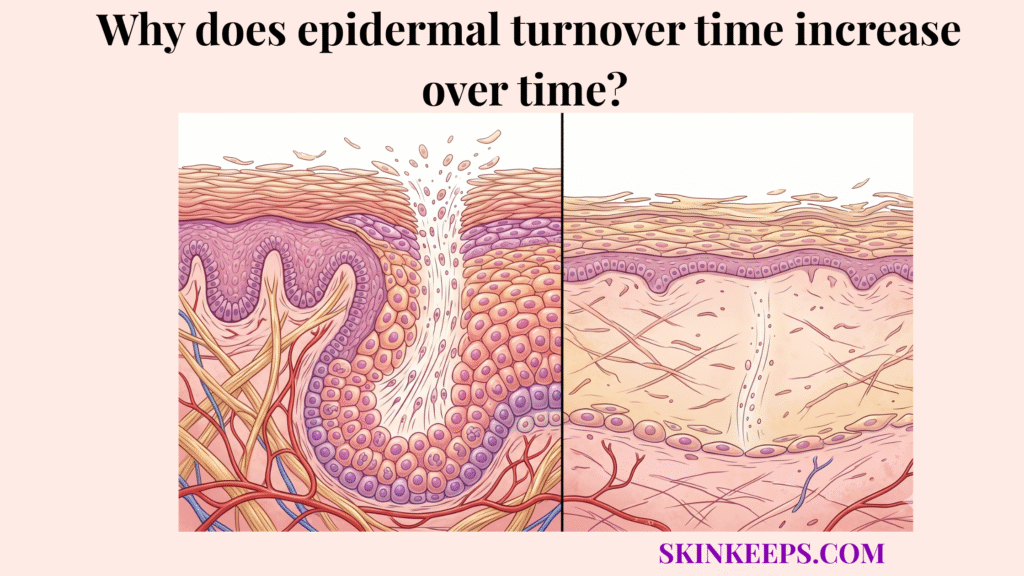
Epidermal turnover time increases over time because the skin gradually produces, moves, and sheds epidermal cells less efficiently. As basal-cell division slows, upward migration becomes less robust, and surface-cell shedding becomes less orderly, the full renewal cycle takes longer to complete. Classic turnover work and re-examinations cited in later reviews place normal adult epidermal turnover at roughly 40 to 56 days, with aging associated with further slowing rather than complete cessation (Wiley, 1972).
A longer turnover cycle does not only mean duller skin. It often means slower fading of marks, rougher texture, weaker visible freshness, delayed recovery, and more surface buildup. In other words, the epidermis is not stopping renewal, but it is completing that renewal more slowly. Reviews of aging skin describe slower proliferation, weaker barrier recovery, and less efficient surface renewal as linked features rather than separate problems.
Understanding increasing epidermal turnover time makes it easier to explain what slows first, how the renewal cycle stretches out over time, why backlog builds at the surface, and what actually helps support healthier turnover.
What begins first in increasing epidermal turnover time?
Increasing epidermal turnover time often begins when the epidermis starts generating replacement cells less efficiently at the base. The basal layer—the deepest epidermal layer where new keratinocytes are generated—functions as the starting point for all new cells.
One of the earliest changes is reduced efficiency in basal-cell production, so fresh keratinocytes are generated more slowly or less consistently even before dramatic surface aging appears.
The cycle begins to stretch before the skin obviously looks older. In aging skin, reduced proliferative activity is already detectable at the basal level, which means the renewal stream weakens before the visible backlog becomes obvious.
How does slower basal-cell production drive increasing epidermal turnover time?
Slower basal-cell production drives increasing epidermal turnover time because the epidermis cannot complete a fast cycle without a strong flow of new cells from below. A healthy cycle requires consistent keratinocyte output—the stream of new epidermal cells supplied from below.
The epidermis depends on a steady supply of newly formed keratinocytes, and when basal production slows, the renewal pipeline receives fewer fresh cells.
This reduces the speed at which the epidermis can repopulate and refresh itself. Studies describe age-related reductions in epidermal growth factor, parallel declines in keratinocyte proliferation, and increased keratinocyte apoptosis, all of which help explain why a longer cycle begins with weaker production rather than only delayed shedding.
How does delayed upward migration worsen increasing epidermal turnover time?
Delayed upward migration worsens increasing epidermal turnover time because cells take longer to reach the surface and complete the renewal journey. After cell birth, the tissue relies on steady upward migration, the movement of cells through the epidermal layers toward the surface.
New cells must travel upward through the epidermis to replace the surface, and when this migration becomes less efficient, the full cycle takes longer even if cell birth continues.
Slower vertical movement means the skin surface is refreshed later than before. Aging and wound-healing literature describes age-related impairment in keratinocyte migration, and studies specifically reported that oxygen tension changes the migration rate of human keratinocytes in an age-related manner, supporting the idea that the renewal journey itself becomes slower with age.
How does slower shedding contribute to increasing epidermal turnover time?
Slower shedding contributes to increasing epidermal turnover time because retained surface cells create backlog and delay the completion of the renewal cycle. This terminal phase, known as desquamation—the shedding of outer surface corneocytes—is the final bottleneck.
Surface shedding must stay coordinated with deeper renewal, and when old cells are retained longer the epidermis develops a visible surface backlog, where retained older cells accumulate at the surface because the cycle is slower.
This makes the full turnover cycle appear even slower and less efficient. Research describes corneocyte desquamation as a complex biologic event influenced by age, while age-dependent architectural work reports that reduced turnover allows longer residence time in the epidermis and more delayed maturation before shedding.
| Backlog Sequence | Effect on Cycle |
|---|---|
| 1. Shedding slows | Older cells detach less efficiently. |
| 2. Cells retained | Residence time at the surface increases. |
| 3. Crowded environment | New cells arrive underneath the backlog. |
| 4. Turnover delays | Visible renewal slows further. |
How do aging and cumulative stress accelerate increasing epidermal turnover time?
Aging and cumulative stress accelerate increasing epidermal turnover time by weakening multiple stages of the cycle at once.
Aging reduces renewal efficiency across production, migration, and shedding, while cumulative stress from UV exposure, pollution, inflammation, and repeated barrier damage adds repair burden to an already slowing system.
This is why delayed turnover becomes cumulative rather than isolated. A review notes that stratum corneum renewal time increases by about 50% in older adults, while broader aging reviews describe simultaneous decline in proliferation, lipid production, and barrier recovery (Wiley, 2024).
How does aging accelerate increasing epidermal turnover time?
Aging accelerates increasing epidermal turnover time by reducing renewal efficiency across production, migration, and shedding.
The full cycle becomes less dynamic and more stretched over time, which makes delayed turnover a cumulative rather than isolated change.
This makes the epidermis slower to complete a full cycle and more likely to show backlog at the surface. Reviews of cellular senescence in skin aging describe this slower cycling as part of broader epidermal aging biology.
How does cumulative stress accelerate increasing epidermal turnover time?
Cumulative stress accelerates increasing epidermal turnover time by increasing repair burden and weakening the systems needed for smooth renewal.
UV exposure, pollution, inflammation, and repeated barrier damage all increase the amount of correction the epidermis must perform while its renewal efficiency is already slowing.
Over time the epidermis becomes slower to complete a full cycle because stress keeps adding backlog faster than the skin can resolve it. Skin-aging reviews consistently describe cumulative environmental injury as a co-driver of visible epidermal aging and slower renewal behavior.
How does increasing epidermal turnover time create surface backlog and dullness?
Increasing epidermal turnover time creates surface backlog and dullness because the skin keeps older cells longer before replacing them fully. If you want to check your progress, try our Barrier Health Checker.
When turnover takes longer, older cells remain visible at the surface longer, which creates a buildup effect that reduces smoothness and reflectivity.
The skin may look duller, rougher, thicker, and less fresh because the outermost cells are being cleared more slowly. Age-dependent architecture studies specifically note longer residence time in the epidermis with reduced turnover, which supports the backlog model rather than a simple “dry skin only” explanation.
How does increasing epidermal turnover time affect barrier quality and recovery?
Increasing epidermal turnover time affects barrier quality and recovery by slowing the skin’s ability to replace and restore its outer protective layer efficiently.
A slower renewal cycle can reduce how quickly the barrier restores itself after irritation, inflammation, or minor damage.
The skin may become less adaptable and less responsive to routine stress because surface renewal and permeability-barrier recovery are both delayed. Studies report that barrier recovery after acute disruption is significantly delayed in aged humans and mice, and aging-and-wound-healing reviews describe slower epithelial repair as a characteristic consequence of aging skin.
Which signs suggest increasing epidermal turnover time is becoming more visible?
Increasing epidermal turnover time may be becoming more visible when the skin looks slower, rougher, more built up, and less quick to recover.
Warning signs can include duller skin tone, slower fading of post-inflammatory marks, rougher texture, more visible surface buildup, less bounce or freshness, slower recovery after irritation, and skin that looks tired even without strong inflammation.
These signs reflect a longer cycle rather than just a temporary bad-skin day. Reviews of aging epidermis and delayed barrier recovery support this pattern of visible slowdown, roughness, and slower reset after stress.
How does youthful turnover compare with increasing epidermal turnover time?
Youthful turnover keeps the epidermis moving through a shorter, cleaner cycle, while increasing epidermal turnover time stretches the cycle and leaves more backlog behind.
Youthful turnover depends on stronger basal output, more efficient migration, and more orderly shedding, which keeps the surface fresher and less congested by retained cells.
A lengthened cycle behaves differently: production is weaker, movement is slower, shedding is less efficient, and the surface looks duller and more built up as a result.
| Renewal state | Basal output | Migration speed | Shedding efficiency | Visible skin quality |
|---|---|---|---|---|
| Youthful turnover | Stronger | Faster | More orderly | Fresher, smoother, radiant |
| Increasing epidermal turnover time | Reduced | Slower | Less efficient | Duller, rougher, built up |
What factors make increasing epidermal turnover time worse?
Increasing epidermal turnover time worsens when cumulative stress slows renewal faster than the skin can compensate.
Common worsening factors include chronic UV exposure, over-exfoliation that creates repeated stress, ongoing inflammation, harsh routines that weaken barrier recovery, poor consistency with supportive skin care, and chronic environmental stress.
These conditions worsen the cycle-lengthening pattern because they increase repair demand while also weakening the systems needed for orderly renewal.
What habits and ingredients help support skin affected by increasing epidermal turnover time?
The best support for skin affected by increasing epidermal turnover time combines careful renewal support, gentle backlog reduction, and lower barrier stress.
The goal is not to force the skin into chronic irritation. The goal is to help a slower cycle move more efficiently while keeping the barrier stable enough to recover. You can monitor your tolerance to these adjustments using the Routine Stability Index (RSI).
This transition guides us to the specific interventions below.
How do retinoids help support skin affected by increasing epidermal turnover time?
Retinoids help support skin affected by increasing epidermal turnover time by improving renewal dynamics over time when they are used carefully.
Retinoids can help normalize slower turnover behavior, but they work best with barrier support rather than aggressive layering.
Retinoid reviews and systematic summaries report improved epidermal thickness, compaction of the stratum corneum, and structural improvement in photoaged skin, with some histologic changes noted as early as 15 days in certain studies and clearer clinical support over longer use periods (Mukherjee et al., 2006).
How does gentle exfoliation help support skin affected by increasing epidermal turnover time?
Gentle exfoliation helps support skin affected by increasing epidermal turnover time by reducing visible surface backlog without forcing the skin into repeated irritation.
Strategic use works better than chronic overuse, because the goal is to assist a slow cycle, not repeatedly injure the barrier.
Controlled chemoexfoliation is best understood as a targeted epidermal intervention, which is why the same mechanism becomes harmful when overused. Practical peel reviews consistently frame exfoliation as a controlled process rather than something to intensify indefinitely.
How does barrier support help skin affected by increasing epidermal turnover time?
Barrier support helps skin affected by increasing epidermal turnover time because stable surface care reduces stress on an already slowing cycle.
Less irritation means more capacity for orderly renewal and less risk that the skin will spend its resources on repeated repair.
Barrier stability helps the epidermis use its available renewal capacity more effectively. Aging-associated barrier dysfunction literature emphasizes that improving epidermal function can be a practical strategy for older skin rather than an optional cosmetic step.
Problem: increasing epidermal turnover time is creating slowdown and backlog
Implication: the skin is renewing less efficiently and recovering more slowly
Solution: support renewal carefully, reduce surface backlog gently, and keep the barrier stable
What are the key takeaways about increasing epidermal turnover time?
Increasing epidermal turnover time happens when cell production, migration, and shedding all become less efficient over time.
To maintain long-term skin health, the focus must shift from rapid fixes to consistent support.
Summary Points
- Increasing epidermal turnover time happens when cell production, migration, and shedding all become less efficient over time.
- The result is a longer renewal cycle, more surface backlog, and weaker visible freshness.
- Aging and cumulative stress accelerate the cycle-lengthening process.
- The best support strategy focuses on renewal support, barrier stability, and avoiding chronic over-irritation.
FAQs About Increasing Epidermal Turnover Time
Does increasing epidermal turnover time mean the skin stops renewing?
The epidermis usually keeps renewing, but the full cycle becomes less efficient and takes longer to complete.
Why does the skin look duller when epidermal turnover time increases?
Older cells remain on the surface longer, creating more visible backlog, roughness, and reduced reflectivity.
Can aggressive exfoliation fix increasing epidermal turnover time?
Over-forcing the surface can increase barrier stress and worsen recovery, even if it temporarily reduces buildup.
What helps most when increasing epidermal turnover time is already visible?
The most useful approach is careful renewal support, gentle backlog reduction, and stable barrier care rather than repeated aggressive correction.
What daily steps help reduce the impact of increasing epidermal turnover time?
Daily steps help reduce the impact of increasing epidermal turnover time by supporting the cycle gently while lowering cumulative stress.
The most useful support usually comes from consistency and lower stress rather than short bursts of aggressive correction.
Daily Renewal Support Checklist
Epidermal turnover time usually increases gradually, not all at once. The cycle stretches out first, then the visible consequences appear.
Build your routine around cycle support, barrier stability, and careful renewal if your goal is fresher, smoother, more resilient skin over time.