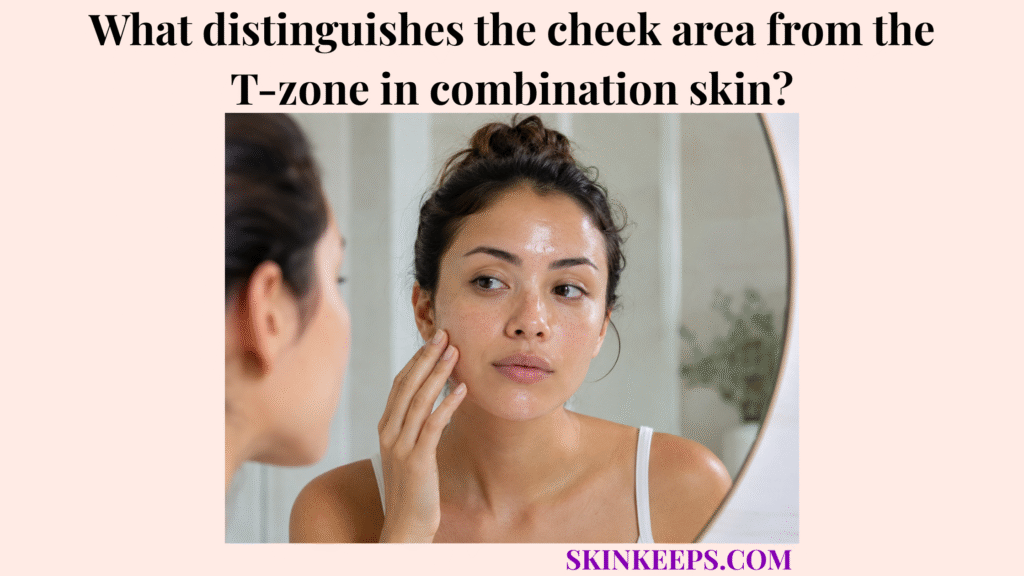
In combination skin, the T-zone is usually oilier, shinier, more pore-visible, and more congestion-prone than the cheek area, while the cheeks are often normal, drier, tighter, flakier, or less oily. The distinction is not oiliness alone; it is the repeated contrast between the center of the face and the side cheek areas.
That contrast becomes clearer when the article compares T-zone and cheek areas through oiliness, shine, pore visibility, tightness, flaking, congestion, product behavior, makeup wear, cleansing response, seasonal shifts, tracking, and professional evaluation.
What Areas Are Included in the T-Zone and Cheek Area?
The T-zone includes the forehead, nose, and chin, while the cheek area includes the side mid-face, outer cheeks, lower cheeks, and cheekbone area. Because combination skin depends on mixed zone behavior, the T-zone and cheek area should be compared instead of judging the whole face from one oily or dry patch.
This definition matters because the same face can show oil activity in the center while the cheeks stay balanced, tight, or flaky. Once the zones are separated, the T-zone becomes the main comparison point because it is often the area where oil and shine appear first.
Why Does the T-Zone Often Behave Oilier?
The T-zone often behaves oilier because the center of the face commonly shows more visible oil, shine, pores, and congestion than the cheek area.
Why May Cheeks Feel Drier or More Balanced?
Cheeks may feel drier or more balanced because they often show less visible oil than the forehead, nose, or chin in combination skin.
| Facial area | What it includes | Common combination-skin behavior |
|---|---|---|
| T-zone | Forehead, nose, chin | Oiliness, shine, visible pores, congestion |
| Forehead | Upper central face | Shine or oil buildup during the day |
| Nose | Center of face | Most visible pores, blackheads, oil, shine |
| Chin | Lower center face | Oiliness, clogged pores, or breakouts |
| Cheek area | Side mid-face | Normal, dry, tight, flaky, or less oily |
| Outer cheeks | Side of face near ears | Often less oily than the center face |
| Lower cheeks | Area above jawline | May feel dry, textured, or tight |
| Cheekbone area | Upper cheek | May be normal, dry, or makeup-clinging |
Cheek Area Versus T-Zone Map
This visual separates the center-face T-zone from the cheek area so the contrast can be observed clearly.
Figure 1. The T-zone is the center-face comparison point, while the cheek area helps reveal whether the face is truly mixed by zone.
How Does Oiliness Differ Between the Cheeks and T-Zone?
Oiliness differs because the T-zone usually shows more visible oil buildup than the cheeks in combination skin. Oiliness becomes easier to interpret when it is viewed as part of repeated facial-zone patterns rather than as one shiny area after one day.
| Feature | T-zone | Cheek area |
|---|---|---|
| Oil buildup | More noticeable | Lower or uneven |
| Shine | Often appears first | Often less visible |
| Blotting paper result | More oil transfer | Little or moderate transfer |
| Midday feel | Greasy or slick | Normal, dry, or tight |
| Product layering | Can feel heavy quickly | May need more comfort support |
| Sunscreen finish | May look shiny | May look normal or cling to dry texture |
Oil, Shine, and Dryness Contrast
This visual compares the common center-face oil clues with cheek-area dryness, tightness, or lower oil.
Figure 2. Combination skin is easiest to recognize when center-face oil repeats while the cheeks stay different.
How Does Pore Visibility Differ Between the Cheek Area and T-Zone?
Pore visibility usually differs because pores often look more noticeable in the T-zone, especially around the nose, than on the cheek area. This clue supports combination skin only when it follows the same oilier center-face pattern rather than appearing evenly across the whole face.
| Pattern | What it may suggest |
|---|---|
| Nose pores more visible than cheek pores | Common combination-skin pattern |
| Blackheads mostly on nose | T-zone congestion tendency |
| Chin pores clog faster than cheeks | Center-face oil activity |
| Cheeks look smoother but feel dry | Mixed oil and dryness pattern |
| Cheeks have visible pores too | Could still be combination if T-zone is oilier |
| Full-face visible pores and shine | May lean more oily than combination |
| Pores plus irritation or rash | Not just skin type; may need evaluation |
Why Do Cheeks Often Feel Tighter Than the T-Zone in Combination Skin?
Cheeks often feel tighter than the T-zone in combination skin because they usually have less visible oil and may lose comfort faster after cleansing, wind, cold, or harsh products. Tightness is most meaningful when it appears alongside a still-oily T-zone, because that contrast shows mixed zone behavior.
Cheek Tightness Clues
- Cheeks feel tight after washing.
- Moisturizer absorbs quickly on cheeks.
- Foundation clings to cheek texture.
- Cheeks feel dry while the nose looks oily.
- Cheeks flake when oil-control products are used all over.
- Cheeks sting before the T-zone does when products are too strong.
- Cheeks feel comfortable only with richer support than the T-zone needs.
How Does Flaking Differ Between Cheeks and the T-Zone?
Flaking differs because combination skin often shows flakes on the cheeks, around the mouth, or lower outer face while the T-zone still looks oily or shiny. When flaking appears near the nose or brows too, the pattern should be interpreted carefully because irritation, over-cleansing, or another condition may overlap.
| Flaking location | Possible meaning |
|---|---|
| Cheeks flake while nose shines | Common combination-skin contrast |
| Around mouth feels dry | Lower face may need gentler care |
| Flakes after mattifying products | Oil-control products may be too drying for cheeks |
| Nose flakes but stays oily | Dehydration, irritation, or over-cleansing may overlap |
| Thick or persistent scaling | Professional evaluation may be needed |
| Flaking with burning or rash | Not just combination skin |
How Does Congestion Differ Between Cheeks and the T-Zone?
Congestion often differs because the T-zone is more likely to show blackheads, clogged pores, shine, or oil-related buildup than the cheek area. This does not make the article an acne guide; it only shows how center-face oil activity can contrast with cheek dryness or balance.
| Congestion pattern | What it may suggest |
|---|---|
| Blackheads mostly on nose | T-zone oil and pore activity |
| Clogged chin but dry cheeks | Combination pattern with chin congestion |
| Forehead bumps with shiny skin | T-zone congestion tendency |
| Cheek bumps with dryness | Irritation, friction, makeup, or acne overlap |
| Breakouts everywhere with shine | More oily or acne-prone pattern may be involved |
| Painful jawline bumps | Not explained by combination skin alone |
How Do Products Feel Different on Cheeks Compared With the T-Zone?
Products feel different on cheeks compared with the T-zone because one area may need comfort while the other area becomes greasy, shiny, or heavy quickly. This product behavior is a recognition clue only, not a reason to recommend a full routine or specific products.
| Product behavior | T-zone clue | Cheek clue |
|---|---|---|
| Moisturizer feels heavy | Common on nose or forehead | Less common if cheeks are dry |
| Lightweight lotion feels enough | May suit oily center | May leave cheeks tight |
| Rich cream feels comfortable | May feel greasy in T-zone | May help dry cheeks |
| Mattifying product works | May reduce shine | May dry or tighten cheeks |
| Exfoliant feels strong | May reduce congestion | May sting or dry cheeks |
| Sunscreen looks shiny | Often T-zone issue | May cling to dry texture |
| Cleanser feels fine at first | Oil returns later | Tightness appears quickly |
How Does Makeup Wear Differ Between the Cheeks and T-Zone?
Makeup wear differs because foundation, powder, primer, or sunscreen-makeup layers may separate faster in the T-zone but cling or patch on the cheeks. This clue is useful because the same product can reveal oil in one zone and dryness in another.
| Makeup behavior | Zone clue |
|---|---|
| Foundation separates on nose | T-zone oil activity |
| Forehead becomes shiny under makeup | T-zone shine pattern |
| Chin makeup breaks down quickly | Center-face oil or movement |
| Foundation clings to cheeks | Dry or textured cheek area |
| Powder looks cakey on cheeks | Cheeks may be dry or tight |
| Blush area looks patchy | Cheek dryness or texture |
| Primer helps T-zone but dries cheeks | Different zone needs |
How Does Cleansing Response Differ Between the Cheek Area and T-Zone?
Cleansing response differs because a cleanser may feel effective on the T-zone but too stripping on the cheeks. This after-feel matters because a single cleanser can create different signals across the same face.
| After-cleansing sign | T-zone meaning | Cheek meaning |
|---|---|---|
| T-zone feels clean | Oil was removed | Not enough to judge whole face |
| Cheeks feel tight | Cleanser may be too stripping for dry zones | Dry-zone warning |
| Nose becomes oily again quickly | Oil rebound or natural oil activity | Not seen equally on cheeks |
| Moisturizer stings cheeks | Cheek barrier may be stressed | Needs gentler handling |
| Whole face feels squeaky | Cleanser may be too harsh | Can worsen both zones |
| Cheeks flake after cleansing | Dry-zone irritation | Product or habit may need change |
Can the Cheeks Be Sensitive While the T-Zone Is Oily?
Yes, the cheeks can be sensitive while the T-zone is oily because combination skin can overlap with cheek dryness, stinging, flushing, itching, or product discomfort. Cheek sensitivity can overlap with sensitive skin, but the cheek vs T-zone distinction still depends on repeated oil and dryness differences by zone.
| Zone | Possible behavior |
|---|---|
| Cheeks | Tight, stingy, reactive, dry, or easily flushed |
| Nose | Oily, shiny, or pore-visible |
| Forehead | Shiny during the day |
| Chin | Oily, congested, or breakout-prone |
| Outer face | Drier or more sensitive |
| Whole routine response | Products may suit one zone but bother another |
Important Distinction
This pattern is still about mixed facial zones. It should not be confused with sensitive skin as the whole skin type.
How Do Seasonal Changes Affect Cheeks and the T-Zone Differently?
Seasonal changes can affect cheeks and the T-zone differently because heat and humidity often increase T-zone shine, while cold, wind, and low humidity often increase cheek tightness. The contrast may become stronger in certain weather, but the repeated pattern matters more than one seasonal shift.
| Condition | T-zone response | Cheek response |
|---|---|---|
| Hot weather | More shine and oil | May stay normal or slightly oily |
| Humidity | Greasier feel | Less dry, but may still need comfort |
| Cold weather | Oil may reduce slightly | Tightness and flaking may increase |
| Wind | Less central effect | Cheeks may feel rough or irritated |
| Indoor heating | Mild dryness possible | Cheek dryness often increases |
| Sweating | T-zone congestion may increase | Cheeks may sting if salty sweat irritates |
How Does This Cheek vs T-Zone Pattern Differ From Oily Skin?
This cheek vs T-zone pattern differs from oily skin because combination skin has a stronger contrast between an oilier center and less oily or drier cheeks. Oily skin usually shows a broader shine pattern, while cheek vs T-zone contrast points more strongly toward combination skin.
| Feature | Cheek vs T-zone combination pattern | Oily skin pattern |
|---|---|---|
| T-zone | Oilier and shinier | Oily and shiny |
| Cheeks | Normal, dry, or less oily | Often oily too |
| Makeup | Separates center, clings cheeks | Separates more evenly |
| Moisturizer | Different feel by zone | Lighter texture often suits more areas |
| Pores | More visible center face | More visible across wider areas |
| Tightness | Common on cheeks | Less central unless dehydrated |
How Does This Cheek vs T-Zone Pattern Differ From Dry Skin?
This cheek vs T-zone pattern differs from dry skin because the T-zone still becomes oily, shiny, pore-visible, or congested even when the cheeks feel dry. Dry skin usually feels dry across more facial zones, while combination skin keeps an oil-prone T-zone even when the cheeks feel tight.
| Feature | Cheek vs T-zone combination pattern | Dry skin pattern |
|---|---|---|
| Cheeks | Dry, normal, or tight | Dry or tight |
| Nose | Often shiny or pore-visible | Usually not very oily |
| Forehead | May become shiny | Often dry or normal |
| Chin | May be oily or clogged | Often dry or normal |
| Product feel | Rich creams may suit cheeks but not T-zone | Richer products may suit more areas |
| Shine | Central shine appears | Minimal shine overall |
How Can Someone Observe Cheek and T-Zone Differences at Home?
Someone can observe cheek and T-zone differences at home by comparing shine, tightness, pore visibility, product feel, and makeup behavior across repeated calm-skin days. The goal is to see whether the contrast repeats when the skin is not actively irritated.
Zone-Specific Observation Checklist
- Start with gentle cleansing.
- Avoid harsh scrubs before observing.
- Notice which zone becomes shiny first.
- Compare nose oil with cheek comfort.
- Check whether cheeks feel tight after cleansing.
- Watch whether moisturizer feels different by zone.
- Observe makeup wear on nose versus cheeks.
- Track whether cheeks flake while T-zone shines.
- Repeat observations across several days.
- Avoid judging during an active rash or irritation flare.
What Mistakes Make Cheek vs T-Zone Differences Harder to Read?
Cheek vs T-zone differences become harder to read when harsh cleansing, heavy products, mattifying products, breakouts, or daily product changes distort the natural pattern. The goal is to reduce confusion before deciding the skin type.
| Mistake | Why it causes confusion |
|---|---|
| Judging immediately after harsh cleansing | Creates artificial cheek tightness |
| Using mattifying products everywhere | Can over-dry cheeks |
| Using rich creams everywhere | Can make the T-zone look oilier |
| Judging during a breakout flare | Acne can distort zone patterns |
| Ignoring makeup behavior | Makeup often reveals zone differences |
| Assuming dry cheeks mean dry skin | T-zone oil may still indicate combination skin |
| Assuming oily nose means oily skin | Cheeks may show the real contrast |
| Changing products daily | Prevents stable pattern recognition |
How Should Cheek vs T-Zone Patterns Be Tracked?
Cheek vs T-zone patterns should be tracked by recording shine, oil, pore visibility, tightness, flaking, product feel, and makeup behavior in both zones. Repeated notes reveal whether the pattern is stable or product-driven.
Cheek vs T-Zone Tracking Worksheet
- Date and weather.
- Forehead shine level.
- Nose shine level.
- Chin oil or congestion level.
- Cheek tightness level.
- Cheek flaking or roughness.
- Cheek sensitivity or stinging.
- Pore visibility on nose.
- Pore visibility on cheeks.
- Makeup behavior on T-zone.
- Makeup behavior on cheeks.
- Moisturizer feel by zone.
- Cleanser after-feel by zone.
- Products used recently.
- Whether the pattern repeats over time.
- Photos of shine or dry patches if helpful.
Cheek vs T-Zone Recognition Loop
This visual shows the safe logic: define the zones, compare visible clues, repeat observations, then separate warning signs from skin-type recognition.
Figure 3. Recognition is safer when repeated zone contrast is separated from rash, swelling, pain, or other warning signs.
When Should Cheek or T-Zone Changes Be Professionally Evaluated?
Cheek or T-zone changes should be professionally evaluated when they are severe, persistent, painful, swollen, oozing, bleeding, rash-like, eye-area related, suddenly inflamed, or recurring despite gentle care. Cheek and T-zone observation can support skin-type recognition, but severe, painful, swollen, oozing, bleeding, eye-area, or rash-like changes need professional evaluation.
Professional Evaluation Warning Signs
- Cheek rash, swelling, oozing, crusting, or bleeding appears.
- Burning, pain, or itching is severe or persistent.
- Flaking becomes thick, spreading, or recurring.
- T-zone breakouts are painful, cyst-like, or scarring.
- One zone becomes suddenly inflamed.
- Skin reacts to many basic products.
- Eye or eyelid irritation occurs.
- Redness or darker irritation does not settle.
- Symptoms continue despite gentle care.
- Eczema, dermatitis, rosacea, infection, psoriasis, acne complications, or another condition may be involved.
Urgent Safety Note
Rapid swelling, severe pain, pus, fever with skin symptoms, rapidly spreading warmth, breathing difficulty, throat tightness, faintness, or rapid facial, lip, tongue, or throat swelling requires urgent medical care.
What Should You Remember About Cheeks and the T-Zone in Combination Skin?
Remember that the main cheek vs T-zone difference in combination skin is repeated contrast: the T-zone is oilier while the cheeks are normal, drier, tighter, flakier, or less oily.
What Should You Remember?
- The T-zone includes the forehead, nose, and chin.
- The cheek area includes the side mid-face, outer cheeks, lower cheeks, and cheekbone area.
- The T-zone is usually oilier, shinier, more pore-visible, or more congestion-prone.
- The cheeks are often normal, dry, tight, flaky, or less oily.
- Nose pores may look more visible than cheek pores.
- Cheeks may feel tight while the nose or forehead looks shiny.
- Products may feel greasy in the T-zone but needed on the cheeks.
- Makeup may separate in the T-zone and cling to cheek texture.
- Sensitive cheeks can overlap with an oily T-zone.
- Seasonal changes can exaggerate the contrast.
- Repeated zone contrast matters more than one oily or dry day.
- Severe, painful, swollen, oozing, bleeding, rash-like, or persistent changes need professional evaluation.
Frequently Asked Questions
What Is the Main Difference Between the Cheeks and T-Zone in Combination Skin?
The main difference is that the T-zone is usually oilier, shinier, more pore-visible, or more congestion-prone, while the cheeks are often normal, dry, tight, flaky, or less oily.
Are Dry Cheeks and an Oily T-Zone Combination Skin?
Dry cheeks with an oily T-zone can suggest combination skin when the pattern repeats over time. One temporary day of dryness or shine is not enough to confirm the pattern.
Can the Cheeks Be Sensitive While the T-Zone Is Oily?
Yes. Some people have sensitive or dry cheeks while the forehead, nose, or chin remain oily or shiny. This is still a zone-contrast pattern.
Why Does Makeup Separate on the T-Zone but Cling to Cheeks?
Makeup may separate on the T-zone because of oil and shine, while it may cling to cheeks because of dryness, tightness, or texture.
Does an Oily Nose Mean Oily Skin Instead of Combination Skin?
Not always. An oily nose may suggest combination skin if the cheeks are repeatedly normal, dry, tight, flaky, or less oily. Oily skin usually shows broader shine across more of the face.
When Should Cheek or T-Zone Changes Be Checked Professionally?
Cheek or T-zone changes should be checked if they include persistent pain, burning, swelling, rash, oozing, bleeding, eye-area symptoms, painful breakouts, or symptoms that continue despite gentle care.
Conclusion
The cheek area is distinguished from the T-zone in combination skin by a repeated contrast between a more oil-prone center face and less oily or drier side-face areas. The T-zone usually gives the clearest oil-related clues because the forehead, nose, and chin may look shinier, more pore-visible, or more congestion-prone.
That center-face pattern becomes more meaningful when the cheeks stay normal, dry, tight, flaky, or less oily at the same time. Because products, makeup, cleanser after-feel, weather, and temporary irritation can distort the pattern, cheek vs T-zone differences should be judged by repeated observation.
If the pattern includes severe burning, pain, swelling, rash, oozing, bleeding, eye-area symptoms, or persistent irritation, professional evaluation is safer than skin-type guessing. The simplest recognition rule is this: in combination skin, the T-zone usually shows oil activity while the cheeks show comfort, dryness, tightness, flaking, or lower oil.
Sources & Evidence
Cleveland Clinic — Understanding Skin Types
Supports combination skin as mixed facial-zone behavior, including oilier T-zone and drier cheek-area patterns.
[Cleveland Clinic]DermNet — Soaps and Cleansers
Supports the common combination-skin description of an oily T-zone with normal or dry cheeks.
[DermNet]American Academy of Dermatology — Dry Skin Signs and Symptoms
Supports dry skin signs such as roughness, flaking, itch, cracking, and moisture-loss symptoms.
[AAD]Mayo Clinic — Dry Skin
Supports dry skin symptoms and common causes such as harsh soaps, overbathing, cold or dry weather, and sun damage.
[Mayo Clinic]DermNet — Acne
Supports acne as a follicle and sebaceous-gland related condition, helping avoid overdiagnosing congestion from facial zones alone.
[DermNet]Cleveland Clinic — Contact Dermatitis
Supports professional evaluation when itchy, swollen rash or irritant/allergen-related reactions appear.
[Cleveland Clinic]Disclaimer: This article provides general educational information about recognizing cheek-area and T-zone differences and does not diagnose combination skin, acne, dermatitis, eczema, rosacea, psoriasis, infection, allergy, or another skin condition. Zone observation can help with skin-type recognition, but severe, persistent, spreading, painful, swollen, oozing, crusting, bleeding, eye-area, or rash-like symptoms should be professionally evaluated. Breathing difficulty, throat tightness, faintness, fever with rapidly worsening skin symptoms, pus, severe pain, or rapid facial, lip, tongue, or throat swelling requires urgent medical care.