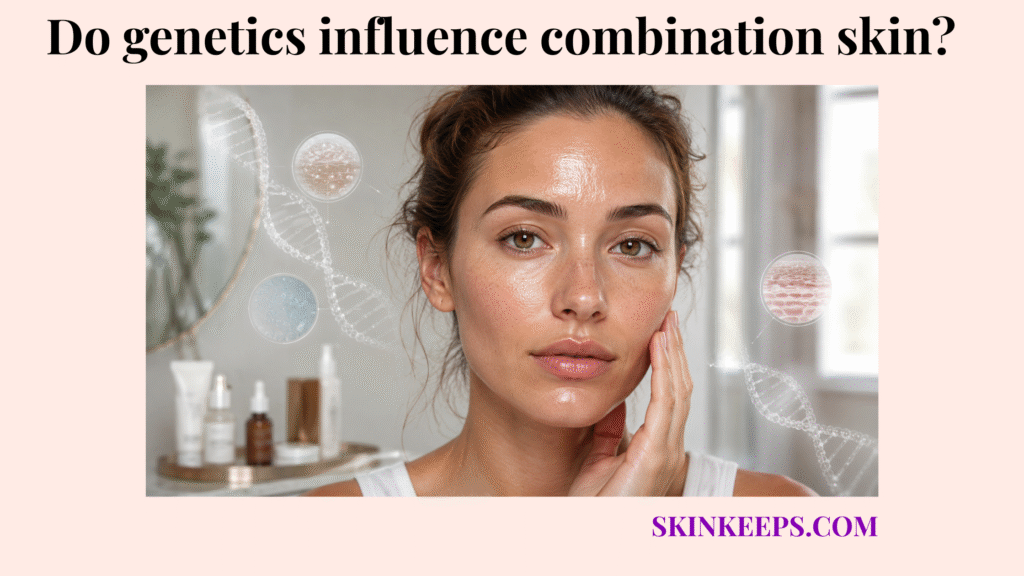
Yes, genetics can influence combination skin by shaping how much oil different facial areas tend to produce, how visible pores may be, how easily some zones feel dry, and how stable the skin barrier feels. A person may inherit a pattern where the T-zone becomes oily while the cheeks stay normal, dry, or less oily.
Genetics create a baseline tendency, not a fixed destiny, so combination skin can still look stronger, weaker, oilier, drier, or more reactive when hormones, age, stress, weather, and skincare habits change. The practical goal is to recognize the baseline pattern and manage each zone without treating the whole face as one uniform skin type.
How do genetics influence combination skin?
Genetics influence combination skin by shaping baseline oil production, pore tendency, barrier comfort, dryness tendency, acne tendency, and how different facial zones behave. This inherited baseline can make the face behave unevenly instead of acting like one uniform oily, dry, normal, or sensitive skin type.
That influence does not fully decide the skin forever. It creates a starting pattern that daily routine choices and life changes can modify.
| Genetic influence in combination skin | What it can affect | How it may appear |
|---|---|---|
| Sebum tendency | How oily certain zones become | Oily forehead, nose, or chin |
| Pore tendency | How visible or clog-prone pores look | More visible pores in the T-zone |
| Barrier tendency | How comfortable or tight skin feels | Dry or normal cheeks beside oily zones |
| Acne tendency | How easily oily zones clog | Blackheads, bumps, or breakouts in select areas |
| Sensitivity tendency | How quickly skin reacts | Cheeks or mouth area may sting faster |
| Family pattern | Repeated traits across relatives | Similar oily T-zone or mixed-zone behavior |
Practical rule: Genetics usually create the starting pattern. Daily routine and life changes can modify how strongly that pattern shows.
Genetic Baseline Pattern Map
This visual separates inherited baseline tendencies from the facial zones where they may show most clearly.
Figure 1. Genetics may shape a baseline facial-zone pattern, but that pattern can still be modified by life stage, routine, and irritation.
Which inherited traits can shape combination skin?
Inherited traits can shape combination skin by influencing oil tendency, dryness tendency, pore behavior, acne tendency, and sensitivity across different facial zones. These traits are best read as tendencies, not guarantees, because the same inherited pattern can look different under different routines or life stages.
How inherited oil tendency can affect combination skin
Inherited oil tendency can affect combination skin when selected zones, especially the forehead, nose, and chin, naturally produce more visible oil than the cheeks. This can show as T-zone shine, an oil film by midday, or a greasy feel that stays more central than full-face.
How inherited dryness tendency can affect combination skin
Inherited dryness tendency can affect combination skin when some facial areas naturally feel less oily, more tight, or more dependent on moisturizer. The cheeks, outer face, or around-mouth area may feel normal, dry, or tight even while the T-zone becomes shiny.
How inherited pore and acne tendency can affect combination skin
Inherited pore and acne tendency can affect combination skin when oil-prone zones show visible pores, clogged pores, blackheads, or recurring breakouts. Those clogged zones do not mean the entire face is oily, because the cheeks may still stay normal or dry.
How inherited sensitivity tendency can affect combination skin
Inherited sensitivity tendency can affect combination skin when some zones sting, burn, peel, or react faster than other areas. This may show more around the cheeks, mouth area, or eye-adjacent skin, but stinging alone should not be treated as proof of allergy.
How can genetics create oily and dry zones in combination skin?
Genetics can create oily and dry zones in combination skin by setting different baseline tendencies for sebum, pores, barrier comfort, and sensitivity across facial areas. The result can be an inherited zone map, where one area repeatedly behaves oilier while another area repeatedly feels normal, dry, or more reactive.
How genetics can make the T-zone oilier in combination skin
Genetics can make the T-zone oilier in combination skin when the forehead, nose, and chin consistently show more shine, visible pores, blackheads, or congestion. This is why an inherited oily center can appear even when the cheeks do not feel greasy.
How genetics can make cheeks normal or dry in combination skin
Genetics can make cheeks normal or dry in combination skin when cheek areas naturally produce less visible oil or feel less greasy than the T-zone. Those cheeks do not need to be flaky every day for the skin to still fit a mixed-zone pattern.
How genetics can make combination skin stable over time
Genetics can make combination skin stable over time when the same facial-zone pattern repeats for years despite a simple routine. The intensity can shift, but the familiar map often remains recognizable.
| Combination skin zone | Genetic tendency that may show | Common visible clue |
|---|---|---|
| Forehead | Higher oil tendency | Shine or small bumps |
| Nose | Higher sebum and pore visibility | Blackheads or visible pores |
| Chin | Oil and acne tendency | Congestion or recurring breakouts |
| Cheeks | Lower oil or barrier difference | Normal comfort, tightness, or dryness |
| Around mouth | Lower oil or sensitivity tendency | Peeling, tightness, or stinging |
| Jawline | Acne or sensitivity tendency | Breakouts, irritation, or mixed texture |
How can you tell if combination skin is genetic?
You can tell combination skin may be genetic when the same oily and normal, dry, or sensitive zones repeat for years and appear even with a simple routine. This is not a genetic test or diagnosis, but repeated location-based behavior can be a useful pattern clue.
Family-Pattern Observation Checklist
- Your oily T-zone and different cheek behavior have existed for years.
- Your skin pattern started before you used many skincare products.
- Close family members have similar oiliness, pores, acne, dryness, or sensitivity.
- The same facial zones behave differently even when your routine is simple.
- The T-zone becomes oily predictably while cheeks stay normal or dry.
- Your pattern changes in intensity but does not disappear completely.
- You notice similar facial-zone behavior across seasons.
Practical rule: A genetic pattern usually repeats. A temporary reaction usually starts after a clear change.
How is genetic combination skin different from product-related combination skin?
Genetic combination skin is usually long-standing and repeatable, while product-related combination skin often starts suddenly after a new cleanser, treatment, moisturizer, sunscreen, or exfoliant. That distinction matters because burning, peeling, sudden tightness, or rash-like changes should not automatically be called genetic.
When sudden irritation appears, the pattern may be better compared with product reactions by facial area in combination skin before assuming inherited skin behavior is the main cause.
| Pattern clue | More likely genetic combination skin | More likely product-related imbalance |
|---|---|---|
| Timing | Long-term pattern | Started after a new product |
| Location | Same zones repeat | Reaction appears where product was applied |
| Family history | Similar traits in relatives | No clear family pattern |
| Skin comfort | Baseline mixed behavior | Burning, peeling, or sudden tightness |
| Routine link | Exists even with simple routine | Improves after stopping a product |
| Oil pattern | T-zone predictably oilier | Oiliness worsens after irritation or stripping |
Practical rule: Do not call every skin change genetic. If the imbalance started suddenly, products, irritation, or barrier disruption may be involved.
Genetic vs Product-Related Pattern
This visual shows how long-term repetition points more toward baseline genetics, while sudden change points more toward a product or irritation trigger.
Figure 2. A genetic pattern is usually long-standing, while product-related imbalance often starts after a clear routine change.
How is genetic combination skin different from hormonal combination skin?
Genetic combination skin is different from hormonal combination skin because genetics often set the baseline pattern, while hormones can make oiliness, breakouts, or sensitivity fluctuate. The two can overlap, so the question is whether the same facial zones repeat steadily or flare at predictable life-stage or cycle-related times.
Identify genetic combination skin patterns that stay consistent
Genetic combination skin patterns often stay consistent because the same oily-zone and cheek-zone behavior repeats over long periods. An oily T-zone with normal or dry cheeks may become stronger or weaker, but the map often stays familiar.
Identify hormonal combination skin patterns that fluctuate
Hormonal combination skin patterns often fluctuate when oiliness, breakouts, or sensitivity rise and fall during puberty, menstrual cycles, pregnancy, postpartum changes, or other life stages. That timing can amplify oiliness or breakouts without proving a permanent new skin type.
Identify overlap between genetic and hormonal combination skin
Genetic and hormonal combination skin can overlap because genetics may set the baseline while hormones intensify oiliness, clogged pores, or reactivity at certain times. This baseline-plus-modifier model prevents the answer from becoming either genetic or hormonal only.
| Combination skin clue | Genetic influence | Hormonal influence |
|---|---|---|
| Long-term oily T-zone | Common | Can intensify |
| Monthly breakout pattern | Possible but not enough alone | More likely |
| Puberty-related oil increase | Genetic tendency may appear | Hormones often amplify |
| Family acne or oiliness | Strong clue | May overlap |
| Sudden life-stage change | Less likely alone | More likely |
| Stable cheek behavior | Common | May shift during hormonal changes |
Baseline Plus Modifier Model
This visual explains how inherited tendency can be intensified or softened by hormones, age, stress, weather, and skincare habits.
Figure 3. Genetics can set the starting pattern, while modifiers change how oily, dry, sensitive, or congested the zones look.
How should genetically influenced combination skin guide routine choices?
Genetically influenced combination skin should guide routine choices by encouraging zone-based care instead of one aggressive full-face routine. This routine direction should respond to the inherited pattern without assuming that every zone needs the same oil control or the same moisture support.
Cleanse genetically influenced combination skin without stripping it
Genetically influenced combination skin should be cleansed without stripping because the goal is to clean oilier zones without making normal or dry zones tight. A stable oily T-zone does not justify harsh cleansing across the whole face.
Moisturize genetically influenced combination skin by zone
Genetically influenced combination skin should be moisturized by zone because oily areas may need lighter layers while dry or normal cheeks may need steady comfort support. This approach connects genetic tendency to the broader oil-and-dryness patterns in combination skin.
Treat clogged pores in genetically influenced combination skin only where needed
Clogged pores in genetically influenced combination skin should be treated only where needed because oil-prone zones may not represent the whole face. If breakouts and dryness appear together, the pattern may need the same balanced thinking used for breakouts and dry patches in combination skin.
| Genetic combination skin pattern | Routine direction | What to avoid |
|---|---|---|
| Oily T-zone + dry cheeks | Light oil control with cheek barrier support | Drying the whole face |
| Oily T-zone + normal cheeks | T-zone-specific oil control | Over-treating balanced cheeks |
| Nose-dominant oiliness | Localized pore care | Full-face harsh exfoliation |
| Chin congestion + normal cheeks | Targeted acne care | Heavy treatment everywhere |
| Sensitive dry zones + oily T-zone | Gentle, fragrance-free routine | Strong products on reactive areas |
What mistakes happen when genetics influence combination skin?
Mistakes happen when genetics influence combination skin if readers treat heredity as destiny, treat the whole face as oily, ignore dry zones, or blame genetics for sudden irritation. Genetics can shape baseline behavior, but care choices still matter.
Avoid assuming genetic combination skin cannot improve
Assuming genetic combination skin cannot improve is a mistake because inherited tendencies can still be managed with better zone-based care. Shine, tightness, clogged pores, and comfort can still improve without promising perfect skin.
Avoid treating genetic combination skin as full-face oily skin
Treating genetic combination skin as full-face oily skin can over-dry cheeks and reactive zones while chasing oil that mainly appears in the T-zone. This is especially relevant when the inherited pattern looks like an oily T-zone with normal cheeks.
Avoid ignoring dry zones in genetic combination skin
Ignoring dry zones in genetic combination skin can make normal, dry, or sensitive areas feel tighter, rougher, or less tolerant of products. Barrier comfort matters even when the T-zone is oily.
Avoid blaming genetics for sudden irritation in combination skin
Blaming genetics for sudden irritation in combination skin can delay identifying product reactions, allergies, dermatitis, or another trigger. Sudden burning, peeling, rash-like changes, swelling, or persistent irritation should be reassessed rather than dismissed as inherited.
When should genetically influenced combination skin need professional help?
Genetically influenced combination skin needs professional help when breakouts, dryness, irritation, or sudden changes become painful, severe, scarring, bleeding, spreading, or persistent. Genetic tendency does not remove the need for care when symptoms become severe or unusual.
See a Dermatologist If
- Breakouts are painful, deep, cystic, or scarring.
- Dry patches crack, bleed, burn, or spread.
- Skin suddenly changes without a clear reason.
- Skin reacts to many gentle products.
- Oiliness is paired with persistent inflamed acne.
- Cheek dryness keeps worsening despite gentle care.
- A hormonal acne pattern or another medical factor may be intensifying the pattern.
- A simple routine does not improve comfort after several weeks.
What should you remember about genetics and combination skin?
The key point is that genetics can influence combination skin, but genetics do not make the pattern untouchable or impossible to manage.
Genetics and Combination Skin Checklist
- Genetics can influence combination skin.
- Genetics may affect oil production, pores, dryness tendency, acne tendency, and sensitivity.
- A long-standing oily T-zone with normal or dry cheeks may reflect inherited skin behavior.
- Family patterns can be a useful clue.
- Genetics are not the only cause of combination skin changes.
- Hormones, age, stress, weather, and products can modify the baseline pattern.
- Genetic influence does not mean the skin cannot be managed.
- Treat oily zones without drying normal or dry zones.
- Use targeted care instead of one aggressive full-face routine.
- Seek professional help for painful acne, severe dryness, sudden changes, or persistent irritation.
Frequently Asked Questions About Genetics and Combination Skin
Is combination skin genetic?
Combination skin can be genetically influenced. Inherited traits may affect oil production, pore visibility, dryness tendency, acne tendency, sensitivity, and how different facial zones behave.
Can I inherit an oily T-zone?
Yes. Some people appear to inherit stronger oil activity in the forehead, nose, and chin while the cheeks stay normal, dry, or less oily.
Does genetic combination skin stay the same forever?
Not always. Genetics can set the baseline, but hormones, age, stress, weather, and skincare habits can change how strongly the combination skin pattern appears.
Can genetics make combination skin acne-prone?
Yes. Genetics may influence oiliness, pore behavior, and acne tendency, which can make some combination skin zones more prone to clogged pores, blackheads, whiteheads, or breakouts.
How do I know if my combination skin is genetic or caused by products?
A genetic combination skin pattern usually lasts for years and repeats in the same zones. A product-related pattern often starts suddenly after a new cleanser, treatment, moisturizer, sunscreen, or exfoliant.
Conclusion
Genetics can influence combination skin by shaping the baseline pattern of oil production, pore visibility, dryness tendency, acne tendency, sensitivity, and barrier comfort across facial zones. That baseline may look like an oily T-zone with normal or dry cheeks, or it may appear as recurring clogged pores in selected zones while the rest of the face stays more balanced.
Because genetics are only the starting pattern, combination skin should still be read through timing, location, repetition, and sudden changes. If the pattern becomes painful, scarring, cracking, bleeding, swollen, spreading, rash-like, or persistent, professional evaluation is safer than assuming genetics explains everything.
Sources & Evidence
Cleveland Clinic — Understanding Skin Types
Supports combination skin as mixed facial-zone behavior, including oilier T-zone patterns and drier or different cheek-area behavior.
[Cleveland Clinic]PubMed — Genetic Control of Sebum Excretion and Acne
Supports the evidence boundary that sebum excretion has genetic influence and that acne lesions can be modified by non-genetic factors.
[PubMed]DermNet — Sebum
Supports sebum biology and hormonal control of oil production through androgens.
[DermNet]DermNet — What Causes Acne?
Supports cautious discussion of sebaceous follicles, DHT, sebum, and acne lesion development without overdiagnosing combination skin.
[DermNet]PubMed — Twin Study of Acne in Women
Supports the claim boundary that acne tendency can have a strong genetic component while remaining influenced by non-shared environmental factors.
[PubMed]American Academy of Dermatology — Acne Dermatologist Guidance
Supports professional escalation when acne is cystic, scarring, persistent, or difficult to control.
[AAD]American Academy of Dermatology — Dry Skin Guidance
Supports escalation context for dry skin that cracks, bleeds, burns, or persists despite gentle care.
[AAD]Educational Disclaimer: This article is for general skin education only and does not diagnose, treat, or replace professional medical care. If combination skin is paired with painful acne, scarring, sudden skin changes, severe dryness, burning, cracking, bleeding, swelling, spreading rash-like symptoms, or persistent irritation, consult a qualified dermatologist.