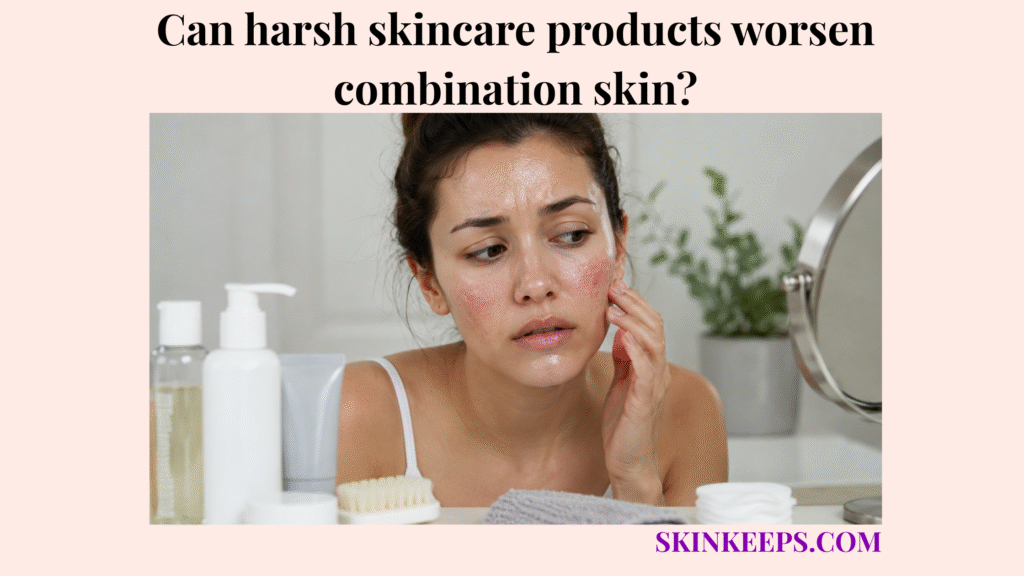
Yes, harsh skincare products can worsen combination skin by stripping oily zones, drying normal or dry zones, irritating the skin barrier, triggering peeling, and making breakouts harder to manage. A strong cleanser, aggressive exfoliant, drying acne treatment, alcohol-heavy toner, harsh mask, or fragranced product may seem helpful at first, but it can push combination skin into a more unstable pattern.
Combination skin does not react evenly across the face. The T-zone may become shiny, congested, or irritated, while the cheeks, around the mouth, or outer face may become tight, flaky, rough, or sensitive after the same harsh product.
How can harsh skincare products worsen combination skin?
Harsh skincare products can worsen combination skin by damaging the balance between oily and dry facial zones. They may remove too much oil, disrupt barrier comfort, increase irritation, trigger tightness, or make acne products harder to tolerate.
In different skin types, the whole face may behave more uniformly. Combination skin is harder because the same product can feel useful on the nose and too strong on the cheeks.
| Harsh product effect in combination skin | Oily-zone result | Dry or normal-zone result |
|---|---|---|
| Stripping | T-zone feels tight, then shiny again | Cheeks feel dry or irritated |
| Over-exfoliation | Bumps, redness, peeling | Roughness, stinging, flakes |
| Drying acne treatment | Less oil briefly, more peeling | Dry patches worsen |
| Alcohol-heavy product | Tight, squeaky feel | Barrier discomfort |
| Fragrance irritation | May seem fine on T-zone | Cheeks or mouth area may sting |
| Heavy “repair” overcorrection | Clogged T-zone | Dry zones may improve |
| Too many active products | Breakouts and irritation overlap | Skin becomes reactive |
Practical rule: If a product makes one zone look better while another zone becomes worse, combination skin may need gentler or more targeted use.
Harsh Product Zone Reaction Map
This visual shows why a harsh product can appear helpful on the T-zone while stressing cheeks, around-mouth skin, and the outer face.
Why does combination skin react badly to harsh skincare products?
Combination skin reacts badly to harsh skincare products because oily, dry, normal, and sensitive zones do not have the same tolerance. A one-size-fits-all routine can over-treat the center of the face and under-support the outer face.
How harsh products strip oily zones in combination skin
Harsh products strip oily zones in combination skin when the T-zone feels cleaner at first but later becomes tight, shiny, irritated, or unstable. The forehead, nose, and chin may feel squeaky after cleansing, but that tight finish is not the same as balanced oil control.
Removing too much oil can make the T-zone harder to interpret. Shine may return while the surface still feels uncomfortable, which can lead the reader to reach for even stronger products.
How harsh products weaken dry zones in combination skin
Harsh products weaken dry zones in combination skin when cheeks, around the mouth, or outer-face areas become flaky, rough, dull, tight, or sting-prone. These areas often show discomfort earlier because they are not as oil-cushioned as the T-zone.
Dry-zone discomfort does not prove a medical condition by itself. It is often a sign that the product strength, contact time, or frequency is not matching the zone.
How harsh products make combination skin harder to read
Harsh products make combination skin harder to read because irritation can look like acne, dryness can look like texture, and oiliness can look like a need for stronger products. Bumps plus peeling, shiny-but-tight skin, and rough cheeks can all appear when the routine is too intense.
This is why tracking product reactions by facial area in combination skin is often more useful than judging the whole face after one wash or one treatment.
Which harsh skincare products most often worsen combination skin?
The harsh skincare products that most often worsen combination skin include stripping cleansers, scrubs, strong exfoliants, overused acne treatments, alcohol-heavy toners, drying masks, fragrance, and too many actives at once.
A product does not have to be unsafe or low quality to be too harsh. It may simply be too strong for the whole face, too frequent for the current barrier, or placed on zones that do not need it.
| Product type | How it can worsen combination skin | Common warning sign |
|---|---|---|
| Strong foaming cleanser | Strips dry zones and irritates oily zones | Squeaky-clean tightness |
| Scrub | Causes friction and micro-irritation | Redness, roughness, burning |
| Strong exfoliating acid | Over-smooths at first, then peels | Stinging, flakes, sensitivity |
| Frequent retinoid misuse | Irritation and peeling | Dry patches around mouth or cheeks |
| Benzoyl peroxide overuse | Dryness and irritation | Peeling around breakouts |
| Alcohol-heavy toner | Tightness and barrier discomfort | Skin feels dry but shiny later |
| Clay mask overuse | Dries normal or dry zones | Tight cheeks after masking |
| Fragranced product | Irritation or stinging | Cheeks react faster than T-zone |
| Multiple active products | Confusing irritation-breakout cycle | More bumps plus more peeling |
Practical rule: A product does not have to be bad to be too harsh. It can be useful in one zone, too strong in another, or too frequent for the whole face.
How do cleansers worsen combination skin when they are too harsh?
Cleansers worsen combination skin when they are too harsh by stripping the T-zone while making cheeks, around-mouth skin, or outer-face areas tighter and more reactive. This is one of the most common routine problems because cleansing touches every zone.
How harsh cleansers make oily areas of combination skin feel unstable
Harsh cleansers make oily areas of combination skin feel unstable when the T-zone becomes squeaky, tight, or shiny soon after washing. The forehead, nose, and chin may feel temporarily clean, but the tight after-feel suggests the cleanser may be too aggressive.
How harsh cleansers make dry areas of combination skin tighter
Harsh cleansers make dry areas of combination skin tighter when cheeks and mouth-area skin feel flaky, rough, or irritated after washing. Dry zones often reveal cleanser damage faster than oily zones because they do not have the same oil buffer.
How to recognize cleanser damage in combination skin
Cleanser damage in combination skin often appears as tightness immediately after washing, stinging when applying moisturizer, rough cheeks, or a shiny-but-tight T-zone. Hot water and scrubbing can intensify the same pattern.
| Cleanser clue in combination skin | What it suggests | Better direction |
|---|---|---|
| Face feels squeaky-clean | Cleanser may be stripping | Use gentler cleanser |
| Cheeks feel tight after washing | Dry zones are being stressed | Reduce harsh cleansing |
| T-zone shines quickly after tightness | Skin may be irritated or over-stripped | Cleanse without attacking oil |
| Moisturizer stings after cleansing | Barrier may be irritated | Simplify routine |
| Skin looks rough after washing | Dryness or irritation | Avoid scrubs and hot water |
Cleanser, Exfoliant, and Acne-Active Tolerance Ladder
This ladder shows how a routine can move from helpful targeted care into stripping, peeling, and irritation when product strength or frequency is too high.
How do exfoliants and scrubs worsen combination skin?
Exfoliants and scrubs worsen combination skin when they turn helpful texture care into irritation, peeling, burning, roughness, or breakout-like bumps. More exfoliation is not automatically better when the face has different tolerance zones.
How over-exfoliation can irritate oily zones in combination skin
Over-exfoliation can irritate oily zones in combination skin when more acids or more frequent use creates bumps, redness, peeling, or breakout-like irritation. The T-zone may look clogged, but irritation can also create small rough bumps.
Texture changes should be checked against the baseline oil-and-dryness patterns in combination skin before stronger exfoliation is added.
How exfoliants can damage dry zones in combination skin
Exfoliants can damage dry zones in combination skin when cheeks or around-mouth areas peel, sting, or burn faster than the T-zone. Applying acids over flaky or sting-prone areas can make the texture look worse instead of smoother.
How scrubs can make combination skin texture worse
Scrubs can make combination skin texture worse when abrasive friction creates redness, roughness, and irritation on already uneven areas. Rough cheeks and inflamed texture often need calm support before extra polishing.
| Exfoliation sign in combination skin | Helpful adjustment needed | Over-exfoliation warning |
|---|---|---|
| Mild clogged pores in T-zone | Targeted gentle exfoliation | Full-face burning |
| Rough cheeks | Barrier support first | Acids over dry patches |
| Small bumps | Check congestion vs irritation | More bumps after more acids |
| Flakes around mouth | Reduce active use nearby | Peeling and stinging |
| Red shiny skin | Pause harsh exfoliation | Barrier stress likely |
How do acne treatments worsen combination skin when overused?
Acne treatments worsen combination skin when they are too strong, too frequent, or spread across dry and normal zones that do not need the same intensity. Benzoyl peroxide, retinoids, salicylic acid, and similar actives can help acne-prone zones, but tolerance matters.
How acne treatments can dry breakout zones in combination skin
Acne treatments can dry breakout zones in combination skin when benzoyl peroxide, retinoids, salicylic acid, or similar actives are too strong or too frequent. Peeling around pimples can mean the treatment is helping the breakout but stressing the nearby skin.
How full-face acne treatment can punish dry zones in combination skin
Full-face acne treatment can punish dry zones in combination skin when normal cheeks, dry cheeks, or around-mouth skin receive the same strength as the breakout-prone T-zone. If acne appears mostly on the nose, chin, or forehead, the whole face may not need the same drying pressure.
This matters when breakouts and dry patches in combination skin happen together, because acne treatment may improve one symptom while worsening another.
How to adjust acne treatment on combination skin without quitting everything
Acne treatment on combination skin can often be adjusted by reducing frequency, buffering dry zones, applying only where needed, and supporting the barrier instead of quitting everything at once. Prescribed treatments should not be stopped without clinician guidance.
| Acne-treatment problem in combination skin | What may be happening | Safer adjustment |
|---|---|---|
| Pimples improve but skin peels | Treatment may be too frequent | Reduce use or target zones |
| Cheeks sting after acne product | Product may be applied too widely | Avoid dry zones |
| T-zone is oily but mouth area flakes | Mixed tolerance pattern | Treat T-zone, protect dry areas |
| Breakouts worsen with redness | Irritation may be mimicking acne | Pause harsh steps and reassess |
| Moisturizer burns after treatment | Barrier may be compromised | Simplify and repair |
How do toners, masks, and drying products worsen combination skin?
Toners, masks, and drying products worsen combination skin when oil-control steps become full-face drying instead of targeted support for oily zones. The T-zone may tolerate a mattifying step better than the cheeks, mouth area, or outer face.
| Product category | Why it can worsen combination skin | Better use pattern |
|---|---|---|
| Alcohol-heavy toner | Can make skin tight, dry, or reactive | Avoid or replace with gentle formula |
| Astringent | May over-dry cheeks and mouth area | Use cautiously, if at all |
| Clay mask | Can help oily T-zone but dry cheeks | Apply only to oily areas |
| Peel mask | Can irritate barrier | Avoid if skin is sensitive or peeling |
| Drying spot treatment | Can peel surrounding skin | Use only on needed spots |
| Mattifying product | Can help shine but feel tight | Apply only to oily zones |
Practical rule: Oil-control products should not be full-face punishment. Combination skin needs targeted control, not global drying.
How can you tell harsh products are worsening combination skin instead of helping it?
You can tell harsh products are worsening combination skin when oiliness, peeling, stinging, roughness, and breakout-like bumps increase instead of becoming more stable. The problem is not one single symptom; it is the pattern getting noisier each week.
Harsh products often confuse uneven skin texture across the face in combination skin because bumps, flakes, roughness, and redness can overlap.
| Symptom in combination skin | Could mean product is too harsh | What to check |
|---|---|---|
| Tightness after cleansing | Yes | Cleanser strength and hot water |
| Stinging after moisturizer | Yes | Barrier irritation |
| More flakes after acne care | Yes | Active frequency and placement |
| Shiny but tight T-zone | Yes | Over-cleansing or over-exfoliation |
| Red bumps after exfoliation | Yes | Irritation mistaken for acne |
| Cheeks rougher than before | Yes | Acid, scrub, or cleanser overuse |
| Breakouts plus peeling | Yes | Active stacking or treatment overload |
| Products that once worked now burn | Yes | Barrier tolerance has dropped |
Practical rule: Helpful products should make combination skin more stable over time. If each week brings more oil, flakes, stinging, and confusion, the routine may be too harsh.
How should combination skin recover after harsh skincare products?
Combination skin should recover after harsh skincare products by simplifying the routine, calming irritated zones, and reintroducing active products slowly by facial area. The goal is to make the skin readable again, not to build a long routine.
Simplify combination skin care after harsh product reactions
Combination skin care should be simplified after harsh product reactions so gentle cleansing, moisturizer, and sunscreen can reveal whether irritation is driving the imbalance. Fewer variables make it easier to know whether the T-zone, cheeks, or around-mouth area is improving.
Protect dry or irritated zones in combination skin first
Dry or irritated zones in combination skin should be protected first when cheeks, the mouth area, or peeling patches show barrier discomfort. Strong actives should not be restarted over zones that still sting, burn, or peel.
Reintroduce active products to combination skin slowly
Active products should be reintroduced to combination skin slowly, one at a time, with lower frequency and targeted placement. Acne treatments, exfoliants, and retinoids become easier to judge when they are not restarted together.
| Recovery step for combination skin | What to do | What to avoid |
|---|---|---|
| Step 1: Simplify | Use gentle cleanser, moisturizer, sunscreen | Multiple actives |
| Step 2: Calm dry zones | Support barrier and reduce friction | Scrubs or acids on flakes |
| Step 3: Watch oily zones | Use light, non-comedogenic products | Heavy overcorrection |
| Step 4: Reintroduce slowly | Add one active at a time | Restarting everything |
| Step 5: Target by zone | Treat T-zone or breakouts only where needed | Full-face drying routine |
| Step 6: Monitor tolerance | Track stinging, flakes, oil, bumps | Ignoring repeat irritation |
Routine Reset Flow for Combination Skin
This flow shows a calm way to simplify after harsh-product reactions, protect irritated areas, and reintroduce active products one at a time.
Which gentler swaps help combination skin after harsh products?
Gentler swaps help combination skin after harsh products when they reduce stripping, friction, over-treatment, and full-face drying while keeping care targeted by zone. A swap should be more precise, not simply heavier or weaker.
| Harsh product habit | Gentler combination skin swap | Why it helps |
|---|---|---|
| Squeaky cleanser | Mild, non-stripping cleanser | Cleans without tightness |
| Full-face acne wash twice daily | Targeted acne care when needed | Reduces dry-zone damage |
| Daily strong exfoliant | Lower-frequency targeted exfoliation | Limits irritation |
| Abrasive scrub | Non-abrasive texture care | Reduces friction |
| Alcohol toner | Hydrating or calming formula | Supports comfort |
| Clay mask on whole face | Clay only on T-zone | Protects cheeks |
| Heavy repair cream everywhere | Rich layer only on dry patches | Avoids T-zone congestion |
| Multiple new actives | One product at a time | Makes reactions readable |
Harsh products are one type of external factor that can make combination skin harder to manage, but the correction should still match the exact trigger and facial zone.
Practical rule: The best swap is not always weaker. It is more precise: right product, right zone, right frequency.
What mistakes make harsh-product damage worse in combination skin?
Harsh-product damage gets worse in combination skin when the routine gets stronger instead of calmer, treats every zone the same, skips moisturizer, or stacks too many active products.
Avoid using stronger products when combination skin feels worse
Using stronger products when combination skin feels worse can increase irritation if shine, bumps, or texture are caused by product damage rather than a weak routine. Escalating cleanser strength, exfoliation, or acne actives too quickly often makes the pattern harder to read.
Avoid treating all combination skin zones with the same harsh product
Treating all combination skin zones with the same harsh product can dry cheeks and mouth-area skin while the T-zone receives more treatment than it can tolerate. Oily zones and dry zones do not need the same intensity.
Avoid skipping moisturizer after harsh products on combination skin
Skipping moisturizer after harsh products on combination skin can lower comfort and product tolerance, especially when acne treatments or exfoliants are being used. Acne-prone skin can still need lightweight moisture support.
Avoid stacking exfoliants, retinoids, and acne treatments on combination skin
Stacking exfoliants, retinoids, and acne treatments on combination skin can create peeling, redness, stinging, and breakout-like irritation. One active at a time makes reintroduction easier to judge.
| Mistake | Why it worsens combination skin | Better move |
|---|---|---|
| Stronger cleanser for oily T-zone | Strips dry zones and irritates skin | Gentle cleansing |
| Full-face drying acne care | Peels normal or dry zones | Target breakouts |
| Scrubbing rough texture | Adds friction and irritation | Repair barrier first |
| Skipping moisturizer | Lowers product tolerance | Use lightweight support |
| Daily clay mask | Dries cheeks and mouth area | Use only on oily zones |
| Several actives together | Confuses acne and irritation | Reintroduce one at a time |
| Heavy cream everywhere after damage | May clog T-zone | Apply richer layers selectively |
When should harsh-product reactions in combination skin need a dermatologist?
Harsh-product reactions in combination skin need a dermatologist when burning, swelling, intense redness, painful acne, cracked patches, bleeding, rash-like irritation, or persistent peeling does not improve after simplifying the routine.
Harsh products can cause temporary irritation, but severe or persistent symptoms deserve professional evaluation. Allergic contact dermatitis, eczema, rosacea, acne, infection, or another skin condition should only be discussed with a qualified clinician, not self-diagnosed from a product reaction.
See a Dermatologist If
- Burning, swelling, or intense redness appears after products.
- Dry patches crack, bleed, spread, or become painful.
- Breakouts become deep, cystic, painful, or scarring.
- Skin reacts to many gentle products.
- Peeling continues after stopping harsh products.
- A rash-like reaction appears.
- Acne treatment repeatedly causes severe irritation.
- A simplified routine does not improve comfort.
- The reader suspects allergic contact dermatitis, eczema, rosacea, acne, infection, or another skin condition.
What should you remember about harsh products and combination skin?
The key point is that harsh skincare products can worsen combination skin when product strength, placement, or frequency does not match each facial zone.
Final Checklist
- Harsh skincare products can worsen combination skin.
- Strong cleansers can strip dry zones and irritate oily zones.
- Exfoliants and scrubs can worsen roughness, redness, and peeling.
- Acne treatments can help but may dry or irritate when overused.
- Alcohol-heavy toners and drying masks can destabilize the skin barrier.
- Fragrance or irritating ingredients may affect cheeks faster than the T-zone.
- Combination skin should not be treated as full-face oily skin.
- Product strength, placement, and frequency matter.
- Simplify the routine when irritation appears.
- Reintroduce active products one at a time.
- Treat oily zones without damaging dry or normal zones.
- Seek professional help for severe, persistent, spreading, painful, rash-like, or scarring changes.
Frequently Asked Questions About Harsh Products and Combination Skin
Can harsh cleansers make combination skin worse?
Yes. Harsh cleansers can make combination skin worse by stripping dry or normal zones while irritating oily areas, which can make the face feel tighter, shinier, rougher, or more reactive.
Can exfoliating too much worsen combination skin?
Yes. Over-exfoliating can worsen combination skin by causing stinging, peeling, redness, roughness, and breakout-like irritation, especially on dry or sensitive zones.
Can acne products worsen combination skin?
Acne products can worsen combination skin if they are used too often, too strongly, or across the whole face. They may help breakout-prone zones but dry or irritate normal and dry areas.
Should combination skin stop all active ingredients after irritation?
Not always. Combination skin may need a temporary pause, simpler routine, and slow reintroduction of one active at a time with lower frequency or targeted placement.
How do I know if my combination skin routine is too harsh?
A combination skin routine may be too harsh if it causes tightness after cleansing, stinging after moisturizer, peeling, burning, shiny-but-tight skin, rough cheeks, worsening bumps after exfoliation, or sudden product intolerance.
Conclusion About Harsh Products and Combination Skin
Harsh skincare products can make combination skin feel more confusing because the same step may dry one area, irritate another, and only partly help the T-zone. The safest correction is usually not a stronger full-face routine; it is a calmer, more targeted approach.
When combination skin becomes shiny but tight, flaky but breakout-prone, or suddenly reactive to products that once felt fine, simplify the routine and rebuild slowly by facial zone. Severe burning, swelling, cracking, bleeding, persistent peeling, or painful acne should be checked by a dermatologist.
Sources & Evidence for Harsh Products and Combination Skin
External sources are grouped here to keep the body content clear and avoid inserting citation links inside the main educational sections.
Cleveland Clinic — Understanding Skin Types
Used for combination-skin zone differences and the idea that oily and dry areas can appear on the same face.
View sourceAmerican Academy of Dermatology — Face Washing 101
Used for gentle cleansing, lukewarm water, patting dry, avoiding scrubbing, and applying moisturizer after cleansing.
View sourceAmerican Academy of Dermatology — How to Control Oily Skin
Used for oil-free, non-comedogenic product language and avoiding irritation from harsh oil-control habits.
View sourceAmerican Academy of Dermatology — Acne Care Habits That Can Worsen Acne
Used for gentle acne-prone care, non-comedogenic makeup and sunscreen, and avoiding scrubbing or irritating acne-prone skin.
View sourceAmerican Academy of Dermatology — Moisturizer for Acne-Prone Skin
Used for moisturizer support when acne-prone skin feels dry and for applying moisturizer after washing.
View sourceAmerican Academy of Dermatology — How to Safely Exfoliate at Home
Used for exfoliation safety, gentle application, and irritation-risk boundaries.
View sourceDermNet — Topical Retinoids
Used for retinoid-related dryness, peeling, irritation, and photosensitivity cautions.
View sourceDermNet — Benzoyl Peroxide
Used for benzoyl-peroxide dryness, scaling, redness, burning, and irritation risk.
View sourceDermNet — Irritant Contact Dermatitis
Used for soaps, detergents, irritants, friction, barrier injury, dryness, cracking, redness, itch, burning, and stinging boundaries.
View sourceAmerican Academy of Dermatology — Pick the Right Moisturizer
Used for fragrance-free and non-comedogenic moisturizer language and escalation when dryness becomes painful, cracked, bleeding, stinging, or very irritating.
View sourceEducational Disclaimer: This article is for general skin education only and does not diagnose, treat, or replace professional medical advice. If harsh-product reactions cause severe burning, swelling, persistent redness, cracked or bleeding patches, painful acne, scarring, rash-like irritation, spreading symptoms, or symptoms that do not improve after simplifying your routine, consult a qualified dermatologist.