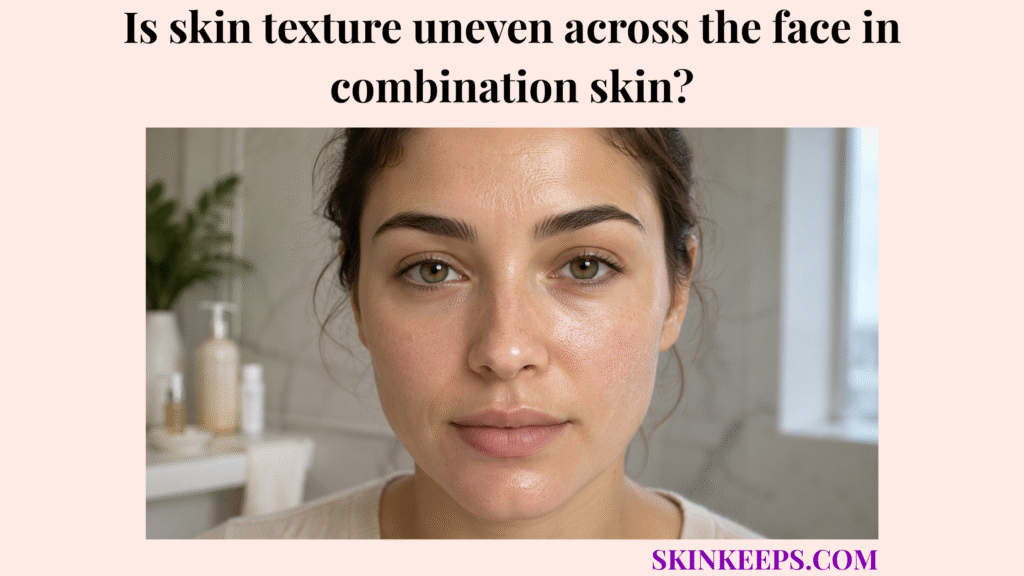
Yes, skin texture can be uneven across the face in combination skin because different facial zones may have different oil levels, hydration levels, pore visibility, and sensitivity. In combination skin, the T-zone may feel bumpy, shiny, congested, or pore-visible while the cheeks or outer face may feel rough, flaky, tight, dull, or dry.
This uneven skin texture does not automatically mean something is wrong, and it should not be judged from one mirror check. The better approach for combination skin is zone-specific care, because one full-face method can over-dry rough areas or overload bumpy oily areas.
Why can skin texture look uneven across the face in combination skin?
Skin texture can look uneven across the face in combination skin because oily, dry, congested, and irritation-prone zones can appear at the same time. This mixed behavior is one reason combination skin needs to be read by facial zone instead of judged as only oily or only dry.
Texture is affected by oil, dead skin buildup, dryness, barrier comfort, product residue, and irritation. When those factors are not equal across the face, the result can be a bumpy T-zone beside rough cheeks or a smooth area beside a flaky patch.
How oilier zones in combination skin can create bumps and visible pores
Oilier zones in combination skin can create bumps and visible pores when sebum, dead skin buildup, and product residue collect around pore openings. The forehead, nose, and chin are common oily-texture zones, so clogged pores, blackheads, whiteheads, rough bumps, shine, and enlarged-looking pores may show there first.
How drier zones in combination skin can create roughness and flakes
Drier zones in combination skin can create roughness and flakes when the skin has less oil, weaker barrier comfort, or irritation from harsh products. Cheeks, the outer face, and the around-mouth area may feel tight, dull, flaky, or stingy after cleansing or strong products.
How combination skin can make smooth and rough areas appear at the same time
Combination skin can make smooth and rough areas appear at the same time because each facial zone may respond differently to oil, hydration, weather, and products. A product can feel useful on the cheeks but heavy on the T-zone, or it can reduce bumpy oil-zone texture while making dry areas rougher.
Combination Skin Texture Zone Map
This visual separates common oily-zone texture from common dry-zone texture so uneven skin texture can be read by facial area.
Figure 1. Uneven texture in combination skin is easier to understand when the T-zone and cheeks are compared separately.
What does uneven skin texture in combination skin usually look like?
Uneven skin texture in combination skin usually looks like shiny, bumpy, pore-visible areas in one zone and rough, flaky, dull, or tight areas in another zone. This is easier to understand when the reader maps texture by forehead, nose, chin, cheeks, and around-mouth areas rather than describing the whole face with one word.
Makeup behavior can make the same pattern easier to notice. Foundation may cling to dry patches on the cheeks while separating over oily zones, which shows how one face can hold more than one texture pattern at the same time.
Key Signs of Uneven Texture in Combination Skin
- Forehead, nose, or chin may look shiny, bumpy, or congested.
- Cheeks may look dull, dry, rough, or flaky.
- Some areas may feel smooth while nearby areas feel grainy.
- Pores may look more noticeable in the T-zone than on the outer face.
- Makeup may cling to dry patches but separate over oily zones.
| Combination skin area | Texture pattern | Common cause | Routine signal |
|---|---|---|---|
| Forehead | Small bumps, shine, clogged pores | Oil buildup or congestion | Use light, targeted oil control |
| Nose | Visible pores, blackheads, rough feel | Sebum and pore congestion | Avoid heavy products here |
| Chin | Bumps, breakouts, uneven surface | Oil, hormones, or product buildup | Treat carefully without stripping |
| Cheeks | Roughness, flakes, tightness | Dryness or barrier weakness | Add barrier-support hydration |
| Around mouth | Peeling, tightness, irritation | Harsh products or dryness | Reduce strong actives nearby |
How can combination skin texture differ between oily zones and dry zones?
Combination skin texture can differ between oily zones and dry zones because oily areas often show congestion, while dry areas often show roughness, flakes, tightness, or dullness. This is why repeated facial-zone patterns matter more than one temporary patch of roughness or shine.
Both texture types can happen on one face at the same time, so the answer is not to exfoliate every uneven area equally. The safer first step is to separate oily-zone texture from dry-zone texture.
Identify oily-zone texture in combination skin
Oily-zone texture in combination skin often appears as shine, clogged pores, blackheads, whiteheads, visible pores, or a slightly raised grainy surface. The T-zone, forehead, nose, and chin may show this pattern when oil and buildup collect faster than they do on the cheeks.
Identify dry-zone texture in combination skin
Dry-zone texture in combination skin often appears as rough patches, flakes, tightness, dullness, or stinging after cleansing or applying products. Cheeks, the outer face, and around-mouth areas may show this texture when dryness or barrier discomfort makes the surface feel rough.
Identify mixed-zone texture in combination skin
Mixed-zone texture in combination skin means one area can feel bumpy or oily while another area feels flaky, rough, or tight. A bumpy T-zone with flaky cheeks is a common example, and it explains why one full-face product may fail.
How can you tell what is causing uneven texture in combination skin?
You can tell what may be causing uneven texture in combination skin by matching the texture clue to timing, location, product use, and skin sensation. This matrix is not a diagnosis tool, but it can help separate likely congestion, dryness, irritation, and product-related texture.
| Texture clue in combination skin | More likely cause | What to check first |
|---|---|---|
| Bumps mainly in T-zone | Clogged pores or oil buildup | Heavy products, infrequent cleansing, pore congestion |
| Rough cheeks | Dryness or weak barrier | Moisturizer use, cleanser harshness, weather |
| Flakes around pimples | Acne treatment dryness | Active ingredient strength and frequency |
| Burning or stinging texture | Irritation | New products, over-exfoliation, fragrance |
| Makeup clings in some areas | Dry patches | Hydration and barrier support |
| Makeup separates in other areas | Oil imbalance | Product texture and T-zone oil control |
Texture Cause Sorting Pathway
This visual shows how location, sensation, and product timing help separate congestion, dryness, and irritation.
Figure 2. Texture clues are safest when they are sorted by zone, sensation, timing, and product history.
How should combination skin care change when texture is uneven across the face?
Combination skin care should change when texture is uneven by treating congested zones lightly and supporting dry or rough zones without applying the same strength product everywhere. This keeps the focus on the mixed-zone pattern instead of forcing dry cheeks and an oily T-zone into one routine.
Product behavior often shows why the cheek area differs from the T-zone in real use. A texture routine should therefore adjust cleansing, moisturizing, and targeted treatment by zone rather than by panic.
Cleanse combination skin without stripping dry-textured areas
Combination skin should be cleansed without stripping dry-textured areas because tight, squeaky skin can make roughness and irritation more noticeable. Oily areas still need cleansing, but dry areas should not feel tight afterward.
Moisturise combination skin differently where texture feels dry or oily
Combination skin may need different moisturizer amounts or textures where the face feels dry, oily, rough, or congested. Lighter layers may suit oily areas, while dry areas may need more barrier support.
Treat bumpy texture in combination skin with targeted care
Bumpy texture in combination skin should be treated with targeted care so congested zones receive support without over-irritating dry patches. This is especially relevant when uneven texture appears beside combination skin breakouts and dry patches at the same time.
| Combination skin texture issue | Better adjustment | Avoid |
|---|---|---|
| Bumpy T-zone | Light exfoliation or targeted acne care | Scrubbing the whole face |
| Rough cheeks | Barrier-support moisturizer | Strong acids on dry patches |
| Oily nose with visible pores | Lightweight, non-comedogenic products | Thick creams over congested pores |
| Flaky areas near breakouts | Reduce active frequency | Adding more acne products |
| Uneven makeup texture | Hydrate dry zones and control oily zones separately | One heavy product everywhere |
Zone-Specific Texture Care Loop
This visual shows the practical care logic: cleanse gently, support dry texture, target bumpy zones, and stop guessing if warning signs appear.
Figure 3. Uneven texture in combination skin usually needs zone-specific adjustment rather than one aggressive full-face response.
Which ingredients can support uneven texture in combination skin?
Ingredients can support uneven texture in combination skin when they are matched to the right zone: pore-focused ingredients for congested areas and barrier-support ingredients for rough or flaky areas. The goal is not to chase maximum strength, because stronger texture-smoothing products can make dry or irritated zones sting.
Salicylic acid may be useful for clogged pores and bumpy oily zones, but it can dry some areas. Niacinamide may support oil balance, barrier comfort, and uneven-looking texture when the overall formula is tolerated.
Ceramides can support dry, rough, or barrier-weakened areas, while glycerin or hyaluronic acid can help hydrate dry-textured zones without necessarily feeling heavy. Retinoids may help texture and clogged pores, but they should be introduced carefully because irritation, peeling, and dryness can occur.
Fragrance-free moisturizers may be useful when texture is linked with stinging or product discomfort. If fragrance or product irritation seems involved, reviewing irritating skincare ingredients can help separate texture from avoidable irritation.
Practical Rule
Use stronger texture-smoothing ingredients where congestion exists, and use barrier-support ingredients where roughness, tightness, or flaking exists.
What mistakes make uneven skin texture worse in combination skin?
Uneven skin texture gets worse in combination skin when the routine treats every zone as acne-prone, over-exfoliates rough areas, skips moisturizer, or applies heavy products everywhere. Recognizing different skin types helps prevent the mistake of treating combination skin like a dry-only or oily-only face.
The mistake is usually not lack of effort; it is using the same intensity everywhere. Texture does not always mean acne, and roughness does not always need stronger exfoliation.
Avoid treating all combination skin texture as acne
Treating all combination skin texture as acne can worsen roughness, flakes, and stinging when the real issue is dryness or irritation. Bumps, flakes, and roughness can have different causes, so stronger acne products are not always the right response.
Avoid over-exfoliating combination skin to smooth texture quickly
Over-exfoliating combination skin to smooth texture quickly can make dry patches rougher and oily zones more irritated. Scrubs, strong acids, frequent exfoliation, and stacked actives can backfire when the barrier is already stressed.
Avoid using heavy products across all combination skin zones
Using heavy products across all combination skin zones can help dry patches but weigh down or clog oily areas. Thick creams or balms may be better as spot support on dry patches than as a full-face response over congested pores.
Avoid skipping moisturiser because combination skin has oily areas
Skipping moisturizer because combination skin has oily areas can leave dry zones rough and make active products harder to tolerate. Lightweight moisturizer can be a middle option when the T-zone is oily but the cheeks feel tight.
When should uneven texture in combination skin need a dermatologist?
Uneven texture in combination skin needs a dermatologist when texture becomes painful, deep, inflamed, scarring, spreading, burning, cracking, bleeding, rash-like, or persistent despite gentle care. Persistent painful texture is not just a cosmetic issue, and acne, dermatitis, eczema, allergic reaction, rosacea, or infection may need professional assessment.
See a Dermatologist If
- Uneven texture comes with painful acne.
- Bumps become deep, inflamed, or scarring.
- Dry patches crack, bleed, burn, or spread.
- Texture suddenly worsens after a new product.
- Skin reacts to many basic products.
- A simple gentle routine does not improve symptoms.
- Rough patches look rash-like, scaly, or persistent.
Urgent Safety Note
Rapid facial swelling, severe pain, pus, fever with worsening skin symptoms, rapidly spreading warmth, breathing difficulty, throat tightness, faintness, or rapid lip, tongue, or throat swelling requires urgent medical care.
What should you remember about uneven skin texture in combination skin?
The key point is that uneven skin texture in combination skin should be handled by zone, not by treating the whole face as oily, dry, acne-prone, or rough in the same way.
Final Checklist
- Combination skin can have uneven texture across the face.
- Oily zones may feel bumpy, shiny, or congested.
- Dry zones may feel rough, tight, flaky, or dull.
- Do not treat all texture as acne.
- Do not exfoliate every zone equally.
- Use lighter products on oily areas.
- Use barrier support on dry areas.
- Adjust treatment by zone, not by panic.
- Seek dermatology help if texture is painful, spreading, scarring, burning, or persistent.
Frequently Asked Questions About Uneven Texture in Combination Skin
Can combination skin have smooth cheeks but a bumpy T-zone?
Yes. Combination skin can have smoother or drier cheeks while the forehead, nose, or chin feels bumpy, oily, congested, or pore-visible.
Why does combination skin feel rough in some places and oily in others?
Combination skin can feel rough in some places and oily in others because oil production, hydration, barrier comfort, and pore congestion are not equal across every facial zone.
Should combination skin exfoliate the whole face for uneven texture?
Not always. Combination skin should not automatically exfoliate the whole face because dry or sensitive zones may become rougher, stingier, or more irritated. Targeted use is often safer.
Can moisturizer help uneven texture in combination skin?
Yes. Moisturizer can help uneven texture in combination skin when roughness comes from dryness or barrier weakness. The texture should still suit oily areas so the T-zone does not feel overloaded.
Is uneven texture in combination skin always acne?
No. Uneven texture in combination skin is not always acne. It can come from clogged pores, dry patches, flakes, irritation, visible pores, product buildup, or uneven oil distribution.
Conclusion: Uneven Texture in Combination Skin
Uneven texture across the face in combination skin is usually a zone pattern, not a reason to treat the whole face aggressively. The T-zone may look bumpy, shiny, pore-visible, or congested while the cheeks or outer face feel rough, flaky, tight, or dull.
Because texture can come from oil buildup, dryness, product residue, irritation, or acne-treatment dryness, the safest response is to compare zones before choosing the next step. Gentle cleansing, dry-zone barrier support, and targeted care for bumpy oily zones usually make more sense than one strong full-face approach.
If texture becomes painful, spreading, scarring, burning, cracking, bleeding, rash-like, or persistent despite gentle care, professional evaluation is safer than continued guessing.
Sources & Evidence
American Academy of Dermatology — Acne Skin Care Habits
Supports gentle washing for acne-prone skin and avoiding harsh scrubbing or aggressive cleansing.
[AAD]American Academy of Dermatology — Dermatologists’ Tips for Relieving Dry Skin
Supports gentle cleansers, warm water, and moisturizer support for dry, rough, or flaky zones.
[AAD]American Academy of Dermatology — Moisturizer and Acne-Prone Skin
Supports the idea that acne-prone skin may still need moisturizer when it feels dry, especially after washing.
[AAD]DermNet — Topical Retinoids
Supports caution that retinoids can cause erythema, peeling, dry skin, irritant contact dermatitis, and sun sensitivity.
[DermNet]DermNet — Irritant Contact Dermatitis
Supports irritation-related texture from topical medications, product exposure, and barrier stress.
[DermNet]American Academy of Dermatology — Acne Scars Signs and Symptoms
Supports dermatologist escalation when bumps become deep, cyst-like, or scarring.
[AAD]American Academy of Dermatology — When to See a Dermatologist for Acne
Supports professional evaluation for cystic acne, acne scars, and acne concerns that need medical guidance.
[AAD]Educational Disclaimer: This article is for general skin education only and does not diagnose, treat, or replace professional medical care. If uneven texture is painful, spreading, scarring, burning, cracking, bleeding, rash-like, or persistent despite gentle care, consult a qualified dermatologist.