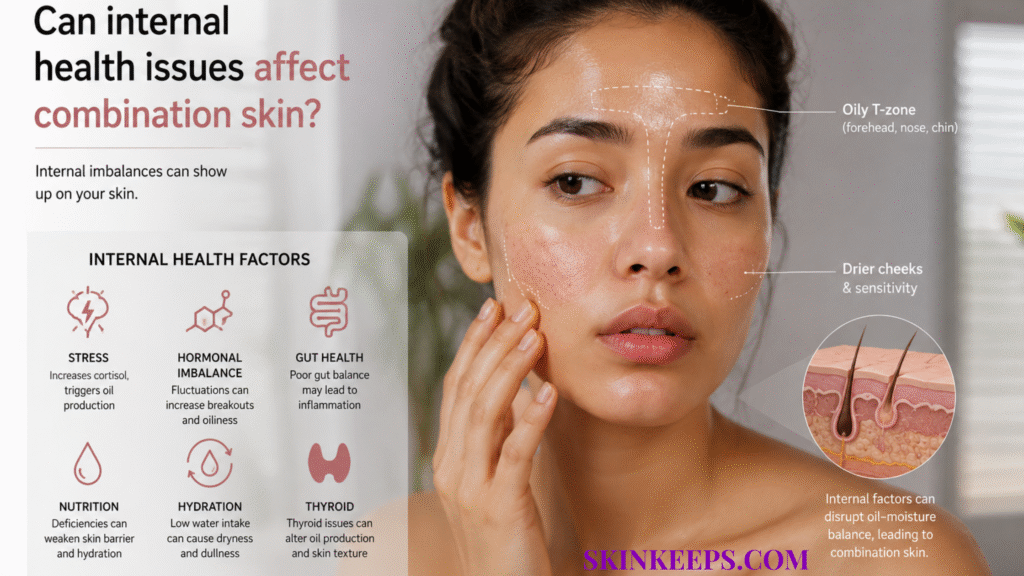
Yes, internal health issues can sometimes affect combination skin by changing oil production, dryness, acne tendency, sensitivity, healing, or barrier comfort.
A person with combination skin may notice the T-zone becoming oilier, cheeks becoming drier, breakouts becoming more persistent, or product tolerance changing. Combination skin by itself is not proof of an internal health problem; concern becomes stronger when changes are sudden, painful, severe, persistent, slow-healing, rash-like, or paired with symptoms elsewhere in the body.
How can internal health issues affect combination skin?
Internal health issues can affect combination skin by changing oiliness, acne tendency, dryness, sensitivity, healing speed, product tolerance, or the stability of the usual facial-zone pattern.
Internal health issues may affect combination skin through sebum production in oily zones, acne tendency in the T-zone or jawline, dryness on the cheeks or around the mouth, barrier comfort, healing speed, and product sensitivity. These changes should not be diagnosed from skin type alone.
| Internal issue category | Possible effect on combination skin | Pattern clue |
|---|---|---|
| Hormonal imbalance | More oil, acne, clogged pores | Chin, jawline, or T-zone flares |
| Thyroid-related change | More dryness or roughness | Cheeks or full-face dryness increases |
| Blood sugar/metabolic issues | Dry, itchy, slow-healing skin | Dryness plus body-wide symptoms |
| Inflammatory skin conditions | Redness, irritation, flakes, burning | “Dry patches” look rash-like |
| Medication-related changes | Oiliness, acne, dryness, or sensitivity | Change starts after medication shift |
| Chronic stress or sleep disruption | More breakouts, oiliness, or barrier discomfort | Flares during high-stress periods |
| Nutritional or hydration issues | Dullness, dryness, slow recovery | Skin changes with wider health signs |
Which hormonal health issues can affect combination skin?
Hormonal health issues can affect combination skin by increasing sebum, clogged pores, acne tendency, or zone instability, especially in the T-zone, chin, or jawline.
Hormone-linked combination skin patterns may need clinician evaluation when acne is persistent, adult-onset, deep, cyclical, or paired with body-wide signs. This is especially relevant when the pattern does not match the reader’s usual hormonal fluctuations and combination skin timing.
How androgen-related changes can make combination skin oilier
Androgen-related changes can make combination skin oilier when sebaceous activity increases in already oil-prone zones such as the T-zone, chin, or jawline.
This may show as more shine, clogged pores, blackheads, whiteheads, or acne-prone behavior. It does not mean every oily flare is a hormonal disease.
How PCOS-like patterns may show up in combination skin
PCOS-like patterns may show up in combination skin as persistent adult acne, deeper chin or jawline breakouts, irregular cycles, excess hair growth, or other body-wide signs that need clinician evaluation.
Acne plus irregular cycles or excess facial or body hair should not be treated as a cosmetics-only issue. The wording here is intentionally cautious because skin changes alone cannot diagnose PCOS.
How life-stage hormones can destabilize combination skin
Life-stage hormones can destabilize combination skin during puberty, menstrual-cycle shifts, pregnancy, postpartum changes, perimenopause, menopause, or hormonal medication changes.
These shifts can make combination skin look oilier, drier, more acne-prone, or more reactive. Pregnancy, postpartum, breastfeeding, and trying to conceive also require clinician guidance before using strong acne treatments.
| Hormonal clue in combination skin | Possible skin change | Why it matters |
|---|---|---|
| Monthly flare pattern | Chin, jawline, or T-zone breakouts | Timing may suggest hormone influence |
| Sudden adult acne | Persistent clogged pores or deeper bumps | May need medical review |
| Irregular cycles plus acne | Oilier, breakout-prone skin | Do not treat only with cosmetics |
| Pregnancy or postpartum shift | Acne, dryness, sensitivity, pigmentation changes | Product safety matters |
| Perimenopause or menopause | Dryness, sensitivity, acne fluctuation | Routine may need adjustment |
How can thyroid or metabolic issues affect combination skin dryness?
Thyroid or metabolic issues can affect combination skin dryness when new roughness, itching, slow healing, or spreading dryness appears with wider body symptoms.
Baseline cheek dryness is different from sudden, progressive, itchy, cracked, bleeding, slow-healing, or body-symptom-linked dryness. A reader who already understands oil-and-dryness patterns in combination skin can use that baseline to notice when something new is happening.
How thyroid-related changes may make combination skin feel drier
Thyroid-related changes may make combination skin feel drier when new or worsening roughness appears alongside clues such as fatigue, cold sensitivity, constipation, weight change, or coarse skin.
Dry or coarse skin can be one clue, not a diagnosis. If dryness appears with wider symptoms, clinician evaluation may be appropriate.
How blood sugar-related issues may affect combination skin comfort
Blood sugar-related issues may affect combination skin comfort when dry, itchy skin, slow healing, repeated infections, or unusual skin changes appear with broader symptoms.
Unusual thirst, frequent urination, repeated infections, or slow wound healing change the meaning of skin dryness. Facial dryness alone should not be used to diagnose diabetes.
How internal dryness can be mistaken for normal combination skin
Internal dryness can be mistaken for normal combination skin when new cheek dryness, spreading roughness, itching, cracking, or fatigue-linked dryness is treated as ordinary dry cheeks.
Track timing, severity, and body symptoms instead of assuming every dry patch is just a skin-type pattern.
| Dryness clue in combination skin | More likely routine-level dryness | More concerning internal-pattern clue |
|---|---|---|
| Cheeks feel tight after harsh cleanser | Product or barrier issue | Less concerning if it resolves after simplification |
| New roughness with fatigue or cold sensitivity | Not enough information | Consider medical evaluation |
| Dry, itchy skin plus frequent thirst | Not typical skin-type change | Needs clinician review |
| Slow healing after breakouts | Can happen with irritation | More concerning if persistent or widespread |
| Dry patches crack or bleed | Barrier damage possible | Needs medical attention if persistent |
| Full-face dryness appears suddenly | Could be environment/product | Reassess if paired with body symptoms |
How can inflammatory skin conditions mimic combination skin?
Inflammatory skin conditions can mimic combination skin when redness, flakes, bumps, burning, greasy scale, or sensitivity appears in selected facial areas.
Some inflammatory patterns create selected facial patches that look like dryness, oiliness, flakes, bumps, or uneven texture. The difference is that these areas often feel uncomfortable, persistent, rash-like, spreading, or resistant to normal skincare adjustments.
| Skin pattern | Ordinary combination skin clue | Possible inflammatory clue |
|---|---|---|
| Dry cheeks | Tight or rough, improves with moisturizer | Red, burning, spreading, or scaly patches |
| Oily T-zone | Shine and visible pores | Greasy flakes, redness, or persistent irritation |
| Around-mouth dryness | Mild tightness or peeling | Burning, rash-like bumps, cracking |
| Cheek sensitivity | Stings after strong products | Stings with many gentle products |
| Uneven texture | Bumps or roughness by zone | Painful, inflamed, or persistent patches |
How can medications or treatments change combination skin?
Medications or medical treatments can change combination skin by shifting oiliness, acne, dryness, flushing, sensitivity, healing, or product tolerance.
The exact effect depends on the medication, dose, timing, and individual health context. A sudden change after starting, stopping, or adjusting a medication should be tracked and discussed with the prescribing clinician rather than handled by stopping medication on your own.
How can you tell baseline combination skin from health-linked combination skin changes?
Baseline combination skin is usually predictable, while health-linked combination skin changes are more likely to be sudden, progressive, severe, persistent, or paired with body-wide symptoms.
The goal is not to self-diagnose. The goal is to separate normal facial-zone variation from changes that deserve medical context, especially when symptoms do not match the person’s usual different skin types pattern.
| Pattern clue | More likely baseline combination skin | More likely health-linked change |
|---|---|---|
| Timing | Long-standing pattern | Sudden or progressive change |
| Location | Same zones repeat | New areas become oily, dry, itchy, or inflamed |
| Severity | Mild to moderate | Painful, severe, spreading, or persistent |
| Body symptoms | None | Fatigue, thirst, weight change, irregular cycles, temperature sensitivity |
| Healing | Normal | Slow healing, repeated infection, persistent marks |
| Product response | Improves with gentle routine | Does not improve or reacts to many basics |
| Acne pattern | Occasional clogged pores | Deep, painful, adult-onset, cyclical, or scarring |
How should combination skin care respond when internal health issues may be involved?
Combination skin care should respond safely when internal health issues may be involved by staying simple, gentle, trackable, and supportive while medical signs are evaluated.
Skincare can support comfort, but it cannot treat an internal medical condition. This is why it helps to use fewer variables, keep routines calm, and connect changes to timing, location, severity, body symptoms, and product history.
Keep combination skin care simple while tracking health-linked changes
Combination skin care should stay simple while tracking health-linked changes because fewer variables make it easier to separate baseline skin type, product irritation, and persistent internal patterns.
A gentle cleanser, moisturizer, and sunscreen can be enough while the reader tracks what is changing. If stress or sleep disruption appears to be a major modifier, the page on stress and combination skin imbalance can support that comparison.
Protect dry zones in combination skin without overloading oily zones
Dry zones in combination skin should be protected without overloading oily zones when internal changes make cheeks, mouth-area skin, or outer-face areas feel rough, tight, or irritated.
Lightweight moisturizer and gentle cleansing can support comfort, but moisturizer should not be presented as a cure for internal dryness causes.
Treat breakouts in combination skin carefully when health issues may be involved
Breakouts in combination skin should be treated carefully when health issues may be involved because deep, painful, scarring, adult-onset, or cyclical acne may need professional care.
Targeted mild acne care may support breakout-prone zones, but persistent or severe acne should not be handled with endless over-the-counter experiments.
| Combination skin change | Safer routine response | Do not do |
|---|---|---|
| New dryness | Simplify cleanser and moisturize | Scrub or over-exfoliate |
| Oilier T-zone | Use light, non-comedogenic layers | Wash repeatedly |
| New adult acne | Use targeted care and track timing | Assume hygiene is the cause |
| Product stinging | Reduce actives and support barrier | Add more strong ingredients |
| Rash-like patches | Stop irritating products and seek advice | Treat as simple dry skin |
| Slow healing or severe irritation | Get medical evaluation | Keep experimenting endlessly |
What mistakes happen when internal health issues affect combination skin?
Mistakes happen when internal health issues affect combination skin if readers self-diagnose from skin type alone, ignore severe changes, blame hygiene, or keep using stronger products despite warning signs.
These mistakes can create two opposite problems: panic over ordinary combination skin or delayed care when symptoms are severe, persistent, or body-symptom-linked.
Avoid diagnosing internal health issues from combination skin alone
Diagnosing internal health issues from combination skin alone is unsafe because oily and dry zones do not prove a medical condition.
Diagnosis requires medical history, symptoms, examination, and sometimes testing. Combination skin is often baseline and common.
Avoid treating severe combination skin changes with skincare only
Treating severe combination skin changes with skincare only can delay care when painful acne, severe dryness, slow healing, or rash-like changes need medical evaluation.
Skincare-only experimentation can backfire when the problem is spreading, bleeding, slow-healing, or associated with body-wide symptoms.
Avoid blaming hygiene for health-linked acne in combination skin
Blaming hygiene for health-linked acne in combination skin can lead to over-cleansing that worsens dryness, irritation, and barrier discomfort.
Hormonal or inflammatory acne is not simply dirty skin. Cleansing matters, but aggressive cleansing is not a medical evaluation.
Avoid ignoring body-wide symptoms with combination skin changes
Ignoring body-wide symptoms with combination skin changes can make the skin pattern seem isolated when fatigue, thirst, irregular cycles, weight changes, temperature sensitivity, or slow wound healing may matter.
These symptoms should prompt medical discussion rather than self-diagnosis.
| Wrong assumption | Why it is risky | Better interpretation |
|---|---|---|
| “My skin is oily and dry, so I must have a health problem” | Overdiagnosis creates fear | Combination skin is common and often baseline |
| “It is only combination skin” | May ignore severe changes | Watch severity, timing, and body symptoms |
| “I just need stronger products” | Can worsen barrier damage | Simplify and reassess |
| “Acne means poor hygiene” | Leads to over-cleansing | Acne can have internal drivers |
| “Dryness is always normal” | May miss medical dryness patterns | Seek help if severe or persistent |
| “I should stop my medication” | Can be unsafe | Ask the prescribing clinician |
When should combination skin changes need medical evaluation?
Combination skin changes need medical evaluation when they are sudden, painful, severe, spreading, scarring, slow-healing, rash-like, or paired with symptoms elsewhere in the body.
The skin is one clue, not the whole diagnosis. Medical evaluation matters when skin changes are unusual for the reader’s normal pattern, especially when symptoms are persistent or systemic.
- Painful, deep, cystic, or scarring acne.
- Sudden adult-onset acne.
- Acne with irregular periods, excess facial hair, or unexplained weight changes.
- Dryness that cracks, bleeds, burns, or spreads.
- Dry, itchy skin with unusual thirst, frequent urination, or slow healing.
- Dryness with fatigue, cold sensitivity, constipation, or weight gain.
- Rash-like redness, swelling, warmth, or infection signs.
- Skin reacting to many gentle products.
- Sudden skin change after starting or changing medication.
- Persistent symptoms despite a simple gentle routine.
- Any skin change that feels unusual for the reader’s normal pattern.
What should you remember about internal health issues and combination skin?
The key point is that internal health issues can sometimes affect combination skin, but combination skin alone does not prove a medical condition.
- Internal health issues can sometimes affect combination skin.
- Combination skin alone does not prove a medical condition.
- Hormonal issues may increase oiliness, acne, or jawline/chin breakouts.
- Thyroid-related changes may be associated with new or worsening dryness.
- Blood sugar-related issues may be associated with dry, itchy skin or slow healing.
- Inflammatory conditions can mimic dry patches, flakes, redness, or sensitivity.
- Medication changes can alter oiliness, acne, dryness, or tolerance.
- Track timing, location, severity, and body symptoms.
- Keep skincare simple while evaluating changes.
- Do not self-diagnose from skin type alone.
- Seek medical help for painful acne, sudden changes, severe dryness, slow healing, rash-like symptoms, or body-wide warning signs.
Frequently asked questions about internal health issues and combination skin
Can internal health issues cause combination skin?
Internal health issues usually do not cause combination skin by themselves, but they can change, worsen, or mimic the oil-and-dryness imbalance of combination skin.
Can hormonal issues make combination skin oilier?
Yes. Hormonal changes can increase oiliness and breakouts in oil-prone combination skin zones such as the T-zone, chin, or jawline.
Can thyroid issues make combination skin drier?
Thyroid-related changes can be associated with dry or coarse skin. If dryness is new, persistent, or paired with fatigue, cold sensitivity, constipation, or weight changes, medical advice is appropriate.
Can diabetes affect combination skin?
Diabetes can be associated with dry, itchy skin, slow healing, infections, and other skin signs. Dryness alone does not diagnose diabetes, but persistent symptoms with body-wide signs should be checked.
When should combination skin changes not be handled with skincare alone?
Skincare alone is not enough when combination skin changes are painful, sudden, spreading, scarring, cracking, bleeding, slow-healing, rash-like, or paired with symptoms elsewhere in the body.
Conclusion: Can internal health issues affect combination skin?
Internal health issues can sometimes affect combination skin by changing oiliness, dryness, acne tendency, sensitivity, healing, or product tolerance, but combination skin alone is not a diagnosis or proof of an internal condition.
The safest approach is to track timing, location, severity, body symptoms, medication changes, and product changes while keeping skincare simple. Sudden, painful, severe, slow-healing, rash-like, or body-symptom-linked changes deserve medical evaluation rather than stronger skincare experiments.
Sources & Evidence
Educational Disclaimer
This article is for general skin education only and does not diagnose, treat, or replace professional medical advice. If combination skin changes are sudden, painful, spreading, scarring, slow-healing, rash-like, or paired with symptoms such as irregular periods, excess hair growth, fatigue, unexplained weight changes, unusual thirst, frequent urination, swelling, warmth, infection signs, or persistent dryness, consult a qualified healthcare professional or dermatologist.