Hormonal fluctuations can affect combination skin by increasing oiliness in the T-zone, triggering clogged pores or breakouts, changing cheek comfort, increasing sensitivity, or making dry areas feel tighter than usual. Combination skin already behaves differently by facial area, so hormonal shifts can amplify the existing zone pattern instead of changing every part of the face equally.
In combination skin, oily zones may become oilier while normal or dry zones may become less stable during puberty, menstrual cycle shifts, pregnancy, postpartum changes, perimenopause, menopause, or hormonal medication changes. Timing, location, and repetition matter more than one random skin day.
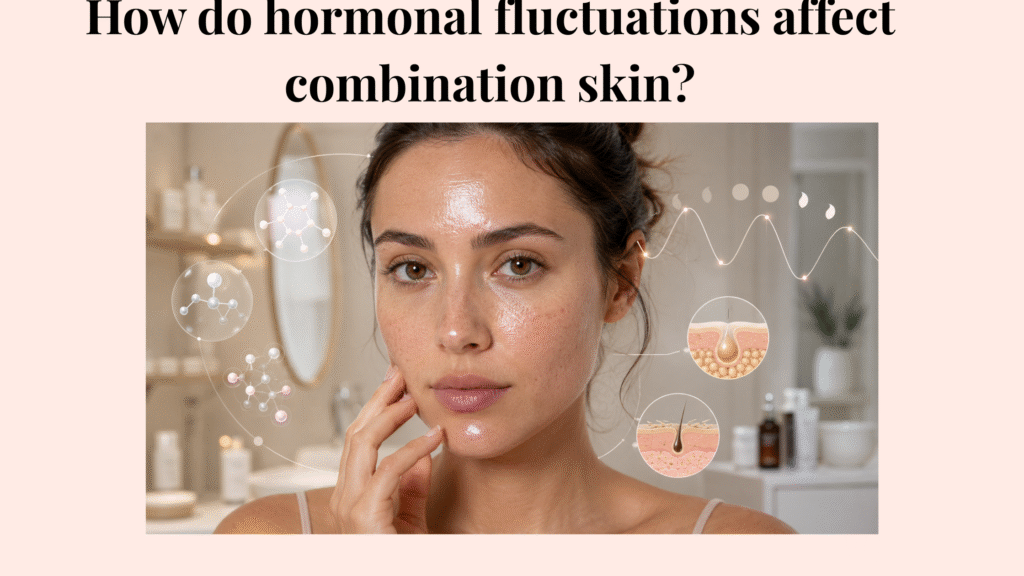
How do hormonal fluctuations affect combination skin?
Hormonal fluctuations affect combination skin by amplifying oiliness, clogged pores, breakouts, dryness, sensitivity, and week-to-week facial-zone instability. The main pattern is not always full-face oiliness; it is often a stronger version of the oily-zone and dry-zone contrast that already exists.
Because this pattern can shift across days, the first step is to separate repeated hormonal timing from random irritation or one unusually oily day. Compared with broad different skin types, hormonal combination skin is best read through timing and zone contrast rather than one label.
| Hormonal effect in combination skin | How it may show up | Common zone |
|---|---|---|
| Increased sebum | More shine or greasy feel | Forehead, nose, chin |
| Clogged pores | Blackheads, whiteheads, small bumps | Nose, chin, forehead |
| Inflamed breakouts | Pimples or tender bumps | Chin, jawline, T-zone |
| Dryness shift | Tightness, roughness, dullness | Cheeks, mouth area |
| Sensitivity shift | Stinging, redness, product intolerance | Cheeks, mouth area, jawline |
| Pattern instability | Skin changes week to week | Mixed zones |
Hormonal Timing and Combination Skin Zones
This visual shows how hormonal windows can amplify oiliness in the T-zone while cheeks or mouth-area skin may stay normal, dry, or sensitive.
Figure 1. Hormonal changes are easier to interpret when the same zones change during repeated timing windows.
Why do hormonal fluctuations make combination skin oilier?
Hormonal fluctuations can make combination skin oilier because androgen activity can stimulate sebaceous glands to produce more sebum in oil-prone zones. This hormone-to-oil connection is usually most visible where the skin already tends to shine, clog, or feel greasy.
How androgens can increase oiliness in combination skin
Androgens can increase oiliness in combination skin by stimulating sebaceous glands, which may increase sebum and make oil-prone zones shinier or more congested. Sebum is the skin’s oily substance, and more visible sebum can make shine, visible pores, and congestion stand out.
How the T-zone in combination skin responds to hormonal oil changes
The T-zone in combination skin may respond to hormonal oil changes faster because the forehead, nose, and chin are already more oil-prone for many people. This is why internal factors in combination skin often show up first as extra T-zone shine, nose blackheads, or chin congestion.
How hormonal oiliness can still leave cheeks normal or dry in combination skin
Hormonal oiliness can still leave cheeks normal or dry in combination skin because increased oil does not always spread evenly across every facial zone. The T-zone may become greasy while the cheeks remain balanced, dry, dull, or reactive.
Hormone-to-Sebum Pathway
This visual shows the simplified pathway from hormonal fluctuation to sebaceous activity, visible oil, clogged pores, and zone-specific breakouts.
Figure 2. Hormonal sebum changes may be most visible in the T-zone, chin, or jawline rather than evenly across the face.
Which hormonal timing patterns affect combination skin?
Hormonal timing patterns affect combination skin when oiliness, breakouts, dryness, or sensitivity repeat during puberty, menstrual cycles, pregnancy, postpartum, perimenopause, menopause, or medication changes. Timing does not prove hormones alone, but repeated timing makes the pattern more useful than a one-day change.
| Hormonal timing | Possible effect on combination skin | Pattern clue |
|---|---|---|
| Puberty | More oil, clogged pores, acne tendency | T-zone becomes noticeably oilier |
| Menstrual cycle shifts | Recurring breakouts or oiliness | Similar timing each month |
| Pregnancy | Acne, dryness, sensitivity, or pigmentation changes may appear | Skin changes after pregnancy begins |
| Postpartum | Oil and acne may shift as hormones change again | Breakouts or oil changes after birth |
| Perimenopause | Oil, dryness, sensitivity, or acne patterns may fluctuate | Skin becomes less predictable |
| Menopause | Dryness may become more noticeable | Cheeks or outer face feel drier |
| Hormonal medication changes | Oiliness, acne, or dryness may shift | Change follows medication timing |
A hormonal pattern usually repeats with timing. A random one-day change is not enough to prove hormones are the cause.
How do hormonal fluctuations change facial zones in combination skin?
Hormonal fluctuations change facial zones in combination skin by making oil-prone areas more active while less oily areas may stay normal, become dry, or feel more sensitive. This is why genetics and combination skin can create the baseline while hormones modify how strongly that baseline appears.
| Facial zone in combination skin | Hormonal change that may appear | What to watch |
|---|---|---|
| Forehead | More shine, bumps, congestion | Oil increases during hormonal windows |
| Nose | Blackheads, visible pores, greasy feel | Pore congestion becomes more obvious |
| Chin | Breakouts, bumps, tenderness | Recurring cycle-linked acne |
| Jawline | Inflamed or deeper breakouts | Hormonal acne pattern possibility |
| Cheeks | Dryness, dullness, sensitivity | Barrier comfort changes |
| Around mouth | Peeling, tightness, irritation | Actives may become less tolerable |
Hormonal combination skin does not always mean the whole face becomes oily. It often means the existing oily zones become more active while the less oily zones remain normal, dry, or sensitive.
How can hormonal fluctuations cause breakouts in combination skin?
Hormonal fluctuations can cause breakouts in combination skin when increased sebum, clogged pores, and follicle irritation concentrate in oil-prone zones. This breakout tendency should be read through timing and location, not through location alone.
How hormonal oil changes can clog pores in combination skin
Hormonal oil changes can clog pores in combination skin when increased sebum mixes with dead skin cells and blocks follicles in already oil-prone zones. Blackheads, whiteheads, small bumps, and pimples can appear more often in the nose, chin, forehead, or jawline.
How chin and jawline breakouts can appear in hormonal combination skin
Chin and jawline breakouts can appear in hormonal combination skin when recurring bumps, tenderness, or inflammation follow a repeated hormonal timing pattern. One chin breakout is not enough to diagnose a hormonal cause, but repeated timing can be a useful clue.
How acne treatments can dry some zones in hormonal combination skin
Acne treatments can dry some zones in hormonal combination skin when strong or frequent treatment reaches areas that are not as oily. This is where breakouts and dry patches in combination skin may appear together because acne care and dry-zone comfort are moving in opposite directions.
How can hormonal fluctuations make combination skin feel dry or sensitive?
Hormonal fluctuations can make combination skin feel dry or sensitive when normal or less oily zones become tighter, duller, sting-prone, or less tolerant of products. This less obvious side of hormonal skin change matters because more T-zone oil does not protect every facial zone from dryness.
How hormonal shifts can change cheek comfort in combination skin
Hormonal shifts can change cheek comfort in combination skin when the cheeks feel tighter, duller, drier, or more easily irritated during certain hormonal windows. The cheeks, outer face, and mouth area may change even while the T-zone becomes shinier.
How hormonal fluctuations can reduce product tolerance in combination skin
Hormonal fluctuations can reduce product tolerance in combination skin when products that usually feel comfortable start to sting, burn, or feel stronger during reactive windows. Stinging or warmth should be tracked carefully, especially if it begins after a new product.
How oily and dry symptoms can appear together in hormonal combination skin
Oily and dry symptoms can appear together in hormonal combination skin because sebum changes and barrier comfort do not always shift in the same direction. The same face can have a shiny T-zone and tight cheeks, so treating everything as oily can backfire.
| Symptom in combination skin | More oil-linked | More dryness/sensitivity-linked |
|---|---|---|
| T-zone shine | Yes | No |
| Nose blackheads | Yes | No |
| Chin breakouts | Often | Sometimes if irritated |
| Cheek tightness | No | Yes |
| Stinging after products | Rare | Yes |
| Peeling near acne treatment | Sometimes treatment-related | Yes |
| Oily but tight feeling | Mixed | Mixed |
How can you tell hormonal combination skin from product-related or seasonal changes?
You can tell hormonal combination skin from product-related or seasonal changes by tracking timing, location, repetition, and whether symptoms follow cycles, new products, or weather shifts. Hormonal patterns usually repeat with timing, while product-related patterns often begin after a new formula is added.
| Pattern clue | More likely hormonal combination skin | More likely product-related change | More likely seasonal change |
|---|---|---|---|
| Timing | Repeats monthly or by life stage | Starts after a new product | Follows weather or humidity |
| Location | Chin, jawline, T-zone, recurring zones | Where product was applied | Dry cheeks or oilier T-zone by climate |
| Breakouts | Cyclical or recurring | Sudden after new routine | May vary by season |
| Dryness | May fluctuate with hormonal window | Often linked to actives or cleansers | Strong in cold or dry air |
| Sensitivity | Comes and goes | Appears after irritants | May worsen in harsh weather |
| Pattern duration | Repeats over time | Improves when product is removed | Improves when season changes |
Track timing before blaming products. But do not blame hormones if symptoms began immediately after a new active, cleanser, sunscreen, or moisturizer; repeated product reactions by facial area in combination skin need their own review.
Hormonal Combination Skin Tracking Loop
This visual shows a simple loop for separating hormonal patterns from product-related or seasonal changes.
Figure 3. Timing, location, and repetition help separate hormonal changes from new-product irritation or seasonal shifts.
How should combination skin adjust care during hormonal fluctuations?
Combination skin should adjust care during hormonal fluctuations by staying gentle, treating breakouts by zone, supporting dry areas, and changing active ingredients slowly. These steps give direction without turning a hormonal pattern into a full acne protocol.
Keep combination skin cleansing gentle during hormonal oiliness
Combination skin cleansing should stay gentle during hormonal oiliness because over-cleansing can make dry or sensitive zones worse without fixing hormonal sebum changes. Stronger washing may temporarily remove surface oil, but it can make cheeks feel tighter.
Use targeted acne care for hormonal combination skin
Targeted acne care is safer for hormonal combination skin because breakouts may be local while cheeks or mouth-area skin may be normal, dry, or sensitive. Treatment placement should follow the breakout zone rather than the whole face by default.
Support dry zones in combination skin during hormonal changes
Dry zones in combination skin may need extra support during hormonal changes when cheeks, the mouth area, or outer face feel tighter or more reactive. This support matters because oil-and-dryness patterns in combination skin can shift without becoming one uniform skin type.
Adjust active ingredients slowly when combination skin is hormonally reactive
Active ingredients should be adjusted slowly when combination skin is hormonally reactive because exfoliants, retinoids, and benzoyl peroxide can worsen peeling or stinging. During pregnancy, breastfeeding, or conception planning, readers should ask a clinician before using strong acne treatments.
| Hormonal combination skin issue | Better adjustment | What to avoid |
|---|---|---|
| Oilier T-zone | Lightweight, non-comedogenic layers | Heavy full-face products |
| Chin breakouts | Targeted acne care | Treating dry cheeks like acne zones |
| Cheek tightness | Barrier-support moisturizer | Strong exfoliation on dry zones |
| Product stinging | Reduce active frequency | Adding more actives |
| Monthly flare pattern | Track and prepare routine | Changing everything at once |
| Pregnancy/postpartum changes | Ask clinician before strong acne treatments | Assuming all acne products are safe |
What mistakes make hormonal combination skin worse?
Hormonal combination skin gets worse when the routine strips oil aggressively, treats every zone as acne-prone, ignores pregnancy or breastfeeding safety, or treats temporary shifts as permanent. These mistakes usually happen when a changing zone pattern is treated as a whole-face emergency.
Avoid stripping combination skin when hormones increase oiliness
Stripping combination skin when hormones increase oiliness can make cheeks tighter and more reactive without addressing the hormonal trigger. The T-zone may still become oily again, while the cheeks lose comfort.
Avoid using acne treatments everywhere on hormonal combination skin
Using acne treatments everywhere on hormonal combination skin can dry normal or sensitive zones that are not part of the breakout pattern. Chin, jawline, or T-zone care should not automatically become a full-face routine.
Avoid ignoring pregnancy or breastfeeding safety in hormonal combination skin
Ignoring pregnancy or breastfeeding safety in hormonal combination skin is risky because some acne treatments may not be appropriate during pregnancy, breastfeeding, or conception planning. Retinoids and prescription acne medications especially require clinician guidance.
Avoid assuming hormonal combination skin is permanent
Assuming hormonal combination skin is permanent can lead to unnecessary routine overhauls when the change is tied to a cycle, pregnancy, postpartum phase, medication change, or life stage. Tracking helps separate temporary shifts from patterns that need professional support.
When should hormonal combination skin need a dermatologist?
Hormonal combination skin needs a dermatologist when breakouts are painful, deep, cystic, scarring, persistent, pregnancy-related, or paired with severe dryness, burning, bleeding, or repeated irritation. Recurring cycle-linked acne that does not respond to gentle care may need professional evaluation.
See a Dermatologist If
- Breakouts are painful, deep, cystic, or scarring.
- Acne flares repeatedly around menstrual cycles and does not respond to gentle care.
- Skin changes suddenly after pregnancy, postpartum, menopause, or medication changes.
- Dry patches crack, bleed, burn, or spread.
- Skin becomes highly reactive to basic products.
- Acne treatments cause persistent peeling or irritation.
- The reader is pregnant, breastfeeding, or trying to conceive and needs acne treatment.
- A hormonal condition may be contributing to severe acne or sudden skin changes.
Urgent Safety Note
Rapid swelling, severe pain, pus, fever with skin symptoms, rapidly spreading warmth, breathing difficulty, throat tightness, faintness, or rapid facial, lip, tongue, or throat swelling requires urgent medical care.
What should you remember about hormonal fluctuations and combination skin?
The key point is that hormonal fluctuations can make combination skin oilier, drier, more acne-prone, or more sensitive without permanently changing every facial zone.
Hormonal Combination Skin Tracking Checklist
- Hormonal fluctuations can affect combination skin.
- The T-zone may become oilier during hormonal windows.
- Chin or jawline breakouts may repeat with hormonal timing.
- Cheeks may stay normal, become dry, or feel more sensitive.
- Hormonal changes can make combination skin less predictable.
- Timing matters: track cycle, life stage, medication changes, pregnancy, postpartum, and menopause.
- Do not treat the whole face as oily just because hormones increase T-zone shine.
- Do not ignore dry or sensitive zones during acne care.
- Use targeted care and gentle barrier support.
- Seek dermatology help for painful acne, scarring, severe dryness, pregnancy-related treatment questions, or persistent irritation.
Frequently Asked Questions About Hormonal Fluctuations and Combination Skin
Can hormones make combination skin oilier?
Yes. Hormonal fluctuations can make combination skin oilier, especially in the T-zone, chin, jawline, or other acne-prone areas, while other facial zones may remain normal or dry.
Can hormonal changes make combination skin dry?
Yes. Hormonal changes can make combination skin feel drier when cheeks, the mouth area, or outer face become tighter, duller, more reactive, or less comfortable than usual.
Why does combination skin break out before a period?
Combination skin may break out before a period when recurring hormonal shifts increase oiliness, clogged pores, or inflammation in acne-prone zones such as the chin, jawline, or T-zone.
Can pregnancy affect combination skin?
Yes. Pregnancy can affect combination skin by changing acne, dryness, sensitivity, pigmentation, and product tolerance. Acne treatment choices should be checked with a clinician during pregnancy.
Is hormonal combination skin permanent?
Hormonal combination skin is not always permanent. Some changes are temporary and tied to a cycle, pregnancy, postpartum phase, medication change, or life stage, while others need professional evaluation.
Conclusion: What do hormonal fluctuations mean for combination skin?
Hormonal fluctuations affect combination skin by making existing facial-zone differences more noticeable. The T-zone, chin, or jawline may become oilier or more breakout-prone while the cheeks, mouth area, or outer face may remain normal, become drier, or feel more sensitive.
The safest interpretation is to track timing, location, and repetition before changing everything. If hormonal changes bring painful acne, scarring, pregnancy-related treatment questions, severe dryness, burning, bleeding, swelling, spreading rash-like symptoms, or persistent irritation, professional evaluation is safer than guessing.
Sources & Evidence for Hormonal Combination Skin
DermNet — Sebum
Supports androgen control of sebaceous gland activity and the relationship between hormones and sebum production.
[DermNet]DermNet — What Causes Acne?
Supports sex hormones, DHT, sebaceous glands, and acne lesion formation without turning this article into a diagnosis page.
[DermNet]Mayo Clinic — Acne: Symptoms and Causes
Supports acne basics and hormone-change contexts such as puberty and midlife changes.
[Mayo Clinic]Cleveland Clinic — Acne
Supports clogged pores, blackheads, whiteheads, pimples, and the need to avoid overdiagnosing by location alone.
[Cleveland Clinic]American Academy of Dermatology — Acne Treatment During Pregnancy
Supports pregnancy-specific caution and clinician review before using acne treatments during pregnancy.
[AAD]JAAD 2024 — Acne Vulgaris Treatment Guideline Development
Supports evidence-boundary language for acne treatment guidance and pregnancy/lactation caution.
[JAAD]NCBI Bookshelf / StatPearls — Acne Vulgaris
Supports cautious language around acne formation, hormones, irritation, and treatment-related side effects.
[NCBI]Educational Disclaimer: This article is for general skin education only and does not diagnose, treat, or replace professional medical care. If combination skin changes are paired with painful acne, scarring, sudden hormonal symptoms, pregnancy-related treatment questions, severe dryness, burning, cracking, bleeding, swelling, spreading rash-like symptoms, or persistent irritation, consult a qualified dermatologist.