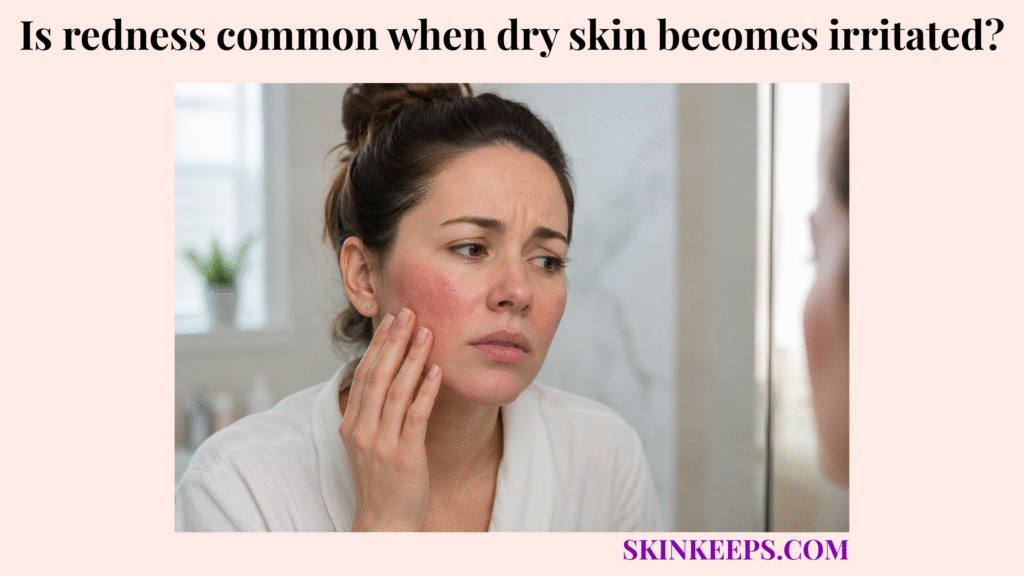
Yes, redness can be common when dry skin becomes irritated because a weakened skin barrier is more likely to inflame, itch, sting, or react to soaps, weather, friction, and skincare products. This redness is best understood as an irritation signal rather than a simple cosmetic color change.
This guideline explains why irritated dry skin can look red or darker, how inflammation may appear across different skin tones, how dry-skin redness differs from rash or dermatitis, which triggers commonly worsen irritation, and when redness needs professional evaluation.
Why does dry skin become red when it is irritated?
Dry skin becomes red when it is irritated because barrier dryness makes the skin more reactive and can trigger visible inflammation in the outer layers. This inflammation may appear after washing, scratching, friction, cold weather, harsh soap, or product exposure. The color change means the barrier is stressed, not automatically infected or diseased.
Redness should be interpreted alongside sensation and texture. Mild redness with roughness may reflect ordinary irritation, while redness with burning, swelling, or oozing carries more concern. When redness appears with itching, tightness, or soreness, the broader guide on dry skin barrier discomfort can help explain why the barrier is reacting.
How barrier dryness makes skin more reactive
Barrier dryness makes skin more reactive by reducing the outer layer’s ability to buffer friction, cleanser, weather, and product contact. This lower buffering capacity allows everyday triggers to feel stronger than they would on a comfortable barrier. When the dry surface reacts repeatedly, redness or darker irritation can appear as part of the response.
Why irritation can trigger visible inflammation
Irritation can trigger visible inflammation because dry skin responds to repeated stress with color change, itching, warmth, tenderness, or swelling. This inflammatory response can be mild and short-lived, or it can become more concerning when symptoms persist or intensify. The pattern matters more than the color alone.
| Redness Pattern | What It May Suggest |
|---|---|
| Mild redness after washing | Dryness or cleanser irritation. |
| Redness with itching | Irritated dry skin or a dermatitis tendency. |
| Redness with stinging or burning | Stronger barrier irritation. |
| Redness with cracking | More advanced dryness. |
| Redness with swelling | More active inflammation. |
| Redness with oozing or crusting | A possible dermatitis or infection concern that needs review. |
| Redness that keeps returning | May need professional evaluation. |
How can irritation look different across skin tones?
Irritation can look different across skin tones because inflammation may appear pink or red on lighter skin, but darker, purple-brown, grayish, dusky, or ashy on deeper skin. This means dry-skin irritation should not be judged by redness alone. Texture, swelling, warmth, itching, stinging, and pain can matter as much as color.
Skin-tone awareness prevents missed irritation. A person with deeper skin may notice roughness, darker patches, ashiness, or tenderness before seeing obvious redness. On deeper complexions, irritation may look grayish or darker, so the article on ashy skin on darker skin tones can support more accurate visual recognition.
Why irritated dry skin may look pink or red on lighter skin tones
Irritated dry skin may look pink or red on lighter skin tones because inflammation creates visible surface color change against lighter surrounding skin. The color contrast can make mild irritation easier to see. That visibility should still be interpreted with symptoms such as itching, tenderness, warmth, or swelling.
Why irritated dry skin may look darker, purple-brown, grayish, or ashy on deeper skin tones
Irritated dry skin may look darker, purple-brown, grayish, or ashy on deeper skin tones because inflammation and dryness can change both pigment appearance and surface reflectivity. The affected area may look less bright red and more dusky, darkened, or chalky. This means the reader should evaluate the full pattern rather than waiting for bright redness.
| Skin Tone Context | Irritation May Look Like |
|---|---|
| Lighter skin | Pink or red patches. |
| Medium skin | Red-brown, darker pink, dusky, or uneven patches. |
| Deeper skin | Purple-brown, grayish, darkened, or ashy patches. |
| Any skin tone | Roughness, scaling, swelling, warmth, itch, sting, or pain can matter as much as color. |
How is dry-skin redness different from a rash or dermatitis?
Dry-skin redness is different from a rash or dermatitis when the irritation is mild, short-lived, dryness-linked, and improves with gentle care rather than becoming swollen, blistered, oozing, crusted, recurrent, or spreading. Simple dry irritation usually follows washing, weather, or friction. Dermatitis-like patterns tend to show stronger inflammation or return repeatedly.
The distinction depends on pattern, not just color. Redness with mild roughness may be ordinary irritation, while redness with pain, fluid, crusting, or blistering should not be treated as simple dryness. If redness appears around visible splits, the guide on dry skin cracked appearance can help separate surface cracking from ordinary dryness.
Why mild dry-skin irritation can improve with gentle care
Mild dry-skin irritation can improve with gentle care because reducing harsh triggers and adding moisturizer may calm the stressed outer barrier. This type of redness often follows a clear irritant pattern such as hot water, harsh soap, cold air, or rubbing. Improvement with simple barrier-supportive care makes ordinary irritation more likely than a severe process.
Why rash-like redness needs closer attention
Rash-like redness needs closer attention because swelling, blistering, oozing, crusting, intense itch, or recurring patches may suggest more than ordinary dryness. These signs show that inflammation is stronger or more persistent than a brief dry-skin reaction. Professional evaluation is safer when the pattern spreads, returns, or becomes painful.
| Feature | Dry-Skin Irritation | Dermatitis, Eczema, or Contact Reaction |
|---|---|---|
| Main trigger | Dry air, hot water, harsh soap, friction. | Irritant, allergen, eczema flare, or chronic inflammation. |
| Appearance | Mild redness or darker irritation with dryness. | Rash, swelling, blisters, oozing, crusting, or thickening. |
| Sensation | Tightness, mild itch, roughness. | Strong itch, burning, pain, or recurrent flare-ups. |
| Response to moisturizer | Often improves. | May persist or need medical treatment. |
| Concern level | Usually mild if short-lived. | Higher if persistent, severe, spreading, or recurrent. |
What commonly triggers redness in irritated dry skin?
Common triggers of redness in irritated dry skin include hot showers, harsh soaps, cold or dry weather, friction, scratching, fragrance, alcohol-heavy products, and over-exfoliation. These triggers make dry skin more reactive by adding either moisture loss, chemical irritation, or mechanical stress. Removing the trigger often matters more than adding multiple new products.
The trigger pattern can guide the next step. Redness after washing may require gentler cleansing, while redness after fragrance or a new product may point toward product irritation. If the redness comes with burning rather than only color change, the page on dry skin stinging or burning gives a more precise irritation framework.
Why hot showers and harsh soaps can make dry skin redder
Hot showers and harsh soaps can make dry skin redder because they increase barrier stress and leave the skin more reactive after washing. Heat and strong cleansing can remove surface comfort more aggressively than a gentle wash. When the barrier is already dry, that extra stress can turn mild dryness into visible irritation.
Why weather, friction, and scratching can worsen irritation
Weather, friction, and scratching can worsen irritation because they repeatedly stress a dry barrier that already has reduced tolerance. Cold air and low humidity can increase dryness, while rubbing or scratching adds mechanical injury. This repeated stress can keep redness active even when the original dryness seemed mild.
Why fragrance and alcohol-heavy products can trigger redness
Fragrance and alcohol-heavy products can trigger redness because compromised dry skin often reacts poorly to avoidable irritants. These ingredients may feel tolerable on comfortable skin but sting, burn, or redden a dry irritated barrier. A product that repeatedly worsens redness should be paused while the skin settles.
| Trigger | Why It Can Cause Redness or Irritation |
|---|---|
| Hot showers | Increase dryness and barrier stress. |
| Harsh soaps | Strip and irritate the skin. |
| Cold or dry weather | Increases moisture loss. |
| Friction from clothing or towels | Adds mechanical irritation. |
| Scratching | Extends inflammation and surface injury. |
| Fragrance | Can irritate sensitive dry skin. |
| Alcohol-heavy products | Can sting and increase irritation. |
| Over-exfoliation | Leaves the surface more reactive. |
How should redness from irritated dry skin be calmed?
Redness from irritated dry skin should be calmed by stopping irritating triggers, using gentle fragrance-free cleansing, moisturizing after washing, and pausing scrubs, acids, fragrance, or harsh products until the skin settles. This approach reduces repeated stress while supporting the outer barrier. The goal is calmer comfort, not aggressive correction.
Moisturizer texture should match the dryness level. Very dry or visibly irritated areas may need richer cream or ointment support, while mild irritation may improve with a simpler fragrance-free routine. When redness keeps returning despite gentle care, the page on persistent dry skin needs a dermatologist can guide escalation.
Why irritating products should be stopped first
Irritating products should be stopped first because continued exposure can keep dry skin red, reactive, and harder to calm. Repeated stinging, burning, or worsening redness after the same product is useful pattern information. Pausing that trigger makes it easier to judge whether the barrier settles.
Why gentle cleansing and fragrance-free moisturizing are safer first steps
Gentle cleansing and fragrance-free moisturizing are safer first steps because they support dry skin comfort while reducing avoidable irritation. A mild cleanser reduces contact stress, and moisturizer helps the outer layer feel less tight and reactive. This basic approach is safer than adding multiple active products while skin is red.
Why scrubs, acids, and fragrance should pause while dry skin is red
Scrubs, acids, and fragrance should pause while dry skin is red because inflamed skin usually needs fewer triggers, not stronger treatment pressure. These products can be useful in other contexts, but they can worsen discomfort when the barrier is already reactive. Reintroducing stronger products should wait until the skin feels calmer.
Care Direction Checklist
When does redness with dry skin need professional evaluation?
Redness with dry skin needs professional evaluation when it is severe, spreading, persistent, painful, recurrent, sleep-disrupting, or appears with swelling, warmth, oozing, crusting, blistering, bleeding, or infection-looking changes. These patterns suggest the issue may be more than ordinary dryness. The safest language is to seek evaluation without self-diagnosing.
Evaluation is especially important when redness keeps returning in the same place or appears after a new product, detergent, medication, workplace exposure, or repeated irritant contact. A clinician can help separate dry irritation from dermatitis, eczema, psoriasis, allergy, infection, or another condition. The goal is clarity, not fear.
Why swelling, oozing, crusting, or blistering changes the concern level
Swelling, oozing, crusting, or blistering changes the concern level because these signs suggest stronger inflammation than ordinary dry-skin redness. These features may mean the skin reaction is deeper, more active, or more complicated than simple surface dryness. Professional evaluation is the safer choice when these signs appear.
Why recurrent or persistent redness should be checked
Recurrent or persistent redness should be checked because repeating inflammation may reflect an ongoing trigger, dermatitis pattern, infection risk, or another skin condition. A patch that keeps returning is not just a one-time dry-skin response. Tracking products, detergents, weather exposure, and friction can help a clinician understand the pattern.
Warning-Sign Checklist
What should you remember about redness and irritated dry skin?
The main point to remember is that redness can be common when dry skin becomes irritated, but persistent, painful, swollen, oozing, crusted, blistered, or recurrent redness should not be treated as ordinary dryness. Mild irritation may improve when triggers are removed and the barrier is supported. Stronger or repeating patterns deserve more careful evaluation.
Final Takeaways
- Redness can be common when dry skin becomes irritated.
- Redness usually means the dry barrier is inflamed or reactive, not just dry.
- On darker skin tones, irritation may appear darker, grayish, purple-brown, or ashy rather than bright red.
- Redness with itching, stinging, burning, cracking, or swelling is more concerning than mild dryness alone.
- Persistent, painful, oozing, crusted, blistered, bleeding, or recurrent redness needs professional evaluation.
- The safest first step is gentle cleansing, fragrance-free moisturizing, and pausing irritating products.
- Skin-tone differences should be considered when evaluating dry-skin irritation.
FAQs
Is redness common when dry skin becomes irritated?
Yes, redness can be common when dry skin becomes irritated because the weakened barrier may inflame and react to washing, weather, friction, or products.
Does irritated dry skin always look bright red?
No, irritated dry skin does not always look bright red because inflammation may appear darker, purple-brown, grayish, or ashy on deeper skin tones.
Why does dry skin turn red after washing?
Dry skin can turn red after washing when hot water, harsh soap, friction, or cleanser exposure irritates an already dry barrier.
Is redness with dry skin the same as dermatitis?
No, redness with dry skin is not always dermatitis, but redness with swelling, blistering, oozing, crusting, strong itching, pain, or recurrence needs closer evaluation.
What should I stop using if dry skin becomes red?
Stop products that sting, burn, worsen redness, contain fragrance, feel harsh, or increase irritation until the skin feels calmer.
How can I calm redness from dry skin?
Calm redness from dry skin by using gentle fragrance-free cleansing, moisturizing after washing, avoiding hot water, and pausing scrubs, acids, fragrance, or harsh products.
When should red dry skin need a dermatologist?
Red dry skin should be evaluated when it is severe, spreading, persistent, painful, swollen, oozing, crusted, blistered, bleeding, recurrent, or disrupting sleep.
Conclusion
Redness can be common when dry skin becomes irritated because a weakened barrier is more likely to inflame after contact with washing, weather, friction, scratching, or skincare products. This redness may look pink or red on lighter skin, but darker, grayish, purple-brown, or ashy on deeper skin tones. Mild irritation may improve with gentle fragrance-free care, but persistent, painful, swollen, oozing, crusted, blistered, or recurrent redness should be evaluated professionally.