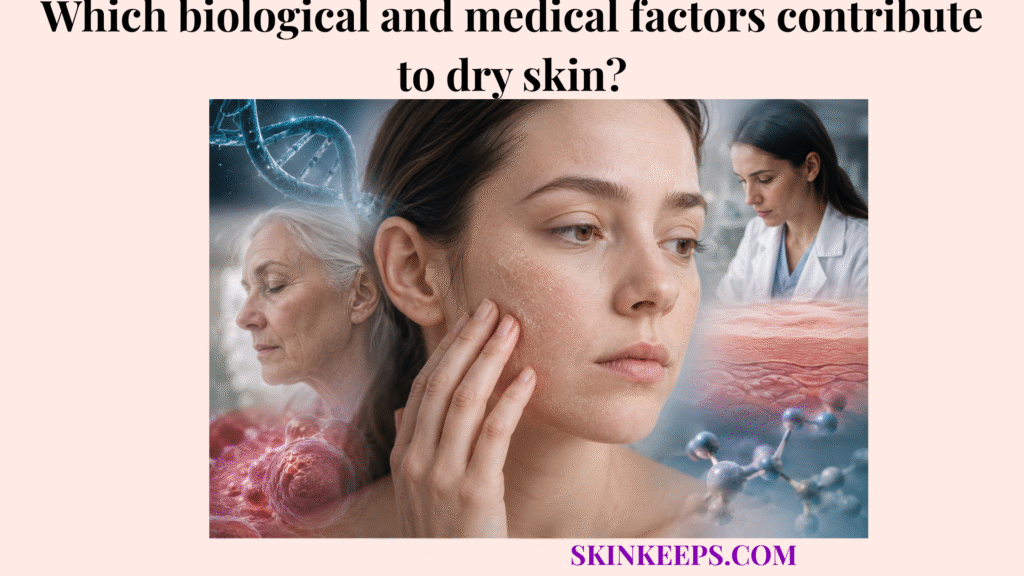
Biological and medical factors that contribute to dry skin include low sebum production, weakened barrier lipids, aging, genetics, hormonal changes, skin diseases, systemic conditions, medications, and nutritional deficiencies. These factors can reduce surface lubrication, weaken moisture retention, slow skin renewal, or increase inflammation, which makes dryness more persistent and harder to explain through weather or cleansing habits alone.
This article explains how internal skin biology, age, hormones, genetics, skin conditions, systemic diseases, medications, nutrition, and hydration status can contribute to dry skin. It also explains how biological or medical dryness differs from environmental dryness and when severe, sudden, painful, widespread, or persistent dryness should be professionally evaluated.
How do biological factors contribute to dry skin?
Biological factors contribute to dry skin by reducing surface oil, weakening barrier lipids, slowing skin renewal, increasing inflammation, or lowering the skin’s ability to hold water. These internal factors can make the outer layer feel tight, rough, itchy, flaky, or less flexible. Internal body factors are one reason dry skin may continue even when the person has already improved basic skincare habits.
Biological dryness is not always visible in one single way. Some people mainly feel tightness, while others see flaking, scaling, redness, darker irritation, or rough texture. When the main clue is what the skin looks like, visible characteristics of dry skin can help separate roughness, scaling, dullness, and cracking.
How low sebum production reduces surface lubrication
Low sebum production reduces surface lubrication by leaving the outer skin layer with less natural oil to soften friction and support comfort. Sebum is not the only factor in dry skin, but it helps the skin surface feel less rough. When oil support is low, ordinary washing, clothing friction, or dry air can feel harsher.
How weak barrier lipids increase moisture loss
Weak barrier lipids increase moisture loss by making the outer skin layer less able to hold water and protect itself from irritation. Barrier lipids help the stratum corneum stay organized and comfortable. When that structure is weaker, dry skin can become tight, flaky, or more reactive.
| Biological Factor | What Changes in the Skin | Dry-Skin Result |
|---|---|---|
| Low sebum production | Less natural surface oil | Tightness and roughness |
| Reduced barrier lipids | Weaker moisture barrier | More water loss |
| Slower skin renewal | Dry cells shed unevenly | Flaking or scaling |
| Inflammation tendency | Barrier becomes reactive | Itching, redness, or irritation |
| Lower water-holding ability | Less surface flexibility | Fine lines and tightness |
Why does aging make dry skin more common?
Aging makes dry skin more common because the skin often produces less natural oil, holds moisture less effectively, and repairs surface stress more slowly over time. This can make older skin feel tighter, rougher, and more easily irritated after weather exposure, bathing, or cleanser use. The point is not that dryness is inevitable; it is that the skin’s support needs often change with age.
Age-related dryness can also overlap with hormonal shifts, medication use, medical conditions, and thinner surface resilience. Aging should be treated as one contributor among several rather than the only reason dry skin develops. Mayo Clinic lists older age as a dry-skin risk factor, but dry skin patterns still need context. Mayo Clinic
How aging reduces natural oil production
Aging reduces natural oil production by lowering the amount of surface lubrication that helps skin feel soft, flexible, and protected from dryness. Less natural oil can make the skin surface feel less cushioned. That change can make dry skin more vulnerable to weather, cleansers, and friction.
Why older skin holds moisture less effectively
Older skin holds moisture less effectively because the outer layer may have less lipid support and reduced flexibility, making water balance harder to maintain. This can make tightness appear faster after washing or exposure. It can also make moisturizer feel more necessary for daily comfort.
How slower repair makes dryness last longer
Slower repair makes dryness last longer because older skin may take more time to recover from irritation, weather exposure, washing, or barrier stress. Recovery speed matters because repeated irritation can build before the skin has fully regained comfort. That is why gentle care and early protection can matter more with age.
How do hormones affect dry skin?
Hormones affect dry skin by changing oil production, moisture retention, skin renewal, and sensitivity during life stages such as perimenopause, menopause, pregnancy, postpartum shifts, or thyroid imbalance. These changes can make skin feel drier, more reactive, or less comfortable than before. One hormone alone does not explain every case of dryness.
Hormonal dryness may appear gradually or fluctuate during specific life stages. Some people notice dryness around hormonal transitions, while others notice dryness only when hormones combine with weather, cleansing habits, age, or medication use. The safest approach is to recognize the timing without using dry skin alone as a diagnosis.
| Hormonal Factor | How It May Affect Skin |
|---|---|
| Menopause or perimenopause | Less oil and weaker moisture retention |
| Low estrogen states | More dryness and sensitivity |
| Thyroid imbalance | Slower skin turnover and rough dryness |
| Pregnancy or postpartum shifts | Temporary changes in dryness or sensitivity |
Can genetics make someone more prone to dry skin?
Genetics can make someone more prone to dry skin by influencing oil production, barrier strength, eczema tendency, sensitivity, and how easily the skin loses comfort. This is why two people can live in the same climate and use similar products but have very different dryness patterns. Genetic tendency sets vulnerability, but it does not remove the role of environment or skincare habits.
A family history of eczema, sensitive skin, or chronic dryness may suggest an inherited barrier tendency. Genetics should be framed as predisposition rather than destiny. External triggers still matter, but environmental factors that worsen dry skin explain a different pathway than aging, hormones, disease, or medication.
How inherited barrier weakness can increase dryness risk
Inherited barrier weakness can increase dryness risk by making the outer skin layer less able to hold moisture and tolerate irritation. This can make dryness appear more easily after triggers that other people tolerate. It can also make itching or flaking more recurrent.
Why some people naturally produce less oil than others
Some people naturally produce less oil than others because sebaceous activity varies across individuals, families, ages, hormones, and skin types. Lower oil output can reduce surface softness and comfort. That variation helps explain why one routine does not fit every dry-skin pattern.
| Genetic Pattern | Dry-Skin Effect |
|---|---|
| Naturally low oil production | Skin feels dry more easily |
| Family history of eczema | Barrier may be more reactive |
| Sensitive-skin tendency | Higher irritation risk |
| Inherited barrier weakness | More flaking, itching, or tightness |
Which skin conditions commonly contribute to dry skin?
Skin conditions that commonly contribute to dry skin include eczema, atopic dermatitis, contact dermatitis, psoriasis, ichthyosis, and rosacea-prone sensitivity. These conditions can weaken barrier comfort, increase inflammation, change skin renewal, or create dry, itchy, scaly patches. Biological dryness may become visible as dry skin flaking and scaling when the outer layer sheds unevenly.
Every dry patch should not be presented as a skin disease. Ordinary dry skin can be temporary, mild, and responsive to basic care. Skin-condition dryness becomes more likely when patches are recurrent, itchy, inflamed, thick, scaly, painful, or resistant to simple moisturizer. AAD notes that atopic dermatitis, ichthyosis, and psoriasis can cause excessively dry skin. American Academy of Dermatology
| Skin Condition | How It Contributes to Dryness |
|---|---|
| Eczema / atopic dermatitis | Weak barrier, itching, inflammation |
| Contact dermatitis | Irritation or allergy damages barrier comfort |
| Psoriasis | Thick scaling and abnormal skin turnover |
| Ichthyosis | Very dry, scaly skin pattern |
| Rosacea-prone sensitivity | Irritation can increase dryness-like discomfort |
Which systemic medical conditions can contribute to dry skin?
Systemic medical conditions can contribute to dry skin when they affect circulation, nerve function, metabolism, inflammation, fluid balance, sweating, skin renewal, or itch pathways. Hypothyroidism, diabetes, kidney disease, liver or bile-related disease, and autoimmune conditions are examples of medical contexts where dryness or itching may appear. Dry skin alone does not diagnose any of these conditions.
Medical dryness becomes more concerning when it is severe, widespread, sudden, recurrent, intensely itchy, slow to heal, or paired with other body symptoms. Readers should not stop medications, start supplements, or assume a diagnosis without clinical evaluation. AAD notes that persistent overly dry skin can sometimes be linked with underlying medical conditions such as atopic dermatitis, psoriasis, or kidney disease. American Academy of Dermatology
| Medical Condition | Possible Dry-Skin Link |
|---|---|
| Hypothyroidism | Rough, dry, slowed skin changes |
| Diabetes | Dryness, itching, slower healing risk |
| Kidney disease | Dryness and itching can occur |
| Liver or bile-related disease | Itching and skin discomfort may appear |
| Autoimmune conditions | Dryness may affect skin or mucous membranes |
Can medications contribute to dry skin?
Medications can contribute to dry skin when they change oiliness, fluid balance, sweating, skin renewal, irritation tolerance, or treatment-related barrier stress. Acne medications, retinoids, diuretics, some cholesterol or blood pressure medications, antihistamines, cancer treatments, and radiation can be relevant examples. Medication-related dryness may appear gradually or after a routine changes.
Readers should not stop prescribed medication because of dry skin without speaking with a clinician. The safer approach is to document timing, symptoms, new products, new medications, and body changes. A healthcare professional can then assess whether the dryness may be treatment-related.
Medication-Related Dryness Checklist
Can nutrition or hydration status affect dry skin?
Nutrition or hydration status can affect dry skin by influencing water balance, barrier lipid support, inflammation, and the nutrients needed for normal skin repair. This does not mean drinking water alone fixes dry skin. It means internal support can matter when dryness is linked to dehydration, dietary restriction, poor intake, or deficiency risk.
Miracle-food claims should be avoided. Nutrition may support skin health, but severe, sudden, painful, widespread, or persistent dryness needs proper evaluation. Dryness with fatigue, weight changes, excessive thirst, frequent urination, poor healing, or other body symptoms should not be treated as a simple skincare issue.
Why dehydration can make skin feel less flexible
Dehydration can make skin feel less flexible because the outer layer needs adequate water balance to stay comfortable, smooth, and less tight. This does not make dehydration the only explanation for dry skin. It simply means hydration status can influence how the surface feels.
Why essential fatty acids and nutrient status matter for barrier support
Essential fatty acids and nutrient status matter for barrier support because the skin needs internal building blocks to maintain surface comfort and repair. Nutrient status can influence how well the skin supports its outer layer. Severe restriction, deficiency risk, or body symptoms should be discussed with a clinician.
Why diet support cannot replace medical care for severe dryness
Diet support cannot replace medical care for severe dryness because persistent or unusual dryness may reflect inflammation, medication effects, or an underlying condition that needs evaluation. Food and hydration can support general skin health, but they should not be used to ignore bleeding, pain, oozing, severe itching, or sudden widespread dryness.
How can biological dryness be separated from environmental dryness?
Biological dryness can be separated from environmental dryness by looking at whether symptoms persist without obvious exposure triggers, recur despite good habits, or appear with medical, hormonal, genetic, or medication-related clues. Environmental dryness usually worsens after weather, bathing, harsh soaps, or dry air. Biological or medical dryness may be more persistent, recurrent, or linked with body-wide changes.
Real dry skin is often mixed rather than purely internal or purely external. A person may have inherited barrier weakness and still worsen in cold weather. Another person may have medication-related dryness that becomes more obvious after harsh cleansing. The goal is pattern recognition, not self-diagnosis.
| Dryness Type | Main Driver | Common Clue |
|---|---|---|
| Biological dryness | Low oil, weak barrier, aging, genetics | Persistent dryness even with good habits |
| Medical dryness | Disease, medication, inflammation | Severe, recurrent, itchy, or unusual dryness |
| Environmental dryness | Weather, bathing, soaps, low humidity | Worsens with exposure and improves with protection |
| Mixed dryness | Internal tendency plus external triggers | Common in real life |
When should biological or medical dry skin be checked professionally?
Biological or medical dry skin should be checked professionally when dryness is severe, widespread, sudden, painful, bleeding, intensely itchy, recurrent, infection-looking, or linked with other body symptoms. These patterns are more concerning than mild seasonal roughness. Dryness that becomes severe or persistent should be evaluated rather than repeatedly treated with stronger products.
Dryness that burns or stings may overlap with dry skin stinging or burning, especially when the barrier is inflamed or reactive. Inflammation-related dryness can also overlap with dry skin redness and irritation, especially when itching or sensitivity is present. Dryness that becomes severe, sudden, widespread, bleeding, or persistent may fit the escalation pattern where persistent dry skin needs a dermatologist.
Doctor / Dermatologist Warning Signs
What should you remember about biological and medical dry skin factors?
The main point to remember is that dry skin can come from internal biological and medical factors, not only from weather, bathing, soaps, or skincare habits. Internal biology can reduce oil, weaken barrier lipids, slow repair, or increase moisture loss. Dry skin alone does not diagnose a disease, but persistent or unusual patterns deserve attention.
Final Takeaways
- Dry skin is not always caused by weather or harsh products.
- Internal biology can reduce oil, weaken barrier lipids, slow repair, or increase moisture loss.
- Aging, genetics, hormones, eczema tendency, thyroid issues, diabetes, kidney disease, medications, and nutrition can all contribute to dry skin.
- Dry skin alone does not diagnose a disease.
- Persistent, severe, painful, itchy, bleeding, sudden, widespread, or unusual dryness should be evaluated professionally.
- The best approach is internal cause recognition, not self-diagnosis.
FAQs
Which biological factors contribute to dry skin?
Biological factors that contribute to dry skin include low sebum production, weak barrier lipids, slower skin renewal, inflammation tendency, and reduced water-holding ability.
Can aging make dry skin more common?
Yes, aging can make dry skin more common because the skin may produce less natural oil, hold moisture less effectively, and repair irritation more slowly.
Can hormones affect dry skin?
Yes, hormones can affect dry skin by changing oil production, moisture retention, skin renewal, and sensitivity during transitions such as menopause, pregnancy, postpartum shifts, or thyroid imbalance.
Can genetics make someone prone to dry skin?
Yes, genetics can make someone prone to dry skin by influencing natural oil production, barrier strength, eczema tendency, and irritation risk.
Which skin conditions can cause dry skin?
Eczema, atopic dermatitis, contact dermatitis, psoriasis, ichthyosis, and rosacea-prone sensitivity can all contribute to dry, itchy, rough, or scaly skin.
Can medications contribute to dry skin?
Yes, some medications or treatments can contribute to dry skin by changing oiliness, fluid balance, skin renewal, or irritation tolerance.
When should dry skin be checked medically?
Dry skin should be checked medically when it is severe, widespread, sudden, bleeding, painful, intensely itchy, infection-looking, recurrent, or linked with other body symptoms.
Conclusion
Biological and medical factors can contribute to dry skin by reducing oil production, weakening barrier lipids, changing hydration balance, increasing inflammation, or slowing repair. Aging, genetics, hormonal shifts, skin conditions, systemic disease, medications, nutrition, and hydration status can all shape how dry the skin becomes and how long dryness lasts.
Dry skin alone does not diagnose a disease, but persistent, severe, sudden, painful, bleeding, or body-symptom-linked dryness deserves professional evaluation. The safest interpretation is to notice the pattern, avoid self-diagnosis, and seek care when warning signs appear.