
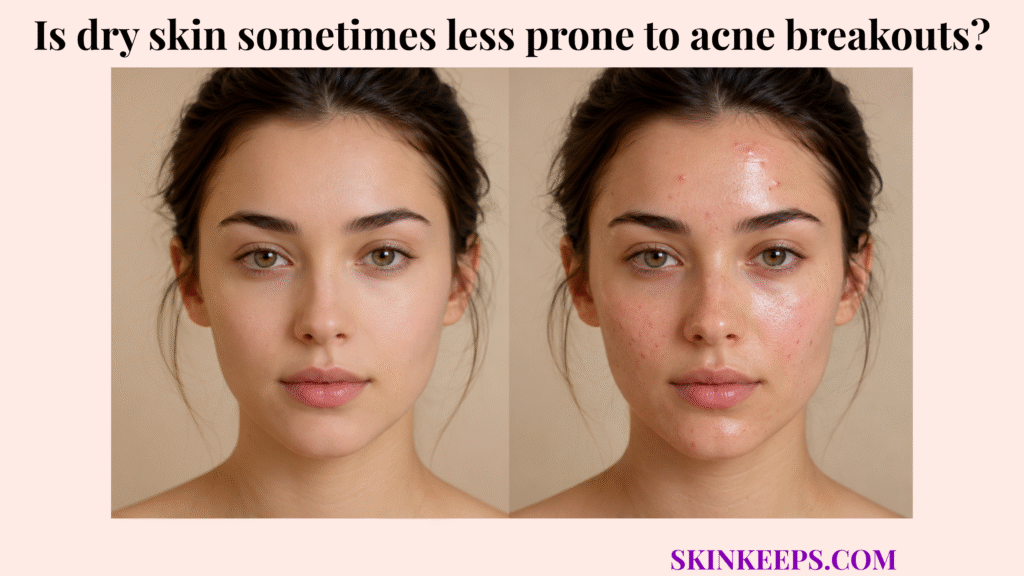
Yes, dry skin can sometimes be less prone to acne breakouts that are driven by excess sebum, oily congestion, and enlarged oil-filled pores. Because dry skin usually produces less surface oil, it may have fewer blackheads or grease-related clogged pores than oily skin.
Dry skin can still break out when the barrier becomes irritated, products are too heavy, hormones fluctuate, or dead skin cells and inflammation block pores. This article covers lower sebum, remaining breakout risk, dry-skin triggers, dry acne vs oily acne, safe care, mistakes, and warning signs.
Why Can Dry Skin Be Less Prone to Some Acne Breakouts?
Dry skin can be less prone to some acne breakouts because lower sebum output may reduce oily pore congestion and grease-related clogged pores. Sebum is the skin’s natural oil, and sebum-driven acne patterns are more tied to oil-heavy buildup than to dry-skin tightness alone. This lower-oil pattern can reduce one acne pathway, but it does not remove every breakout pathway.
This lower-oil pattern fits the broader behavior of dry skin, where moisture support often matters more than oil control. The comparison is clearer beside oily skin, where higher sebum activity can make pore congestion more visible. The useful distinction is lower sebum-driven acne risk, not acne immunity.
How Lower Sebum Output Can Reduce Oily Pore Congestion
Lower sebum output can reduce oily pore congestion because less oil reaches the pore opening and mixes with dead skin cells. When less oil collects in the pore environment, greasy pore buildup may be less likely to dominate the breakout pattern. Sebum still has a normal protective role, so less oil should not be treated as automatically better.
Why Dry Skin May Develop Fewer Blackheads Than Oily Skin
Dry skin may develop fewer blackheads than oily skin because blackheads often become more visible when oil-heavy buildup collects inside pores. Blackheads are one acne pattern, not the whole acne category. Dry skin can still develop blackheads when dead skin buildup, product residue, or local congestion blocks pores.
| Dry-Skin Factor | What It Changes | Acne-Related Effect |
|---|---|---|
| Lower sebum output | Less oil reaches the pore opening | Less greasy buildup |
| Less surface shine | Pores are less oil-coated | Fewer oil-heavy clogs |
| Smaller-looking pores | Less visible oil expansion | Less blackhead-prone appearance |
| Lower oil film | Less sebum mixing with dead cells | Reduced congestion tendency |
Which Acne Types May Be Less Common in Dry Skin?
The acne types that may be less common in dry skin are usually oil-heavy patterns such as greasy T-zone blackheads, enlarged-looking oily pores, and thick sebum buildup. These patterns depend heavily on visible surface oil and pore oil accumulation. Dry skin may show fewer oil-heavy clogs than skin where blackheads and breakouts are more common in oily skin.
This does not mean the patterns never happen in dry skin. A dry face can still form blackheads, whiteheads, or clogged pores if buildup, products, hormones, or irritation affect the follicle. The advantage is narrower than “dry skin does not get acne.”
Usually Less Associated With Dry Skin
- Greasy T-zone blackheads.
- Oil-heavy clogged pores.
- Enlarged-looking oily pores.
- Midday shine-related congestion.
- Thick sebum buildup around the nose and forehead.
Why Can Dry Skin Still Get Acne?
Dry skin can still get acne because pores can become blocked or inflamed from dead skin buildup, irritation, heavy products, hormones, bacteria, or barrier damage. Acne is not only an oily-skin issue. The breakout pathway changes when the skin background is dry, tight, flaky, or sensitive.
The core myth to reject is that dry skin is acne-proof. Dry skin may have fewer sebum-heavy breakouts, but it can still develop clogged pores, pimples, rash-like bumps, or hormonal breakout patterns. The safest approach is to identify the likely pathway without assuming every bump is acne.
How Dead Skin Buildup Can Still Block Pores
Dead skin buildup can still block pores on dry skin because dry surface cells may collect around pore openings even when oil output is low. Pores can still block when surface buildup collects, especially if flaking and scaling are common signs of dry skin. Aggressive scrubbing may worsen irritation instead of clearing the pore environment.
Why Irritation Can Make Dry Skin More Breakout-Prone
Irritation can make dry skin more breakout-prone because a stressed barrier can become inflamed, reactive, and less tolerant of products or acne actives. Harsh cleansers, fragrance, scrubs, and over-exfoliation can create breakout-like bumps even when the skin is not oily. The wording matters because irritation bumps may look like acne without always being true acne.
Why Hormones Can Trigger Acne Even When Skin Is Dry
Hormones can trigger acne even when skin is dry because hormonal signaling can affect oil glands, inflammation, and breakout patterns regardless of how dry the skin surface feels. Chin or jaw breakouts can be one possible pattern, but that pattern is not a diagnosis. Painful, persistent, or scarring acne should be evaluated rather than treated aggressively at home.
| Breakout Pathway | More Common in Oily Skin | Can Happen in Dry Skin? |
|---|---|---|
| Excess sebum buildup | Yes | Less often, but possible |
| Dead skin cell blockage | Yes | Yes |
| Hormonal acne | Yes | Yes |
| Product-related clogging | Yes | Yes |
| Irritation-driven breakouts | Yes | Yes, especially if barrier is weak |
What Triggers Breakouts on Dry Skin?
Breakouts on dry skin can be triggered by heavy products, dead skin buildup, over-exfoliation, harsh cleansing, irritation, hormonal shifts, or occlusive layering. These triggers affect pores or the skin barrier rather than simply adding oil. The result may be clogged pores, inflamed bumps, or breakout-like texture on a dry background.
Exfoliation needs caution because gentle exfoliation may be safer for dry skin than aggressive scrubbing. Heavy creams can also create facial-zone congestion when the texture is too occlusive for the face. The same rich product that helps dry body skin may feel too heavy on acne-prone facial areas.
| Trigger | How It Causes Breakouts |
|---|---|
| Heavy creams or balms | Can trap residue in pores |
| Over-exfoliation | Irritates barrier and increases inflammation |
| Harsh cleansers | Makes dry skin reactive and uncomfortable |
| Dead skin buildup | Can block pores even without excess oil |
| Fragrance or irritating products | Can trigger rash-like bumps or irritation |
| Hormonal shifts | Can cause chin or jaw breakouts regardless of skin type |
| Occlusive layering | Can create congestion if too heavy for the face |
How Is Acne on Dry Skin Different From Acne on Oily Skin?
Acne on dry skin is different from acne on oily skin because dry-skin breakouts often appear against a tight, flaky, rough, or sensitive background, while oily-skin acne often appears with shine, grease, and visible congestion. This comparison helps with pattern recognition, not diagnosis. Dry skin is not automatically safer, and oily skin is not automatically worse.
The treatment risk also changes. Dry skin is easier to over-dry with harsh acne products, while oily skin may need more oil-control attention. The practical direction for dry acne-prone skin is acne care with barrier protection.
| Feature | Dry-Skin Acne | Oily-Skin Acne |
|---|---|---|
| Main background | Tight, flaky, sensitive, or rough skin | Greasy, shiny, congested skin |
| Common trigger | Irritation, heavy products, dead skin buildup | Excess sebum and clogged pores |
| Pore appearance | Often smaller-looking | Often more visible or enlarged |
| Skin feel | Dry but bumpy or inflamed | Slick, oily, or heavy |
| Treatment risk | Easy to over-dry | Easy to under-control oil |
Can Dry Skin Break Out From Moisturizer?
Dry skin can break out from moisturizer if the formula is too heavy, irritating, fragrance-heavy, or poorly matched to acne-prone facial zones. This does not mean dry skin should stop moisturizing. Moisturizer choice matters because moisturizer ingredients for very dry skin can feel different on the face than on the body.
Body-level dryness and facial acne-prone zones may need different textures. A rich balm may suit dry elbows or legs, while a lighter non-comedogenic facial moisturizer may suit bumpy or congestion-prone areas. The better direction is texture matching, not moisturizer avoidance.
Better Direction for Moisturizer Use
- Use richer textures where the body is very dry.
- Use lighter non-comedogenic textures on acne-prone facial zones.
- Avoid assuming dry skin means any heavy cream is safe.
- Separate dry body care from dry acne-prone facial care.
How Should Dry Acne-Prone Skin Be Managed?
Dry acne-prone skin should be managed by protecting the skin barrier while using acne care cautiously enough to avoid extra dryness, peeling, or irritation. Gentle cleansing, consistent moisturizer, non-comedogenic facial products, cautious acne actives, and sunscreen can all support the direction. Severe acne should not be self-treated with an aggressive routine.
Acne actives such as salicylic acid, benzoyl peroxide, or retinoids may be useful for some acne patterns, but dry skin often needs slower introduction and careful tolerance checks. The goal is to reduce breakout pathways without creating more barrier inflammation. Barrier-protective care is the anchor.
Dry Acne-Prone Care Checklist
- Use a gentle cleanser.
- Avoid harsh soaps and scrubs.
- Moisturize consistently to protect barrier comfort.
- Choose non-comedogenic facial moisturizers.
- Avoid heavy occlusive layering on breakout-prone zones.
- Use acne actives cautiously because dry skin irritates easily.
- Introduce salicylic acid, benzoyl peroxide, or retinoids slowly if needed.
- Use sunscreen because irritated dry skin can mark more visibly after breakouts.
What Mistakes Make Dry Skin Breakouts Worse?
Mistakes that make dry skin breakouts worse usually involve stripping the barrier, skipping moisturizer, scrubbing flakes, overusing acne products, or treating irritation bumps like oily acne. These choices can make the skin tighter, more reactive, and more inflamed. Aggressive acne care can backfire when the background skin is already dry.
The common trap is trying to remove bumps by removing more oil. Dry acne-prone skin often needs less stripping and more careful barrier support. If a product creates burning, stinging, or rash-like bumps, continuing harder is not a safer strategy.
| Mistake | Why It Backfires |
|---|---|
| Skipping moisturizer | Barrier gets tighter and more reactive |
| Using harsh acne products daily | Dryness, peeling, and irritation worsen |
| Scrubbing flakes off | Creates inflammation and more bumps |
| Using heavy creams everywhere | Can clog acne-prone facial zones |
| Treating irritation bumps like oily acne | Can damage the barrier further |
When Do Breakouts on Dry Skin Need Professional Evaluation?
Breakouts on dry skin need professional evaluation when they are painful, scarring, persistent, rash-like, swollen, oozing, crusting, or affecting sleep, confidence, or daily life. Professional evaluation helps distinguish acne from lookalike conditions without forcing a home diagnosis. That matters because eczema, dermatitis, rosacea, fungal folliculitis, irritation, and hormonal acne can overlap visually.
Persistent or painful breakouts need a safer boundary, especially when persistent dry skin concerns need a dermatologist instead of stronger home treatment. A clinician can separate acne from irritation, infection-looking changes, or other inflammatory patterns. The goal is safer care, not fear.
Dermatologist Warning Checklist
- Painful cysts or nodules.
- Breakouts leave scars or dark marks.
- Acne keeps returning despite gentle care.
- Skin is very dry, cracked, and inflamed.
- Rash-like bumps appear after a new product.
- Burning, swelling, oozing, or crusting appears.
- Breakouts affect sleep, confidence, or daily life.
- You suspect eczema, dermatitis, rosacea, fungal folliculitis, or hormonal acne.
What Should You Remember About Dry Skin and Acne Breakouts?
Dry skin can be less prone to sebum-heavy acne, but it can still break out from dead skin buildup, irritation, hormones, heavy products, or barrier stress. The lower-oil advantage is real but limited. Dry acne-prone skin needs barrier protection, not aggressive stripping.
Final Takeaways
- Dry skin can be less prone to sebum-heavy acne.
- Lower oil output may mean fewer greasy clogged pores and blackheads.
- Dry skin can still break out from dead skin buildup, irritation, hormones, or heavy products.
- Dry acne-prone skin needs barrier protection, not aggressive stripping.
- The best approach is gentle cleansing, suitable moisturizer, careful acne actives, and non-comedogenic facial products.
- Dry skin with painful, scarring, persistent, or rash-like breakouts should be evaluated.
Frequently Asked Questions
Does Dry Skin Mean You Will Not Get Acne?
Dry skin does not mean you will not get acne because pores can still become blocked or inflamed without heavy surface oil. Dry skin may have fewer sebum-heavy breakouts, but acne can still come from dead skin buildup, irritation, products, hormones, or barrier stress.
Why Do I Get Pimples If My Skin Is Dry?
You can get pimples with dry skin because dryness does not stop pore blockage, inflammation, or hormonal breakout pathways. Dead skin buildup, irritating products, heavy moisturizers, and hormonal changes can all contribute without making the skin surface oily.
Are Blackheads Less Common On Dry Skin?
Blackheads may be less common on dry skin when lower sebum output reduces oil-heavy pore buildup. Dry skin can still get blackheads, especially if dead skin buildup, heavy products, or facial-zone congestion blocks pores.
Can Moisturizer Cause Acne On Dry Skin?
Moisturizer can contribute to breakouts on dry skin if it is too heavy, irritating, or poorly matched to acne-prone facial zones. Dry skin still needs moisturizer, but acne-prone facial areas may need lighter non-comedogenic textures than very dry body areas.
Should Dry Acne-Prone Skin Avoid Acne Actives?
Dry acne-prone skin does not always need to avoid acne actives, but it usually needs them introduced cautiously. Salicylic acid, benzoyl peroxide, and retinoids can help some acne patterns but may irritate dry skin if used too aggressively.
Conclusion
Dry skin can sometimes be less prone to sebum-heavy acne because lower oil output may reduce greasy pore buildup, blackheads, and oil-related congestion. That advantage is limited because dry skin can still break out from dead skin buildup, irritation, hormones, heavy products, or barrier stress.
The safest approach is not to strip dry skin harder. Dry acne-prone skin needs gentle cleansing, suitable moisturizer, careful acne actives, and professional evaluation when breakouts are painful, scarring, persistent, rash-like, or difficult to control.