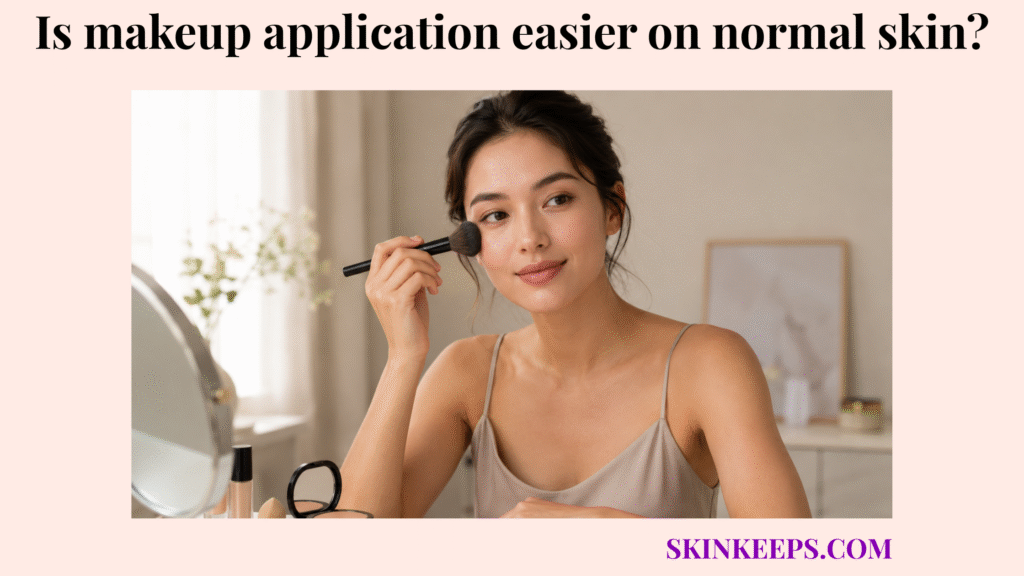
Yes, makeup application is often easier on normal skin because the surface is usually more balanced. Foundation, concealer, sunscreen, primer, and powder may blend more evenly when the skin is not strongly oily, flaky, tight, acne-prone, or reactive. Normal skin still needs preparation because makeup can cling, crease, separate, look shiny, emphasize pores, or irritate the skin if products are too heavy, too drying, poorly removed, or layered over sunscreen and skincare incorrectly.
Why is makeup application often easier on normal skin?
Makeup application is often easier on normal skin because the skin surface is usually less dominated by heavy oil, persistent flakes, severe tightness, frequent irritation, or repeated breakouts.
Makeup may spread and blend more smoothly when the surface is steadier. This does not mean normal skin is poreless, texture-free, or immune to blemishes.
This surface advantage connects with how normal skin feels comfortable and balanced on ordinary days.
Normal skin usually has fewer extreme surface issues
Normal skin usually has fewer extreme surface issues because heavy oil, persistent flakes, frequent irritation, and severe dryness are not dominant baseline patterns.
Makeup may spread and blend more smoothly when the surface is steadier. Normal skin can still show pores, fine lines, texture, and occasional blemishes.
Normal skin still needs basic preparation
Normal skin still needs basic preparation because sweat, sunscreen, moisturizer, dry-feeling areas, and product residue can affect how makeup sits.
Gentle cleansing, light moisture support when needed, and sunscreen can help makeup sit better without overloading the skin.
| Makeup issue | Why normal skin may handle it better |
|---|---|
| Foundation blending | Surface is usually more even |
| Concealer placement | Less flaking or greasiness may interfere |
| Powder use | Less need for heavy oil control |
| Primer need | Often optional or targeted |
| Product layering | Usually more predictable |
| Makeup wear | Less sliding or clinging than extreme skin types |
| Finish control | Easier to keep balanced, not too matte or shiny |
Normal skin makes makeup easier because it gives makeup a steadier surface, not a perfect surface.
How does normal skin help foundation and concealer apply better?
Normal skin can help foundation and concealer apply better because the surface is usually comfortable, moderately smooth, and less likely to strongly reject product through oiliness, dry patches, or stinging.
Foundation and concealer may apply more easily because normal skin often needs less correction before makeup. Light prep still matters when sunscreen, dryness, sweat, or residue could interfere.
This easier base behavior overlaps with the way normal skin is usually less prone to acne and dryness than stronger acne-prone or dry patterns.
- Foundation blends without heavy patchiness.
- Concealer does not cling strongly to dry flakes.
- Makeup does not slide quickly from oil.
- Skin does not feel tight under makeup.
- Sunscreen and makeup layer more predictably.
- A natural finish is easier to maintain.
Normal skin often needs less correction before makeup, but it still benefits from light prep.
How does normal skin compare with oily, dry, and reactive skin for makeup?
Normal skin often compares favorably with oily, dry, acne-prone, combination, and reactive skin for makeup because it usually has fewer repeated surface extremes.
Normal skin can simplify makeup, but it does not remove all texture or product-matching needs. Comparison should focus on surface behavior, not beauty ranking.
Lower repeated product discomfort also connects with the advantages normal skin can have compared with reactive skin types.
| Skin pattern | Common makeup challenge | Normal skin advantage |
|---|---|---|
| Oily skin | Foundation may separate or slide | Less frequent excess shine |
| Dry skin | Makeup may cling to flakes | Less persistent roughness |
| Combination skin | T-zone and cheeks need different prep | More even surface behavior |
| Acne-prone skin | Texture, bumps, or marks may need targeted coverage | Fewer frequent breakouts |
| Reactive skin | Products may sting, burn, or flush | Lower repeated reactivity |
| Normal skin | Still may show pores, texture, or occasional blemishes | Easier baseline blending |
Normal skin can make makeup simpler, but it does not remove all texture or product-matching needs.
Can makeup still look uneven on normal skin?
Makeup can still look uneven on normal skin when dehydration, over-exfoliation, sunburn, irritation, sweat, friction, heavy layers, or poor removal habits disrupt the surface.
Normal skin can also have visible pores, fine lines, texture, and occasional blemishes. Uneven makeup should be read as a surface-condition clue, not proof that the skin type changed.
Sunscreen layers can affect makeup behavior, but normal skin still needs protection from sun damage under makeup.
- Too much moisturizer or sunscreen.
- Too little moisturizer on dry-feeling days.
- Harsh cleansing before makeup.
- Over-exfoliation.
- Heavy foundation layers.
- Wrong finish for the weather.
- Sweat, humidity, or friction.
- Sleeping in makeup the night before.
When makeup looks uneven on normal skin, check prep, product amount, weather, and removal habits before blaming skin type.
What mistakes should normal skin avoid before makeup?
Normal skin should avoid makeup-prep mistakes that create dryness, pilling, heaviness, clogged pores, shine, redness, or irritation before makeup is applied.
Makeup prep should solve a clear surface need without building a heavy routine. Normal skin makeup usually looks best when prep is simple, not overloaded.
This matches why normal skin usually needs less specialized skincare than problem-dominant patterns.
| Mistake | How it affects normal skin makeup | Better move |
|---|---|---|
| Skipping sunscreen | UV protection is missed | Apply sunscreen before makeup |
| Applying makeup on dry-feeling skin | Foundation may cling | Moisturize lightly if needed |
| Using too many layers | Pilling or heaviness may happen | Keep prep simple |
| Over-powdering | Skin may look flat or dry | Powder only where needed |
| Using heavy products in humidity | Makeup may slide or feel greasy | Adjust texture |
| Scrubbing before makeup | Redness or stinging may appear | Cleanse gently |
| Sleeping in makeup | Breakouts or irritation may increase | Remove gently at night |
| Chasing poreless finish | Creates cakey makeup risk | Aim for natural balance |
Normal skin makeup looks best when prep is simple, not overloaded.
When should makeup problems on normal skin need attention?
Makeup problems on normal skin need attention when makeup or skincare repeatedly causes burning, stinging, swelling, rash-like redness, painful breakouts, cracked patches, or changing lesions.
Makeup difficulty can be cosmetic, but repeated reactions or painful changes need professional review rather than more product layering.
- Makeup or skincare repeatedly burns, stings, or causes rash-like redness.
- Breakouts become painful, frequent, deep, or scarring.
- Dry patches crack, bleed, burn, or spread.
- Skin reacts to many gentle products.
- Eye-area swelling appears after makeup.
- Redness becomes persistent, warm, swollen, or spreading.
- A mole, spot, or lesion changes color, shape, size, or behavior.
Makeup difficulty can be cosmetic, but repeated reactions or painful changes need professional review.
What should you remember about makeup application on normal skin?
The key point is that makeup application is often easier on normal skin, but normal skin still needs realistic prep, sun protection, gentle removal, and irritation awareness.
Normal skin usually gives makeup a more balanced surface, but it can still show pores, texture, blemishes, dryness, shine, and irritation. The goal is a comfortable, realistic finish, not a poreless promise.
Frequently Asked Questions About Makeup Application on Normal Skin
Does foundation look better on normal skin?
Foundation may look smoother on normal skin because the surface is usually less oily, less flaky, and less reactive.
Does normal skin need primer?
Not always. Normal skin may only need primer for a specific goal, such as longer wear, smoother texture, or shine control in certain areas.
Can makeup still clog normal skin?
Yes. Heavy makeup, poor removal, sweat, and product buildup can still clog normal skin.
Can normal skin wear matte or dewy makeup?
Yes. Normal skin can often wear either finish, but the best choice depends on comfort, weather, and product texture.
Should normal skin remove makeup every night?
Yes. Makeup, sunscreen, sweat, and debris should be removed gently to reduce irritation and clogged pores.
Sources & Evidence About Makeup Application on Normal Skin
Cleveland Clinic skin-type guidance was used to ground normal, dry, oily, combination, and sensitive skin distinctions.
American Academy of Dermatology face-washing guidance was used for gentle cleansing and removing makeup, sunscreen, sweat, oil, dirt, and debris without harsh scrubbing.
American Academy of Dermatology sunscreen guidance was used for broad-spectrum sunscreen, SPF 30 or higher, and daily sun-protection boundaries.
American Academy of Dermatology acne-and-makeup guidance was used for makeup, acne-prone skin, product selection, and breakout-prevention boundaries.
American Academy of Dermatology acne skin-care tips were used for non-comedogenic sunscreen, clogged-pore caution, and acne-related product boundaries.
American Academy of Dermatology dry-skin signs guidance was used for dryness, flaking, cracking, bleeding, itching, and dry-skin warning boundaries.
American Academy of Dermatology contact-dermatitis overview was used for irritation, allergic-type skin reactions, itching, rash, blisters, and dermatology-care boundaries.
American Academy of Dermatology exfoliation guidance was used for irritation, redness, peeling, and over-exfoliation risk boundaries.
American Academy of Dermatology melanoma signs guidance was used for changing mole, spot, lesion behavior, and referral boundaries.
Educational Disclaimer: This article is for general skin education only and does not diagnose, treat, or replace professional medical advice. If makeup or skincare causes repeated burning, swelling, rash-like redness, painful acne, cracked or bleeding patches, severe itching, eye-area swelling, sudden unexplained reactions, broader health symptoms, or changing moles or lesions, consult a qualified dermatologist or healthcare professional.