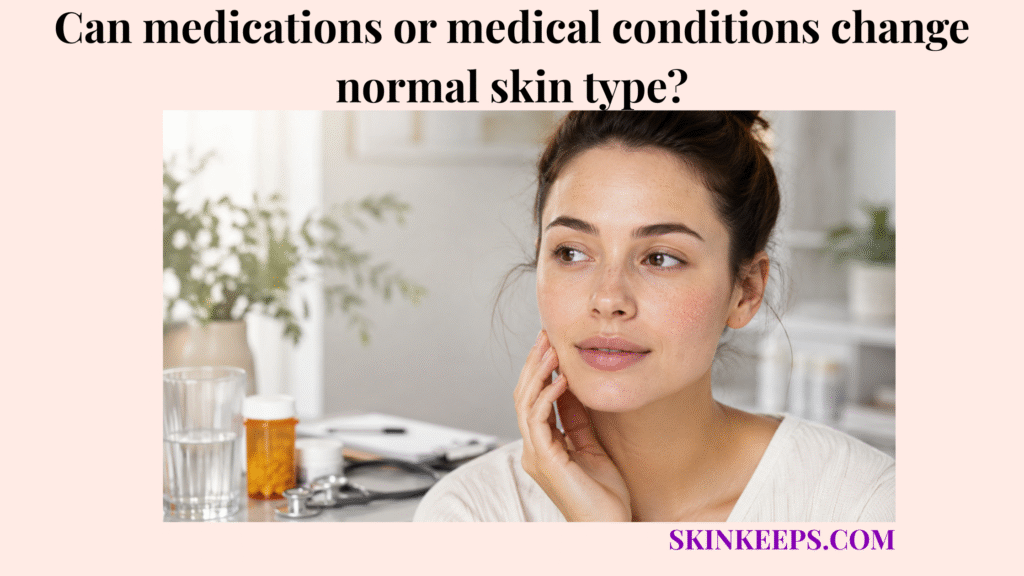
Yes, medications or medical conditions can change how normal skin behaves. Normal skin may become drier, oilier, more breakout-prone, more sensitive, more rash-prone, more sun-sensitive, or slower to recover when the body is affected by a drug, illness, hormone shift, immune reaction, allergy, or inflammatory condition.
This does not always mean the person’s basic skin type has permanently changed. A medical or medication-related trigger can temporarily disturb the usual pattern before the skin returns closer to baseline.
Normal skin may improve after the trigger is understood or managed, but medication-related skin changes should be handled carefully with a qualified healthcare professional, especially if the medication was prescribed.
Why can normal skin change behavior without permanently changing skin type?
Normal skin can change behavior without permanently changing skin type because medication effects, illness, inflammation, hormones, allergies, or immune reactions can temporarily disturb the skin’s usual pattern.
These triggers may affect oil production, barrier comfort, hydration, pigmentation, sensitivity, or recovery. The skin may act dry, oily, rash-prone, acne-prone, or reactive even if its usual baseline is balanced.
Changes may be short-term, repeated, or persistent depending on the cause. A sudden flare should be judged against timing, severity, medication history, and broader body symptoms rather than appearance alone.
Sudden behavior shifts should be compared with the wider pattern of different skin types before normal skin is reclassified permanently.
| Change in normal skin | Possible medical link | What it does not prove |
|---|---|---|
| Sudden dryness | Medication, illness, aging, hormone shift | Permanent dry skin type |
| New breakouts | Medication, hormones, stress, condition | Acne diagnosis by itself |
| New sensitivity | Barrier stress, allergy, medication reaction | Sensitive skin forever |
| Rash-like redness | Drug reaction, dermatitis, infection, allergy | One guaranteed cause |
| Sun sensitivity | Medication or condition-related photosensitivity | Ordinary sunburn only |
| Pigmentation change | Hormones, inflammation, medication, sun | Harmless change always |
| Slow healing | Health, medication, circulation, immune factors | Simple skincare issue |
Normal skin type should be judged after the medical trigger is understood, not during a sudden unexplained flare.
Which medication effects can change normal skin behavior?
Medication effects can change normal skin behavior by causing dryness, acne-like breakouts, photosensitivity, rash, itching, pigmentation changes, bruising, or slower recovery.
Medication-related skin effects can appear as a broad pattern rather than one exact symptom. A person with normal skin may notice dryness, rash, itching, acne-like bumps, bruising, sun sensitivity, or uneven color after a new medicine or repeated exposure.
Timing matters when symptoms appear after a new medication, dose change, or supplement. The goal is not to guess the drug cause alone, but to collect useful details for a prescriber, pharmacist, dermatologist, or qualified clinician.
Medication-linked dryness often overlaps with surface water loss, so hydration level and normal skin balance can become part of the same pattern.
| Medication-related effect | How normal skin may change | Safer response |
|---|---|---|
| Dryness | Tightness, peeling, chapped lips, roughness | Ask prescriber or pharmacist about side effects |
| Acne-like breakouts | New pimples, clogged pores, inflamed bumps | Track timing and location |
| Photosensitivity | Easier sunburn, rash, burning after sun | Strengthen sun protection and ask clinician |
| Rash or hives | Itchy, raised, red, or widespread reaction | Contact healthcare provider |
| Pigmentation change | Darkening, patches, uneven tone | Track and seek review if persistent |
| Hair or nail changes | Shedding, brittleness, texture shifts | Mention during medical review |
| Skin thinning or bruising | Fragility, easy marks | Ask clinician if related |
| Itching | Dryness, allergy, irritation, systemic trigger | Do not ignore if persistent |
A new medication can change normal skin behavior, but the safest next step is professional review — not self-stopping the drug.
Can acne medications make normal skin dry or sensitive?
Acne medications can make normal skin dry or sensitive because treatments that reduce oil or target breakouts may also increase peeling, stinging, redness, or barrier stress.
Acne treatments can make otherwise balanced skin feel abnormal because they often act on oil, shedding, inflammation, or bacteria. If the skin was not very oily before treatment, dryness and tightness may feel more noticeable.
Acne medications can dry normal skin
Acne medications can dry normal skin when they reduce oil, increase peeling, or make the surface feel tight and rough.
Dryness may appear as tight cheeks, chapped lips, peeling, or rough texture. Those signs should be discussed with the prescribing clinician or pharmacist instead of answered by adding more exfoliation.
Acne medications can irritate normal skin
Acne medications can irritate normal skin when they are strong, frequent, layered, or paired with harsh cleansers and exfoliation.
Irritation may feel like burning, stinging, redness, or shiny-tight discomfort. Pushing through pain is not a safe goal because barrier stress can make normal skin more reactive.
Acne medications can increase normal skin sun sensitivity
Acne medications can increase normal skin sun sensitivity when the skin becomes easier to irritate or burn in sunlight.
Sun protection becomes more important when photosensitivity is possible. A clinician or pharmacist can clarify sun precautions for prescribed or active treatments.
Acne treatment changes should be separated from the usual pattern of whether normal skin is less prone to frequent breakouts.
| Treatment-related change in normal skin | What it may look like | What to avoid |
|---|---|---|
| Dryness | Tight cheeks, peeling, chapped lips | Adding more exfoliation |
| Irritation | Burning, stinging, redness | Pushing through pain |
| Photosensitivity | Faster sunburn or irritation | Skipping sunscreen |
| Barrier stress | Moisturizer stings | Using harsh cleansers |
| Breakouts plus peeling | Active overload | Stacking multiple treatments |
| Eye or lip dryness | Discomfort around delicate areas | Ignoring worsening symptoms |
If acne treatment makes normal skin feel dry, raw, or reactive, the routine may need medical or professional adjustment.
Can non-skin medications affect normal skin?
Non-skin medications can affect normal skin because drugs used for other health reasons may still influence dryness, rashes, itching, bruising, pigmentation, acne-like eruptions, or sun sensitivity.
Medications not meant for skin can still affect the skin. A medication taken for another health reason may appear in the skin as itching, rash, dryness, bruising, pigmentation, photosensitivity, or acne-like bumps.
The timing of the change matters because reactions can appear soon after a new medicine or after repeated exposure. Dose changes and new supplements should also be included in the timeline.
| Clue in normal skin | Why medication may be considered |
|---|---|
| Rash begins after starting a new medicine | Possible drug reaction |
| Sunburn happens faster than usual | Possible photosensitivity |
| Skin becomes much drier after medication change | Side effect possible |
| Acne begins suddenly in adulthood | Medication or hormone link possible |
| Itching appears without a new skincare product | Internal trigger possible |
| Bruising increases | Medication or health factor possible |
| Skin changes after dose change | Timing clue matters |
| Symptoms improve or worsen with medication schedule | Useful detail for clinician |
Normal skin changes should be compared with medication start dates, dose changes, and new supplements.
Which medical conditions can change normal skin behavior?
Medical conditions can change normal skin behavior by affecting dryness, oiliness, healing, pigmentation, inflammation, sensitivity, breakouts, rashes, or infection risk.
Broad medical categories can influence skin without proving one diagnosis from the face alone. Hormonal factors, thyroid-related changes, blood-sugar issues, inflammation, allergies, infections, and nutritional problems may all show skin clues.
Skin signs alone are not enough to confirm a condition. Persistent, sudden, spreading, painful, or body-linked changes should be evaluated because skincare alone may not address the cause.
Illness, hormones, medication timing, and body-level changes sit beside other internal factors that help maintain normal skin balance.
| Medical factor | How normal skin may change | Why evaluation matters |
|---|---|---|
| Hormonal conditions | Acne, oiliness, dryness, pigmentation | May need medical assessment |
| Thyroid-related changes | Dryness, texture, hair changes | Skin signs alone are not enough |
| Diabetes or blood-sugar issues | Dryness, infections, slow healing | Persistent wounds need care |
| Autoimmune or inflammatory conditions | Rash, sensitivity, redness, photosensitivity | May mimic skincare irritation |
| Eczema or dermatitis | Itching, dryness, rash-like patches | Needs correct diagnosis |
| Rosacea-like conditions | Flushing, burning, redness | Often confused with sensitivity |
| Allergies | Hives, itching, swelling | Can become urgent |
| Infections | Warmth, pain, pus, spreading redness | Needs prompt care |
| Nutritional problems | Dryness, hair/nail changes, slow healing | Needs whole-body review |
Medical conditions can make normal skin act oily, dry, sensitive, rash-prone, or acne-prone, but the cause cannot be confirmed by appearance alone.
Can hormone-related conditions change normal skin?
Hormone-related conditions can change normal skin by shifting oiliness, breakouts, dryness, pigmentation, sensitivity, or the timing of skin changes.
Hormones can affect how normal skin behaves without making the reader diagnose themselves. Repeated chin breakouts, sudden oiliness, unusual dryness, pigmentation changes, or life-stage shifts may suggest a hormone-linked influence.
Pattern clues matter most when skin changes appear with broader symptoms. Irregular cycles, hair changes, painful acne, deep breakouts, or sudden adult-onset acne should be discussed with a qualified clinician.
- New repeated chin or jawline breakouts.
- Sudden oiliness without a product change.
- Unusual dryness during life-stage transitions.
- Pigmentation changes during hormonal shifts.
- Skin changes with irregular cycles or broader body symptoms.
- Acne that becomes painful, deep, or persistent.
- Sudden adult-onset breakouts.
Hormones can change normal skin behavior, but persistent or body-wide symptoms need medical review rather than skincare guessing.
Can immune, allergy, or inflammatory conditions change normal skin?
Immune, allergy, or inflammatory conditions can change normal skin by causing sudden hives, rash-like redness, swelling, itching, burning, peeling, or sensitivity.
Rash, hives, redness, and sensitivity should be treated differently from ordinary skin-type variation. A sudden widespread reaction needs more caution than a mild dry patch after harsh cleansing.
Immune reactions can make normal skin rash-prone
Immune reactions can make normal skin rash-prone when a drug reaction, allergy, infection, or inflammatory flare causes hives, swelling, itching, or widespread redness.
Sudden widespread reactions need more caution than routine dryness or irritation. Swelling, hives, fever, blistering, skin pain, or rapid spreading redness should prompt medical review.
Inflammatory conditions can mimic sensitive normal skin
Inflammatory conditions can mimic sensitive normal skin because burning, flushing, itching, peeling, or rash-like patches may look like product sensitivity.
The cause may not be obvious from appearance alone. Repeated, spreading, or painful symptoms need professional evaluation rather than repeated product switching.
New stinging or rash-like redness can temporarily disrupt the usual pattern of normal skin being less sensitive than reactive skin types.
| Symptom in normal skin | Possible meaning | Safer action |
|---|---|---|
| Hives | Allergy or drug reaction possible | Contact healthcare provider |
| Widespread rash | Medication, infection, allergy, inflammation | Seek evaluation |
| Burning redness | Irritation or condition possible | Stop harsh products and seek guidance |
| Swelling | Possible allergic reaction | Urgent if face, lips, tongue, throat, or breathing involved |
| Blisters | Serious reaction or infection possible | Prompt medical care |
| Skin pain | More concerning than ordinary irritation | Seek care |
| Fever with rash | Possible serious reaction or infection | Medical care needed |
A rash on normal skin should not be treated like a simple skin-type change.
Can medications or medical conditions make normal skin sun-sensitive?
Medications or medical conditions can make normal skin sun-sensitive by increasing the chance of faster sunburn, burning, itching, rash, redness, or irritation after UV exposure.
Photosensitivity means the skin reacts more strongly to sunlight than expected. Normal skin may burn faster, itch, develop redness, or show rash-like irritation after sun exposure when medication or medical factors increase UV reactivity.
Sudden sun sensitivity should be compared with medication timing, supplements, medical history, and whether the reaction appears mainly on exposed areas. A clinician or pharmacist can help check whether a medicine or condition is involved.
| Sun-related change in normal skin | Possible clue | Safer response |
|---|---|---|
| Burns faster than before | Medication or condition may increase photosensitivity | Ask clinician and strengthen protection |
| Rash after sun exposure | Photosensitivity or sun reaction possible | Seek guidance if repeated |
| Itching after sun | UV-triggered reaction possible | Avoid repeated exposure |
| Redness after short exposure | Increased sensitivity possible | Use shade, clothing, sunscreen |
| Blisters after sun | More concerning | Prompt medical review |
| Reaction only on exposed areas | Photosensitivity clue | Track exposure and medication timing |
| Reaction after new medicine | Medication link possible | Contact healthcare professional |
If normal skin suddenly reacts strongly to sunlight, check medications, supplements, and medical history with a professional.
How can normal skin tell if a change may be medication-related?
Normal skin can tell if a change may be medication-related by comparing the skin change with medication start dates, dose changes, new supplements, and sun exposure patterns.
Tracking gives structure without creating a diagnosis. A clear timeline can help a clinician see whether dryness, acne, rash, itching, photosensitivity, or pigmentation appeared near a medication change.
Delayed reactions can happen, so both recent and repeated exposure timing matter. The reader should track what changed, when it changed, and whether urgent symptoms appeared.
| Tracking question | Why it matters |
|---|---|
| Did the skin change after starting a new medication? | Timing can reveal a possible link |
| Did the dose change recently? | Dose changes can affect side effects |
| Did a new supplement start? | Supplements can also trigger reactions |
| Did sun sensitivity increase? | Some medicines affect UV response |
| Did dryness, acne, or rash appear suddenly? | Sudden changes need review |
| Did symptoms appear days or weeks later? | Some reactions are delayed |
| Did symptoms improve when another trigger stopped? | Helps separate product vs medication cause |
| Are there fever, swelling, blisters, pain, or breathing symptoms? | These can be urgent |
Good tracking helps the clinician. It does not replace the clinician.
How can normal skin tell if a medical condition may be involved?
Normal skin can tell a medical condition may be involved when skin changes appear with persistent symptoms, spreading patterns, slow healing, infections, or broader body changes.
The skin can give a clue that the issue is bigger than skincare. Persistent itching, slow-healing wounds, repeated infections, spreading rashes, or skin changes with fatigue, fever, cycle changes, hair changes, or weight changes deserve medical review.
Looking beyond skincare is especially important when many gentle products suddenly burn or sting. That pattern may reflect barrier stress, but it may also reflect a medical or medication-linked change.
- Sudden severe dryness or oiliness.
- Persistent itching.
- Slow-healing wounds.
- Repeated infections.
- Rash-like patches that spread or return.
- Redness with warmth, pain, or swelling.
- New acne with other body changes.
- New pigmentation changes.
- Skin changes plus fatigue, fever, cycle changes, hair changes, or weight changes.
- Skin reacting to many gentle products after previously tolerating them.
When normal skin changes arrive with broader body symptoms, it is no longer just a skincare question.
Can normal skin return to baseline after medication or medical-condition changes?
Normal skin can sometimes return to baseline after medication or medical-condition changes, but recovery depends on the trigger, severity, treatment needs, and whether the medicine remains necessary.
Temporary change is possible when the skin improves after illness recovery, barrier support, or clinician-guided management. Persistent changes need follow-up because the trigger may still be active.
Some skin changes improve after the cause is identified, while others continue because a medication remains medically necessary or a condition needs ongoing care. The answer should be individualized, not guessed.
Medication-linked changes can overlap with age, dryness, and recovery speed, so age changes in normal skin over time can complicate the pattern.
| Change pattern | What it may mean |
|---|---|
| Skin returns to baseline after illness recovery | Temporary disruption possible |
| Dryness improves after routine support and clinician-guided changes | Side effect may be manageable |
| Rash clears after medical treatment | Trigger may have been identified |
| Sun sensitivity continues | Ongoing medication or condition effect possible |
| Acne persists after obvious triggers are removed | Acne pattern may need care |
| Skin remains reactive for weeks | Barrier or medical issue may persist |
| Symptoms worsen or spread | Needs professional review |
| Medication is medically necessary | Skin support may need to work around it |
Some normal skin changes are reversible, but persistent changes should be evaluated rather than guessed.
What should normal skin avoid doing when medication or medical-condition changes appear?
Normal skin should avoid unsafe reactions to medication or medical-condition changes, especially stopping prescribed medication alone, treating rashes only with skincare, or adding strong actives to sudden symptoms.
Unsafe self-management can delay needed care or make irritation worse. A sudden rash, sun reaction, painful acne flare, or medication-linked change should not be answered with random product stacking.
Common mistakes create trigger confusion. New acids, harsh scrubs, heavy creams, or multiple new products can make it harder to identify whether the change came from medication, illness, allergy, sun exposure, or skincare.
| Mistake | Why it is risky for normal skin | Safer move |
|---|---|---|
| Stopping prescribed medication alone | Can be medically unsafe | Contact prescriber first |
| Treating drug rash with skincare only | May delay needed care | Seek medical guidance |
| Adding strong actives to sudden acne | Can worsen irritation | Stabilize and ask if persistent |
| Scrubbing rash or flakes | Can worsen inflammation | Avoid friction |
| Ignoring sun sensitivity | Can increase burns and rash risk | Use protection and ask clinician |
| Assuming all dryness is skin type change | Medication or condition may be involved | Track timing |
| Using many new products to fix changes | Makes triggers harder to identify | Simplify |
| Ignoring swelling or breathing symptoms | Can be dangerous | Seek urgent care |
When medicine or illness may be involved, normal skin should be managed cautiously and medically.
When should medication-related changes in normal skin need urgent care?
Medication-related changes in normal skin need urgent care when rash appears with breathing trouble, facial or throat swelling, fever, blisters, skin pain, rapid spreading redness, or severe systemic symptoms.
Emergency boundaries should be clear. A severe medication reaction is not a cosmetic issue and should not be handled as a routine skin-type change.
Urgent signs include airway symptoms, swelling in the face or throat, widespread blistering, skin pain, fever with rash, rapid spread, or infection signs. These patterns need prompt medical attention.
- Rash appears with trouble breathing.
- Lips, tongue, throat, eyes, or face swell.
- Skin becomes painful or blistered.
- Rash spreads quickly.
- Rash appears with fever.
- Skin peels widely.
- Hives appear with dizziness, faintness, wheezing, or vomiting.
- There are signs of infection such as warmth, pus, severe pain, or rapidly spreading redness.
- A drug reaction feels severe or systemic.
A severe medication reaction is not a skin-type change. It is a medical safety issue.
When should normal skin changes from medications or conditions need a dermatologist or clinician?
Normal skin changes from medications or conditions need a dermatologist or clinician when they are sudden, persistent, painful, spreading, bleeding, rash-like, sun-sensitive, scarring, or linked with medication timing or broader symptoms.
Non-emergency changes still deserve review when they persist or repeat. A rash after medication, painful dryness, deep acne, unusual sun sensitivity, or sudden pigmentation change should be discussed with the right professional.
A dermatologist, prescriber, pharmacist, or qualified clinician can help separate side effects, allergies, inflammatory conditions, infection, acne, and product irritation. That separation is safer than guessing from appearance.
- Skin suddenly becomes very oily, dry, sensitive, or acne-prone.
- A rash appears after starting or changing medication.
- Dryness becomes persistent, painful, or cracking.
- Breakouts become deep, painful, frequent, cystic, or scarring.
- Skin becomes unusually sun-sensitive.
- Itching is persistent or intense.
- Products that used to work suddenly burn or sting.
- Pigmentation changes suddenly, spreads, or darkens.
- A mole, spot, or lesion changes color, shape, size, or behavior.
- Skin changes appear with broader health symptoms or medication changes.
Normal skin can change, but sudden, persistent, spreading, painful, bleeding, rash-like, or medication-linked changes deserve professional review.
What should you remember about medications, medical conditions, and normal skin?
The key point is that medications and medical conditions can change normal skin behavior without always proving a permanent skin-type change.
Normal skin may become drier, oilier, more sensitive, rash-prone, acne-prone, or sun-sensitive when medication effects, illness, hormones, inflammation, allergy, or immune reactions disturb its usual balance.
Timing, professional guidance, and urgent warning signs matter most. New medicine, dose change, illness, rash, breathing trouble, swelling, fever, blisters, or skin pain should be handled with medical caution.
Frequently Asked Questions About Medications, Medical Conditions, and Normal Skin
Can medication make normal skin dry?
Yes. Some medications can make normal skin feel drier, tighter, flaky, or more irritated. Ask the prescribing clinician or pharmacist if dryness begins after a new medication.
Can medication make normal skin break out?
Yes. Some medications may contribute to acne-like breakouts or oil changes. Track when the breakouts started and discuss persistent or painful acne with a clinician.
Can normal skin become sensitive because of medication?
Yes. Normal skin can become more sensitive, especially if a medication causes dryness, irritation, rash, or sun sensitivity.
Should I stop medication if my normal skin changes?
Do not stop prescribed medication without guidance from your healthcare professional. Contact the prescriber, pharmacist, or dermatologist to discuss the skin change safely.
When is a medication-related skin change serious?
It is serious if there is trouble breathing, swelling of the lips, tongue, throat, eyes, or face, widespread rash, blisters, skin pain, fever, rapid spreading redness, or signs of infection.
Sources & Evidence About Medications, Medical Conditions, and Normal Skin
Cleveland Clinic skin-type guidance was used to ground normal, oily, dry, combination, and sensitive skin distinctions.
American Academy of Dermatology acne treatment guidance was used for acne-medication dryness, peeling, irritation, burning, worsening acne, and professional-care boundaries.
American Academy of Dermatology hives guidance was used for hives, swelling, breathing or swallowing difficulty, and medical-care boundaries.
DermNet drug-induced photosensitivity guidance was used for medication-linked UV reactions, sunburn-like reactions, rash, and exposed-area timing clues.
Mayo Clinic drug allergy guidance was used for rash, hives, fever, airway symptoms, throat tightness, breathing trouble, and anaphylaxis warning boundaries.
American Academy of Dermatology sun-protection guidance was used for UV protection, sunburn prevention, and stronger protection when photosensitivity is possible.
American Academy of Dermatology dry-skin signs guidance was used for persistent dryness, itching, cracking, bleeding, and dry-skin referral boundaries.
American Academy of Dermatology contact-dermatitis symptom guidance was used for burning, stinging, itching, swelling, rash-like reactions, and product-reaction boundaries.
American Academy of Dermatology melanoma signs guidance was used for changing mole, spot, and lesion referral boundaries.
Educational Disclaimer: This article is for general skin education only and does not diagnose, treat, or replace professional medical advice. Do not stop or change prescribed medication without guidance from a qualified healthcare professional. If skin changes include trouble breathing, facial or throat swelling, widespread rash, fever, blisters, skin pain, severe itching, painful acne, scarring, cracked or bleeding patches, spreading redness, persistent product reactions, broader health symptoms, or changing moles or lesions, seek medical care promptly.