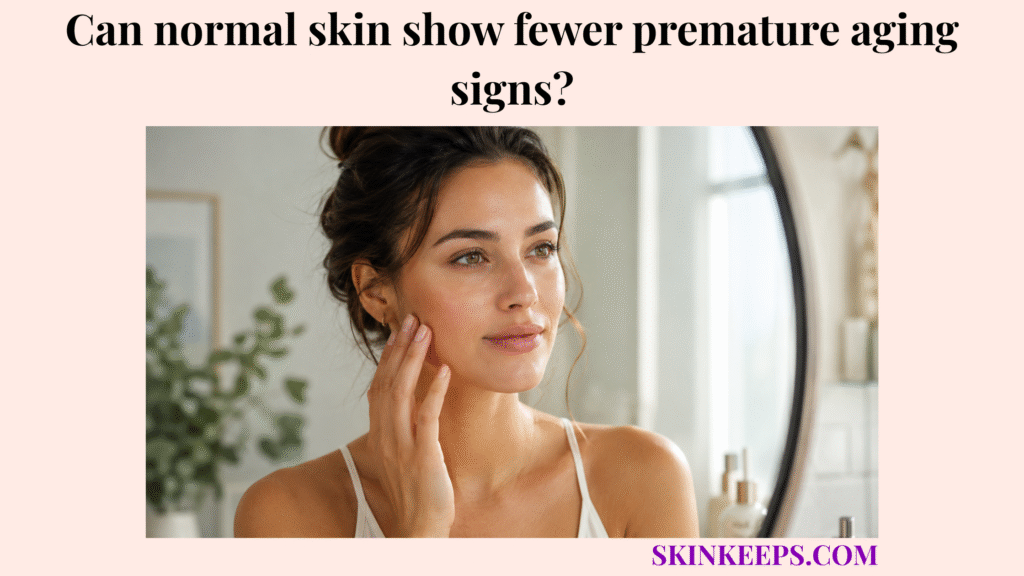
Yes, normal skin can sometimes show fewer premature aging signs because it is usually more balanced, less persistently dry, less oily, and less reactive than more disrupted skin patterns.
This balance may help the skin look smoother, calmer, and more even when it is also protected from sun damage and harsh routines. Normal skin is not aging-proof, because premature aging signs can still appear from UV exposure, tanning, smoking, pollution, chronic stress, poor sleep, dehydration, harsh products, over-exfoliation, and natural age-related changes.
Why can normal skin show fewer premature aging signs?
Normal skin can show fewer premature aging signs when its balanced baseline reduces repeated dryness, irritation, oil disruption, breakout marks, and barrier stress.
This does not mean normal skin ages slowly or avoids wrinkles by default. It means repeated visible stress patterns may be less dominant when oil, moisture, comfort, and reactivity stay steady.
Normal, dry, oily, combination, and reactive patterns should still be understood within different skin types, not used to predict aging by skin type alone.
Normal skin may have a steadier baseline
Normal skin may have a steadier baseline because oil, moisture, comfort, and reactivity are usually more balanced.
This may reduce repeated dryness, irritation, inflammation-like stress, and texture disruption. A steadier baseline does not stop natural aging.
Normal skin still depends on protection habits
Normal skin still depends on protection habits because premature aging is strongly shaped by sun exposure, harsh routines, smoking, sleep, stress, and environmental stress.
Sun protection, gentle cleansing, moisturizer when needed, sleep, stress management, and avoiding smoking still matter. Exposure patterns often matter more than the skin-type label.
| Factor | How it may help normal skin | What can still cause premature signs |
|---|---|---|
| Balanced moisture | Less persistent tightness or roughness | Cold weather, harsh cleansers |
| Moderate oil | Less greasy stress and less constant dryness | Hormones, aging, climate |
| Lower reactivity | Fewer irritation cycles | Fragrance, acids, over-exfoliation |
| Fewer frequent breakouts | Fewer marks from acne/picking | Stress, products, hormones |
| Better comfort baseline | Makeup and texture may look smoother | UV exposure, sleep loss |
| Simpler routine | Less product overload risk | Skipping sunscreen |
| Lower daily irritation | Calmer-looking tone | Pollution, smoke, sun |
Normal skin may start from a better balance, but premature aging signs are shaped mostly by protection and exposure patterns.
Which premature aging signs can still appear on normal skin?
Premature aging signs can still appear on normal skin as fine lines, uneven tone, dark spots, dryness, texture changes, dullness, redness, slow recovery, or early loss of firmness.
These signs can appear even when the skin feels balanced on ordinary days. Normal skin can look steady and still develop early visible changes if exposure and habits work against it.
Dark spots, uneven tone, roughness, and surface changes overlap with the way normal skin usually has even tone and texture before those patterns are disrupted.
| Premature aging sign | How it may appear on normal skin |
|---|---|
| Fine lines | Around eyes, forehead, mouth, or expression areas |
| Uneven tone | Patchiness, dullness, or discoloration |
| Dark spots | Sun spots or post-irritation marks |
| Dryness | Tightness, roughness, or flaky areas |
| Texture changes | Less smooth surface or more visible pores |
| Loss of firmness | Less bounce or early laxity |
| Wrinkles | Lines that appear earlier than expected |
| Persistent dullness | Skin looks tired or less fresh |
| Redness | Repeated irritation or sun-related change |
| Slow recovery | Marks and irritation take longer to fade |
Normal skin can look balanced and still develop premature aging signs if exposure and habits work against it.
How does sun exposure affect premature aging signs in normal skin?
Sun exposure affects premature aging signs in normal skin because repeated UV exposure can contribute to fine lines, wrinkles, dark spots, uneven tone, roughness, and loss of firmness.
UV protection should stay central, but this section is not a sunscreen product guide. Repeated exposure can affect tone, texture, pigmentation, and surface smoothness over time.
That is why normal skin still needs protection from sun damage, even when it feels calm and balanced.
UV exposure can create visible premature aging signs on normal skin
UV exposure can create visible premature aging signs on normal skin when repeated exposure affects tone, texture, pigmentation, and surface smoothness.
Fine lines, wrinkles, dark spots, uneven tone, roughness, and firmness changes can become more visible over time. The point is prevention, not fear.
UV damage can build before normal skin looks damaged
UV damage can build before normal skin looks damaged because repeated exposure does not always create immediate visible signs.
Cumulative exposure can still affect long-term appearance and health. Tanning and sunburn are UV responses, not healthy aging strategies.
| UV-related factor | Possible premature-aging effect on normal skin |
|---|---|
| Daily unprotected exposure | Gradual tone and texture changes |
| Sunburn | Redness, peeling, irritation, later damage risk |
| Tanning | Sign of UV response, not healthy aging prevention |
| Skipping sunscreen | More cumulative exposure |
| Outdoor work or sports | Repeated UV load |
| Driving/window exposure | Day-to-day UVA exposure |
| Tanning beds | Faster photoaging risk |
| Ignoring hats/shade | More exposed-area changes |
Normal skin cannot show its best aging pattern if it is repeatedly unprotected from UV exposure.
How do lifestyle and environmental factors affect premature aging signs in normal skin?
Lifestyle and environmental factors affect premature aging signs in normal skin by adding repeated stress through smoking, pollution, poor sleep, chronic stress, dehydration, harsh cleansing, over-exfoliation, alcohol patterns, dry climate, and makeup residue.
These non-UV factors should be explained without overclaiming. Normal skin may show fewer premature signs when lifestyle and environment reduce repeated skin stress.
Smoking, sleep, stress, hydration, and routine habits also fit within lifestyle choices that affect normal skin health.
| Factor | How it may affect normal skin over time |
|---|---|
| Smoking | Dullness, texture changes, premature aging risk |
| Pollution | Oxidative stress and dull-looking skin |
| Poor sleep | Dullness and slower recovery |
| Chronic stress | Breakouts, picking, redness, recovery disruption |
| Dehydration | Tightness and dullness |
| Harsh cleansing | Barrier stress and dryness |
| Over-exfoliation | Stinging, peeling, roughness, redness |
| Heavy alcohol patterns | Dehydration and dullness |
| Cold/dry climate | Roughness and moisture loss |
| Makeup not removed | Congestion and irritation |
Normal skin may show fewer premature signs when lifestyle and environment reduce repeated stress on the skin.
How does normal skin compare with dry, reactive, and acne-prone skin for premature aging signs?
Normal skin may compare favorably with dry, reactive, and acne-prone skin for premature aging signs because it often has fewer repeated dryness, irritation, and breakout-mark cycles.
This comparison should stay careful. Normal skin may have fewer repeated stress patterns, but sun exposure can age any skin type.
| Skin pattern | Premature-aging challenge | Normal skin possible advantage |
|---|---|---|
| Dry skin | Fine lines may look stronger when skin is tight or flaky | More balanced moisture comfort |
| Reactive skin | Redness, stinging, and irritation may repeat | Lower repeated reactivity |
| Acne-prone skin | Marks, picking, inflammation, texture changes | Fewer frequent breakout cycles |
| Oily skin | Shine and enlarged-looking pores may dominate | More moderate surface balance |
| Combination skin | Zones may age or react differently | More even baseline behavior |
| Normal skin | Still exposed to UV, stress, aging, pollution | Advantage depends on protection |
Normal skin may have fewer repeated stress patterns, but sun exposure can age any skin type.
Can normal skin still age early if it is not protected?
Normal skin can still age early if it is repeatedly exposed to UV rays, tanning, smoking, pollution, poor sleep, stress, harsh products, or skipped protection.
Balanced skin type does not cancel exposure damage. Normal skin lowers some skin-type stress, but it does not erase exposure risk.
Natural aging should also be separated from premature aging because age changes normal skin over time even with good prevention habits.
- Normal skin can develop sun spots after years of unprotected sun.
- Normal skin can look dull after poor sleep and stress.
- Normal skin can look rough after over-exfoliation.
- Normal skin can show fine lines more clearly when dehydrated.
- Normal skin can become sensitive after aggressive routines.
- Normal skin can develop early texture changes from UV exposure.
Normal skin lowers some skin-type stress, but it does not erase exposure risk.
What helps normal skin show fewer premature aging signs?
Normal skin may show fewer premature aging signs when daily habits reduce UV exposure, irritation, dryness, smoking exposure, sleep disruption, and unnecessary product stress.
These are broad prevention principles, not a product routine. For normal skin, prevention matters more than aggressive correction.
- Daily sun protection.
- Avoiding tanning beds.
- Seeking shade during strong sun.
- Wearing hats, sunglasses, and protective clothing.
- Gentle cleansing.
- Moisturizer when skin feels dry or tight.
- Avoiding smoking.
- Managing stress where possible.
- Getting enough sleep.
- Avoiding unnecessary over-exfoliation.
- Introducing strong actives slowly.
- Removing makeup and sunscreen gently.
- Watching changing spots or lesions.
For normal skin, prevention matters more than aggressive correction.
What mistakes make premature aging signs more likely on normal skin?
Mistakes make premature aging signs more likely on normal skin when they increase UV exposure, irritation, dryness, product overload, smoking exposure, or delayed evaluation.
Normal skin often ages better with protection and consistency than with aggressive anti-aging routines. Care should reduce stress, not create more of it.
Gentle care and product restraint also connect with why normal skin usually needs less specialized skincare than problem-dominant patterns.
| Mistake | Why it can affect normal skin | Better move |
|---|---|---|
| Skipping sunscreen | UV damage accumulates | Protect daily |
| Tanning for glow | Tanning is UV response | Use safer glow methods |
| Over-exfoliating texture | Barrier stress can worsen lines and redness | Use restraint |
| Harsh cleansing | Dryness and irritation can increase | Cleanse gently |
| Ignoring moisturizer | Fine lines may look stronger when dry | Moisturize when needed |
| Smoking | Raises premature aging risk | Avoid smoke exposure |
| Sleeping in makeup | Congestion and irritation can increase | Remove gently |
| Ignoring changing spots | Delays medical review | Seek evaluation |
| Chasing anti-aging trends | Product overload can irritate | Keep care purposeful |
Normal skin often ages better with protection and consistency than with aggressive anti-aging routines.
When should aging-like changes in normal skin need professional attention?
Aging-like changes in normal skin need professional attention when spots, lesions, rough patches, pigmentation, redness, wounds, acne, or sudden sensitivity become changing, persistent, bleeding, painful, spreading, or unexplained.
Not every aging sign is urgent, but changing spots, bleeding areas, persistent rough patches, and sudden unexplained changes should be checked rather than treated as routine aging.
- A mole, spot, or lesion changes color, shape, size, or behavior.
- A new spot grows, bleeds, crusts, or does not heal.
- A rough, scaly, persistent patch appears on sun-exposed skin.
- Pigmentation appears suddenly, spreads, darkens, or changes.
- Redness becomes persistent, warm, swollen, or rash-like.
- Dry patches crack, bleed, burn, or spread.
- Breakouts become painful, deep, frequent, cystic, or scarring.
- Skin suddenly becomes very sensitive to products.
- A wound heals slowly or repeatedly reopens.
- Aging-like changes appear with illness, medication changes, or broader symptoms.
Not every aging sign is urgent, but changing spots, bleeding, persistent rough patches, and sudden unexplained changes should be checked.
What should you remember about normal skin and premature aging signs?
The key point is that normal skin can show fewer premature aging signs when its balanced baseline is protected from UV exposure, irritation, dryness, smoking, stress, and harsh routines.
Normal skin may have steadier moisture, comfort, and lower repeated irritation than some disrupted patterns, but it is not immune to premature aging. Prevention, protection, and realistic habits matter most.
Frequently Asked Questions About Normal Skin and Premature Aging Signs
Does normal skin age slower?
Not necessarily. Normal skin may show fewer early stress signs when balanced and protected, but aging speed depends on genetics, sun exposure, lifestyle, hormones, and environment.
Can normal skin get wrinkles early?
Yes. Normal skin can develop early wrinkles from UV exposure, smoking, tanning, dehydration, stress, poor sleep, or natural aging.
Can normal skin get dark spots from sun?
Yes. Normal skin can develop freckles, dark spots, uneven tone, or pigmentation changes from repeated sun exposure.
Does sunscreen help normal skin show fewer premature aging signs?
Yes. Daily sun protection can help reduce avoidable UV-related premature aging signs, including uneven tone, texture changes, and wrinkles.
Can normal skin look older from over-exfoliation?
Yes. Over-exfoliation can make normal skin look irritated, shiny-tight, red, flaky, or rough, which may make aging signs look more noticeable.
Sources & Evidence About Normal Skin and Premature Aging Signs
Cleveland Clinic skin-type guidance was used to ground normal, dry, oily, combination, and sensitive skin distinctions.
Cleveland Clinic photoaging guidance was used for UV exposure, UVA, UVB, photoaging, premature aging, wrinkles, spots, and skin-cancer risk boundaries.
American Academy of Dermatology sunscreen guidance was used for broad-spectrum sunscreen, SPF 30 or higher, shade, protective clothing, wrinkles, age spots, and UV-protection boundaries.
American Academy of Dermatology tanning guidance was used for tanning as UV damage, premature aging acceleration, and skin-cancer risk boundaries.
American Academy of Dermatology tanning-bed guidance was used for tanning-bed UV exposure, premature skin aging, and skin-cancer prevention boundaries.
American Academy of Dermatology dry-skin signs guidance was used for dryness, cracking, bleeding, itching, and moisturizer-support boundaries.
American Academy of Dermatology face-washing guidance was used for gentle cleansing, avoiding harsh scrubbing, and reducing irritation from cleansing mistakes.
American Academy of Dermatology exfoliation guidance was used for irritation, redness, peeling, acne breakouts, and over-exfoliation risk.
Peer-reviewed smoking and skin-aging study from NIH/PMC was used for smoking-related premature skin aging and wrinkle-risk context.
Peer-reviewed sleep-quality and skin-aging study was used for chronic poor sleep, intrinsic aging signs, barrier function, and recovery boundaries.
Peer-reviewed air-pollution and extrinsic skin-aging review from NIH/PMC was used for pollution, oxidative stress, lentigines, wrinkles, and environmental-aging context.
American Academy of Dermatology melanoma signs guidance was used for changing moles, changing spots, suspicious lesions, and referral boundaries.
Educational Disclaimer: This article is for general skin education only and does not diagnose, treat, or replace professional medical advice. If aging-like skin changes include changing moles or lesions, bleeding or non-healing spots, persistent rough patches, painful acne, scarring, cracked or bleeding patches, persistent burning, swelling, spreading redness, rash-like irritation, sudden unexplained changes, broader health symptoms, or severe itching, consult a qualified dermatologist or healthcare professional.