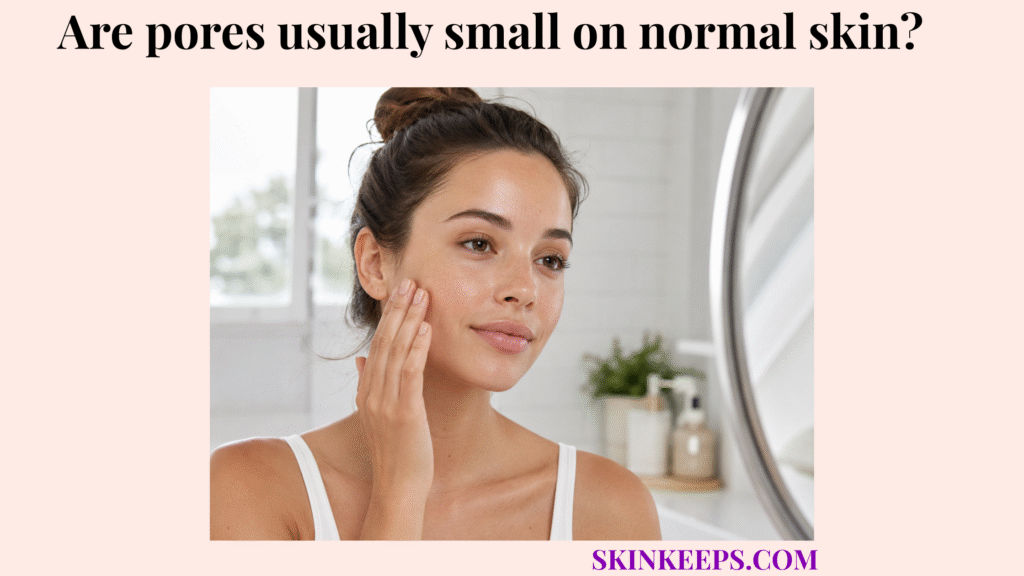
Pores on normal skin are often less noticeable, but they are not invisible. Normal skin usually has pores that look balanced, especially on the cheeks. The nose may still show more visible pores because some facial areas naturally show texture and surface oil more clearly.
For normal skin, “less prominent” is more accurate than “small.” Normal skin can still have visible pores, mild texture, occasional blackheads, or temporary pore visibility after sweat, sunscreen, makeup, humidity, heavy products, or harsh lighting.
Normal skin should be read as a steady pattern. If pores are present but not heavily clogged, oily-looking, inflamed, or dominant across the face, they can still fit a normal skin pattern.
Why should normal skin pores be judged by prominence instead of perfection?
Normal skin pores should be judged by prominence instead of perfection because pores are normal skin structures and should not be expected to disappear.
Normal skin pores should be judged by how noticeable, clogged, oily, or dominant they look. Pores are part of skin structure, so normal skin should not be expected to have no visible openings at all.
| Pore question for normal skin | Better way to judge it | What to avoid assuming |
|---|---|---|
| Are pores visible? | Visibility is normal | Visible pores mean bad skin |
| Are pores dominant? | Usually not dominant on normal skin | Normal skin must have no visible pores |
| Are pores clogged? | Normal skin usually has less repeated congestion | Every visible dot is dirt |
| Are pores oily-looking? | Normal skin usually has moderate shine | Any shine means oily skin |
| Are nose pores more visible? | This can still be normal | Nose pores define the whole skin type |
| Are cheek pores subtle? | Often supports a normal skin pattern | Cheeks must look airbrushed |
| Do pores change during the day? | Product, sweat, and lighting can affect appearance | One day proves skin type |
Practical rule: Normal skin is recognized by pores that do not dominate the face, not by pores that disappear.
What do pores usually look like on normal skin?
Pores on normal skin usually look visible up close but balanced, subtle, and not heavily clogged or dominant across the face.
Normal skin still has natural texture. The useful question is not whether pores exist, but whether pores repeatedly control the face’s appearance through oiliness, congestion, redness, or roughness.
The previous SkinKeeps guide to visible traits that make normal skin easy to recognize uses the same idea: normal skin is recognized by balance and consistency, not by one ideal feature.
| Visible pore trait on normal skin | What it usually means |
|---|---|
| Pores are visible up close | Normal skin still has texture |
| Cheek pores look subtle | Oil and congestion are not dominant there |
| Nose pores look slightly more visible | Nose pores are commonly more noticeable |
| Pores do not look heavily clogged | No strong congestion pattern is visible |
| Pores do not control the face’s appearance | Skin looks balanced overall |
| Pores may look clearer after gentle cleansing | Surface oil and residue are controlled |
| Pores may look more noticeable in harsh lighting | Lighting can exaggerate normal texture |
| Pores may change with sweat or products | Appearance is not fixed every day |
Practical rule: On normal skin, pores are usually present but not distracting.
Are cheek pores usually small-looking on normal skin?
Cheek pores are usually small-looking or subtle on normal skin because cheek areas often show less oiliness, congestion, and visible pore dominance.
Cheek pores can support a normal skin pattern when they look subtle from a normal distance and do not repeatedly appear clogged, inflamed, rough, or red.
Cheek pores on normal skin often look subtle
Cheek pores on normal skin often look subtle when oiliness, dryness, congestion, and irritation are not dominating the cheek surface.
Normal skin cheeks often look smoother because there is no repeated visible extreme pulling attention toward the pores.
Cheek pores on normal skin are still real skin texture
Cheek pores on normal skin are still real skin texture and may be visible close up, in bright light, or under makeup.
Close-up mirrors, side lighting, camera flash, and makeup can reveal pores that are not obvious in ordinary viewing conditions.
Cheek pores on normal skin can look larger after irritation or heavy products
Cheek pores on normal skin can look larger after irritation, product buildup, dryness, inflammation, or rough makeup application.
That change often reflects the surface around the pores rather than a permanent pore-size shift. Heavy product, flaking, redness, or makeup settling can make ordinary texture look more obvious.
| Cheek pore appearance on normal skin | Likely interpretation |
|---|---|
| Subtle pores at normal distance | Common normal-skin trait |
| Visible pores close up | Normal texture |
| Makeup sits evenly over pores | Supports balanced surface |
| Pores look bigger after heavy cream | Product effect possible |
| Pores look rough with flakes | Dryness or irritation may be involved |
| Pores look red or inflamed | Not just pore size; check irritation |
| Cheek pores suddenly look larger | Review product, weather, or barrier stress |
Practical rule: Small-looking cheek pores can support a normal skin pattern, but visible cheek pores are still normal.
Are nose pores usually small on normal skin?
Nose pores are not always small on normal skin because the nose naturally tends to show more visible pores than the cheeks.
The nose should be interpreted as one zone, not as the full answer for the whole face. Normal skin can still show nose pores while cheeks, forehead, and chin remain balanced.
Nose pores on normal skin may be more visible than cheek pores
Nose pores on normal skin may be more visible than cheek pores because the nose often shows texture and oil more clearly than flatter cheek areas.
Visible nose pores alone do not automatically mean oily skin. They need to be compared with repeated shine, clogged pores, blackheads, makeup separation, and cheek behavior.
Nose pores on normal skin should not automatically be treated as blackheads
Nose pores on normal skin should not automatically be treated as blackheads because visible dots are not always dirt or true clogged pores.
Some dots can be normal sebaceous-looking structures or ordinary pore openings. Over-scrubbing the nose can create redness and rough texture that makes pores look more noticeable.
Nose pores on normal skin may look larger with oil, sweat, or sunscreen residue
Nose pores on normal skin may look larger when surface oil, sweat, sunscreen residue, makeup, or heavy products collect around texture.
Gentle cleansing and product observation are safer than trying to scrape the pores clear.
| Nose pore sign on normal skin | Possible meaning | Better response |
|---|---|---|
| Pores visible on the nose | Common and normal | Do not over-scrub |
| Nose pores slightly darker | Oil or sebaceous material may be visible | Observe pattern |
| Repeated blackheads | More congestion may be present | Use gentle targeted care if needed |
| Nose gets shiny by midday | Could be normal variation or mild oiliness | Track repeated shine |
| Nose pores look bigger after sunscreen | Product residue or texture issue | Cleanse gently and reassess |
| Pores look irritated or red | Possible irritation | Stop harsh pore treatments |
| Nose pores dominate appearance | May lean oily or combination | Compare with cheeks and chin |
Practical rule: Normal skin can still have visible nose pores. The nose should not define the whole skin type alone.
Why can pores look less prominent on normal skin?
Pores can look less prominent on normal skin because balanced oil, low repeated congestion, comfortable hydration, and low irritation make surrounding texture look steadier.
Normal skin often looks smoother because the skin around the pores is not repeatedly shiny, flaky, inflamed, or congested. This is a surrounding-surface effect, not proof that pores are absent.
| Factor in normal skin | How it affects pore appearance |
|---|---|
| Balanced oil level | Pores are less likely to look shiny or stretched by surface oil |
| Low repeated congestion | Pores are less likely to look clogged or dark |
| Comfortable hydration | Surface texture looks smoother |
| Low visible irritation | Redness does not draw attention to pores |
| Minimal flaking | Dry texture does not exaggerate pores |
| Consistent routine | Skin appearance stays steadier |
| Gentle cleansing | Reduces residue without stripping |
| Daily sunscreen | Supports long-term skin appearance |
Practical rule: Normal skin pores often look smaller because the surrounding skin looks balanced, not because pores are absent.
When can pores look larger on normal skin?
Pores can look larger on normal skin when oil, sweat, humidity, heavy products, makeup settling, harsh cleansing, over-exfoliation, lighting, aging, or sun exposure changes surface appearance.
Normal skin can look temporarily more textured after climate shifts, product mismatch, residue, or irritation. These changes should be tracked across repeated days before changing the skin-type label.
| Trigger | How normal skin pores may look | What it means |
|---|---|---|
| Humidity | More shine, more visible pores | Temporary oil or sweat effect |
| Sweat | Pores look more noticeable | Activity-related |
| Heavy sunscreen | Pores look coated or emphasized | Formula or removal issue |
| Thick moisturizer | Pores look more obvious | Product texture mismatch |
| Makeup settling | Pores appear deeper | Makeup-layering issue |
| Harsh cleansing | Skin looks shiny but tight | Barrier stress |
| Over-exfoliation | Pores look red or rough | Irritation, not normal pore size |
| Sun exposure over time | Texture may look less smooth | Long-term skin change risk |
| Aging | Pores may look more visible with texture changes | Normal aging-related appearance |
Practical rule: Normal skin pores can look larger temporarily when oil, residue, irritation, lighting, or product texture changes.
How do normal skin pores differ from oily skin pores?
Normal skin pores differ from oily skin pores because normal skin usually has visible but non-dominant pores without a strong repeated shine or congestion pattern.
In oily skin, pores often appear with stronger repeated shine, more visible oil, more frequent congestion, or makeup that separates faster. Normal skin usually does not show that pattern as the main face-wide behavior.
| Pore feature | Normal skin | Oily skin |
|---|---|---|
| Overall pore visibility | Present but not dominant | Often more noticeable |
| Shine pattern | Mild natural glow | Stronger or repeated shine |
| Nose pores | May be visible | Often more prominent |
| Cheek pores | Usually subtle | May be more visible in some people |
| Congestion | Occasional or mild | More frequent clogged pores possible |
| Makeup wear | Usually even | May slide or separate faster |
| Cleansing response | Comfortable after gentle cleanse | Oil may return quickly |
| Product preference | Balanced textures | Lightweight, oil-free, noncomedogenic often preferred |
Practical rule: Normal skin pores usually do not come with a strong, repeated oil pattern across the face.
How do normal skin pores differ from combination skin pores?
Normal skin pores differ from combination skin pores because normal skin usually shows lower zone contrast, while combination skin often shows more visible T-zone pores with different cheek behavior.
In combination skin, pore appearance often has a zone pattern: more visible pores or oil on the forehead, nose, and chin, with cheeks that may be normal, dry, or less oily.
| Pore feature | Normal skin | Combination skin |
|---|---|---|
| T-zone pores | May be slightly visible | Often more visible or oily |
| Cheek pores | Often subtle | May be normal, dry, or less oily |
| Zone contrast | Low contrast | Clear T-zone vs cheek contrast |
| Nose congestion | Occasional | More repeated possible |
| Cheek dryness | Usually minimal | May be more obvious |
| Product response | Same product may suit most zones | T-zone and cheeks may need different textures |
| Makeup wear | Usually steady | T-zone may slide while cheeks cling |
| Daily pattern | Balanced | Mixed behavior by area |
Practical rule: Normal skin pores look fairly consistent across the face, while combination skin often shows a stronger T-zone and cheek difference.
How do normal skin pores differ from dry or sensitive skin pores?
Normal skin pores differ from dry or sensitive skin pores because dryness, redness, burning, flakes, and irritation can make ordinary texture look rougher or more noticeable.
With dry skin, flakes and tightness can exaggerate texture around pores.
With sensitive skin, redness, burning, or stinging can make normal pore texture look inflamed or rough.
| Pore-related appearance | Normal skin | Dry or sensitive pattern |
|---|---|---|
| Pores with flakes | Less typical | Dryness may exaggerate texture |
| Pores with redness | Less typical | Irritation may be involved |
| Pores with burning | Not typical | Sensitivity or barrier stress possible |
| Pores with tightness | Occasional only | Dryness or over-cleansing possible |
| Makeup clings around pores | Less frequent | Dry texture may be involved |
| Pores look rough after products | Product mismatch possible | Reaction may be involved |
| Pores look calm most days | Common | Less common if skin is reactive |
Practical rule: Sometimes “large pores” are actually dryness, redness, irritation, or makeup settling around normal texture.
Can normal skin have clogged pores?
Normal skin can have clogged pores occasionally, but repeated congestion in the same areas may suggest oily, combination, acne-prone, or product-related patterns.
One blackhead or occasional clogged pore does not automatically change normal skin into another type. Frequency, location, and repeated behavior matter more than one spot.
Normal skin can have occasional clogged pores
Normal skin can have occasional clogged pores or blackheads without automatically becoming oily, acne-prone, or combination skin.
Normal skin can still react to heavy products, sweat, sunscreen residue, makeup, or hormonal shifts with a temporary clogged pore.
Normal skin should not have repeated dominant congestion
Normal skin should not have repeated dominant congestion because recurring clogged pores in the same zones suggest a stronger pattern to track.
If the nose, chin, or forehead repeatedly clogs, compare pore appearance with oil level, makeup wear, cleansing, and product texture.
Normal skin clogged pores should be treated gently
Normal skin clogged pores should be treated gently because harsh scrubbing, pore strips, strong acids, and daily stripping can create irritation.
Gentle targeted care is safer than turning a small pore concern into full-face irritation.
| Clogged pore pattern on normal skin | Interpretation | Better move |
|---|---|---|
| Occasional blackhead | Can happen | Gentle targeted care |
| Repeated nose blackheads | Possible mild congestion pattern | Review product texture |
| Chin clogged pores after heavy products | Product-related possible | Switch to lighter formula |
| Forehead bumps after hair products | Contact trigger possible | Check haircare |
| Clogged pores plus oiliness | May lean oily or combination | Observe zones |
| Clogged pores plus redness | Irritation may be involved | Avoid harsh treatments |
| Painful inflamed acne | Not just normal pores | Seek acne guidance |
Practical rule: Normal skin can have clogged pores sometimes, but repeated congestion should be read as a pattern.
How should normal skin observe pore size accurately?
Normal skin should observe pore size accurately by checking pores in normal lighting, from normal distance, and across repeated days instead of relying on magnifying mirrors.
Fresh washing, harsh light, phone close-ups, and magnifying mirrors can exaggerate normal pores. A more accurate comparison checks how the skin looks from ordinary distance after it has settled.
For wider skin-type comparison, the main guide to different skin types helps place normal skin pores beside oily, dry, combination, and sensitive patterns.
| Observation method for normal skin | Why it helps |
|---|---|
| Check skin in normal lighting | Harsh light exaggerates pores |
| Observe from normal mirror distance | Close-up inspection exaggerates texture |
| Wait 30–60 minutes after cleansing | Fresh washing can distort oil or dryness |
| Observe midday pattern | Shows whether pores pair with oil |
| Compare T-zone and cheeks | Helps detect combination pattern |
| Watch product effects | Heavy formulas can emphasize pores |
| Track repeated patterns | One day does not define skin type |
| Avoid magnifying mirrors for diagnosis | They exaggerate normal pores |
Practical rule: Normal skin pores should be judged in real-life conditions, not under magnifying-mirror pressure.
What mistakes happen when normal skin tries to make pores look smaller?
Mistakes happen when normal skin tries to make pores look smaller by over-scrubbing, using harsh astringents, overusing acids, skipping moisturizer, or chasing poreless skin.
Normal skin can become less balanced when pore care becomes too aggressive. Friction, harsh toner, and too many acids can create redness, peeling, burning, or shiny-tight texture that makes pores look more obvious.
Avoid over-scrubbing normal skin pores
Normal skin pores should not be over-scrubbed because friction can irritate the skin and make texture look rougher.
Gentle cleansing is usually safer than trying to polish pores away.
Avoid harsh astringents on normal skin pores
Harsh astringents should be avoided on normal skin pores because drying products can create tightness and irritation without truly changing pore size.
Alcohol-heavy toner or strong astringent steps may create a short clean feel, then leave the surface tight or reactive.
Avoid overusing exfoliating acids on normal skin pores
Exfoliating acids should not be overused on normal skin pores because too much acid can cause redness, peeling, burning, or shiny-tight texture.
Acids may support some clogged pores when tolerated, but they should not be used as a pore-erasing strategy.
Avoid chasing pore-free normal skin
Normal skin should not chase pore-free skin because visible pores are normal and completely invisible texture is not a realistic or healthy goal.
Filtered images and close-up mirror habits can make ordinary pores feel like flaws. Normal skin should be judged in real-life conditions.
| Mistake | Why it hurts normal skin | Better move |
|---|---|---|
| Scrubbing pores daily | Adds friction and irritation | Cleanse gently |
| Pore strips repeatedly | Can irritate or over-focus on texture | Use carefully or avoid |
| Alcohol-heavy toner | Can dry and tighten skin | Choose gentle products |
| Daily strong acids | Peeling and redness may appear | Use only if needed |
| Skipping moisturizer | Texture may look rougher | Keep skin comfortable |
| Heavy product to blur pores | May clog or emphasize texture | Use lightweight layers |
| Underapplying sunscreen | Long-term texture risk | Use proper sun protection |
| Comparing to filtered skin | Unrealistic expectations | Judge real skin normally |
Practical rule: Trying too hard to erase pores can make normal skin look less normal.
When should pore changes on normal skin need professional attention?
Pore changes on normal skin need professional attention when they come with painful acne, inflammation, spreading bumps, bleeding dryness, product burning, or changing moles or lesions.
Visible pores alone are normal. Pain, swelling, spreading rash-like redness, bleeding patches, or changing spots should not be treated as a cosmetic pore issue.
- Pores are accompanied by painful, deep, cystic, or scarring acne.
- Blackheads or clogged pores keep returning despite gentle care.
- Skin becomes red, warm, swollen, or rash-like.
- Products repeatedly burn or sting.
- Dry patches crack, bleed, burn, or spread.
- Pore-like bumps are itchy, inflamed, or spreading.
- A mole, spot, or lesion changes shape, color, size, or behavior.
- Skin suddenly shifts from balanced to very oily, very dry, or very reactive.
- The reader suspects acne, dermatitis, rosacea, allergy, folliculitis, infection, or another condition.
Practical rule: Visible pores are normal. Painful, inflamed, spreading, bleeding, or changing skin signs are not just a pore-size issue.
What should you remember about pores on normal skin?
The key point is that pores on normal skin are usually visible but less prominent, and normal skin should not be expected to look poreless.
Frequently Asked Questions About Pores on Normal Skin
Does normal skin have small pores?
Normal skin often has pores that look less prominent, especially on the cheeks. But pores are still visible because real skin has natural openings and texture.
Why are my pores visible if I have normal skin?
Visible pores are normal. Pores may show more on the nose, in bright light, after sweat, after heavy products, or when makeup settles into texture.
Do large pores mean I have oily skin?
Not always. Oily skin can make pores look more noticeable, but pore appearance can also be affected by product buildup, irritation, aging, sun exposure, makeup, and lighting.
Can normal skin have blackheads?
Yes. Normal skin can have occasional blackheads or clogged pores. If congestion is frequent or concentrated in the T-zone, the pattern may lean oily, combination, acne-prone, or product-related.
Can pores on normal skin be closed?
No. Pores do not close like doors. Skin care may help pores look clearer or less noticeable, but pores are a normal part of skin.
Conclusion About Pores on Normal Skin
Pores on normal skin are usually visible but less dominant than they are in strongly oily, congested, dry-textured, or irritated patterns. Cheek pores may look subtle, nose pores may show more, and both can still fit normal skin when the whole face looks balanced across repeated ordinary days.
The safest way to read pores is to look for repeated patterns instead of chasing an invisible-texture goal. If pores come with painful acne, spreading bumps, rash-like redness, bleeding dryness, product burning, or changing moles or lesions, professional evaluation is safer than guessing from pore appearance alone.
Sources & Evidence for Pores on Normal Skin
Cleveland Clinic — Skin Types: Supports the distinction between normal, oily, dry, combination, and sensitive skin patterns used in the comparison sections. Cleveland Clinic
American Academy of Dermatology — Large Pores: Supports the point that clogged pores or oil can make pores look larger and that gentle cleansing is preferred over scrubbing. American Academy of Dermatology
American Academy of Dermatology — Oily Skin Guidance: Supports oil-free and noncomedogenic guidance for oily or clog-prone patterns and cautions about irritation from acid use. American Academy of Dermatology
American Academy of Dermatology — Acne Care Tips: Supports gentle, non-abrasive cleansing, noncomedogenic sunscreen guidance, and avoiding harsh scrubbing when clogged pores or acne patterns appear. American Academy of Dermatology
Cleveland Clinic — Clogged Pores: Supports clogged-pore causes such as dead skin cells, oil, or dirt buildup, and the use of noncomedogenic skin care. Cleveland Clinic
Cleveland Clinic — Sebaceous Filaments: Supports the caution that normal sebaceous-looking structures can resemble blackheads close up and are a normal presence on skin. Cleveland Clinic
American Academy of Dermatology — Safe Exfoliation: Supports caution around exfoliation, irritation risk, and avoiding aggressive methods when skin is reactive. American Academy of Dermatology
American Academy of Dermatology — Dry Skin Relief: Supports warning boundaries for flaking, cracking, bleeding, and dry-skin irritation signs. American Academy of Dermatology
American Academy of Dermatology — ABCDEs of Melanoma: Supports referral caution for changing moles, spots, or lesions. American Academy of Dermatology
Educational Disclaimer About Normal Skin
Educational Disclaimer: This article is for general skin education only and does not diagnose, treat, or replace professional medical advice. If pore-related concerns include painful acne, scarring, cracked or bleeding patches, burning, swelling, spreading redness, rash-like irritation, persistent product reactions, or changing moles or lesions, consult a qualified dermatologist.