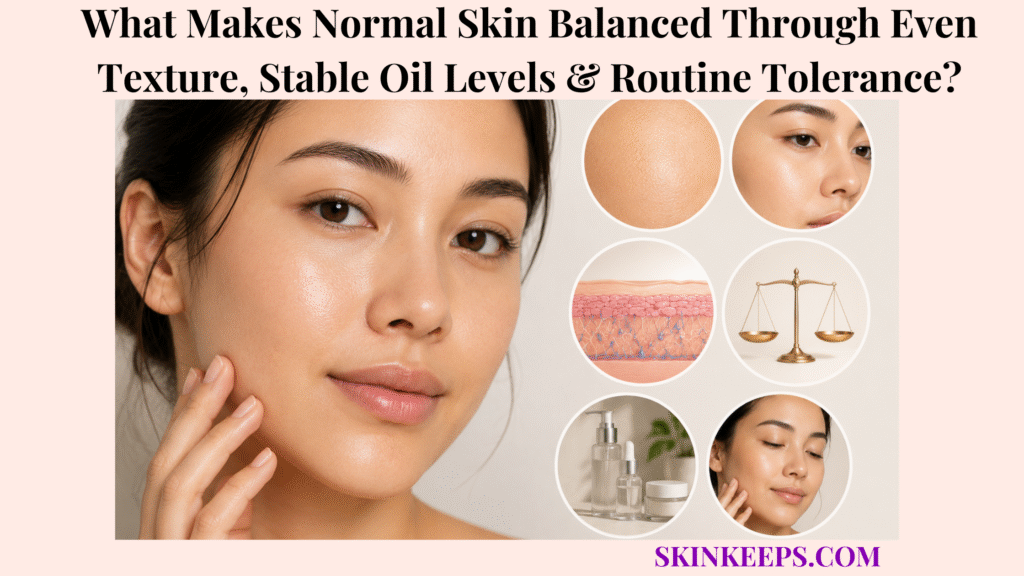
Normal skin is balanced because sebum production, barrier water retention, surface texture, and routine tolerance stay stable without chronic oiliness, dryness, or reactivity. This balance allows normal skin to look even, feel comfortable, and respond to basic skincare without frequent stinging, tightness, shine, or flaking.
This guideline explains how normal skin maintains cutaneous homeostasis through stable oil levels, intact barrier function, smoother corneocyte shedding, and lower routine reactivity. It also shows how over-treatment can disrupt that balance and why minimalist preventive care protects normal skin better than aggressive correction.
What biologically defines normal skin balance?
Normal skin balance is biologically defined by cutaneous homeostasis, where sebum output, barrier lipids, hydration, pH, and inflammation remain stable enough to keep the skin comfortable. This cutaneous homeostasis keeps oil, water, barrier lipids, and irritation signals within a stable range. The stable range explains why normal skin usually feels comfortable without constant dryness, shine, or reactivity.
Normal skin sits within the broader classification of different skin types, but its defining feature is stable balance rather than a persistent excess or deficiency.
Adult average sebum excretion is often described around 1 mg/10 cm² every 3 hours. This moderate sebum level sits between very low oil output and oily or seborrheic output. Moderate oil output helps explain why normal skin usually feels neither greasy nor tight. [ScienceDirect]
The post on normal skin characteristics helps readers connect this biological balance with visible signs such as small-looking pores, comfort, and even surface appearance.
What stable sebum production means in normal skin
Stable sebum production in normal skin means sebaceous glands release enough lipid to lubricate the stratum corneum without causing constant shine or follicular congestion. This stable sebum output gives the stratum corneum enough lipid support for flexibility. The same lipid support reduces tightness without flooding pores with excess oil.
What intact barrier function means in normal skin
Intact barrier function in normal skin means the stratum corneum limits water loss while reducing the entry of irritants and environmental stressors. This outer protective layer relies on ceramides, cholesterol, and free fatty acids to organize the lipid matrix. When these barrier lipids remain organized, the skin defends against external elements and avoids severe dryness.
Adult TEWL can be measured as a barrier-function marker, with one 2025 clinical measurement review reporting adult upper ventral arm average around 8.2 g/m²/h in its comparison. This specific marker demonstrates that water evaporation remains safely controlled. [PMC]
Why normal skin is defined by balance, not by the absence of a skin type
Normal skin is defined by balance, not by absence, because the epidermis actively regulates oil, water, pH, shedding, and immune calm at the same time. This biological activity means the tissue continuously works to sustain its baseline condition. Maintaining this baseline condition requires ongoing cellular coordination rather than a lack of function.
Normal skin is defined by balance because the acid mantle supports a mildly acidic surface environment. Healthy adult skin surface pH is often reported within acidic ranges such as 4–6, with variation by site, sex, age, and measurement context. This acidic surface supports barrier function and microbial balance. [IJDVL]
How do stable sebum levels and barrier hydration create even texture in normal skin?
Stable sebum levels and barrier hydration create even texture in normal skin by keeping corneocytes flexible, pores less congested, and surface shedding more uniform. This flexible stratum corneum allows surface cells to sit more smoothly. The smoother surface reflects light more evenly and reduces the rough look linked with dryness or congestion.
Normal skin texture stays more refined when pores are not overloaded by excess sebum. This lower congestion pressure keeps follicular openings less visually prominent. The result is a surface that often looks more even than oil-heavy or severely dry skin.
The guide on normal skin even tone and texture explains why balanced oil, hydration, and shedding often create a smoother visible surface.
How moderate sebum output reduces visible congestion and excess shine
Moderate sebum output reduces visible congestion and excess shine because oil moves through follicles without consistently pooling, oxidizing, or trapping shed cells. This steady follicular flow prevents the deep blockages that commonly enlarge pore appearance. Avoiding these severe blockages keeps the overall skin texture refined.
How adequate hydration supports smoother cell shedding
Adequate hydration supports smoother cell shedding because hydrated corneocytes separate more evenly during normal desquamation. This natural shedding process relies on moisture to dissolve the bonds holding dead cells together. When moisture levels are stable, outer cells fall away invisibly rather than clumping into rough patches.
Why balanced skin usually shows a more refined surface texture
Balanced skin usually shows a more refined surface texture because oil, hydration, and shedding remain coordinated instead of pushing the surface toward congestion or flaking. This coordinated mechanism prevents the tissue extremes that disrupt surface appearance. The result is a consistently smooth skin profile.
| Mechanism | What Happens Biologically | Visible Effect |
|---|---|---|
| Moderate oil output | Sebum supports comfort without constant excess | Skin looks comfortable, not greasy |
| Stable hydration | Corneocytes remain more flexible | Texture feels smoother |
| Controlled shedding | Dead cells release more evenly | Less visible flaking or rough buildup |
| Lower congestion pressure | Pores are less burdened by oil and debris | Pores look less prominent |
Why can normal skin tolerate routine changes and active ingredients better than reactive skin?
Normal skin can tolerate routine changes and active ingredients better than reactive skin because its intact barrier lowers penetration speed, irritation risk, and baseline inflammatory signaling. This barrier buffering slows irritant entry and reduces sudden sensory discomfort. The reduced discomfort explains why normal skin type often accepts mild product changes more easily than sensitive skin.
Routine tolerance still has limits in normal skin. These limits appear when strong actives, frequent exfoliation, or harsh cleansers overwhelm barrier capacity. When barrier capacity is exceeded, even normal skin can become tight, red, dry, or reactive.
The post on normal skin product tolerance explains why balanced skin can accept new products more easily while still needing gradual introduction.
How barrier integrity lowers irritation risk in normal skin
Barrier integrity lowers irritation risk in normal skin by reducing how quickly potential irritants move through the stratum corneum. This filtering effect gives the skin more time to buffer applied chemicals. Slower irritant movement minimizes sudden stinging or burning responses.
How lower baseline inflammation improves routine tolerance
Lower baseline inflammation improves routine tolerance because normal skin is not already primed to flush, sting, or itch after minor routine changes. This background calm means the immune signals within the tissue remain at a steady, resting state. Maintaining this calm state prevents the skin from overreacting to daily environmental contact.
Why normal skin can still become irritated if actives are overused
Normal skin can still become irritated if actives are overused because even a balanced barrier has a finite tolerance for exfoliation, retinoids, acids, and strong cleansers. This finite tolerance means unnecessary product layers will eventually compromise the tissue. Pushing the skin beyond this limit leads to preventable redness and barrier stress.
Routine Tolerance Guide
- Stronger barrier integrity reduces rapid irritation.
- Stable surface pH supports barrier comfort.
- Lower background reactivity reduces frequent flushing.
- Better tolerance does not mean unlimited tolerance.
- New active ingredients should still be introduced gradually.
What over-treatment mistakes disrupt normal skin balance?
Over-treatment mistakes disrupt normal skin balance when aggressive exfoliation, unnecessary actives, or excessive product layering push a stable barrier into irritation or congestion. This unnecessary correction adds irritation load through repeated acids, scrubs, retinoids, or strong cleansers. The added irritation load can turn balanced skin into dry, tight, red, or congested skin.
The article on normal skin exfoliation explains how balanced skin can exfoliate safely without creating unnecessary barrier stress.
Why too many active products can destabilize normal skin
Too many active products can destabilize normal skin because repeated exposure to strong formulas increases cumulative irritation load. This cumulative load stresses the acid mantle and overworks the barrier. Once the barrier is overworked, the skin loses its natural stability.
How unnecessary exfoliation weakens barrier comfort
Unnecessary exfoliation weakens barrier comfort by removing surface cells faster than balanced skin needs them removed. Normal skin already sheds its outer layers naturally through coordinated desquamation. Accelerating this process unnecessarily exposes vulnerable, immature cells to environmental triggers.
Why using treatment products without a real problem can create new problems
Using treatment products without a real problem can create new problems because acne-focused, eczema-focused, or high-strength products may not match normal skin’s baseline needs. This mismatched treatment logic introduces severe drying or heavy occlusive agents to a barrier that does not require them. Implementing a self-caused imbalance forces the skin to recover from the exact products meant to care for it.
| Mistake | Biological Effect | Likely Result |
|---|---|---|
| Over-exfoliating | Barrier stress and higher irritation load | Tightness, stinging, roughness |
| Layering too many actives | Cumulative formula exposure | Redness or sensitivity |
| Using acne products unnecessarily | Excess oil stripping | Dryness or reactivity |
| Using very heavy occlusives unnecessarily | Heavier surface film | Congested or less refined texture |
Which preventive ingredients best support long-term balance in normal skin?
Preventive ingredients support long-term balance in normal skin by protecting against UV stress, oxidative damage, dehydration, and gradual barrier weakening without forcing aggressive correction. These components prioritize preservation over intensive transformation. Utilizing a preventive strategy maintains cutaneous homeostasis without disrupting the lipid matrix.
The guide on normal skin ingredients explains which ingredient categories support prevention without overloading a balanced routine.
Which antioxidant ingredients help protect balanced skin from environmental stress
Antioxidants help protect balanced skin from environmental stress by reducing oxidative pressure from UV exposure, pollution, and daily environmental contact. Options like vitamin C and vitamin E serve as excellent daily support against free radicals. However, these antioxidants act as supplements to broad-spectrum sunscreen, not as complete replacements.
Which barrier-supporting ingredients help preserve comfort and resilience
Barrier-supporting ingredients help preserve comfort and resilience by reinforcing hydration and lipid balance in the stratum corneum. Ceramides effectively bolster the lipid matrix, while hyaluronic acid functions as an exceptional water-binding agent. These ingredients ensure the skin retains moisture smoothly.
Which collagen-supporting ingredients fit a preventive routine without overloading the skin
Collagen-supporting ingredients fit a preventive routine when they are introduced gradually and used at strengths that normal skin can tolerate. Peptides and mild retinoids present optional preventive categories for long-term optimization. Retinoids require careful, gradual introduction to avoid irritating a healthy barrier.
| Ingredient Category | Main Role | Best Use in Normal Skin |
|---|---|---|
| Sunscreen | Reduces UV-driven damage | Daily morning protection |
| Antioxidants | Reduce oxidative stress | Morning prevention support |
| Ceramides | Support barrier integrity | Comfort and maintenance |
| Humectants | Maintain hydration balance | Daily moisture support |
| Peptides | Support prevention strategy | Gentle long-term optimization |
| Mild retinoids | Support renewal if tolerated | Gradual night use |
How should a minimalist routine preserve normal skin balance each day?
A minimalist routine preserves normal skin balance each day by using gentle cleanser formulations, lightweight hydration, daily sunscreen, and optional preventive actives only when needed. This straightforward approach provides essential defense without overcomplicating daily habits. Keeping the regimen practical ensures the barrier remains unharmed.
The page on normal skin sun protection explains why balanced skin still needs daily UV defense even when it has no visible problem.
What a simple morning routine should include for normal skin
A simple morning routine for normal skin should include gentle cleansing if needed, lightweight moisture, and broad-spectrum sunscreen.
Morning Checklist
What a simple evening routine should include for normal skin
A simple evening routine for normal skin should include removing sunscreen, cleansing gently, and moisturizing according to comfort.
Evening Checklist
How to preserve normal skin without creating unnecessary routine stress
Normal skin can be preserved without unnecessary routine stress by keeping products purposeful, gentle, and limited to clear preventive goals. More products do not equal better preservation. Overbuilding a routine stands out as the main risk for a stable skin profile.
Daily Preservation Checklist
Readers who want a practical routine can use the normal skin care tips guide to keep cleansing, moisturizing, sunscreen, and exfoliation simple.
What to remember about normal skin balance?
The key point to remember about normal skin balance is that stable oil, hydration, texture, and tolerance should be protected rather than aggressively corrected.
Key Takeaways
- Normal skin reflects balanced oil production, hydration, and barrier function.
- Smooth texture comes from regulated shedding and stable surface comfort.
- Routine tolerance is usually better, but it is not unlimited.
- Over-treatment is one of the fastest ways to disrupt balanced skin.
- Preventive care works better than corrective excess for normal skin.
- A simple, consistent routine usually protects normal skin best.
FAQs
What defines normal skin?
Normal skin is defined by balanced sebum production, comfortable hydration, intact barrier function, even texture, and low baseline reactivity. It usually feels neither greasy nor tight and tolerates simple skincare routines well.
Is normal skin the same as perfect skin?
Normal skin is not perfect skin. Normal skin is a balanced skin type that still needs cleansing, sunscreen, hydration when needed, and protection from over-treatment, UV exposure, and harsh products.
Why does normal skin usually have even texture?
Normal skin usually has even texture because oil, hydration, and shedding remain coordinated. This coordination keeps corneocytes flexible, pores less congested, and surface roughness less visible.
Can normal skin become sensitive?
Yes, normal skin can become sensitive if harsh cleansers, over-exfoliation, strong retinoids, frequent acids, or excessive product layering damage the barrier. Normal skin tolerance is stronger than reactive skin, but not unlimited.
Does normal skin need moisturizer?
Normal skin may need moisturizer when the skin feels less comfortable, dry, tight, or exposed to harsh weather. A lightweight moisturizer is usually enough unless the barrier is stressed.
Does normal skin need sunscreen?
Yes, normal skin still needs sunscreen because balanced skin is not immune to UV damage. Daily broad-spectrum sunscreen helps protect collagen, barrier function, pigmentation stability, and long-term texture.
Which ingredients are best for normal skin?
Normal skin usually benefits from preventive ingredients such as sunscreen, antioxidants, lightweight moisturizers, ceramides, humectants, and optional mild retinoids or peptides if they are introduced gradually.
How often should normal skin exfoliate?
Normal skin should exfoliate only when needed, not as a daily habit by default. Over-exfoliation can create tightness, stinging, roughness, or sensitivity even when the skin was balanced before.
Conclusion
Normal skin stays balanced when the routine protects stability instead of chasing correction. Normal skin remains comfortable because oil, hydration, barrier function, and product tolerance stay relatively stable. A simple routine with gentle cleansing, sunscreen, light hydration, and restrained actives protects that balance.
The best strategy for normal skin is to preserve what already works. At SkinKeeps, we explain skin types through clinical evidence to help readers maintain this delicate equilibrium safely.