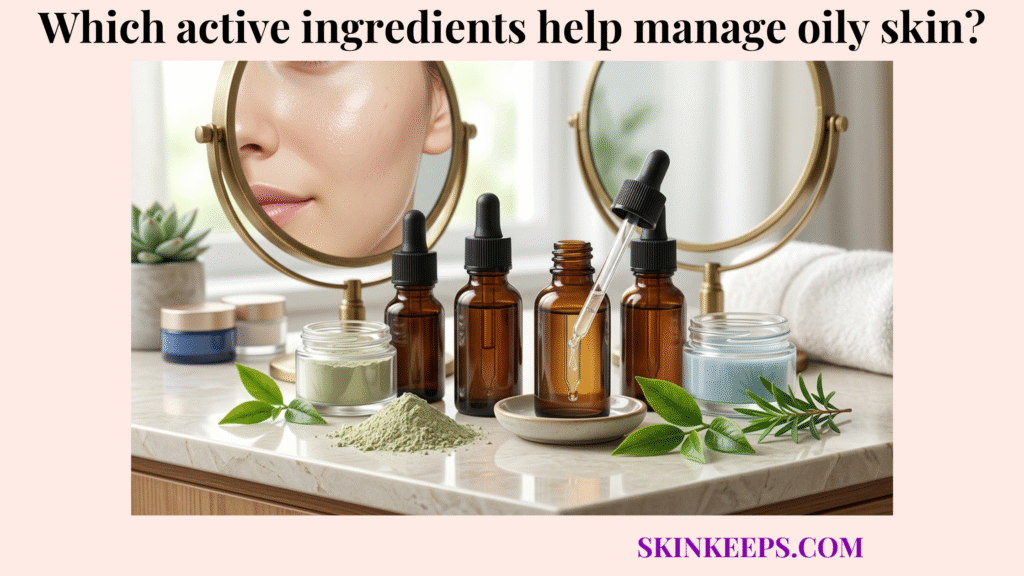
The active ingredients that help manage oily skin most often include salicylic acid for clogged pores, niacinamide for visible oil balance, retinoids for recurring congestion, benzoyl peroxide for inflammatory acne, and AHAs or azelaic acid for texture, tone, or sensitivity-related concerns. This matters because oily skin can present as shine, blackheads, inflamed acne, rough texture, or reactive discomfort, and each concern needs a different active direction.
This guideline explains what each active ingredient does, which oily-skin concern it fits best, how to choose a first active, and how to avoid stacking too many strong ingredients in a way that irritates the barrier.
Which active ingredients are most useful for oily skin?
The most useful active ingredients for oily skin are salicylic acid, niacinamide, retinoids, benzoyl peroxide, glycolic acid, lactic acid, and azelaic acid. These active ingredients do not all do the same job. Each one should be chosen according to whether the main problem is clogged pores, shine, acne, roughness, dullness, or sensitivity.
The best oily-skin active is the one that solves the main concern without irritating the barrier. This means a blackhead-prone user may start with salicylic acid, while a shiny but reactive user may start with niacinamide. The wrong approach is stacking multiple strong actives before the skin proves tolerance.
Why salicylic acid is useful for oily, clogged pores
Salicylic acid is useful for oily, clogged pores because it directly fits blackheads, whiteheads, and pore buildup as the main concern. Exploring oily skin blackheads and breakouts reveals how these persistent blockages require an ingredient capable of diving deep into the follicle. Salicylic acid precisely targets this trapped lipid and keratin mixture.
Why niacinamide is useful for visible oil balance
Niacinamide is useful for visible oil balance because it supports a calmer, less shiny-looking oily-skin profile without acting like a harsh exfoliating acid. This gentle regulation prevents the sebaceous surface from appearing excessively greasy throughout the day. A fortified barrier is significantly better equipped to handle environmental stressors.
Why retinoids and benzoyl peroxide matter when oily skin is acne-prone
Retinoids and benzoyl peroxide matter when oily skin is acne-prone because they target acne-related pathways more directly than general shine-control ingredients. These powerful agents systematically address cellular turnover and bacterial proliferation. Employing them strategically prevents minor congestion from escalating into severe inflammatory lesions.
| Active Ingredient | Main Role | Best Fit |
|---|---|---|
| Salicylic acid | Helps reduce clogged pores and oily buildup | Blackheads, congestion, shine-prone pores |
| Niacinamide | Supports visible oil balance and barrier comfort | Oily but reactive or shiny skin |
| Retinoids | Support turnover and reduce recurrent clogging | Acne-prone or texture-prone oily skin |
| Benzoyl peroxide | Helps reduce acne-aggravating bacteria | Inflamed acne lesions |
| Glycolic acid | Supports surface smoothing and dullness reduction | Rough or dull oily skin |
| Lactic acid | Gentler surface smoothing support | Mild roughness or sensitive-leaning oily skin |
| Azelaic acid | Supports acne-prone texture, redness, and uneven tone | Sensitive acne-prone oily skin |
How does salicylic acid help oily skin?
Salicylic acid helps oily skin by targeting clogged pores, blackheads, and oil-related buildup more directly than surface-only smoothing ingredients. This makes salicylic acid especially relevant when oily skin looks congested rather than simply shiny. It can support clearer-looking pores when used at a tolerable strength and frequency.
FDA OTC acne monograph language lists salicylic acid as an acne active ingredient at 0.5% to 2%. This range prevents vague claims like “use strong salicylic acid” and keeps product discussion grounded in recognized OTC acne concentrations. [eCFR]
How salicylic acid helps clear oil-related pore buildup
Salicylic acid helps clear oil-related pore buildup by supporting the removal of dead skin cells that contribute to follicle congestion. The BHA structure breaks down the bonds holding these stubborn cellular fragments together inside the pore. The targeted dissolution effectively frees the trapped sebum.
Why salicylic acid suits blackheads and congested oily skin
Salicylic acid suits blackheads and congested oily skin because these concerns are driven by pore buildup rather than shine alone. Its unique oil-solubility allows it to bypass superficial moisture and penetrate the lipid-rich environment of the follicle. This direct access makes it exceptionally efficient at dismantling oxidized comedones.
When salicylic acid becomes too drying or irritating
Salicylic acid becomes too drying or irritating when the skin starts stinging, peeling, burning, or feeling tight after use. Monitoring oily skin exfoliation frequency is critical here, as reducing frequency when irritation appears allows the barrier to recover. Pushing through the pain simply compromises the epidermal shield further.
How does niacinamide support oily skin management?
Niacinamide supports oily skin management by helping visible oil balance, barrier comfort, and routine tolerance without functioning as a strong exfoliating acid. This makes niacinamide useful for oily skin that becomes shiny but also reacts easily to stronger actives. It is often a better support ingredient than a harsh stripping approach.
A clinical study tested topical 2% niacinamide for facial sebum excretion rate and casual sebum production, while a 2024 review notes sebum-related findings from 2% to 5% niacinamide preparations. This supports niacinamide as a reasonable oil-balance ingredient, not a guaranteed stand-alone solution for every oily-skin case. [PubMed] [PMC]
How niacinamide helps reduce visible oiliness over time
Niacinamide helps reduce visible oiliness over time by supporting a more balanced-looking surface without stripping the skin. This gentle approach regulates the glossy, greasy sheen that typically accumulates by mid-day. Over several weeks, the surface reflection becomes noticeably refined and subdued.
How niacinamide supports barrier comfort in oily skin
Niacinamide supports barrier comfort in oily skin by helping the routine feel more tolerable when stronger actives would be too irritating. The compound reinforces the protective lipid matrix, decreasing overall tissue reactivity. This fortification prevents environmental stress from triggering unwanted red flushing.
Why niacinamide is often easier to pair with other actives
Niacinamide is often easier to pair with other actives because it is not an exfoliating acid and usually fits supportive routines better than another strong treatment step. Its chemical stability ensures it rarely clashes with popular acne interventions. Incorporating it provides steady, soothing benefits without inciting chemical burns.
When should oily skin use retinoids or benzoyl peroxide?
Oily skin should use retinoids or benzoyl peroxide when acne, recurring clogged pores, or inflammatory lesions are the main concern rather than shine alone. Retinoids are more relevant when recurring congestion and acne-prone texture dominate. Benzoyl peroxide is more relevant when red, inflamed pimples are the main problem.
FDA OTC acne monograph language lists benzoyl peroxide as an acne active ingredient at 2.5% to 10%. This number should be used to describe recognized OTC acne concentrations, not to suggest that higher strength is always better. [eCFR]
When retinoids help recurring clogged pores and acne-prone texture
Retinoids help recurring clogged pores and acne-prone texture when oily skin repeatedly forms comedones despite basic cleansing and mild exfoliation. The active normalizes erratic cellular turnover within the follicle. The regulation of shedding prevents fresh debris from clumping and forming new blockages.
When benzoyl peroxide helps inflammatory acne on oily skin
Benzoyl peroxide helps inflammatory acne on oily skin when red, swollen, or pustular lesions are the main concern. This potent agent introduces oxygen into the pore to eradicate acne-aggravating bacteria. The rapid antibacterial action rapidly deflates angry, painful pimples.
Why acne actives should be introduced slowly to avoid irritation
Acne actives should be introduced slowly because oily skin can still become dry, irritated, peeling, or less tolerant when treatment is too aggressive. Applying massive doses instantly shocks the tissue, resulting in painful red patches. A measured, gradual escalation guarantees the skin adapts smoothly.
| Skin Concern | Better Active Direction | Why |
|---|---|---|
| Recurrent clogged pores | Retinoid or salicylic acid | Supports turnover and reduces recurring congestion |
| Red inflamed pimples | Benzoyl peroxide | Targets acne-aggravating bacteria |
| Blackheads with oiliness | Salicylic acid | Helps clear oily pore buildup |
| Sensitive oily acne | Lower frequency or gentler active | Reduces irritation risk |
| Acne plus dryness | Slow introduction with moisturizer support | Improves treatment tolerance |
Which exfoliating acids help oily skin texture and dullness?
Exfoliating acids such as glycolic acid and lactic acid help oily skin texture and dullness by supporting surface smoothing rather than directly targeting oily pore buildup. This means AHAs may fit rough or dull oily skin better than deeply congested oily pores. When blackheads and pore buildup are the main issue, salicylic acid is usually the more targeted direction.
AHAs still require tolerance control on oily skin. A rough, dull surface may improve with careful acid use, but stinging, peeling, redness, or burning means the acid strength or frequency is too much. Texture support should never come at the cost of barrier irritation.
How glycolic acid helps rough or dull oily skin
Glycolic acid helps rough or dull oily skin by supporting surface exfoliation where uneven dead-cell buildup makes the complexion look less smooth. The small molecular size of this AHA allows it to sever bonds quickly on the upper epidermis. The rapid action effectively reveals a brighter, more polished appearance underneath.
How lactic acid may suit oily skin that needs gentler smoothing
Lactic acid may suit oily skin that needs gentler smoothing because it is often used when surface texture needs support but tolerance is a concern. The larger molecule penetrates slower, making it inherently milder than glycolic formulas. It also possesses unique humectant properties that draw in beneficial hydration.
Why AHAs should not replace salicylic acid for oily clogged pores
AHAs should not automatically replace salicylic acid for oily clogged pores because AHAs are more surface-focused while salicylic acid is more pore-congestion focused. AHAs excel at eliminating dull, sweeping flakes, but fail to navigate through heavy sebum. Relying solely on water-soluble acids leaves the deepest blackheads entirely untouched.
| Acid Type | Best Target | Main Caution |
|---|---|---|
| Salicylic acid / BHA | Oily pores, blackheads, congestion | Can dry or irritate if overused |
| Glycolic acid / AHA | Roughness, dullness, surface texture | Can sting or over-exfoliate |
| Lactic acid / AHA | Gentler surface smoothing | Still needs tolerance monitoring |
| Azelaic acid | Acne-prone texture, redness, uneven tone | Can still irritate sensitive skin |
Which active ingredient should oily skin choose first?
Oily skin should choose its first active ingredient according to the main visible concern, not according to the longest ingredient list. This selection rule keeps the routine targeted. It also reduces the temptation to use acids, retinoids, and acne treatments all at once. Reviewing oily skin product formulations can further assist in choosing formulas by concern and texture.
Blackheads usually point toward salicylic acid, while red inflammatory acne may point toward benzoyl peroxide or retinoid support. Shine with little acne often points toward niacinamide. Roughness or dullness may point toward a gentle AHA or a congestion-focused BHA, depending on what the skin is actually showing.
Which active fits oily skin with blackheads
Salicylic acid is usually the first active to consider for oily skin with blackheads because blackheads are a pore-buildup concern. Its unparalleled ability to dissolve oxidized lipids makes it the premier choice for clearing the nose and chin. Employing it thoughtfully reduces the need for damaging mechanical extractions.
Which active fits oily skin with inflamed acne
Benzoyl peroxide or retinoid support may fit oily skin with inflamed acne because inflamed lesions need acne-focused management rather than simple shine control. Benzoyl targets the active infection, while retinoids keep future blockages from occurring. Integrating either provides a clinical defense against painful papules.
Which active fits oily skin with shine but little acne
Niacinamide may fit oily skin with shine but little acne because the goal is visible oil balance and comfort rather than aggressive acne treatment. This soothing option subdues the slick reflection without launching an unnecessary chemical assault. The skin retains its healthy moisture while ditching the grease.
Which active fits oily skin with roughness or dullness
A gentle AHA or BHA may fit oily skin with roughness or dullness depending on whether the main problem is surface buildup or clogged pores. Analyzing the precise source of the dullness ensures the correct acid is deployed. Proper matching yields a brilliantly refined, smooth complexion.
| Main Oily-Skin Concern | First Active to Consider |
|---|---|
| Blackheads and clogged pores | Salicylic acid |
| Red inflamed acne | Benzoyl peroxide or retinoid support |
| Shine with minimal acne | Niacinamide |
| Roughness or dullness | Gentle AHA or BHA, depending on congestion |
| Reactive oily skin | Niacinamide first, acids slowly |
| Uneven tone with acne-prone sensitivity | Azelaic acid may be considered |
What active ingredient mistakes make oily skin worse?
Active ingredient mistakes make oily skin worse when the routine stacks too many strong treatments, increases strength too quickly, or ignores early irritation signs. This mistake is common because oily-skin users often treat shine as a problem that needs more force. Stronger treatment does not mean better treatment if the barrier becomes irritated.
Burning, peeling, stinging, and tightness are not proof that an active is working well. These signs can mean the routine is exceeding tolerance. When irritation appears, the correct move is to reduce frequency, simplify the routine, and support the barrier.
Why stacking too many actives can irritate oily skin
Stacking too many actives can irritate oily skin because acids, retinoids, and benzoyl peroxide can overlap in dryness and irritation potential. Layering these harsh compounds simultaneously completely decimates the protective lipid shield. The ensuing chemical burn requires weeks of diligent recovery to fix.
Why daily acids are not necessary for every oily face
Daily acids are not necessary for every oily face because oiliness alone does not prove the skin can tolerate frequent exfoliation. Assuming grease equates to invincibility pushes users to aggressively over-treat their faces. Reducing the application rate protects against inevitable hypersensitivity.
Why stronger percentages are not always better
Stronger percentages are not always better because higher strength can increase irritation before it improves oily-skin concerns. Moving from 2% to 10% does not accelerate clearing if the skin breaks out in a rash. Utilizing the lowest effective dose establishes a much safer, sustainable path forward.
| Mistake | Likely Result |
|---|---|
| Using BHA, AHA, retinoid, and benzoyl peroxide at once | Irritation, peeling, barrier stress |
| Increasing strength too quickly | Stinging, redness, over-drying |
| Treating shine with harsh actives only | Oily but dehydrated skin |
| Ignoring moisturizer and sunscreen | Poor tolerance and more irritation |
| Calling every breakout “purging” | Delayed correction of irritation |
| Using actives on already burning skin | More discomfort and lower routine tolerance |
How should oily skin build an active-ingredient routine?
Oily skin should build an active-ingredient routine by starting with one active, matching it to the main concern, and increasing only when the skin remains comfortable. This one-active rule prevents the routine from becoming too aggressive before the skin proves tolerance. It also makes it easier to know which ingredient is helping or irritating the skin.
Moisturizer and sunscreen are not optional support when strong actives are being used. A lightweight oily skin moisturizer improves comfort when actives create dryness, and daily oily skin sunscreen protects skin that may be more reactive during exfoliating or acne-focused routines. Combining these practices with broader oily skin care tips ensures holistic barrier protection. The active routine should improve oily skin, not punish it.
How beginners should introduce one active at a time
Beginners should introduce one active at a time because oily skin needs a clear tolerance test before stronger routine combinations are added. Launching one product isolates the variables, ensuring the user immediately recognizes an adverse reaction. This scientific approach safeguards against overwhelming the delicate skin barrier.
How to separate exfoliating acids from retinoids or benzoyl peroxide
Exfoliating acids should be separated from retinoids or benzoyl peroxide when irritation risk is high because overlapping strong actives can reduce barrier tolerance. Alternating applications between morning and night, or even every other day, grants the skin necessary recuperation time. The enforced downtime halts cumulative inflammatory damage.
How to reduce active frequency when irritation appears
Active frequency should be reduced when irritation appears because stinging, peeling, burning, or tightness means the current routine is too aggressive for the skin. Dialing back the dosage from nightly to twice weekly dramatically accelerates healing. The moderation guarantees the complexion remains strong enough to continue treatment.
Active Ingredient Routine for Oily Skin
What should oily skin remember about active ingredients?
The main point to remember is that oily skin should choose active ingredients by concern and tolerance, not by using every strong ingredient at once.
Key Takeaways
- Oily skin does not need every active ingredient at the same time.
- Salicylic acid is often the most targeted option for oily clogged pores, blackheads, and whiteheads.
- OTC salicylic acid acne products commonly use 0.5% to 2% salicylic acid as an active concentration range.
- Niacinamide is useful for visible oil balance, barrier comfort, and reactive oily skin.
- A clinical study tested 2% niacinamide for facial sebum measures.
- Retinoids and benzoyl peroxide are more acne-focused than shine-focused.
- OTC benzoyl peroxide acne products commonly use 2.5% to 10% benzoyl peroxide as an active concentration range.
- AHAs such as glycolic acid and lactic acid are more texture-focused than oily-pore focused.
- Azelaic acid may fit oily skin when acne-prone texture, redness, or uneven tone are part of the concern.
- Too many strong actives can make oily skin sting, peel, burn, or feel tight.
- The best active is the one that matches the main concern and remains tolerable.
FAQs
Which active ingredient is best for oily skin?
The best active ingredient for oily skin depends on the main concern. Salicylic acid fits clogged pores, niacinamide fits visible oil balance, benzoyl peroxide fits inflamed acne, and retinoids fit recurrent congestion or acne-prone texture.
Is salicylic acid good for oily skin?
Yes, salicylic acid is often useful for oily skin with blackheads, whiteheads, clogged pores, or congestion.
What percentage of salicylic acid is used in OTC acne products?
OTC acne monograph language lists salicylic acid at 0.5% to 2% as an acne active concentration range.
Is niacinamide good for oily skin?
Yes, niacinamide can support visible oil balance and barrier comfort, especially when oily skin reacts poorly to harsher acids.
What percentage of niacinamide has been studied for sebum?
A clinical study tested topical 2% niacinamide for facial sebum excretion rate and casual sebum production.
Is benzoyl peroxide good for oily skin?
Benzoyl peroxide can be useful when oily skin has inflammatory acne, but it is not mainly a shine-control ingredient.
What percentage of benzoyl peroxide is used in OTC acne products?
OTC acne monograph language lists benzoyl peroxide at 2.5% to 10% as an acne active concentration range.
Should oily skin use retinoids?
Oily skin may use retinoids when recurring clogged pores, comedones, or acne-prone texture are the main concern, but retinoids should be introduced slowly.
Are AHAs useful for oily skin?
AHAs such as glycolic acid and lactic acid can help oily skin when roughness, dullness, or uneven surface texture is the main concern.
Can oily skin use too many active ingredients?
Yes, oily skin can use too many active ingredients, and overuse can cause stinging, peeling, burning, tightness, redness, or more irritation.
Conclusion
Oily skin should use active ingredients strategically, choosing the ingredient that matches the main concern instead of stacking every strong treatment together.
Salicylic acid is the most targeted option for clogged oily pores, niacinamide supports visible oil balance, retinoids and benzoyl peroxide fit acne-prone patterns, and AHAs or azelaic acid can support texture, tone, or reactivity concerns. The strongest routine is not the most crowded routine. It is the routine that improves oiliness, congestion, and texture while keeping the skin comfortable.
The best active ingredient for oily skin is the one that solves the main problem without creating a new irritation problem.