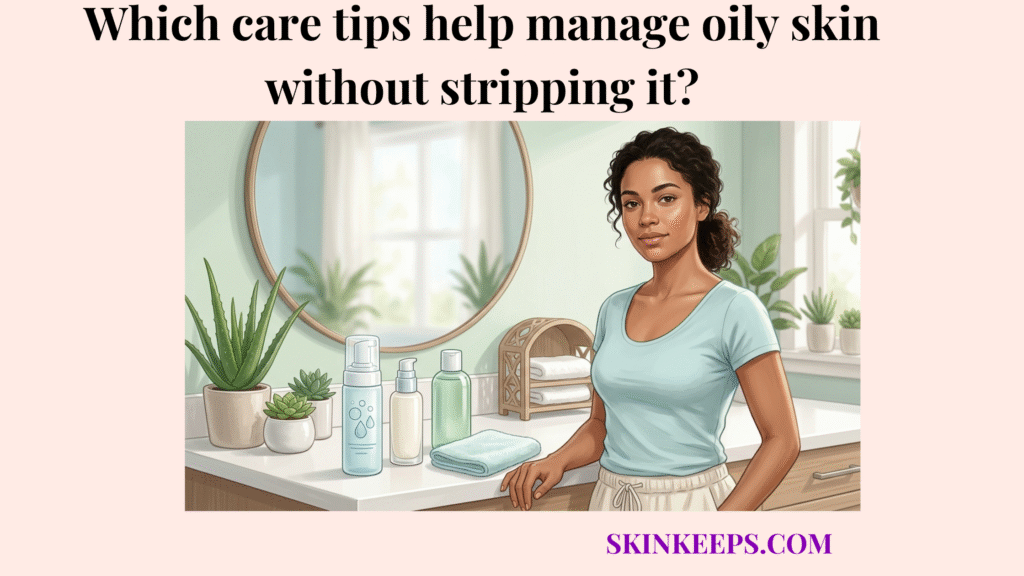
The best care tips for managing oily skin without stripping it are to cleanse gently, hydrate lightly, choose oil-free and non-comedogenic products, control shine with blotting, and use oil-control actives only as tolerated. This approach helps oily skin stay cleaner and more comfortable without forcing the face into tightness, peeling, or irritation.
This guideline explains how to manage oil, shine, sunscreen buildup, congestion, and midday oil breakthrough while preserving skin comfort. It gives a practical routine structure: gentle cleansing, lightweight hydration, careful active use, suitable SPF, non-stripping shine control, and a daily checklist.
What does non-stripping oily skin care mean?
Non-stripping oily skin care means reducing excess surface oil and congestion without removing all sebum or leaving the skin tight, irritated, or squeaky-clean. This principle treats oil as something to manage, not something to erase. The result should be clean, comfortable skin with more predictable shine.
This non-stripping approach is important because oily skin still relies on basic barrier comfort. When a routine removes too much oil or uses actives too aggressively, the face may look temporarily matte but feel less stable. A better routine reduces extra shine while preserving enough comfort for the skin to tolerate daily care.
Why oil control should reduce excess shine without removing all sebum
Oil control should reduce excess shine without removing all sebum because sebum still contributes to surface comfort and normal skin function. This lipid coating provides a natural glide that prevents the stratum corneum from becoming brittle. Aiming for a totally matte, zero-oil finish fundamentally misaligns with the skin’s biological needs.
Why comfortable skin is a better goal than squeaky-clean skin
Comfortable skin is a better goal than squeaky-clean skin because a squeaky finish often signals excessive surface stripping rather than healthy oil control. Prioritizing comfort helps you avoid over-washing oily skin, which frequently creates discomfort rather than providing stable oil control. The skin should feel clean, soft, and pliable, not stretched like a tight drum.
Why oily skin management should protect the barrier while reducing congestion
Oily skin management should protect the barrier while reducing congestion because clogged pores and irritation often worsen when oil control becomes too aggressive. This aggressive correction actively degrades the acid mantle, leading to redness and stinging. Gentle regulation clears the follicles without initiating a disruptive inflammatory response.
| Principle | What It Means | Why It Helps Oily Skin |
|---|---|---|
| Remove excess, not everything | Clean oil buildup without total stripping | Less tightness and irritation |
| Hydrate without heaviness | Use water-based support | Better comfort without extra grease |
| Control shine gently | Blot or mattify instead of overwashing | Less barrier stress |
| Use actives carefully | Apply acids only as tolerated | Oil control without over-irritation |
How should oily skin be cleansed without stripping it?
Oily skin should be cleansed without stripping it by washing gently up to twice daily, using lukewarm water, and applying cleanser with fingertips instead of abrasive tools. AAD recommends cleansing oily skin up to twice daily and after sweating, avoiding scrubbing, rinsing with lukewarm water, and patting dry. This makes gentle technique part of oil control, not a weak routine. [AAD]
The cleansing step should remove oil buildup, sweat, sunscreen, and makeup without making the face feel tight. If cleansing leaves a burning, squeaky, or stretched feeling, the cleanser or frequency may be too aggressive. A better routine manages oil while keeping the skin comfortable enough to tolerate the next steps.
How twice-daily cleansing supports oily skin without over-washing
Twice-daily cleansing supports oily skin without over-washing by removing morning and evening buildup while avoiding repeated surfactant exposure during the day. Recognizing the danger of oily skin harsh products reinforces why limiting wash frequency protects the skin barrier. A midday splash or blot is vastly superior to initiating a third soapy lather.
Why lukewarm water and fingertips are better than scrubbing tools
Lukewarm water and fingertips are better than scrubbing tools because they clean oily skin with less friction and less irritation risk. This low-friction method lifts debris safely without physically tearing at the outer cells. Hot water and stiff brushes simply inflame the skin barrier unnecessarily.
Why makeup, sunscreen, and sweat should be removed gently
Makeup, sunscreen, and sweat should be removed gently because residue can contribute to congestion, but harsh removal can irritate oily skin. This careful purification prevents blackheads from forming without inducing red, angry flare-ups. A soft, thorough cleanse perfectly balances clarity with cutaneous peace.
Which moisturizers help oily skin stay balanced without greasiness?
Moisturizers that help oily skin stay balanced without greasiness are lightweight moisturizer, oil-free, non-comedogenic formulas that support hydration without leaving a heavy film. AAD says oily skin still needs moisturizer after cleansing and recommends products labeled oil-free and non-comedogenic because they are less likely to clog pores or cause acne. This makes moisturizer a comfort step, not a grease step. [AAD]
Humectant-based formulas are useful when oily skin feels tight after cleansing. A clinical study describes hyaluronic acid and glycerin as well-known ingredients able to improve skin hydration, with effects measured for up to 24 hours in the studied moisturizing fluid. This supports gel and fluid moisturizers that hydrate without heavy residue. [PMC]
Why oily skin can still need lightweight hydration
Oily skin can still need lightweight hydration because sebum controls surface oiliness while water balance controls comfort and flexibility. If your skin feels persistently dehydrated, using an oily skin moisturizer acts as crucial structural support. Providing this water prevents the tissue from feeling stretched and rigid under its own oil film.
Why gel, fluid, or lotion-gel textures often fit oily skin
Gel moisturizer, fluid moisturizer, or lotion-gel textures often fit oily skin because they provide hydration with less surface weight than rich creams. Deciding between these weightless formats becomes easier when evaluating different oily skin product formulations. These textures absorb seamlessly, maintaining a fresh rather than heavily coated appearance.
Why oil-free and non-comedogenic labels matter
Oil-free and non-comedogenic labels matter because oily and clog-prone skin usually tolerates products better when formulas avoid added heaviness and pore-clogging risk. These specific labels act as practical guides for avoiding dense occlusives. Opting for non-comedogenic care significantly diminishes the daily threat of new breakouts.
| Label or Texture | Why It Helps |
|---|---|
| Oil-free | Reduces added surface greasiness |
| Non-comedogenic | Better fit for clog-prone skin |
| Gel moisturizer | Lightweight hydration |
| Fluid lotion | Support without heavy residue |
| Fragrance-free option | Safer for easily irritated oily skin |
Which oil-control ingredients should be used carefully on oily skin?
Oil-control ingredients should be used carefully on oily skin because salicylic acid, glycolic acid, and lactic acid can reduce oiliness but may irritate the barrier if used too often. AAD says these ingredients can help reduce oiliness, but they may be too harsh for some skin, so they should be used less often or stopped if irritation occurs. This makes tolerance the rule, not maximum strength. [AAD]
Niacinamide can serve as a gentler daily-support option for many oily-skin routines. A 2024 review notes that several clinical studies report 2% to 5% niacinamide preparations can reduce sebum production. This makes niacinamide useful for oil-balance support, but it should still be introduced based on skin tolerance. [PMC]
How salicylic acid can help oily, congestion-prone skin
Salicylic acid can help oily, congestion-prone skin because its oil-soluble nature makes it useful for managing buildup inside oily pores. Examining oily skin active ingredients reveals why BHA effectively dissolves these stubborn lipid blockages. When used sensibly, it clarifies the follicular canal without ravaging the surrounding tissue.
How glycolic or lactic acid may help oiliness but can irritate if overused
Glycolic or lactic acid may help oiliness by supporting surface turnover, but they can irritate oily skin if used beyond tolerance. These powerful exfoliants sweep away dead cells rapidly. However, applying them daily often overwhelms the acid mantle, generating redness and painful stinging.
When to reduce frequency instead of adding stronger products
You should reduce frequency instead of adding stronger products when oily skin begins to sting, peel, burn, or feel tight after oil-control actives. This immediate pullback allows the barrier to rest and repair itself naturally. Healing the irritation takes priority over forcefully attempting to clear a stubborn blemish.
| Ingredient | Main Role | Non-Stripping Rule |
|---|---|---|
| Salicylic acid | Helps reduce oily congestion | Use only as tolerated |
| Glycolic acid | Helps surface turnover | Reduce if stinging or peeling appears |
| Lactic acid | Gentle exfoliation and hydration support | Avoid overuse |
| Niacinamide | Supports oil balance and barrier comfort | Good daily-support option for many |
How should oily skin use sunscreen without feeling overloaded?
Oily skin should use sunscreen without feeling overloaded by choosing lightweight, oil-free, non-comedogenic SPF formulas that protect the skin without adding heavy residue. AAD recommends a moisturizer with broad-spectrum sunscreen and SPF 30 or higher for oily skin. This means sunscreen should stay in the routine; the formula texture is what needs to be adjusted. [AAD]
The sunscreen step should not make oily skin feel coated all day. Gel, fluid, matte, and non-comedogenic SPF textures usually fit shine-prone skin better than heavy creams. A fuller sunscreen discussion can connect to oily skin sunscreen when evaluating daily UV defense options.
Why oily skin still needs daily sunscreen
Oily skin still needs daily sunscreen because sebum does not provide broad-spectrum UV protection. This means the skin remains entirely vulnerable to photoaging, dark marks, and structural degradation. Skipping SPF based on the myth of “natural lipid protection” is a severe long-term error.
Why lightweight, oil-free, non-comedogenic SPF works better
Lightweight, oil-free, non-comedogenic SPF works better for oily skin because it protects the surface while reducing added greasiness and congestion risk. These tailored formulations absorb flawlessly into the stratum corneum. The invisible finish encourages strict daily compliance without compromising the user’s cosmetic comfort.
Why sunscreen should be removed gently at night
Sunscreen should be removed gently at night because residue needs to be cleared without scrubbing the skin into irritation. A thorough, mild cleanse dissolves the filters cleanly. Eliminating this daily film prevents nighttime follicular blockages from taking root.
How can midday shine be controlled without re-washing?
Midday shine can be controlled without re-washing by blotting excess oil, using light mattifying touch-ups, and avoiding extra cleanser exposure during the day. This method removes the visible oil film without restarting the full cleansing cycle. It helps the skin feel fresher while preserving routine stability.
Oil breakthrough should be managed, not punished. If the forehead and nose become shiny, blotting is usually a better first response than washing again. If the skin feels greasy and tight, the routine may need more lightweight hydration rather than stronger cleansing.
Why blotting papers are better than extra cleansing during the day
Blotting papers are better than extra cleansing during the day because they lift surface oil without repeatedly exposing the skin to surfactants and water. This simple physical absorption instantly neutralizes severe glare. Avoiding mid-day soap prevents the inevitable oil-control instability that follows harsh washing.
How mattifying products can reduce shine without stripping
Mattifying products can reduce shine without stripping by absorbing or diffusing surface oil rather than chemically removing the skin’s protective lipids. Powders or specialized primers sit cleanly on the epidermis to manage the visual reflection. Used sparingly, they perfect the complexion without irritating the acid mantle.
Why oil breakthrough should be managed, not punished
Oil breakthrough should be managed, not punished, because daily shine is part of an oily-skin baseline and does not require aggressive correction every time it appears. Accepting a moderate level of reflection leads to far healthier habits. This patient mindset actively prevents the vicious cycle of stripping and rebounding.
| Situation | Non-Stripping Response |
|---|---|
| Forehead and nose look shiny | Blot gently instead of washing |
| Makeup separates from oil | Blot first, then touch up lightly |
| Skin feels greasy but tight | Add lightweight hydration later, not harsh cleanser |
| Shine returns daily | Adjust routine slowly rather than overcorrecting |
What daily routine manages oily skin without stripping it?
A daily routine that manages oily skin without stripping it should combine gentle cleanser use, lightweight hydration, tolerated oil-control ingredients, sunscreen, and blotting for midday shine. The morning routine should prepare the skin for oil control and UV protection. The evening routine should remove oil, sunscreen, and buildup without leaving tightness.
The routine should be adjusted as soon as irritation appears. AAD specifically advises using salicylic acid, glycolic acid, or lactic acid less often or stopping them if the skin becomes irritated. This keeps oil-control treatment inside the skin’s tolerance range. [AAD]
What a morning routine should include for oily skin
A morning routine for oily skin should include gentle cleansing, lightweight hydration, sunscreen, and optional oil-control support if the skin tolerates it. This straightforward sequence establishes a defensive, matte-leaning base. Keeping the layers thin ensures the complexion remains light and breathable.
What an evening routine should include after oil, sunscreen, and buildup
An evening routine after oil, sunscreen, and buildup should cleanse thoroughly but gently, then restore comfort with lightweight hydration. Removing the daily grime prevents deep follicular clogging overnight. Restoring water balance while the body rests ensures the barrier awakens resilient.
How to adjust the routine if irritation or tightness appears
You should adjust the routine if irritation or tightness appears by reducing active frequency, simplifying product layers, and choosing gentler textures. Listening to this feedback prevents mild stinging from becoming severe redness. Prompt adjustment is the hallmark of sophisticated, long-term skincare maintenance.
Daily Non-Stripping Oily-Skin Routine
What should you remember about managing oily skin without stripping it?
The main point to remember is that oily skin should be controlled, not stripped, because stable oil control works better than forcing the skin into total dryness.
Key Takeaways
- Oily skin should be controlled, not stripped.
- Gentle cleansing works better than aggressive scrubbing.
- Lightweight hydration still matters.
- Oil-free and non-comedogenic products are safer choices for clog-prone skin.
- Actives help only when the barrier can tolerate them.
- Midday shine should be blotted, not punished with more washing.
- The goal is balanced, comfortable oily skin, not totally dry skin.
FAQs
Which care tips help manage oily skin without stripping it?
The best care tips are gentle cleansing, lightweight moisturizer, oil-free and non-comedogenic products, sunscreen, tolerated oil-control actives, and blotting papers for midday shine.
How often should oily skin be cleansed?
AAD recommends cleansing oily skin up to twice daily and after sweating. The skin should be washed gently with lukewarm water and fingertips instead of scrubbing tools. [AAD]
Should oily skin use moisturizer?
Yes, oily skin should use moisturizer after cleansing. AAD recommends moisturizer for oily skin and suggests oil-free and non-comedogenic products because they are less likely to clog pores. [AAD]
Which ingredients help manage oily skin?
Salicylic acid, glycolic acid, lactic acid, and niacinamide may help oily skin, but acids should be reduced or stopped if irritation appears. AAD specifically warns that salicylic, glycolic, and lactic acid may be too harsh for some skin. [AAD]
Is niacinamide useful for oily skin?
Niacinamide may support oil balance. A clinical study tested 2% niacinamide for facial sebum excretion, while later reviews note 2% to 5% niacinamide formulations can reduce sebum production. [PubMed] and [PMC]
How can midday shine be managed without washing again?
Midday shine can be managed by blotting excess oil and using light mattifying products. This removes visible shine without repeatedly exposing the skin to cleanser and water.
Does oily skin need sunscreen?
Yes, oily skin needs sunscreen. AAD recommends a moisturizer with broad-spectrum sunscreen and SPF 30 or higher for oily skin. [AAD]
What is the goal of non-stripping oily-skin care?
The goal is stable, comfortable oil control. The skin should feel clean and balanced, not squeaky, tight, irritated, or totally dry.
Conclusion
Managing oily skin without stripping it means controlling excess shine while preserving enough hydration, comfort, and tolerance for the skin to stay stable. A good oily-skin routine should clean the face, reduce congestion, and control shine without forcing the skin into tightness or irritation.
Gentle cleansing, lightweight hydration, oil-free non-comedogenic products, careful active use, sunscreen, and blotting papers create a practical routine that manages oil without damaging comfort. The best result is not oil-free skin; it is balanced oily skin that feels clean, calm, and manageable.