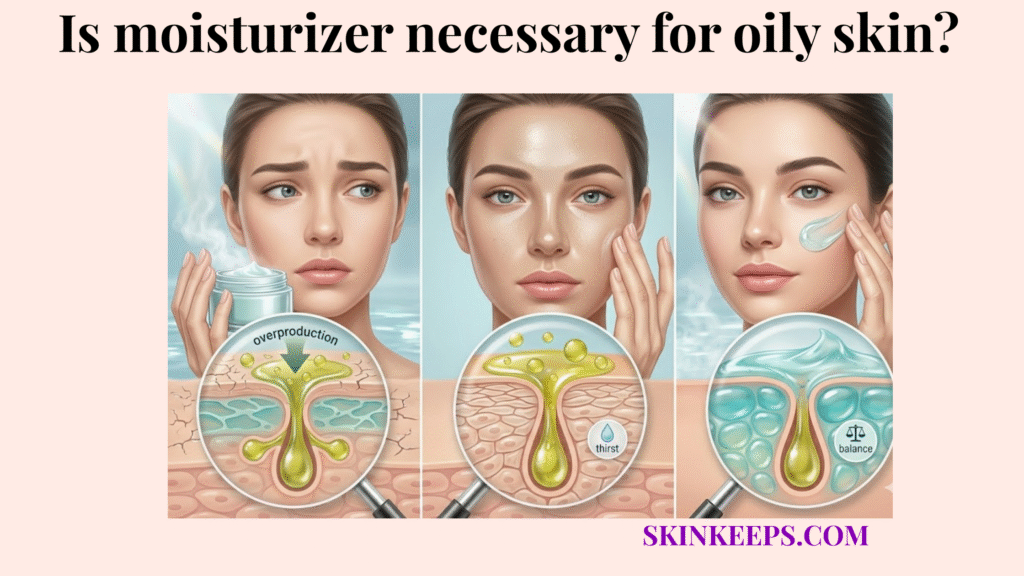
Moisturizer is necessary for oily skin when the skin feels tight, irritated, dehydrated, over-cleansed, acne-treated, or uncomfortable after washing. This matters because oily skin may produce enough surface oil while still lacking the water support needed for comfort and flexibility.
This guideline explains why oily skin may still need moisturizer, how sebum differs from moisturizer, when moisturizer becomes most important, what happens when oily skin skips it, and which lightweight formulas hydrate without creating a greasy or clogged finish.
Why does oily skin still need moisturizer?
Oily skin still needs moisturizer when its surface oil does not provide enough water-based hydration, comfort, or treatment tolerance. This moisturizer need appears because sebum lubricates the surface, while hydration supports the flexibility of the outer skin cells. When those cells lack water support, oily skin can feel tight or uncomfortable even while it looks shiny.
Moisturizer need depends on the skin’s condition, not oil level alone. Comfortable oily skin may need only a very light formula or occasional use. Oily skin that feels tight, stings after washing, or peels from acne treatments usually needs more consistent lightweight hydration.
How moisturizer supports hydration that sebum cannot provide
Moisturizer supports hydration that sebum cannot provide because moisturizer can supply water-binding ingredients while sebum mainly supplies surface lipids. This clear biological difference means a glossy face does not guarantee a fully hydrated cellular structure. Providing specialized humectants bridges this specific gap without adding heavy oils.
Why oily skin can feel greasy but still uncomfortable
Oily skin can feel greasy but still uncomfortable because surface oil and internal water balance are controlled by different skin functions. Understanding why oily skin less dryness applies to surface lipids but not internal water balance helps distinguish oil-deficient dryness from true water dehydration. This distinction ensures the skin receives care tailored to its specific deficit.
Why moisturizer need depends on skin condition, not oil level alone
Moisturizer need depends on skin condition, not oil level alone, because oily skin may be balanced, irritated, acne-treated, over-cleansed, or climate-stressed. These varying states dictate how resilient the stratum corneum remains. Adapting hydration to these shifting conditions helps maintain a more stable, comfortable barrier.
| Oily-Skin Condition | Is Moisturizer Useful? | Why |
|---|---|---|
| Oily but comfortable | Optional or light use | Skin may already feel balanced |
| Oily and tight | Yes | Tightness suggests hydration or barrier stress |
| Oily and acne-treated | Yes | Acne treatments can dry or irritate |
| Oily and over-cleansed | Yes | Lightweight hydration helps comfort |
| Oily and humid climate | Use lighter texture | Hydration may still help without heaviness |
| Oily and cold-weather stressed | Yes | Dry air can make the skin feel tight despite shine |
How is moisturizer different from natural sebum in oily skin?
Moisturizer is different from natural sebum because sebum lubricates oily skin, while moisturizer supports hydration, comfort, and formula-based barrier support. This distinction matters because a shiny face is not automatically a hydrated face. Oily skin can have excess surface lipid and still need water-binding support.
Oil-free moisturizer can still hydrate oily skin because hydration does not require a greasy formula. A lightweight moisturizer may use humectants to hold water and light emollients to improve comfort. This is why the best oily-skin moisturizer is chosen by texture and after-feel, not by the assumption that all moisturizer is heavy.
Why sebum lubricates but does not fully hydrate oily skin
Sebum lubricates but does not replace water-based hydration because oil cannot replace the water balance needed inside the stratum corneum. Reviewing the specific oily skin sebum barrier mechanics reveals its supportive but limited role in preventing moisture escape. The skin often requires targeted water support to maintain cellular flexibility.
Why moisturizers can include humectants, emollients, and barrier-support ingredients
Moisturizers can include humectants, emollients, and barrier-support ingredients because they are designed to improve comfort through multiple formula functions. These combined elements work synergistically to support a healthier-feeling skin environment. The resulting formulation can address multiple signs of barrier distress simultaneously.
Why oil-free moisturizer can still hydrate oily skin
Oil-free moisturizer can still hydrate oily skin because water-binding ingredients can support hydration without adding heavy oils. These specific agents help bind water in the outer skin layers. This mechanism allows the skin to remain supple without any thick, congesting occlusion.
| Feature | Sebum | Moisturizer |
|---|---|---|
| Main source | Sebaceous glands | Topical skincare product |
| Main role | Lubricates and contributes to surface oil | Supports hydration and comfort |
| Can feel greasy? | Yes | Depends on formula |
| Can be oil-free? | No | Yes |
| Best function in oily skin | Natural surface lipid support | Lightweight hydration and barrier support |
| Main limitation | Does not replace water-based hydration | Wrong texture can feel heavy |
When is moisturizer most important for oily skin?
Moisturizer is most important for oily skin after cleansing, acne treatments, over-exfoliation, dry weather, or any routine step that leaves the skin tight, peeling, or irritated. These situations increase moisturizer need because the skin is no longer just oily; it is also uncomfortable or less tolerant. A lightweight moisturizer helps restore comfort without requiring a heavy cream.
Acne-treatment periods often make moisturizer more important for oily skin. Salicylic acid, benzoyl peroxide, and retinoids can help acne-prone skin, but they may also create dryness, peeling, or stinging. When that happens, moisturizer becomes part of treatment tolerance, not an optional luxury.
When cleansing leaves oily skin tight
Moisturizer becomes important when cleansing leaves oily skin tight because tightness suggests the face needs water-supporting comfort after washing. Optimizing your oily skin cleansing frequency can reduce this tightness, but a lightweight hydrator may still be necessary if the barrier feels compromised. The proper fluid helps restore a more comfortable balance.
When salicylic acid, benzoyl peroxide, or retinoids cause dryness
Moisturizer becomes important when salicylic acid, benzoyl peroxide, or retinoids cause dryness because treatment irritation can make oily skin less tolerant. This therapeutic stress often demands soothing support to manage local inflammation. Proper hydration allows the user to continue using their necessary acne interventions more comfortably.
When cold weather, low humidity, or over-exfoliation makes oily skin uncomfortable
Moisturizer becomes important when cold weather, low humidity, or over-exfoliation makes oily skin uncomfortable because these stressors can reduce comfort even when surface oil remains. Addressing oily skin over-exfoliating with dedicated hydration support allows the stratum corneum to recover. This targeted support helps manage the environmental and mechanical stress the skin has encountered.
What happens when oily skin skips moisturizer?
When oily skin skips moisturizer, the skin may become tight, shiny, flaky, irritated, or harder to tolerate after cleansing and acne treatments. This happens because surface oil can return while water-based comfort remains low. The result is often a confusing face that looks oily but feels stripped.
Skipping moisturizer can also push the user toward over-cleansing or over-drying. When the skin feels greasy and uncomfortable at the same time, the user may reach for stronger cleansers instead of correcting hydration. That mistake can make the routine feel harsher without solving comfort.
Why oily skin can become tight, shiny, and dehydrated at the same time
Oily skin can become tight, shiny, and dehydrated at the same time because surface sebum can coexist with low water comfort in the outer skin. This structural paradox means the epidermis is simultaneously reflective and thirsty. Correcting this usually requires adding water-based support rather than just washing the shine away.
Why skipping moisturizer can make acne treatments harder to tolerate
Skipping moisturizer can make acne treatments harder to tolerate because treated oily skin may peel, sting, or feel irritated without hydration support. This lack of support can make effective treatments feel uncomfortably harsh. The skin may then struggle to accept the medication due to the resulting sensory discomfort.
Why no-moisturizer routines often lead to over-cleansing or over-drying
No-moisturizer routines often lead to over-cleansing or over-drying because the user tries to fix tight, greasy discomfort with stronger oil removal. This misguided effort can degrade the delicate epidermal barrier over time. The ongoing stripping cycle may simply perpetuate a less stable, unpredictable complexion.
| Skipping Scenario | Common Result |
|---|---|
| After harsh cleansing | Tight, uncomfortable skin |
| During acne treatment | More peeling, stinging, or irritation |
| In dry climate | Oily but dehydrated feeling |
| After over-exfoliation | Barrier discomfort and sensitivity |
| Under sunscreen or makeup | Less comfortable layering and texture |
Which moisturizer type is best for oily skin?
The best moisturizer type for oily skin is usually a lightweight gel, lotion-fluid, or gel-cream labeled oil-free and non-comedogenic. These textures hydrate with less surface weight than rich creams. They are usually easier to layer under sunscreen or makeup without creating a coated finish.
Heavy creams and occlusive ointments are not usually the first full-face choice for very oily skin. They may help specific irritated areas, but they can feel too greasy across the whole face. The better starting point is a thin layer of a lightweight moisturizer that improves comfort without creating heaviness.
Why gel moisturizers often suit oily skin
Gel moisturizers often suit oily skin because they feel light, absorb quickly, and hydrate without the heavy finish of rich creams. Evaluating different oily skin product formulations reveals why these water-based bases effectively deliver moisture while reducing the chance of a heavy, residual film. This texture match makes daily use much more appealing.
Why lightweight lotion-fluids work for oily but dehydrated skin
Lightweight lotion-fluids work for oily but dehydrated skin because they provide more comfort than gels without feeling as heavy as creams. This middle-ground texture can help support a barrier that feels tight. It ensures skin that feels parched receives some soothing care without triggering a visibly greasy shine.
Why oil-free and non-comedogenic labels matter
Oil-free and non-comedogenic labels matter because oily and clog-prone skin usually needs hydration without added greasiness or pore-clogging heaviness. Scanning for these targeted descriptors acts as a helpful starting point when choosing products. Such diligent selection can lower the risk of unwanted follicular blockages.
| Moisturizer Type | Best Fit | Main Caution |
|---|---|---|
| Gel moisturizer | Very oily or shiny skin | May not be enough if barrier is very irritated |
| Lotion-fluid | Oily but tight or dehydrated skin | Choose lightweight versions |
| Gel-cream | Oily combination skin | Avoid heavy residue |
| Heavy cream | Usually not first choice for oily skin | Can feel greasy or congesting |
| Occlusive ointment | Only for specific irritated areas if needed | Too heavy for full-face oily zones |
Which ingredients should oily-skin moisturizers include or avoid?
Oily-skin moisturizers should include lightweight humectants and comfort-support ingredients while avoiding textures that feel greasy, heavy, or pore-clogging. Humectants are useful because they support water balance without needing a thick oil-heavy finish. This makes them a better first choice for oily skin that feels tight after washing.
A clinical moisturizing-fluid study tested a formula containing 1% hyaluronic acid and 5% glycerin and measured hydration and barrier-related effects over 24 hours. This does not mean every oily-skin moisturizer needs the same formula, but it supports the general role of humectant-based hydration in lightweight moisturizers. [PMC]
Niacinamide may also be useful in oily-skin moisturizers when the goal is comfort plus oil-balance support. A clinical study tested 2% niacinamide for facial sebum measures, and a later review discusses 2% to 5% niacinamide preparations in relation to sebum reduction. This makes niacinamide a reasonable supporting ingredient, not a replacement for hydration. [PubMed] and [PMC]
Which humectants hydrate oily skin without heaviness
Humectants such as glycerin and hyaluronic acid hydrate oily skin without heaviness because they bind water rather than adding a thick greasy layer. These specialized ingredients help bind water in the outer skin layers. The resulting moisture support can help the tissue feel more comfortable.
Which barrier-support ingredients help irritated oily skin
Barrier-support ingredients help irritated oily skin by improving comfort when the skin feels tight, over-cleansed, or treatment-stressed. Specialized lightweight ceramides and soothing agents may help support the skin’s surface. This support can help calm the sensation of tightness.
Which heavy or comedogenic textures may feel worse on oily skin
Heavy or comedogenic-feeling textures may feel worse on oily skin because they can add surface weight to an already shiny or congestion-prone face. Rich butters, heavy ointments, or very occlusive textures may feel greasy or poorly tolerated on oily, acne-prone skin. They are not automatically pore-clogging for everyone, but they are usually not the best first full-face choice when the goal is lightweight hydration.
| Ingredient or Label | Why It Helps |
|---|---|
| Glycerin | Water-binding hydration |
| Hyaluronic acid | Lightweight hydration support |
| Niacinamide | Barrier comfort and oil-balance support |
| Oil-free | Reduces added greasiness |
| Non-comedogenic | Better for clog-prone skin |
| Fragrance-free | Helpful for reactive or irritated skin |
| Gel texture | Hydration with lower residue |
| Fluid texture | Lightweight comfort for oily but tight skin |
How should oily skin use moisturizer every day?
Oily skin should use moisturizer every day only as needed for comfort, applying a thin layer after cleansing or whenever the skin feels tight, dry, treated, or irritated. This approach prevents moisturizer from becoming too heavy while still supporting hydration when the skin needs it. The amount should match skin feel, not fear of oil.
Moisturizer texture should change with the skin’s condition. A gel may be enough in humid weather, while a lotion-fluid may feel better during dry weather or acne-treatment periods. If the face feels coated or congested, reduce richness rather than removing hydration completely.
When to apply moisturizer after cleansing
Moisturizer should be applied after cleansing when oily skin feels tight, dry, irritated, or less comfortable than usual. Applying the product while the face is still slightly damp can help trap moisture more effectively. This timing may help reduce the tight sensation that sometimes follows washing.
How much moisturizer oily skin usually needs
Oily skin usually needs only a thin layer of lightweight moisturizer because too much product can create heaviness without improving comfort. This modest amount is often enough to support the skin surface. Over-application can make the skin feel coated or unnecessarily slick.
How to adjust moisturizer by season, acne treatment, or skin feel
Moisturizer should be adjusted by season, acne treatment, or skin feel because oily skin can need different hydration support in different conditions. This adjustment helps the skin manage winter dryness or the irritation of a new active treatment. Adjusting the routine helps keep the skin feeling more balanced throughout the year.
Checklist: Daily Moisturizer Routine for Oily Skin
What should you remember about moisturizer and oily skin?
The main point to remember is that moisturizer can be necessary for oily skin when the skin lacks comfort, hydration, or treatment tolerance.
Final Takeaways
- Moisturizer can be necessary for oily skin when the skin feels tight, irritated, over-cleansed, or acne-treated.
- Sebum is not the same as water-based hydration.
- Oily skin may need moisturizer most after cleansing, acne treatments, over-exfoliation, or dry weather.
- The wrong moisturizer can feel greasy, but the right one supports comfort without clogging.
- Oil-free, non-comedogenic gel or fluid moisturizers are usually the safest starting point.
- The goal is hydrated oily skin, not heavy skin or completely dry skin.
FAQs
Is moisturizer necessary for oily skin?
Moisturizer is necessary for oily skin when the skin feels tight, irritated, dehydrated, over-cleansed, acne-treated, or uncomfortable after washing.
Can oily skin be dehydrated?
Yes, oily skin can be dehydrated because sebum is surface oil, while hydration refers to water balance inside the outer skin layers.
What moisturizer type is best for oily skin?
The best moisturizer type for oily skin is usually a lightweight gel, lotion-fluid, or gel-cream labeled oil-free and non-comedogenic.
Should oily skin use moisturizer after cleansing?
Oily skin should use moisturizer after cleansing if the skin feels tight, dry, stinging, irritated, or less comfortable than usual.
Can moisturizer make oily skin worse?
Moisturizer can make oily skin feel worse if the formula is too heavy, greasy, or residue-forming for that person’s skin.
Which ingredients are good in oily-skin moisturizers?
Glycerin, hyaluronic acid, niacinamide, and lightweight barrier-support ingredients can be useful in oily-skin moisturizers because they support comfort without requiring a heavy finish.
Is oil-free moisturizer enough for oily skin?
Oil-free moisturizer can be enough for oily skin when it hydrates comfortably without leaving the face greasy or coated.
Should oily skin skip moisturizer in humid weather?
Oily skin may need a lighter moisturizer in humid weather, but it should not skip hydration automatically if the skin still feels tight or irritated.
Conclusion
Moisturizer is necessary for oily skin when the skin needs water-based comfort, treatment support, or relief from tightness after cleansing. Oily skin does not always need a heavy moisturizer, but it often benefits from a lightweight formula when the skin feels tight, treated, irritated, or dehydrated. Sebum can lubricate the surface, but it cannot replace water-binding support from a well-chosen moisturizer.
The best moisturizer for oily skin should leave the face comfortable and hydrated, not greasy, coated, or completely matte.