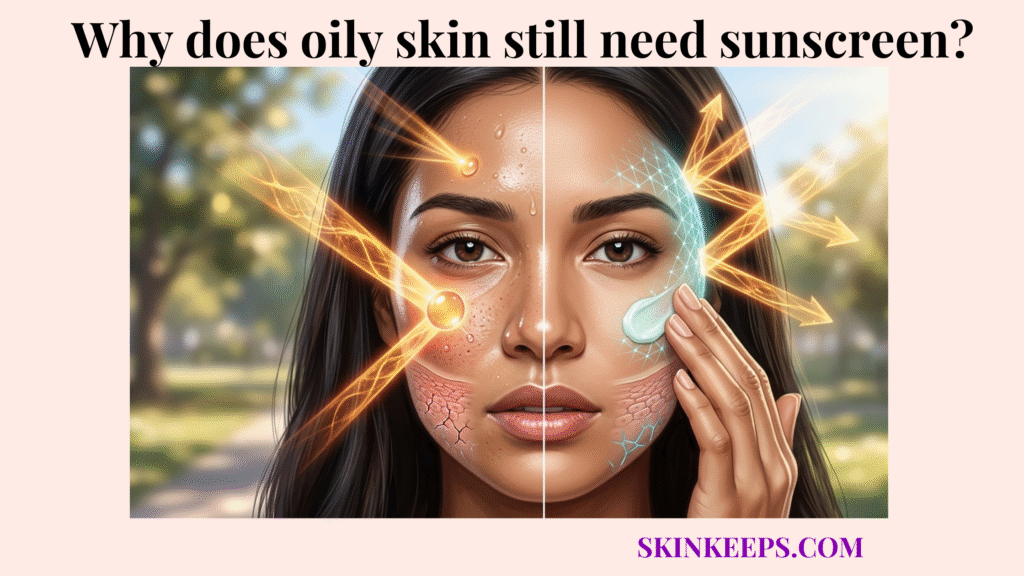
Oily skin still needs sunscreen because excess sebum does not provide reliable protection against ultraviolet exposure, sunburn risk, post-acne mark darkening, uneven tone, or premature visible aging. This is why oily skin should be protected from UV exposure even when the face already feels greasy or shiny.
This guideline explains why sebum is not sunscreen, how UV exposure can worsen common oily-skin concerns, why many oily-skin users avoid SPF, which sunscreen textures work better, and how to apply sunscreen without making the face feel heavy or clogged.
Why does oily skin still need daily sunscreen?
Oily skin still needs daily sunscreen because oiliness does not block UV exposure or prevent the visible and structural effects of sun damage. This sunscreen need exists because sebum and sunscreen have different jobs. Sebum affects surface feel, while sunscreen is designed to reduce UV exposure.
Daily sunscreen is prevention, not optional cosmetic layering. Oily skin can still develop uneven tone, irritated-looking redness, post-acne mark darkening, and premature texture aging after repeated UV exposure. The issue is not whether oily skin needs sunscreen; the issue is choosing a sunscreen that feels compatible with oily skin.
Why sebum does not replace UV protection
Sebum does not replace UV protection because natural surface oil is not designed to filter UVA and UVB exposure the way sunscreen is. This biological limitation means that while oil lubricates the stratum corneum, it fundamentally lacks the chemical capacity to block incoming radiation. A shiny face simply cannot substitute for a properly tested barrier.
Why oily skin can still develop sun damage
Oily skin can still develop sun damage because UV exposure affects pigment, collagen, surface texture, and irritation risk regardless of how much sebum the skin produces. This ongoing vulnerability highlights the danger of confusing surface moisture with dermal defense. The deep, structural layers remain completely exposed without intervention.
Why sunscreen is prevention, not optional skincare
Sunscreen is prevention, not optional skincare, because it protects oily skin before UV exposure turns into visible discoloration, redness, or texture change. This proactive defense preserves clarity by halting the inflammatory triggers that degrade the complexion. Committing to this daily step ensures that minor imperfections do not permanently etch into the tissue.
| Reason | What It Means for Oily Skin |
|---|---|
| Sebum is not UV protection | Oiliness does not replace sunscreen |
| UV exposure still affects tone | Oily skin can develop uneven tone |
| Post-acne marks can look darker | UV exposure can make discoloration more visible |
| Texture aging still happens | Oily skin is not immune to photoaging |
| Sunscreen texture can be adjusted | The solution is a better formula, not skipping SPF |
How is sebum different from sunscreen in oily skin?
Sebum is different from sunscreen because sebum lubricates the skin surface, while sunscreen is formulated to reduce UV exposure. This distinction matters because a shiny face can still be unprotected. Oil on the skin may change how the surface feels, but it does not provide reliable broad-spectrum protection.
For oily skin, the safer sunscreen direction is a lightweight broad-spectrum formula with SPF 30 or higher when sun protection is needed. This number matters because it gives the writer a concrete protection threshold instead of vague “use SPF” wording. [AAD]
How sebum lubricates but does not provide reliable SPF
Sebum lubricates but does not provide reliable SPF because surface oil is part of skin’s natural lipid function, not a regulated UV-filtering system. This natural lubrication supports epidermal flexibility without offering any defense against the solar spectrum. Relying on this slick finish for sun safety invites severe cumulative damage.
How sunscreen filters help reduce UV exposure
Sunscreen filters help reduce UV exposure by forming a protective formula layer designed to limit how much ultraviolet radiation affects the skin. This sophisticated cosmetic chemistry acts as an invisible shield, either absorbing or scattering the harmful rays. The resulting barrier significantly minimizes the oxidative stress that ages the tissue.
Why natural oil cannot protect against both UVA and UVB damage
Natural oil cannot protect against both UVA and UVB damage because sebum does not function as a broad-spectrum photoprotective product. This critical gap leaves the skin completely susceptible to both deep structural aging and superficial burning. Only a purposefully formulated compound can bridge this dual vulnerability.
| Feature | Sebum | Sunscreen |
|---|---|---|
| Main function | Lubrication and surface lipid support | UV protection |
| Protection type | Not reliable sun protection | Designed to reduce UV exposure |
| Effect on oily skin | Can create shine or greasiness | Can protect without heaviness if well chosen |
| Best role | Natural skin lipid function | Daily photoprotection |
| Main limitation | Cannot replace SPF | Wrong texture can feel heavy |
Which oily-skin problems can sun exposure make worse?
Sun exposure can make oily-skin problems worse by intensifying post-acne marks, uneven tone, irritation, and long-term texture aging. These concerns matter because oily skin is often also breakout-prone or mark-prone. Sunscreen helps reduce the UV exposure that can make those visible concerns look more persistent.
Post-acne marks are a major reason oily skin still needs sunscreen. When a breakout leaves discoloration, UV exposure can make that discoloration appear darker or last longer. This makes sunscreen part of mark prevention, not just sunburn prevention.
How UV exposure can darken post-acne marks
UV exposure can darken post-acne marks by stimulating pigment activity around already-inflamed or recently healed breakout areas. Examining oily skin blackheads and breakouts reveals how these initial lesions leave vulnerable spots prone to hyperpigmentation. This intense, targeted melanin production ensures that the temporary redness evolves into a long-lasting, stubborn dark patch.
How sun exposure can worsen uneven tone on oily skin
Sun exposure can worsen uneven tone on oily skin by increasing visible pigment irregularity across areas already affected by breakouts or irritation. This scattered hyperpigmentation disrupts the natural uniformity of the complexion. The continuous solar onslaught effectively guarantees that the skin appears progressively blotchier.
How UV damage contributes to texture aging even when skin is oily
UV damage contributes to texture aging even when skin is oily because sebum cannot stop photoaging-related changes in smoothness, firmness, or surface quality. This deep structural degradation dismantles the supportive collagen framework. As the foundation crumbles, the epidermis develops a coarse, permanently weathered appearance.
| Oily-Skin Concern | How UV Exposure Can Affect It | Visible Result |
|---|---|---|
| Post-acne marks | Can make discoloration look darker or last longer | More visible marks |
| Uneven tone | Increases pigment irregularity risk | Patchier complexion |
| Texture aging | Contributes to long-term surface aging | Rougher or older-looking texture |
| Redness and irritation | Can stress reactive skin | More visible inflammation |
Why do people with oily skin avoid sunscreen?
People with oily skin often avoid sunscreen because the wrong formulas can feel greasy, heavy, shiny, or clog-prone on an already oil-rich surface. This avoidance is usually practical, not careless. Many oily-skin users have experienced sunscreens that separate makeup, increase shine, or leave the face coated.
Sunscreen avoidance creates a bigger problem than shine because unprotected oily skin remains exposed to UV-related discoloration and texture change. The better solution is formula selection. A lightweight sunscreen can protect the skin without creating the heavy finish that caused avoidance in the first place.
Why greasy sunscreen textures discourage oily-skin users
Greasy sunscreen textures discourage oily-skin users because they add surface weight to skin that already feels shiny or coated. This redundant layer transforms a mildly glowing complexion into an unbearably slick mask. The profound sensory discomfort quickly drives the user to abandon photoprotection entirely.
Why fear of clogged pores leads to sunscreen avoidance
Fear of clogged pores leads to sunscreen avoidance because acne-prone oily skin users often associate heavy SPF formulas with congestion. Discussing sunscreen neglect and oily skin emphasizes that overcoming this fear is vital for long-term health. Choosing modern, refined formulations eliminates the threat of unmanageable breakouts.
Why sunscreen avoidance creates bigger problems than shine
Sunscreen avoidance creates bigger problems than shine because UV exposure can worsen visible marks, uneven tone, and premature texture change over time. This chronic exposure silently erodes the skin’s structural integrity while the user worries only about a temporary sheen. Addressing the gloss is meaningless if the foundation is permanently damaged.
| Avoidance Reason | Why It Happens | Better Direction |
|---|---|---|
| “Sunscreen feels greasy” | Formula is too heavy | Try gel, fluid, or matte finish |
| “Sunscreen clogs me” | Formula may be too rich or residue-forming | Choose non-comedogenic |
| “My face is already oily” | Sebum is mistaken for protection | Use lightweight SPF |
| “Makeup separates” | Sunscreen texture may not layer well | Use thinner layers and blotting |
| “I hate reapplying” | Reapplication feels heavy | Blot first, then reapply |
Which sunscreen types work best for oily skin?
The sunscreen types that work best for oily skin are usually lightweight, oil-free, non-comedogenic, broad-spectrum formulas with gel, fluid, serum, or matte textures. These formula types reduce the main reasons oily-skin users avoid sunscreen. They protect while feeling less heavy than rich cream-based options.
A strong starting point for oily skin is a broad-spectrum sunscreen with SPF 30 or higher in a texture that does not feel greasy or coated. The number gives the protection baseline, while the texture decides whether the product is usable every day. [AAD]
Why oil-free sunscreen suits oily skin
Oil-free sunscreen suits oily skin because it avoids adding extra oily residue to a complexion that already produces more surface sebum. This elegant chemistry guarantees the product sinks in instantly without contributing to the natural slickness. The resulting finish is breathable and profoundly more comfortable.
Why non-comedogenic formulas matter for acne-prone oily skin
Non-comedogenic formulas matter for acne-prone oily skin because they are designed with clog-prone users in mind. This critical designation assures the wearer that the ingredients will not nestle into the follicles and provoke inflammation. It completely neutralizes the primary fear that drives SPF avoidance.
Why gel, fluid, serum, and matte textures often feel better
Gel, fluid, serum, and matte sunscreen textures often feel better on oily skin because they spread thinly and reduce the heavy finish associated with richer creams. Exploring different oily skin product formulations shows how advanced bases evaporate cleanly without residue. This technological leap allows the skin to remain fiercely protected yet remarkably bare.
| Sunscreen Feature | Why It Helps Oily Skin |
|---|---|
| Oil-free | Reduces added greasiness |
| Non-comedogenic | Better fit for clog-prone skin |
| Matte finish | Helps control visible shine |
| Gel or fluid texture | Feels lighter than thick cream |
| Broad-spectrum SPF 30+ | Protects against UV exposure |
How should oily skin apply sunscreen without feeling greasy?
Oily skin should apply sunscreen without feeling greasy by using thin layers, choosing lightweight textures, blotting before reapplication, and cleansing SPF off gently at night. This application method reduces heaviness while keeping sunscreen part of the daily routine. The goal is protection without a coated, slippery finish.
When outdoors, sunscreen should be reapplied every two hours, and immediately after swimming or sweating. For oily skin, blotting excess surface oil before reapplication can make the next layer feel lighter. [AAD]
How to layer sunscreen after moisturizer or serum
Sunscreen should be layered after moisturizer or serum by keeping the earlier layers lightweight so the final SPF layer does not feel heavy. Adding an oily skin moisturizer beforehand is usually only needed if the face feels tight or dehydrated. Minimizing unnecessary steps underneath ensures the sunscreen anchors properly to the skin.
How to reapply sunscreen when oily skin becomes shiny
Sunscreen should be reapplied on shiny oily skin by blotting excess surface oil first, then applying a light, even SPF layer. This preliminary blotting step clears the slick film that normally causes fresh sunscreen to pill or separate. Establishing a clean canvas allows the new defense matrix to settle perfectly.
How to remove sunscreen at night without over-stripping
Sunscreen should be removed at night without over-stripping by using a gentle cleanser or a suitable first cleanse when SPF, makeup, or residue is heavy. Proper oily skin makeup removal gently breaks down these tenacious layers without aggressively scrubbing the barrier. Incorporating structured oily skin care tips helps establish these healthy daily rhythms.
Daily Sunscreen Routine for Oily Skin
What should oily skin remember about sunscreen?
The main point to remember is that oily skin still needs sunscreen because sebum is not broad-spectrum UV protection.
Final Takeaways
- Oily skin still needs sunscreen because sebum does not replace UV protection.
- Sebum can lubricate the surface, but it does not function as broad-spectrum SPF.
- UV exposure can make post-acne marks, uneven tone, redness, and texture aging more visible.
- Sunscreen avoidance usually happens because the formula feels too greasy, heavy, or clog-prone.
- Oil-free and non-comedogenic sunscreen textures are often better starting points for oily skin.
- Gel, fluid, serum, and matte textures can protect oily skin with less surface heaviness.
- Oily skin should use broad-spectrum SPF 30 or higher when sun protection is needed. [AAD]
- Oily skin should reapply sunscreen about every two hours when outdoors, and after swimming or sweating. [AAD]
FAQs
Why does oily skin still need sunscreen?
Oily skin still needs sunscreen because excess sebum does not provide reliable UV protection. Sebum can make the face shiny, but it cannot replace sunscreen.
Is sebum the same as sunscreen?
No, sebum is not the same as sunscreen. Sebum lubricates the skin surface, while sunscreen is formulated to reduce UV exposure.
Can oily skin get sun damage?
Yes, oily skin can still get sun damage. Oil production does not stop UV-related effects on tone, marks, texture, or visible aging.
What sunscreen type is best for oily skin?
The best sunscreen type for oily skin is usually lightweight, oil-free, non-comedogenic, and broad-spectrum, with a gel, fluid, serum, or matte texture.
What SPF should oily skin use?
Oily skin should use broad-spectrum SPF 30 or higher when sun protection is needed. [AAD]
How often should oily skin reapply sunscreen?
Oily skin should reapply sunscreen about every two hours when outdoors, and immediately after swimming or sweating. [AAD]
How can oily skin reapply sunscreen without looking greasy?
Oily skin can reapply sunscreen with less greasiness by blotting excess oil first, then applying a thin layer of lightweight SPF.
Should oily skin remove sunscreen at night?
Yes, oily skin should remove sunscreen at night because SPF, oil, sweat, and daily residue can sit on the surface if not cleansed away.
Conclusion
Oily skin still needs sunscreen because natural sebum cannot replace broad-spectrum UV protection. A shiny face is not a protected face. Oily skin can still develop post-acne mark darkening, uneven tone, irritation, and texture aging when UV exposure is ignored. The solution is not skipping sunscreen; it is choosing a lightweight, oil-free, non-comedogenic SPF that protects without leaving the skin greasy or coated.
The right sunscreen should protect oily skin while keeping the finish comfortable, light, and wearable.