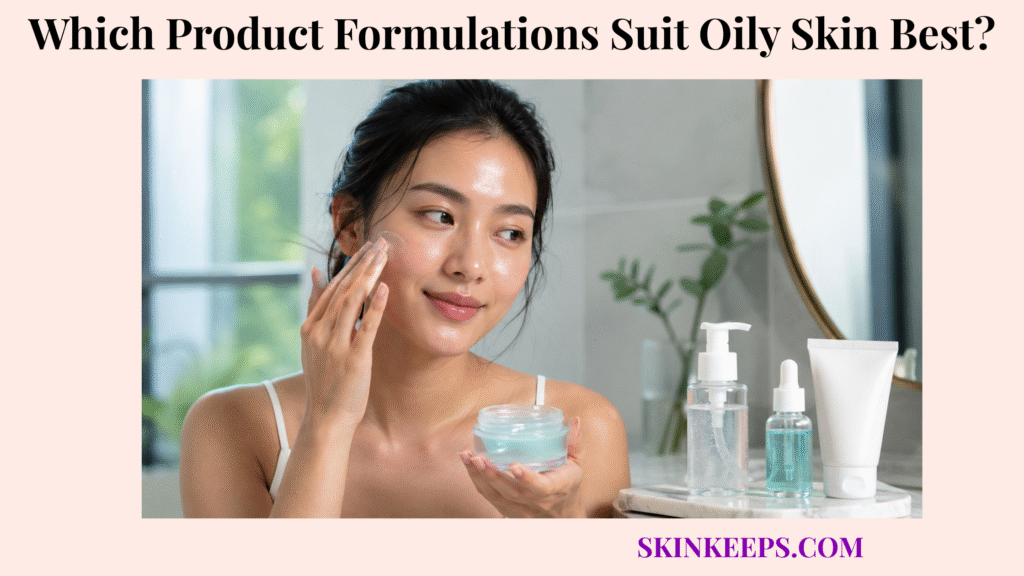
The product formulations that suit oily skin best are usually lightweight, oil-free, non-comedogenic, low-residue textures such as gels, fluids, serums, gel-creams, light lotions, matte sunscreens, and water-based makeup. These formats matter because oily skin already produces more surface oil, so heavy vehicles can make shine, residue, and congestion feel worse.
This guideline explains how formulation type, product vehicle, finish, and residue level affect oily skin across cleansers, moisturizers, sunscreens, makeup, and treatment products.
What formulation types are usually best for oily skin?
The formulation types that are usually best for oily skin are gels, fluids, serums, gel-creams, light lotions, matte finishes, and other low-residue product vehicles. These formulations usually feel better because they spread thinly and leave less surface weight. Less surface weight helps oily skin stay more comfortable when several products are layered.
The best oily-skin formulation is not always the driest formula. A formula can feel lightweight while still supporting hydration, sunscreen protection, or treatment delivery. This distinction prevents oily skin from being pushed into tightness just to avoid shine.
Why lightweight gels suit oily skin
Lightweight gels suit oily skin because they deliver water-based support with minimal oily residue. They are commonly used for moisturizers, hydrators, and sunscreens. Their refreshing finish absorbs instantly, leaving the barrier plumped but never coated in excess lipids.
Why fluids and serums suit oily skin
Fluids and serums suit oily skin because they spread thinly and deliver function without the heavy coating effect of richer vehicles. Incorporating oily skin active ingredients via a serum ensures potent treatment delivery while fluid sunscreens guarantee invisible protection.
Why gel-creams and light lotions suit oily-but-dehydrated skin
Gel-creams and light lotions suit oily-but-dehydrated skin because they add more comfort than a pure gel without becoming as heavy as a rich cream. Oily skin can still experience barrier stress, meaning a carefully selected oily skin moisturizer offers crucial hydration without clogging the pores.
| Formulation Type | Why It Suits Oily Skin | Best Use |
|---|---|---|
| Gel | Lightweight, low-residue feel | Moisturizers, hydrators, some sunscreens |
| Fluid | Spreads thinly without heaviness | Sunscreens, moisturizers, treatments |
| Serum | Delivers actives with minimal residue | Niacinamide, antioxidants, hydrating actives |
| Gel-cream | Adds comfort without heavy occlusion | Oily but tight or dehydrated skin |
| Light lotion | More support than gel, less heavy than cream | Combination-oily or barrier-stressed skin |
| Matte finish | Reduces visible shine | Sunscreens, primers, makeup |
Why do lightweight formulations work better for oily skin?
Lightweight formulations work better for oily skin because they reduce surface heaviness while still allowing the product to perform its main function. This low-residue design matters when oily skin already has a natural lipid film. Adding another heavy layer can make the face feel coated before the product has any real benefit.
Lightweight does not mean weak. A lightweight sunscreen can still protect, a lightweight moisturizer can still hydrate, and a lightweight serum can still deliver active ingredients. The formulation goal is efficient delivery without unnecessary residue.
How low-residue textures reduce surface heaviness
Low-residue textures reduce surface heaviness by leaving less greasy, waxy, or sticky material on top of the skin. They are specifically crafted to evaporate or absorb fully. The resulting finish allows the complexion to breathe naturally without contributing to the existing sebum load.
How fast-absorbing vehicles improve comfort on oily skin
Fast-absorbing vehicles improve comfort on oily skin because they reduce the time a formula sits as a noticeable surface film. Rapid penetration ensures that the active components immediately interact with the stratum corneum. This swift action averts the suffocating sensation often triggered by slow-drying creams.
Why lightweight does not mean drying or weak
Lightweight does not mean drying or weak because a product can be low-residue while still supporting hydration, UV protection, or treatment delivery. Modern formulations utilize advanced polymer structures to encapsulate potent ingredients. These structures break upon contact, flooding the tissue with robust efficacy minus the dense weight.
Why do oil-free and non-comedogenic formulas matter for oily skin?
Oil-free and non-comedogenic formulas matter for oily skin because they reduce added surface greasiness and lower the chance that a product vehicle will contribute to clogged pores. These labels are especially useful for acne-prone or congestion-prone oily skin. AAD specifically recommends oily-skin products labeled oil-free and non-comedogenic, including cleansers, moisturizers, and makeup. [AAD]
These labels are useful starting filters, not absolute guarantees. A non-comedogenic formula can still feel heavy on one person, and an oil-free formula can still irritate another person. Real skin tolerance must still be judged by comfort, shine, congestion, and irritation.
How oil-free formulas reduce added greasiness
Oil-free formulas reduce added greasiness by avoiding extra oil-heavy phases that can make oily skin feel coated or shinier. They replace traditional lipids with water, silicones, or advanced synthetic esters. This switch eliminates the redundant lubrication that typically triggers excess glare.
How non-comedogenic formulas lower clogging risk
Non-comedogenic formulas lower clogging risk because they are designed to be less likely to block follicles or contribute to acne-prone congestion. Formulators selectively omit ingredients notorious for inducing comedone formation. The resulting compound glides over the pore opening rather than settling inside it.
Why label claims still need real skin-tolerance testing
Label claims still need real skin-tolerance testing because oily skin can react differently to the same formula depending on climate, routine layering, and barrier condition. A product marked non-comedogenic may perform flawlessly in winter but feel suffocating during a humid summer. Individualized observation dictates whether the vehicle genuinely matches the complexion.
| Label | What It Suggests | Why It Matters |
|---|---|---|
| Oil-free | No added oil-heavy formula direction | Less added shine |
| Non-comedogenic | Designed to be less likely to clog pores | Better for acne-prone oily skin |
| Lightweight | Lower residue feel | More comfortable layering |
| Matte | Reduces visible shine | Useful for SPF, primer, makeup |
| Fragrance-free | Lower irritation risk | Useful for reactive oily skin |
| pH-balanced | Supports barrier comfort | Useful in cleansers |
Which heavy formulations are usually less suitable for oily skin?
Heavy formulations are usually less suitable for oily skin when they leave rich, greasy, waxy, or occlusive residue across already oil-prone zones. This residue can make oily skin feel coated before the product has time to settle. The result is often more shine, heavier makeup wear, and a higher chance of uncomfortable product buildup.
Heavy does not automatically mean bad. A thicker cream, balm, or ointment may be useful for a dry patch, irritation spot, or compromised area. The mistake is using every heavy format across the full face when only a small area needs that level of occlusion.
Why heavy creams can feel greasy on oily skin
Heavy creams can feel greasy on oily skin because their richer vehicle can sit on top of existing sebum instead of feeling fully absorbed. This texture choice fails to respect the skin’s baseline oil output. The result is a persistent, unpleasant slickness.
Why balms and ointments may overload oily zones
Balms and ointments may overload oily zones because their occlusive texture can trap heat, sweat, sebum, and residue against the skin surface. This trap creates an environment ripe for congestion and discomfort. Keeping these formulas away from the full face minimizes this risk.
Why rich product layering can increase congestion-prone residue
Rich product layering can increase congestion-prone residue because multiple creams, oils, balms, and waxy products can accumulate into a heavy surface film. This excessive layering essentially smothers the epidermal layer. The smothered layer inevitably reacts with increased breakouts and profound texture irregularities.
| Formulation Style | Better Fit for Oily Skin? | Main Reason |
|---|---|---|
| Gel or fluid | Usually yes | Lightweight, lower residue |
| Serum | Usually yes | Thin delivery vehicle |
| Gel-cream | Often yes | Balanced hydration and comfort |
| Heavy cream | Sometimes, but not first choice | Can feel greasy or congesting |
| Balm | Use selectively | May leave residue on oily zones |
| Ointment | Spot-use only if needed | Too occlusive for many full-face oily routines |
Which cleanser formulations suit oily skin best?
Cleanser formulations that suit oily skin best are usually gentle gels or gentle foaming cleansers that remove excess oil without leaving the face tight, dry, or irritated. This cleanser format matters because oily skin needs oil removal, but not barrier stripping. AAD recommends cleansing oily skin gently and resisting scrubbing, even when removing makeup. [AAD]
A cleanser should match both oil level and barrier condition. Very oily skin may prefer a gel or foam, while oily but irritated skin may tolerate a softer cream or lotion cleanser better. For deeper cleanser-type selection, the oily skin cleanser type guide can support that decision without turning this page away from formulation compatibility.
Why gentle gel cleansers suit oily skin
Gentle gel cleansers suit oily skin because they usually rinse clean while removing surface oil and daily residue. This straightforward action provides a reliable baseline for the morning and evening routines. The clear rinse prevents residual cleanser elements from accumulating and causing irritation.
Why gentle foaming cleansers suit oily skin
Gentle foaming cleansers suit oily skin because they create a clean-rinsing feel that many oily-skin users prefer without needing abrasive scrubbing. The luxurious lather efficiently dissolves superficial grime. Formulators specifically design this foam to respect the natural acid mantle.
Why harsh soap-like cleansers can over-strip oily skin
Harsh soap-like cleansers can over-strip oily skin because they may remove too much surface lipid and leave the barrier feeling tight or irritated. This chemical hostility fundamentally undermines the skin’s defense mechanisms. An over-stripped surface invariably responds with redness and erratic oil spikes.
| Cleanser Formulation | Best Fit |
|---|---|
| Gentle gel cleanser | Daily oily-skin cleansing |
| Gentle foaming cleanser | Oily skin that wants a cleaner rinse |
| Cream cleanser | Oily but irritated or dehydrated skin |
| Scrub cleanser | Usually poor fit if acne-prone or reactive |
| Harsh bar soap | Usually too stripping for facial oily skin |
Which moisturizer formulations suit oily skin best?
Moisturizer formulations that suit oily skin best are usually gels, fluids, gel-creams, and light lotions that hydrate without leaving a greasy or wax-heavy finish. This formulation choice matters because oily skin still may need water support without extra surface oil. CeraVe’s oily-skin routine guidance similarly recommends non-comedogenic, oil-free moisturizer after cleansing and targeted treatments. [CeraVe]
The right moisturizer format depends on how oily skin feels after cleansing. Very oily skin may prefer a gel, while oily but tight skin may need a gel-cream or light lotion. For hydration-specific logic, the oily skin moisturizer page should carry the deeper explanation.
Why gel moisturizers suit very oily skin
Gel moisturizers suit very oily skin because they provide lightweight hydration with minimal greasy residue. These solutions rely on advanced polymers that quench the skin cells swiftly. The resultant finish leaves the epidermis looking quenched rather than glossed.
Why gel-creams suit oily but tight skin
Gel-creams suit oily but tight skin because they add more comfort than a pure gel while staying lighter than a traditional cream. This hybrid approach supplies the extra structural support necessary to alleviate severe dehydration. It performs this function smoothly without provoking acne flares.
Why light lotions suit oily skin needing more barrier support
Light lotions suit oily skin needing more barrier support because they can provide extra comfort without the weight of a heavy cream. These emulsions typically include ceramides and gentle lipids perfectly balanced for the mid-level dryness. Utilizing them restores tolerance during harsh weather changes.
| Oily-Skin Condition | Better Formulation |
|---|---|
| Very oily and shiny | Gel moisturizer |
| Oily but dehydrated | Gel-cream or fluid moisturizer |
| Oily and sensitive | Fragrance-free light lotion |
| Oily with acne tendency | Oil-free, non-comedogenic gel or fluid |
| Oily but barrier-stressed | Lightweight ceramide lotion or gel-cream |
Which sunscreen and makeup formulations suit oily skin best?
Sunscreen and makeup formulations that suit oily skin best are usually oil-free, non-comedogenic, lightweight, matte or satin-finish vehicles that reduce added shine and residue. These product formats matter because SPF and makeup are often layered on top of moisturizer and treatment products. A heavy SPF or foundation can make oily skin feel overloaded even when the individual ingredients are acceptable.
Long-wear products still need proper removal. A formula that resists sweat or oil may leave more residue if it is not removed well at night. The oily skin makeup removal page should handle that residue-removal topic in detail.
Why matte fluid sunscreens suit oily skin
Matte fluid sunscreens suit oily skin because they spread thinly while reducing the appearance of extra surface shine. Formulators construct these liquids with volatile carriers that vanish instantly. The resulting protective veil secures UV defense precisely and comfortably.
Why water-based or oil-free makeup suits oily skin
Water-based or oil-free makeup suits oily skin because it adds less surface greasiness to a face that already produces visible sebum. These cosmetics rely on non-greasy binders that adhere well without slipping. Their structural integrity ensures the foundation remains impeccably smooth throughout the afternoon.
Why long-wear formulas still need proper removal
Long-wear formulas still need proper removal because low-transfer makeup and resistant sunscreen can leave residue that contributes to buildup if cleansing is incomplete. This tenacious adherence, while beneficial during the day, presents a serious hazard overnight. Eradicating this stubborn layer effectively demands a meticulously planned double-cleanse approach.
| Product Category | Best Formulation Direction |
|---|---|
| Sunscreen | Oil-free, non-comedogenic, matte fluid, gel, or serum SPF |
| Primer | Lightweight mattifying primer where needed |
| Foundation | Oil-free, non-comedogenic, light liquid or powder formula |
| Concealer | Thin, buildable, non-heavy formula |
| Setting product | Light powder or blotting support, not heavy layering |
Which formulation mistakes make oily skin worse?
Formulation mistakes make oily skin worse when the routine uses too many heavy, drying, occlusive, or residue-prone product vehicles at the same time. This often happens when each product seems reasonable alone but becomes too heavy when layered. The face then feels greasy, tight, congested, or unstable.
Matte formulas can also backfire when they dry the skin too aggressively. A good matte finish should reduce visible shine without causing tightness, stinging, or peeling. When matte control creates discomfort, the formulation is too harsh for that skin’s current tolerance.
Why choosing rich textures for every step overloads oily skin
Choosing rich textures for every step overloads oily skin because multiple creams, oils, balms, and waxy layers can build into one heavy surface film. This excessive layering essentially smothers the epidermal layer. The smothered layer inevitably reacts with increased breakouts and profound texture irregularities.
Why matte-at-all-costs formulas can over-dry oily skin
Matte-at-all-costs formulas can over-dry oily skin because some shine-control vehicles reduce oiliness at the expense of comfort and barrier tolerance. These aggressive products frequently utilize high concentrations of volatile alcohols. The alcohol strips away vital moisture, prompting an uncomfortable, tight sensation.
Why product layering matters as much as individual formulation
Product layering matters as much as individual formulation because several lightweight products can still become heavy when they are stacked without purpose. Applying five separate serums and fluids inadvertently recreates the density of a single thick cream. Thoughtful consolidation guarantees the routine maintains its elegant, weightless character.
| Mistake | Likely Result |
|---|---|
| Using heavy cream, balm, and oil together | Greasy, congested surface feel |
| Choosing very drying matte products | Tight, irritated, unstable skin |
| Ignoring non-comedogenic labels | More clogging risk |
| Layering too many silicone, oil, or wax-heavy products | Heavier feel and makeup breakdown |
| Using active-heavy formulas in every step | Irritation and barrier stress |
How should oily skin choose product formulations across a full routine?
Oily skin should choose product formulations across a full routine by selecting lightweight vehicles first, then increasing richness only when comfort, dryness, or barrier stress requires more support. This approach keeps the routine flexible instead of forcing every product to be ultra-matte or ultra-drying. It also protects comfort while still reducing shine and residue.
Formulation success should be judged by how the skin behaves across the day. A good formula should leave oily skin comfortable, less congested, and easier to manage under sunscreen or makeup. The broader oily skin care tips page can support full routine planning, but this page should stay focused on formulation choice.
How to choose a cleanser formulation
Choose a cleanser formulation by matching the rinse feel to oil level and barrier comfort. A gel format usually provides the necessary purification without compromising the acid mantle. If the lather induces stinging, switching immediately to a non-foaming lotion preserves essential tolerance.
How to choose a moisturizer formulation
Choose a moisturizer formulation by matching hydration support to how tight or comfortable oily skin feels after cleansing. Selecting a fluid or gel-cream primarily addresses this subtle dehydration gap. The targeted hydration secures pliancy without inadvertently flooding the pores.
How to choose SPF and makeup formulations
Choose SPF and makeup formulations by prioritizing oil-free, non-comedogenic, lightweight, matte or satin-finish vehicles. These specific attributes guarantee the products set quickly and resist mid-day breakdown. Employing these advanced bases actively prolongs the lifespan of cosmetic coverage.
How to adjust formulas by season and skin tolerance
Adjust formulas by season and skin tolerance because oily skin may need lighter vehicles in humid weather and slightly more supportive textures in dry conditions. This seasonal awareness prevents a summer-appropriate gel from causing winter-induced cracking. Dynamic adjustments keep the complexion balanced 365 days a year.
Product Formulation Selection for Oily Skin
What should you remember about oily-skin product formulations?
The key point to remember is that oily skin usually responds best to lightweight, low-residue formulations that perform their job without adding unnecessary grease, shine, or congestion.
Final Takeaways
- Oily skin usually prefers lightweight, low-residue formulations.
- Gel, fluid, serum, gel-cream, matte, oil-free, and non-comedogenic formats are usually the best starting points for oily skin.
- AAD recommends oily-skin products labeled oil-free and non-comedogenic, including cleansers, moisturizers, and makeup.
- Heavy creams, balms, and ointments are not automatically bad, but they are often too much for full-face oily zones.
- Matte formulas should control shine without over-drying or irritating the barrier.
- The best formulation supports the goal of the product without adding unnecessary grease or congestion.
- Product layering matters because several individually acceptable formulas can become too heavy when stacked together.
- The final test is how the formula behaves on the skin: comfort, shine, congestion, residue, and tolerance matter more than marketing claims.
FAQs
Which product texture is best for oily skin?
The best product texture for oily skin is usually a lightweight gel, fluid, serum, gel-cream, or light lotion because these textures support the skin without leaving heavy residue.
Are gel moisturizers good for oily skin?
Yes, gel moisturizers are often good for oily skin because they provide lightweight hydration with less greasy surface residue than many rich creams.
Are oil-free products better for oily skin?
Oil-free products are often a better starting point for oily skin because they reduce added surface greasiness, but the full formula still needs to feel comfortable and non-irritating.
Does non-comedogenic mean a product will never clog pores?
No, non-comedogenic means the product is designed to be less likely to clog pores, but it does not guarantee that every oily or acne-prone person will tolerate it perfectly.
Are creams bad for oily skin?
Creams are not automatically bad for oily skin, but rich creams may feel too heavy on oily zones unless the skin is also dry, irritated, or barrier-stressed.
Are balms and ointments suitable for oily skin?
Balms and ointments are usually better as spot-use products on oily skin because full-face use can feel too occlusive or heavy for many oily-skin routines.
What sunscreen formulation suits oily skin best?
Oily skin often does best with oil-free, non-comedogenic, matte fluid, gel, or serum-style sunscreen formulas.
What makeup formulation suits oily skin best?
Oily skin usually suits oil-free, non-comedogenic, lightweight liquid, powder, or matte-finish makeup formulas that reduce residue and shine.
Conclusion
Oily skin should choose product formulations by texture, finish, residue level, and clogging risk rather than by marketing labels alone.
Oily skin usually suits gels, fluids, serums, gel-creams, light lotions, matte sunscreens, and water-based makeup because these formats deliver function without unnecessary heaviness. Rich creams, balms, oils, and ointments are not forbidden, but they should be used selectively when the skin actually needs more support. The strongest formulation strategy is simple: start lightweight, check tolerance, and increase richness only when comfort or barrier needs require it.