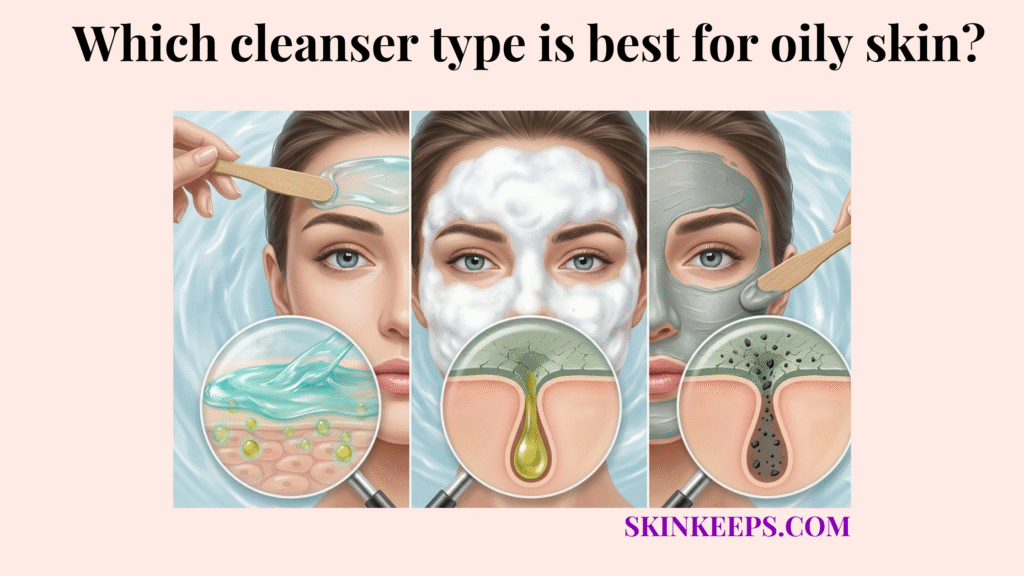
The best cleanser type for oily skin is usually a gentle gel or gentle foaming cleanser that removes excess surface oil without leaving the skin tight, squeaky, or irritated. This matters because oily skin needs oil removal, but it also needs a cleanser that preserves comfort and routine tolerance.
This guideline explains which cleanser textures fit oily skin, when active cleansers like salicylic acid or benzoyl peroxide make sense, which cleanser types are more likely to irritate, and how to choose labels that support oil control without over-stripping.
What cleanser type is usually best for oily skin?
The cleanser type usually best for oily skin is a gentle gel or gentle foaming cleanser that removes excess oil while preserving a comfortable, non-stripped after-feel. This cleanser type fits oily skin because it can lift surface sebum without turning cleansing into a harsh drying step. The skin should feel clean after rinsing, not tight or squeaky.
A treatment cleanser is only needed when oily skin also has a treatment target. Blackheads, clogged pores, and inflamed acne can justify salicylic acid or benzoyl peroxide cleansers. If the skin is already irritated, a non-active gentle cleanser is often the safer first choice.
Why gentle foaming cleansers often suit oily skin
Gentle foaming cleansers often suit oily skin because they lift surface sebum, sweat, and residue while giving the clean finish many oily-skin users prefer. This gentle foam avoids the harsh, aggressive stripping associated with alkaline soaps. The mild lather effectively purifies the skin surface while maintaining essential barrier lipids.
Why gel cleansers often feel better on oily skin
Gel cleansers often feel better on oily skin because they usually rinse clean, feel lightweight, and avoid the heavy residue that some richer cleanser textures can leave behind. Evaluating oily skin product formulations reveals that these water-based gels provide an incredibly fresh finish. The fresh finish leaves the complexion feeling comfortably balanced rather than weighed down.
Why the best cleanser should remove excess oil without stripping the barrier
The best cleanser should remove excess oil without stripping the barrier because oily skin can become tight, reactive, or uncomfortable when cleansing is too aggressive. This barrier preservation ensures the acid mantle remains fully intact and functional. Stripping the barrier completely inevitably leads to long-term irritation and compromised skin health.
| Cleanser Type | Best Fit | Main Caution |
|---|---|---|
| Gentle foaming cleanser | Oily skin that needs oil removal | Avoid harsh, tight after-feel |
| Gel cleanser | Oily or combination skin | Should not be overly drying |
| Salicylic acid cleanser | Oily skin with blackheads or congestion | Use only as tolerated |
| Benzoyl peroxide cleanser | Oily skin with inflammatory acne | Can dry or irritate |
| Cream cleanser | Oily skin that is irritated or dehydrated | May feel too heavy for very oily skin |
Why do gel and foaming cleansers work well for oily skin?
Gel and foaming cleansers work well for oily skin because they are designed to lift surface oil, sweat, and residue while rinsing away with a lighter finish than rich cleanser textures. This texture profile matters because oily skin often dislikes residue. A rinse-clean finish helps the skin feel fresh without requiring harsh scrubbing.
The cleanser’s after-feel decides whether the formula is truly suitable. A good oily-skin cleanser leaves the skin clean and comfortable. A poor cleanser leaves the skin stretched, burning, squeaky, or quickly uncomfortable.
How gel cleansers remove oil while feeling lightweight
Gel cleansers remove oil while feeling lightweight by spreading easily across the skin and rinsing away without leaving a thick film behind. This clean rinsing action lifts away daily debris effortlessly. The resulting texture feels perfectly prepped for subsequent lightweight hydration.
How foaming cleansers lift surface sebum and sweat
Foaming cleansers lift surface sebum and sweat by dispersing oily residue into the cleanser phase so it can be rinsed away more easily. This targeted dispersion gently surrounds the lipid molecules without attacking the skin’s structural mortar. The gentle lifting process purifies the pores without causing underlying tissue distress.
Why a cleanser should rinse clean without leaving the skin tight
A cleanser should rinse clean without leaving the skin tight because tightness usually signals that the formula may be removing too much surface comfort. Recognizing this warning sign helps individuals avoid oily skin harsh products that chronically damage the stratum corneum. A comfortable rinse guarantees the epidermal barrier remains strong and securely hydrated.
When should oily skin use an active cleanser?
Oily skin should use an active cleanser when excess oil is paired with a specific concern such as blackheads, clogged pores, whiteheads, or inflammatory acne. Cleveland Clinic says acne face washes commonly contain benzoyl peroxide or salicylic acid, while AAD notes that salicylic acid is available in cleanser forms and helps open clogged pores. This makes active cleansers targeted tools rather than default cleansers for every oily face. [Cleveland Clinic] and [AAD]
The active ingredient should match the visible problem. Salicylic acid fits oily congestion and clogged pores. Benzoyl peroxide fits acne-prone skin with inflamed lesions, but it can be drying or irritating, so tolerance matters.
When salicylic acid cleansers help oily, clogged skin
Salicylic acid cleansers help oily, clogged skin when blackheads, whiteheads, or oily pore buildup are the main concerns. Exploring oily skin active ingredients clarifies how this oil-soluble beta-hydroxy acid dissolves stubborn follicular plugs. The dissolving action prevents minor blockages from evolving into fully inflamed breakouts.
When benzoyl peroxide cleansers help oily, acne-prone skin
Benzoyl peroxide cleansers help oily, acne-prone skin when inflammatory pimples are part of the problem rather than simple shine alone. AAD’s updated acne guideline strongly recommends topical benzoyl peroxide for acne management to target surface bacteria. Careful, monitored use mitigates the associated drying risks while actively suppressing inflammatory lesions. [AAD]
When a non-active gentle cleanser is the safer choice
A non-active cleanser is the safer choice when oily skin is tight, stinging, peeling, over-cleansed, or already irritated. This non-active cleanser allows the compromised barrier to rest and repair itself naturally. Pausing intense chemical treatments prevents temporary sensitivity from escalating into severe dermatitis.
| Skin Situation | Better Cleanser Direction | Why |
|---|---|---|
| Oily with blackheads | Salicylic acid cleanser | Helps reduce oily pore buildup |
| Oily with inflamed acne | Benzoyl peroxide cleanser | Helps acne-prone skin |
| Oily but sensitive or irritated | Non-active gentle cleanser | Reduces barrier stress |
| Oily but over-cleansed | Gentle low-irritation cleanser | Helps restore comfort |
| Oily with makeup/SPF residue | Gentle cleanser after remover | Removes residue without scrubbing |
Which cleanser types should oily skin avoid?
Oily skin should avoid cleanser types that leave the face tight, burning, squeaky-clean, heavily coated, or irritated after rinsing. AAD specifically advises against oil-based cleansers or alcohol-based cleansers for oily skin because they can irritate the skin. This makes irritation and residue two major warning signs in cleanser selection. [AAD]
The problem is not only cleanser category; it is also after-feel. A harsh bar soap, alcohol-heavy cleanser, or abrasive scrub cleanser may feel powerful at first but can leave oily skin less comfortable. A heavy cleanser that leaves residue can also feel wrong for very oily or acne-prone skin.
Why harsh alkaline soaps can over-strip oily skin
Harsh alkaline soaps can over-strip oily skin because they may remove too much surface lipid and leave the face tight or uncomfortable. This extreme stripping severely disrupts the natural acidic pH of the skin surface. The disruption inevitably triggers a compensatory cycle of dryness and subsequent rebound shine.
Why alcohol-based cleansers can irritate oily skin
Alcohol-based cleansers can irritate oily skin because they can create a fast-drying finish that feels matte at first but uncomfortable later. This rapid evaporation physically dehydrates the outermost epidermal cells. The resulting dehydration leaves the tissue highly reactive and visually inflamed.
Why oil-heavy cleansers may not suit very oily or acne-prone skin
Oil-heavy cleansers may not suit very oily or acne-prone skin when they leave residue, feel coated, or are not followed by proper rinsing. An oil cleanser is usually only needed as the first step of oily skin makeup removal before rinsing thoroughly. Lingering heavy oils easily trap dead skin cells and worsen existing follicular congestion.
| Cleanser Type | Why It May Backfire |
|---|---|
| Harsh bar soap | Can strip and irritate the barrier |
| Alcohol-based cleanser | Can dry and irritate oily skin |
| Strong “squeaky clean” cleanser | Often removes too much surface lipid |
| Heavy oil cleanser used alone | May leave residue if not rinsed well |
| Abrasive scrub cleanser | Can irritate acne-prone oily skin |
Which cleanser labels matter most for oily skin?
The cleanser labels that matter most for oily skin are gentle, oil-free, non-comedogenic, fragrance-free when reactive, and pH-balanced when barrier comfort is a concern. AAD recommends oil-free and non-comedogenic products for oily skin because they are less likely to clog pores or cause acne. These labels help narrow the choice, but the skin’s after-feel still decides whether the cleanser truly fits. [AAD]
Low-irritation matters more than maximum oil removal. A cleanser can remove oil and still be a poor match if it causes stinging, peeling, redness, or tightness. The best oily-skin cleanser should be effective enough to clean but gentle enough to use consistently.
Why oil-free and non-comedogenic labels matter
Oil-free and non-comedogenic labels matter because oily and clog-prone skin usually needs formulas that avoid extra residue and reduce pore-clogging risk. These specific labels guide users away from heavy, occlusive ingredients that block natural sebum flow. Choosing these lighter formulations supports a clearer, more breathable complexion over time.
Why fragrance-free can help reactive oily skin
Fragrance-free can help reactive oily skin because fragrance is an avoidable sensory additive when the skin already stings, flushes, or tolerates products poorly. This fragrance-free safety parameter eliminates unnecessary volatile chemicals from the daily routine. Removing these potential allergens allows an irritated barrier to calm down significantly faster.
Why low-irritation matters more than maximum oil removal
Low-irritation matters more than maximum oil removal because a cleanser that removes too much oil can make oily skin less comfortable and harder to manage. This gentle standard prevents the user from inadvertently inducing chronic skin stress. A balanced, non-irritating wash secures long-term epidermal health and structural resilience.
| Label or Feature | Why It Matters |
|---|---|
| Gentle | Reduces irritation risk |
| Foaming or gel | Often suits oily skin texture preference |
| Oil-free | Avoids adding extra residue |
| Non-comedogenic | Better for clog-prone skin |
| Fragrance-free | Helpful if skin stings or reacts easily |
| pH-balanced | Supports barrier comfort |
How should oily skin choose between cleanser textures?
Oily skin should choose between cleanser textures by matching the cleanser format to the skin’s current oil level, congestion level, acne activity, and irritation status. Very oily skin may prefer gentle foaming textures, while congested skin may tolerate a gel or salicylic acid cleanser. Oily but tight skin may need a gentler gel or cream cleanser instead of stronger oil-removal.
Texture matching prevents the common mistake of treating all oily skin the same. A shiny but comfortable face is different from a shiny, red, stinging face. The cleanser should match the current skin state, not only the skin type label.
When a gel cleanser is the best choice for oily skin
A gel cleanser is often the best choice for oily skin when the face feels greasy, coated, or congested but still reacts poorly to harsh foaming products. This gel texture glides smoothly over the surface to dissolve impurities without aggressive lather. The resulting cleanse leaves the tissue feeling thoroughly purified yet remarkably soft.
When a foaming cleanser is the best choice for oily skin
A foaming cleanser is often the best choice for oily skin when the skin needs stronger surface oil removal but still tolerates a gentle, non-stripping formula. Pairing a foaming wash with the correct oily skin cleansing frequency prevents the barrier from becoming overly stripped. This combination effortlessly manages heavy daily sebum production while keeping the acid mantle entirely safe.
When a cream or lotion cleanser may be better for oily but dehydrated skin
A cream or lotion cleanser may be better for oily but dehydrated skin when gel or foam formulas leave tightness, stinging, or flaky shine after rinsing. Incorporating this adjustment into oily skin care tips ensures users know how to pivot when their barrier becomes temporarily compromised. The creamier base provides necessary conditioning while still lifting away superficial dirt.
| Skin Condition | Best Texture |
|---|---|
| Very oily and shiny | Gentle foaming cleanser |
| Oily and congested | Gel cleanser or salicylic acid cleanser |
| Oily and acne-prone | Gel/foam with acne-support ingredient if tolerated |
| Oily but tight after washing | Gentle gel or cream cleanser |
| Oily and wearing heavy sunscreen/makeup | Makeup remover first, then gentle cleanser |
What should oily skin remember when choosing a cleanser?
Oily skin should remember that the best cleanser is the one that removes excess oil and residue while leaving the face clean, comfortable, and non-irritated.
Final Cleanser Selection Checklist
- Choose a gentle gel or gentle foaming cleanser first when oily skin needs routine oil removal.
- Avoid cleansers that leave the skin tight, squeaky, burning, or irritated after rinsing.
- Use salicylic acid cleanser when blackheads, whiteheads, or clogged pores are the main oily-skin concern.
- Use benzoyl peroxide cleanser only when inflammatory acne is part of the oily-skin problem.
- Choose a non-active gentle cleanser when oily skin feels sensitive, stinging, peeling, or over-cleansed.
- Avoid alcohol-based cleansers because they can irritate oily skin.
- Be cautious with oil-heavy cleansers if very oily or acne-prone skin feels coated after use.
- Choose oil-free and non-comedogenic products when clogging or breakouts are recurring concerns.
- Switch to a gentler cleanser if tightness, flaking, redness, or stinging appears.
FAQs
Which cleanser type is best for oily skin?
The best cleanser type for oily skin is usually a gentle gel or gentle foaming cleanser that removes excess oil without leaving tightness or irritation.
Is a foaming cleanser good for oily skin?
Yes, a gentle foaming cleanser can be good for oily skin because it removes surface sebum and sweat with a cleaner finish. The cleanser should be mild, not harsh or squeaky-clean.
Is a gel cleanser good for oily skin?
Yes, a gel cleanser is often good for oily skin because it feels lightweight, rinses clean, and usually avoids the heavy residue some richer cleansers can leave.
Should oily skin use salicylic acid cleanser?
Oily skin can use a salicylic acid cleanser when blackheads, whiteheads, or clogged pores are major concerns. AAD says salicylic acid helps open clogged pores and is available in cleanser forms. [AAD]
Should oily skin use benzoyl peroxide cleanser?
Oily skin can use a benzoyl peroxide cleanser when inflammatory acne is part of the problem. Cleveland Clinic notes that benzoyl peroxide is available as a wash and targets surface bacteria that can aggravate acne. [Cleveland Clinic]
Should oily skin avoid alcohol-based cleansers?
Yes, oily skin should generally avoid alcohol-based cleansers because AAD says they can irritate the skin. [AAD]
Are oil cleansers bad for oily skin?
Oil cleansers are not automatically bad, but oil-heavy cleansers may not suit very oily or acne-prone skin if they leave residue or are not rinsed properly.
What cleanser should oily but irritated skin use?
Oily but irritated skin should usually use a non-active gentle cleanser until stinging, tightness, or flaking improves.
Conclusion
The best cleanser type for oily skin is a gentle gel or gentle foaming cleanser that cleans excess oil without creating tightness, irritation, or residue. Active cleansers can help when oily skin also has blackheads, clogged pores, or inflammatory acne, but they should not replace a gentle cleanser when the skin is already irritated. The smartest cleanser choice is based on texture, tolerance, after-feel, and whether the skin needs basic cleansing or targeted acne support.
A good oily-skin cleanser should leave the face clean and comfortable, not stripped or coated. By understanding these cosmetic chemistry principles, readers can confidently select formulations that purify effectively while meticulously safeguarding their epidermal barrier.