
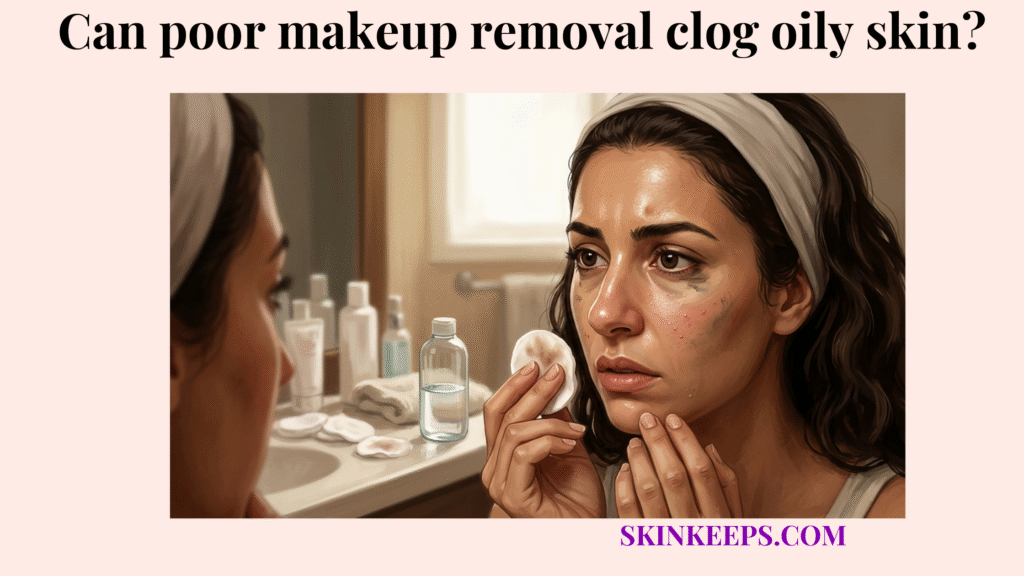
Yes, poor makeup removal can clog oily skin by leaving residue that mixes with sebum, sunscreen, sweat, and dead skin cells around the pores. This matters because oily skin already produces a visible surface lipid film that can make leftover makeup and daily buildup feel harder to clear.
This guideline explains how incomplete makeup removal increases residue buildup, why sleeping in makeup is especially risky, which removal mistakes worsen oily-pore congestion, and how to remove makeup without scrubbing or over-stripping. It also gives a nightly cleansing protocol for clearing makeup, sunscreen, and sebum while preserving barrier comfort.
Why does poor makeup removal clog oily skin?
Poor makeup removal clogs oily skin when leftover cosmetic residue stays around pores and mixes with the skin’s natural surface oil. This makeup residue can include foundation, concealer, pigment, sunscreen film, sweat, and daily debris. When the residue remains on an oil-prone surface, it becomes easier for pores to look congested.
This clogging risk is not proof that all makeup is bad for oily skin. It proves that makeup needs complete removal at night. The mistake belongs inside oily skin skincare mistakes because the problem is routine failure, not makeup use itself.
How leftover makeup residue collects around oily pores
Leftover makeup residue collects around oily pores because foundation, concealer, and pigment can settle into textured areas where sebum is already present. This residue may be more visible around the nose, chin, and inner cheeks. When removal is incomplete, the skin can look duller, darker around pores, or more congested the next morning.
Why oily skin is more vulnerable to makeup-related congestion
Oily skin is more vulnerable to makeup-related congestion because excess sebum can bind with leftover product film and make residue feel stickier on the surface. This sticky surface mixture can make pores appear darker or more filled. When that pattern repeats, it can contribute to the same congestion pathway discussed in oily skin blackheads and breakouts.
Why makeup left overnight creates a stronger clogging risk
Makeup left overnight creates a stronger clogging risk because residue remains on the skin for hours while sebum, sweat, and dead cells continue accumulating. AAD states that even non-comedogenic makeup can cause acne if slept in and recommends removing makeup before bed with no exceptions. This makes nighttime removal the most important anti-congestion step for makeup users with oily skin. [AAD]
How does makeup residue mix with sebum to block oily pores?
Makeup residue mixes with sebum to block oily pores when cosmetic film, sunscreen film, sweat, and dead skin cells combine into a thicker surface buildup. This buildup is more likely when foundation or sunscreen is resistant to water and not fully removed. The result is a residue layer that can make pores look darker, filled, or rough.
This process is mechanical rather than mysterious. Product film remains, sebum spreads through it, and dead cells add texture. When these materials stay near follicles overnight, oily skin can become more prone to visible congestion.
How sebum binds makeup particles, sunscreen film, and daily debris
Sebum binds makeup particles, sunscreen film, and daily debris by creating a lipid-rich surface where residue can spread and adhere more easily. This binding effect is highly noticeable with long-wear cosmetics designed to stick. The natural oil functionally anchors the unwanted products directly over the follicular openings.
How dead skin cells add to makeup-related pore buildup
Dead skin cells add to makeup-related pore buildup by mixing with sebum and leftover product film to create thicker material around follicle openings. This keratin and cell debris transforms the cosmetic film into a substantive, semi-solid blockage. Such an accumulation actively promotes the formation of closed comedones and blackheads.
Why incomplete cleansing leaves oily pores looking darker or more congested
Incomplete cleansing leaves oily pores looking darker or more congested because leftover pigment and oxidized surface buildup can visually emphasize pore openings. This visual darkening makes the skin appear textured and exhausted. Effectively removing this mixture completely prevents the illusion of permanently enlarged, dirty pores.
| Step | What Remains on the Skin | Clogging Effect |
|---|---|---|
| Incomplete makeup removal | Foundation, pigment, concealer | Residue collects around pores |
| Oily-skin surface film | Sebum and sweat | Residue spreads and sticks more easily |
| Dead-cell buildup | Keratin and skin debris | Pore material becomes thicker |
| Overnight wear | Makeup remains for hours | Congestion risk increases |
Why is sleeping in makeup especially harmful for oily skin?
Sleeping in makeup is especially harmful for oily skin because it leaves cosmetic residue on an oil-prone surface for the longest uninterrupted part of the day. AAD states that even non-comedogenic makeup can cause acne if you sleep in it. This warning matters because “non-comedogenic” lowers clogging risk during wear, but it does not make overnight residue harmless. [AAD]
The overnight problem is exposure time. Makeup, sunscreen, sebum, and sweat remain on the skin while the face presses against pillows and bedding. That extended contact can make oily skin look more congested by morning.
Why overnight makeup residue increases clogging time
Overnight makeup residue increases clogging time because the skin stays covered with product film while oil and sweat continue collecting. This extended temporal exposure multiplies the opportunity for follicle blockages to solidify. Time turns a harmless cosmetic application into a severe dermal burden.
Why oily skin can trap more residue during sleep
Oily skin can trap more residue during sleep because the surface lipid film can keep makeup particles, sunscreen film, and debris attached for longer. The continuous nocturnal oil secretion actively refreshes this sticky barrier. The natural stickiness ensures none of the residue flakes away safely overnight.
Why non-comedogenic makeup still needs to be removed
Non-comedogenic makeup still needs to be removed because lower clogging risk during wear does not make makeup safe to leave on overnight. While formulated without heavy occlusives, its pigments and binders still represent foreign matter. Complete removal is the only way to safeguard acne-prone skin from an unexpected morning breakout.
What makeup removal mistakes make oily skin more congested?
Makeup removal mistakes make oily skin more congested when the routine leaves residue behind or irritates the barrier through scrubbing. AAD recommends removing makeup before bed, using an oil-free makeup remover, washing afterward with a gentle cleanser, and avoiding scrubbing even when removing makeup. This makes thorough-but-gentle removal the correct standard. [AAD]
The wrong response is to scrub harder after noticing congestion. Scrubbing adds friction to acne-prone skin and can make redness or breakouts worse. The better response is a remover that dissolves product film before the cleanser step.
Why half-cleansing leaves pore-clogging residue behind
Half-cleansing leaves pore-clogging residue behind because one quick wash may not fully remove long-wear foundation, sunscreen film, and pigment. Modern oily skin product formulations are often water-resistant and designed to grip tightly. A hurried splash of soap fails to break down these resilient chemical binders.
Why scrubbing makeup off can irritate oily skin
Scrubbing makeup off can irritate oily skin because friction aggravates acne-prone tissue and weakens routine tolerance. This aggressive action physically distresses the outer barrier. Such abrasive habits are detailed extensively in oily skin harsh products, highlighting why forceful removal always backfires.
Why using only water often fails to remove long-wear makeup and sunscreen
Using only water often fails to remove long-wear makeup and sunscreen because these products are designed to resist easy breakdown during daily wear. Water alone lacks the lipid-dissolving surfactants necessary to unbind cosmetic films. A dedicated remover ensures these robust formulas lift away cleanly.
Why oily skin should not be stripped after makeup removal
Oily skin should not be stripped after makeup removal because harsh cleansing can remove residue while also irritating the barrier. Exploring over-washing oily skin explains why repeated, aggressive cleansing triggers discomfort and redness rather than healthy clarity.
| Mistake | Why It Backfires | Better Replacement |
|---|---|---|
| Sleeping in makeup | Leaves residue for hours | Remove makeup every night |
| Half-cleansing | Leaves pigment and film behind | Use makeup remover, then cleanser |
| Scrubbing hard | Irritates acne-prone oily skin | Use gentle pressure |
| Using only water | May fail to remove resistant film | Use suitable remover or cleanser |
| Over-stripping afterward | Irritates barrier | Use gentle cleansing |
Which makeup removers work best for oily skin?
Makeup removers that work best for oily skin remove foundation, sunscreen, and pigment without leaving heavy residue or requiring harsh scrubbing. AAD recommends using an oil-free makeup remover for acne-prone makeup users, followed by a gentle cleanser. This supports a two-step logic when makeup or sunscreen is difficult to remove with cleanser alone. [AAD]
Micellar water, oil-free remover, balm, or cleansing oil can all work differently depending on makeup weight and skin tolerance. The key is whether the remover clears residue without a heavy film. Oily users should choose carefully and cleanse afterward if the remover leaves a coating.
Why oil-free makeup removers can suit oily, acne-prone skin
Oil-free makeup removers can suit oily, acne-prone skin because they help dissolve makeup without adding extra surface oil. These liquid solutions efficiently lift away cosmetic pigments while maintaining a light texture. Using them avoids loading the skin with unnecessary greasy compounds.
Why micellar water may help with light makeup removal
Micellar water may help with light makeup removal because it can lift makeup and surface residue with less friction than repeated washing. The gentle micelles act like tiny magnets for dirt and light foundation. A quick rinse or follow-up cleanse guarantees that absolutely no residue remains.
Why cleansing balms or oils should be chosen carefully for oily skin
Cleansing balm or oils should be chosen carefully for oily skin because they can remove resistant makeup well but may feel heavy if they leave residue. While excellent for dissolving stubborn waterproof SPF, their lipid-rich nature demands thorough rinsing. Selecting a non-comedogenic option mitigates the risk of subsequent follicular plugging.
Why the second cleanse matters after makeup removal
The second cleanse matters after makeup removal because it clears remaining remover residue, sebum, and loosened cosmetic film from the skin surface. This ensures the face is entirely pristine before applying nighttime treatments. The resulting clean barrier is fully prepped to absorb active ingredients effectively.
| Remover Type | Best Use | Caution |
|---|---|---|
| Oil-free makeup remover | Acne-prone or very oily skin | Follow with gentle cleanser |
| Micellar water | Light makeup or quick removal | Rinse or cleanse after if residue remains |
| Cleansing balm/oil | Heavy sunscreen or long-wear makeup | Choose non-comedogenic and rinse thoroughly |
| Gentle cleanser | Final cleanse step | Avoid harsh scrubbing |
How should oily skin remove makeup without clogging pores?
Oily skin should remove makeup without clogging pores by dissolving makeup first, cleansing gently second, and avoiding friction-heavy removal. AAD recommends removing makeup before bed, using oil-free makeup remover, then washing with a gentle cleanser while avoiding scrubbing. This gives oily skin a clear routine that removes residue without turning cleansing into irritation. [AAD]
The first step should focus on makeup, sunscreen, and pigment. The second step should focus on remaining sebum and loosened residue. This sequence keeps the routine thorough without requiring aggressive rubbing.
What the first cleanse should remove from oily skin
The first cleanse should remove makeup, sunscreen film, eye makeup, pigment, and long-wear product residue from oily skin. This initial pass focuses purely on dismantling the robust cosmetic barriers. Breaking down these tough layers makes the subsequent wash remarkably gentle.
What the second cleanse should do after makeup removal
The second cleanse should remove remaining sebum, remover residue, sweat, and loosened makeup film after the first removal step. Using a soft, water-based wash finalizes the purification process. This double-layered approach guarantees a truly pristine epidermal surface.
Why gentle cleansing prevents irritation while still clearing residue
Gentle cleansing prevents irritation while still clearing residue because light fingertips pressure can clean oily skin without abrasive friction. Applying oily skin care tips confirms that long-term nightly maintenance relies on mild techniques. Lukewarm water assists in this gentle removal without shocking the skin thermally.
Nightly Makeup Removal Routine for Oily Skin
What should you remember about poor makeup removal and oily skin?
The main point to remember is that poor makeup removal can clog oily skin by allowing cosmetic residue to mix with sebum and dead cells overnight.
Key Takeaways
- Poor makeup removal can clog oily skin.
- The real problem is residue mixing with sebum, sunscreen, sweat, dead cells, and daily debris.
- Sleeping in makeup is the highest-risk mistake.
- Even non-comedogenic makeup still needs to be removed before bed.
- Scrubbing harder is not better makeup removal.
- Oily skin needs thorough but gentle cleansing.
- The best routine removes makeup fully without stripping the barrier.
FAQs
Can poor makeup removal clog oily skin?
Yes, poor makeup removal can clog oily skin by leaving makeup residue, sunscreen film, sebum, and dead cells around pores overnight. This residue mixture can increase blackhead, closed-comedone, and breakout risk.
Is sleeping in makeup bad for oily skin?
Yes, sleeping in makeup is bad for oily skin because it leaves product residue on an already oil-prone surface for hours. AAD states that even non-comedogenic makeup can cause acne if slept in.
Can non-comedogenic makeup still clog pores if not removed?
Yes, non-comedogenic makeup still needs to be removed because lower clogging risk during wear does not make it safe to leave on overnight. AAD specifically says even non-comedogenic makeup can cause acne if you sleep in it.
What is the best way to remove makeup from oily skin?
The best way is to remove makeup before bed with an oil-free makeup remover if needed, then wash with a gentle cleanser without scrubbing. AAD recommends this approach for acne-prone makeup users.
Should oily skin use cleansing oil or cleansing balm?
Oily skin can use a cleansing oil or balm if it removes heavy makeup or sunscreen well, rinses clean, and does not leave a clog-prone residue. Acne-prone users should choose carefully and follow with a gentle cleanser if residue remains.
Is micellar water enough for oily skin makeup removal?
Micellar water may be enough for light makeup, but oily skin may still need a gentle cleanser afterward if sunscreen, long-wear foundation, or residue remains.
Should oily skin scrub to remove makeup fully?
No, oily skin should not scrub to remove makeup. AAD warns that scrubbing can irritate acne-prone skin and cause acne to flare.
Can makeup and sweat clog oily skin?
Yes, makeup and sweat can make oily skin more congestion-prone, especially during workouts. AAD notes that sweat mixed with makeup can clog pores before the workout begins.
Conclusion
Poor makeup removal can clog oily skin when leftover makeup, sunscreen, sebum, and dead cells remain on the surface overnight. The answer is not to avoid makeup completely. The answer is to remove makeup fully, cleanse gently, and avoid scrubbing or stripping the barrier.
Clearer oily skin depends on complete nighttime removal, not aggressive cleansing. At SkinKeeps, we provide the cosmetic chemistry insights needed to maintain a balanced, non-congested complexion daily.