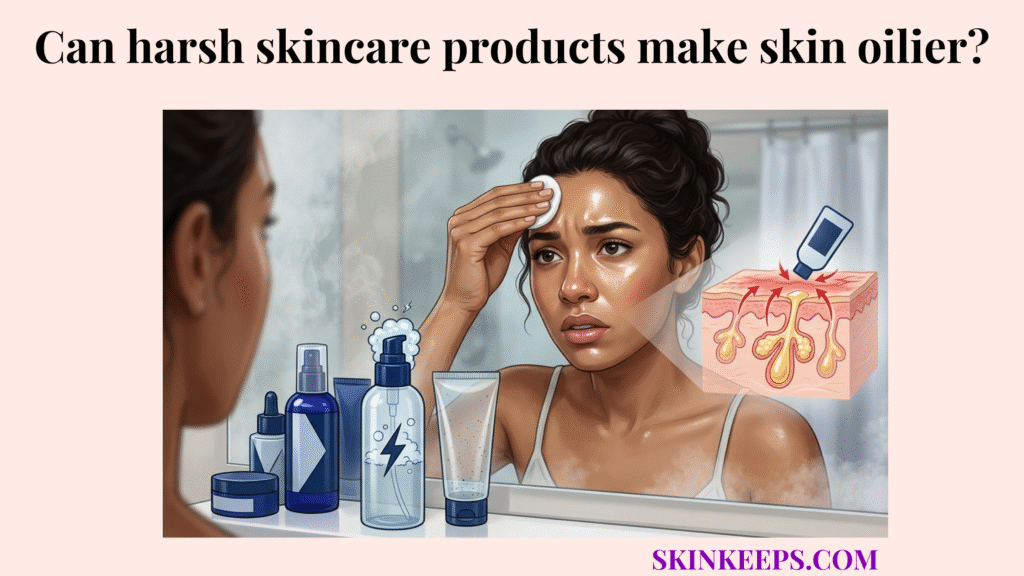
Yes, harsh skincare products can make oily skin feel oilier and harder to control by irritating the barrier, stripping surface lipids, and increasing tight-yet-greasy instability. This is why oily skin often becomes less predictable when the routine focuses on drying the face instead of supporting barrier tolerance.
This guideline explains how harsh cleansing, alkaline soaps, aggressive surfactants, and alcohol-heavy products can destabilize oily skin. It also shows how gentler cleanser chemistry, lightweight hydration, and careful active use can improve comfort without turning oil control into another irritation cycle.
How does the chemical disruption of the acid mantle contribute to rebound oiliness?
Chemical disruption of the acid mantle can contribute to rebound-like oiliness by irritating the barrier, increasing water-loss stress, and making surface oil feel harder to control. The acid mantle is usually discussed around a mildly acidic range of pH 4.5–5.5, and this acidic environment supports barrier function and microbial balance. When a routine repeatedly pushes the surface away from that range, oily skin can feel tighter and less tolerant. [Journal of Integrative Dermatology]
This tight-yet-greasy state happens because water balance and sebum output are separate skin functions. A stripped barrier may feel dehydrated while sebaceous glands continue to release oil. That mismatch creates the user experience of skin that feels dry after washing but looks shiny again later.
How harsh cleansing removes surface lipids and destabilizes the acid mantle
Harsh cleansing removes surface lipids and can destabilize the acid mantle when the cleanser strips more than excess oil from the skin surface. This surface lipid removal decreases natural skin comfort and leaves the outer layer vulnerable to irritation. The resulting barrier irritation explains why over-washing oily skin is counterproductive for long-term control.
Why higher pH cleansing can leave oily skin less comfortable and harder to regulate
Higher skin surface pH cleansing can leave oily skin less comfortable and harder to regulate because alkaline products can disturb the skin’s mildly acidic surface environment. True soap is typically around pH 9–10, and one cited cleansing study found alkaline soap produced the highest skin pH rise and greatest surface-fat reduction among tested cleansing agents. Returning to a balanced pH minimizes this excessive stripping effect. [Journal of Integrative Dermatology]
How barrier stress and TEWL can coexist with visible oiliness
Barrier stress and TEWL can coexist with visible oiliness because water loss can rise while surface sebum still returns. This separation means the stratum corneum can lack internal hydration even when coated in a fresh layer of oil. The resulting oily-but-dehydrated state feels chronically tight despite the persistent shine.
| Skin Change | What Harsh Products May Do | Common Result |
|---|---|---|
| Surface lipid loss | Remove too much oil and barrier-supporting surface material | Tight, stripped feeling |
| pH disruption | Push skin away from its mildly acidic range | More irritation and poorer tolerance |
| TEWL stress | Barrier compromise may increase water-loss stress | Oily yet dehydrated skin feel |
| Oil instability | Shine returns while comfort worsens | Harder-to-control oiliness |
Why do alkaline soaps and harsh surfactants make oily skin worse?
Alkaline soaps and harsh surfactants can make oily skin worse by removing too much surface lipid and increasing irritation instead of improving stable oil control. This cleansing mistake is common because a tight finish feels like oil removal. The problem is that tightness often signals barrier stress, not healthy regulation.
AAD recommends using a gentle foaming face wash for oily skin and warns that strong face wash can irritate oily skin and trigger increased oil production. This makes cleanser tolerance more important than maximum degreasing. The broader mistake belongs inside oily skin skincare mistakes because the product choice is part of a routine pattern. [AAD]
Why traditional alkaline bar soaps can be too harsh for oily facial skin
Traditional alkaline bar soaps can be too harsh for oily facial skin because true soaps often have a high pH that can disturb the acidic surface environment. This pH disruption alters the delicate equilibrium of the facial barrier. Utilizing face-specific, pH-balanced cleansers helps preserve this essential balance.
How strong surfactants increase stripping and irritation risk
Strong surfactants increase stripping and irritation risk when they cleanse so aggressively that the skin feels tight, dry, or uncomfortable afterward. This aggressive cleansing pulls away the functional lipids that keep the stratum corneum intact. The user experiences this loss as a stinging or pulling sensation that immediately precedes an influx of new oil.
Why a squeaky-clean finish is not the same as healthy oil control
A squeaky-clean finish is not the same as healthy oil control because it usually reflects over-removal of surface lipids rather than balanced sebaceous behavior. This tactile friction proves that the skin has lost its lubricating buffer. Healthy regulation leaves the surface feeling clean yet comfortably flexible.
| Cleanser Type | Main Issue | Likely Effect on Oily Skin |
|---|---|---|
| Traditional alkaline soap | Can raise surface pH and strip strongly | Tight, irritated, less stable skin |
| Strong high-foam cleanser | Can remove too much surface lipid | More visible stripping and discomfort |
| Alcohol-based cleanser | Can irritate oily skin | Tightness, stinging, poorer tolerance |
| Gentler low-pH gel or cream cleanser | Cleans with less barrier stress | Better oil-control tolerance |
How do alcohol-heavy astringents worsen product-induced oil instability?
Alcohol-heavy astringents can worsen product-induced oil instability by creating a fast matte finish that may come with irritation, tightness, and poorer barrier comfort. AAD advises against alcohol-based cleansers for oily skin because they can irritate the skin. This makes repeated alcohol-heavy cleansing a poor long-term strategy for oil-control stability. [AAD]
The matte finish from astringents can be misleading because it is often a temporary surface effect. Once the fast-drying feel fades, the skin may still produce oil while also feeling tighter or more reactive. That combination can make the user apply even more drying product, creating a routine loop.
How alcohol-heavy formulas create fast evaporation and surface dehydration
Alcohol-heavy formulas create fast evaporation and surface dryness because volatile alcohols can leave a quick-drying finish on the skin. This rapid dry-down removes surface moisture almost instantaneously. The sudden absence of moisture leaves the barrier feeling unnaturally stretched and dehydrated.
Why temporary matte skin can be followed by greater discomfort and visible oiliness
Temporary matte skin can be followed by greater discomfort and visible oiliness because the product dries the surface without changing the underlying oily-skin tendency. This temporary effect wears off as the sebaceous glands naturally replenish the lipid layer. The contrasting tight feeling and new shine create a highly uncomfortable sensory experience.
Why oily skin can become both greasy and dehydrated after repeated astringent use
Oily skin can become both greasy and dehydrated after repeated astringent use because surface oil and water comfort are controlled by different skin processes. This oily-but-dehydrated state occurs when harsh astringents compromise the skin’s ability to retain internal water. The compromised tissue struggles to stay plump even as it shines with fresh sebum.
| Product Pattern | What It May Do | Common Result |
|---|---|---|
| Alcohol-heavy toner | Creates fast dry-down and surface tightness | Temporary matte feel followed by discomfort |
| Repeated astringent use | Adds ongoing irritation risk | Oily yet irritated skin |
| Matte-at-all-costs routine | Over-corrects visible shine | More instability, not better tolerance |
| Hydrating replacement | Supports water comfort without heavy grease | Calmer, more stable skin feel |
Which formulations help replace harsh products without worsening oily skin?
Formulations that replace harsh products without worsening oily skin use gentler cleansing, lightweight hydration, and controlled acne actives instead of aggressive stripping. A gentle cleanser reduces irritation pressure, while lightweight hydration supports comfort without a heavy finish. The product-selection layer can continue through oily skin product formulations once the user understands why harsh chemistry backfires.
Salicylic acid can support clogged-pore oily skin when used at a tolerated strength and frequency. U.S. OTC acne rules list salicylic acid at 0.5% to 2%, and acne-drug labeling warns that excessive drying can occur and frequency should be reduced if bothersome dryness or peeling appears. This makes controlled use safer than replacing harsh cleansers with harsh active overuse. [eCFR]
Which low-pH non-stripping cleansers suit oily skin better
Low-pH non-stripping cleansers suit oily skin better when they remove daily oil, sweat, and sunscreen without leaving the face tight or irritated. These mild surfactants respect the skin’s natural tolerance limits. Preserving this tolerance prevents the frantic oil-return cycle that typically follows harsh cleansing.
Which lightweight humectant-based moisturizers support oily skin without heaviness
Lightweight humectant-based moisturizers support oily skin without heaviness by improving water comfort without adding a greasy surface film. Ingredients like glycerin and hyaluronic acid effectively bind moisture without clogging pores. This explains why oily skin skipping moisturizer is a flawed strategy that keeps the skin tight and unbalanced.
Additionally, while heavy occlusives like petrolatum are sometimes avoided in active acne zones to prevent a heavy feel, they are highly effective for locking in moisture on dry patches. [PMC]
Which oil-control ingredients help without aggressive stripping
Oil-control products can help without aggressive stripping when they target shine or clogged pores while respecting irritation limits. Niacinamide and salicylic acid offer targeted support when used carefully. For a broader comparison of these options, oily skin active ingredients details how they balance the complexion without stripping it. [PMC]
| Harsh Product Habit | Better Replacement | Why It Works Better |
|---|---|---|
| Alkaline soap | Gentle pH-aware gel cleanser | Cleans with less pH disruption |
| Alcohol-heavy toner | Lightweight hydrating fluid or serum | Reduces tightness and irritation risk |
| Repeated stripping cleanser use | Consistent gentle cleansing | Improves comfort without overcorrection |
| Heavy anti-oil routine | Balanced oil-control plus hydration | Better long-term tolerance |
| Harsh active stacking | One active introduced by tolerance | Reduces irritation while still treating congestion |
What daily routine helps recover from harsh-product-induced oil instability?
A daily routine helps recover from product-induced oiliness by removing stripping products, simplifying active use, and rebuilding comfort with gentle hydration. This recovery phase should feel calmer, not more aggressive. The full routine can continue through oily skin care tips once the harsh-product cycle is controlled.
Progress should be judged by less tightness, less stinging, fewer irritation flares, and more predictable oil return. The goal is not to make oily skin completely dry. The goal is to make oil control more stable by reducing avoidable irritation.
How cleansing frequency should change when harsh products have been overused
Cleansing frequency should change when harsh products have been overused by moving away from repeated stripping and returning to gentle, consistent washing. Cleansing in the morning and evening, or after heavy sweating, provides adequate hygiene. Utilizing blotting papers for midday shine safely replaces the urge to perform repeated full washes.
Why lightweight hydration belongs in recovery for oily skin
Lightweight hydration belongs in recovery for oily skin because restoring water comfort helps reduce the tight-yet-greasy feeling caused by stripping routines. This barrier support relies on non-comedogenic textures that absorb cleanly. Providing this hydration soothes the stressed tissue and restores functional flexibility.
How a short barrier-support phase can improve oily-skin comfort and control
A short barrier-support phase can improve oily-skin comfort and control by pausing irritating products and prioritizing gentle, non-comedogenic care. This simple recovery phase allows the stratum corneum to stabilize its natural lipid and moisture levels. A stabilized barrier drastically minimizes the severity of future oil flares.
Daily Recovery From Harsh-Product-Induced Oiliness
FAQs
Can harsh skincare products make skin oilier?
Yes, harsh skincare products can make oily skin feel oilier and harder to control by irritating the barrier and stripping too much surface lipid. Harsh face washes can irritate oily skin and trigger increased oil-control difficulty over time.
Why does my skin feel tight but look greasy after washing?
Skin can feel tight but look greasy because water balance and sebum output are separate. Harsh washing can leave the barrier uncomfortable while sebaceous glands continue to release surface oil.
Are alkaline soaps bad for oily skin?
Traditional alkaline soaps can be too harsh for some oily facial skin because true soaps often have a high pH. True soap commonly falls around pH 9–10, while the protective acid mantle is usually discussed around pH 4.5–5.5.
Are alcohol toners bad for oily skin?
Alcohol-heavy toners or cleansers can be irritating for oily skin, especially when used repeatedly to chase a matte finish. Alcohol-based cleansers for oily skin can severely irritate the epidermal barrier and cause temporary dryness.
What should replace harsh cleansers for oily skin?
A gentler replacement is a mild, pH-aware cleanser that removes oil, sweat, sunscreen, and makeup without leaving the skin tight. The cleanser should leave the face clean but comfortable.
Should oily skin use moisturizer after harsh-product irritation?
Yes. Oily skin can still need moisturizer because oiliness and hydration are different needs. Applying a lightweight, non-comedogenic moisturizer after cleansing is crucial even for oily skin.
Is salicylic acid safe after harsh products?
Salicylic acid can help clogged-pore oily skin, but it should be reintroduced carefully after irritation. U.S. OTC acne rules list salicylic acid at 0.5% to 2%, and labeling warns that dryness or irritation can occur if overused.
How long should a recovery routine stay simple?
A recovery routine should stay simple until tightness, stinging, redness, and irritation improve. Once the skin feels stable, acne actives can be reintroduced slowly based on tolerance.
Conclusion
Harsh skincare products can make oily skin harder to control when they create irritation, tightness, and barrier stress instead of stable oil management. Alkaline soaps, harsh cleansers, and alcohol-heavy products can make oily skin feel stripped, tight, shiny, and reactive.
A better routine uses gentle cleansing, lightweight hydration, and carefully introduced actives that manage oil without adding more irritation. Stable oily-skin control comes from respecting barrier chemistry, not stripping the face into discomfort.