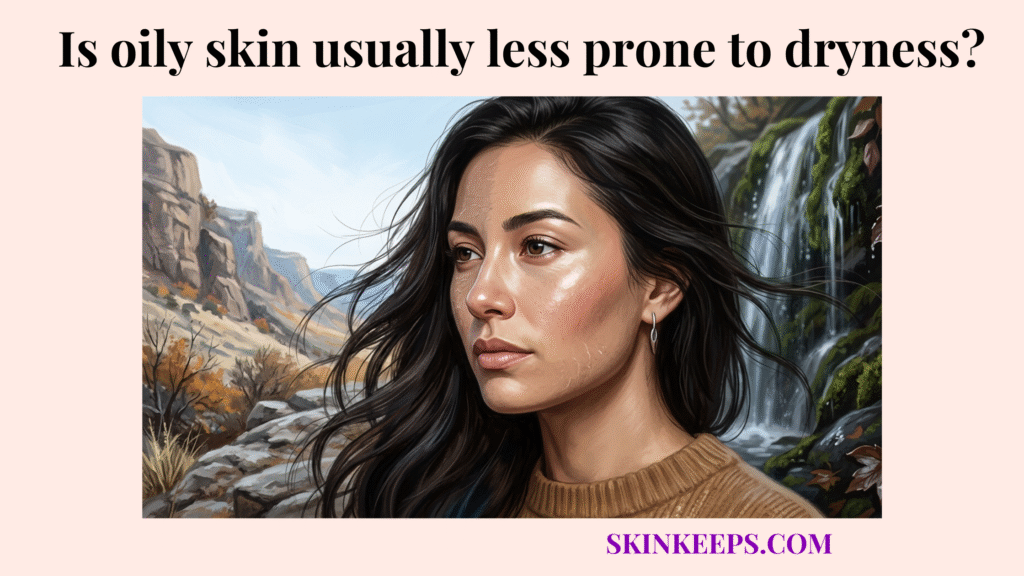
Yes, oily skin is usually less prone to classic lipid-deficient dryness because higher sebum output helps lubricate the surface, but oily skin can still become water-dehydrated and barrier-stressed. This distinction is essential because oily skin can look shiny while still feeling tight, flaky, or irritated underneath.
This guideline explains which type of dryness oily skin usually resists, why sebum reduces classic oil-deficient dryness, how oily skin still becomes dehydrated, and how to identify an oily-but-dry pattern. It also explains which lightweight moisturizer textures help oily skin stay hydrated without becoming greasy or clogged.
What kind of dryness is oily skin usually less prone to?
Oily skin is usually less prone to lipid-deficient dryness, which means dryness caused by too little surface oil or too little natural barrier lipid support. This type of dryness is more common when the skin lacks enough lubricating lipids to reduce roughness and surface friction. Oily skin often has more of that lipid support because sebaceous glands produce more sebum.
This does not mean oily skin is safe from every dry-feeling problem. Dehydration is different because it refers to water shortage inside the stratum corneum. That is why a person can have a shiny face and still feel tight after cleansing.
Why oily skin is less prone to lipid-deficient dryness
Oily skin is less prone to lipid-deficient dryness because sebum provides more natural surface lubrication than skin types with lower oil output. Exploring oily skin benefits provides context on how this lipid abundance creates a smoother tactile feel. This structural characteristic ensures the tissue rarely experiences true lipid starvation.
Why oily skin can still experience water-based dehydration
Oily skin can still experience water-based dehydration because sebum and water balance are controlled by different functions inside the skin. Utilizing an appropriate oily skin moisturizer is vital to prevent internal water loss regardless of surface shine. Failing to support this internal moisture creates a compromised, uncomfortable barrier.
Why dryness and dehydration are not the same skin problem
Dryness and dehydration are not the same skin problem because dryness usually refers to lipid shortage, while dehydration refers to water shortage. Recognizing this distinction prevents users from aggressively stripping their skin or avoiding hydration entirely. Proper diagnosis enables targeted, highly effective barrier support.
| Skin Condition | What Is Lacking | How It Feels | Can Oily Skin Have It? |
|---|---|---|---|
| Lipid-deficient dryness | Oil and barrier lipids | Rough, dry, under-lubricated | Less commonly |
| Dehydration | Water in the stratum corneum | Tight, flaky, uncomfortable | Yes |
| Barrier stress | Stable surface protection | Stinging, irritation, sensitivity | Yes |
| Oily dehydration | Water balance with excess oil | Greasy but tight | Yes |
Why does sebum make oily skin less prone to classic dryness?
Sebum makes oily skin less prone to classic dryness by coating the outer skin surface with lipids that improve lubrication, reduce friction, and support barrier comfort. Review literature describes sebum as contributing to skin homeostasis, maintaining barrier function, and supporting antimicrobial defense. This helps explain why oily skin often resists the rough, under-lubricated feel associated with classic dry skin. [PMC]
Sebum still has limits. It can reduce dry-feeling friction, but it cannot replace water inside the stratum corneum. That is why oily skin sebum barrier should be treated as a barrier-lipid topic, not as proof that oily skin never needs hydration.
How sebum lubricates the skin surface
Sebum lubricates the skin surface by forming a thin lipid layer over the stratum corneum. This layer prevents harsh mechanical friction from environmental exposure. The smooth lipid distribution guarantees the tissue remains pliable rather than brittle.
How surface oil reduces a rough, dry skin feel
Surface oil reduces a rough, dry skin feel by lowering friction between outer skin cells and the environment. This constant emollience smooths down microscopic cellular edges. The smoothed edges physically diminish the coarse sensation typical of true lipid dryness.
Why sebum helps comfort but does not replace hydration
Sebum helps comfort but does not replace hydration because lipids and water perform separate roles in the skin barrier. The lipids provide a sealing mechanism, while water ensures enzymatic and cellular flexibility. Recognizing this biological split is vital for proper routine formulation.
| Sebum Function | Effect on Oily Skin | Dryness-Related Benefit |
|---|---|---|
| Surface lubrication | Adds natural slip | Less roughness |
| Lipid coating | Reduces dry-feeling friction | Less tight surface feel |
| Barrier support | Helps surface comfort | Less classic dryness |
| Excess oil | Can become heavy or congesting | Not a hydration solution |
How can oily skin still become dehydrated?
Oily skin can still become dehydrated when the stratum corneum loses water faster than the routine replaces it, even while sebum continues returning to the surface. This creates the confusing pattern of skin that looks shiny but feels tight or uncomfortable. The shine reflects surface oil, while the tightness reflects water imbalance.
Moisturizer science explains why this pattern needs hydration support. NCBI StatPearls explains that occlusive moisturizers reduce transepidermal water loss by reducing water evaporation from the skin, and petrolatum can reduce epidermal water loss by nearly 99%. This supports the larger principle that water loss can be managed even when the skin is oily, although oily skin often tolerates lighter non-comedogenic textures better than heavy occlusives. [NCBI Bookshelf]
How harsh cleansing removes comfort even when oil returns
Harsh cleansers remove comfort even when oil returns because cleansing can strip surface support while sebum production later resumes independently. Examining oily skin harsh products highlights how aggressive surfactants compromise the acid mantle. This aggressive stripping guarantees uncomfortable tightness prior to the inevitable shine return.
How TEWL makes oily skin feel tight underneath surface shine
TEWL makes oily skin feel tight underneath surface shine because water escapes from the stratum corneum while surface oil remains visible. This invisible evaporation depletes the cellular matrix. The resulting depletion translates directly into a stretched, restrictive physical sensation.
Why shiny skin can still lack enough water
Shiny skin can still lack enough water because sebum controls surface lubrication while hydration controls cellular flexibility. Oily dehydration occurs precisely because these two systems operate independently. Consequently, visual glare does not confirm adequate internal moisture.
| Sign | Balanced Oily Skin | Dehydrated Oily Skin |
|---|---|---|
| Surface shine | Present in oily zones | Present but less comfortable |
| Skin feel | Slick or soft | Tight, stretched, or stingy |
| Texture | Smooth or greasy | Flaky, rough, or dull |
| After cleansing | Oil returns gradually | Tightness appears quickly |
| Moisturizer response | May need light hydration | Usually improves with lightweight hydration |
When does oily skin start acting dry?
Oily skin starts acting dry when harsh cleansing, drying acne treatments, cold weather, low humidity, or over-exfoliation disrupts water balance and barrier comfort. These triggers do not necessarily stop sebum production. Instead, they can create a mixed state where skin remains oily at the surface but feels dry underneath.
Acne treatments can contribute to this pattern when tolerance is low or use is too aggressive. Review literature notes that retinoids and benzoyl peroxide can cause skin irritation and dryness, and combining them can intensify these effects. This supports using actives carefully in oily skin that starts peeling, stinging, or feeling tight. [PMC]
When over-cleansing turns oily skin tight
Over-cleansing turns oily skin tight when repeated washing removes too much surface support and leaves the stratum corneum uncomfortable. The constant surfactant exposure violently strips the natural moisture factors away. This habit guarantees long-term instability.
When acne treatments make oily skin peel or sting
Acne treatments can make oily skin peel or sting when active ingredients exceed the skin’s current tolerance. High concentrations abruptly overwhelm the tissue’s capacity to regenerate smoothly. The resulting chemical stress forces the epidermis into a reactive, shedding state.
When cold weather or low humidity creates oily-but-dry skin
Cold weather or low humidity creates oily-but-dry skin when dry air increases water loss while sebum continues to reach the surface. The atmospheric draw pulls hydration rapidly from the cells. This climate trigger ensures the skin feels taut even as sebaceous output persists.
When over-exfoliation removes too much surface protection
Over-exfoliation removes too much surface protection when acids, scrubs, or brushes are used beyond the skin’s tolerance. Referencing oily skin over-exfoliating illustrates how aggressive physical disruption severely damages barrier integrity. Removing these layers prematurely exposes deeply sensitive tissue.
| Trigger | What It Disrupts | Result |
|---|---|---|
| Harsh cleansers | Surface barrier comfort | Tight, shiny skin |
| Benzoyl peroxide or retinoids | Tolerance and moisture balance | Peeling or irritation |
| Over-exfoliation | Stratum corneum stability | Smooth but sensitive skin |
| Cold or dry air | Water retention | Oily yet dehydrated feel |
| Skipping moisturizer | Hydration support | Greasy but tight skin |
How do you tell oily skin from oily-but-dehydrated skin?
You can tell oily skin from oily-but-dehydrated skin by checking whether shine appears together with tightness, flaking, stinging, or discomfort after cleansing. Balanced oily skin may look shiny but usually feels comfortable. Oily-dehydrated skin often looks shiny while feeling stretched or irritated.
The moisturizer response can also clarify the pattern. If a lightweight gel moisturizer reduces tightness without increasing heaviness, the problem was likely water support rather than a need for stronger oil removal.
How tightness after washing signals dehydration risk
Tightness after washing signals dehydration risk because the skin is losing water comfort faster than it is restoring surface balance. This immediate symptom is the clearest indicator of an underlying hydration deficit. Ignoring it ensures the problem will persist throughout the day.
How flaking with shine points to oily dehydration
Flaking with shine points to oily dehydration because oil remains visible while the outer water balance is failing. This visual paradox confirms that the cells lack internal moisture to shed properly. It visually separates simple greasiness from true barrier distress.
How stinging from basic products reveals barrier stress
Stinging from basic products can reveal barrier stress because a compromised stratum corneum becomes less tolerant of formulas it previously handled well. This sudden hypersensitivity marks a distinct drop in the skin’s defensive capability. Immediate soothing interventions are necessary to restore normal tolerance.
Diagnostic Checklist: Oily Skin or Oily-Dehydrated Skin?
Which moisturizing textures prevent dryness without making oily skin greasy?
Moisturizing textures that prevent dryness without making oily skin greasy are usually lightweight gels, lotion-fluids, humectant serums, and non-comedogenic formulas. Humectants such as glycerin and hyaluronic acid support this goal because they help improve hydration rather than adding heavy surface grease. A clinical hydration study notes that hyaluronic acid and glycerin are known to improve skin hydration. [PMC]
Texture matters because oily skin often dislikes heavy residue. A clinical study found topical 2% niacinamide may reduce facial sebum-related measurements in studied groups, making it a useful addition for oil-balance support. Gel moisturizer and fluid textures usually support comfort while avoiding the coated feel that can make shine and congestion worse. [PubMed]
Why gel moisturizers suit oily skin with dehydration
Gel moisturizers suit oily skin with dehydration because they provide water-based comfort with less surface weight than rich creams. Their elegant texture absorbs flawlessly without depositing unwanted lipid layers. This formulation mastery ensures the tissue receives moisture purely and cleanly.
Why humectants help oily skin hold water
Humectants help oily skin hold water by binding moisture into the stratum corneum instead of adding extra oil. This chemical action draws water into the cells actively. The active binding guarantees persistent flexibility without risking comedogenic buildup.
Why non-comedogenic fluids are safer than heavy creams for many oily faces
Non-comedogenic fluids are safer than heavy creams for many oily faces because they reduce hydration discomfort without adding unnecessary occlusive weight. These liquids fortify the barrier effectively. The fortification provides the necessary stability to withstand the demands of daily oil control.
| Texture or Ingredient | Main Benefit | Best Fit |
|---|---|---|
| Gel moisturizer | Lightweight hydration | Shiny but tight skin |
| Glycerin | Water-binding support | Daily hydration |
| Hyaluronic acid | Surface water support | Dehydrated oily skin |
| Lightweight lotion-fluid | Balance without heaviness | Oily but barrier-stressed skin |
| Non-comedogenic formula | Lower clogging risk | Acne-prone oily skin |
How should oily skin prevent dryness without losing oil control?
Oily skin should prevent dryness without losing oil control by cleansing gently, adding lightweight hydration after washing, and adjusting moisture support when tightness appears. AAD recommends cleansing oily skin up to twice daily and after sweating, choosing oil-free and non-comedogenic products, avoiding scrubbing, and stopping products that irritate the skin. This supports oil control without pushing oily skin into dehydration. [AAD]
The goal is not totally matte skin. The goal is skin that feels comfortable while shine stays predictable. Long-term maintenance can connect to oily skin care tips when the writer explains how to balance cleansing, hydration, and oil control every day.
What a morning routine should do for oily skin dryness prevention
A morning routine for oily skin dryness prevention should remove overnight oil gently, add lightweight moisturizer, and protect the skin without adding heavy residue. This establishes the clean slate needed for the day. Applying protection immediately ensures the tissue remains guarded against harsh elements.
What an evening routine should do after cleansing or actives
An evening routine after cleansing or actives should restore water comfort with a lightweight moisturizer before tightness, flaking, or stinging develops. This preemptive moisturizing secures the barrier over the active night hours. Securing the barrier mitigates any severe chemical stress caused by potent serums.
How to adjust hydration when the skin feels tight but looks shiny
You should adjust hydration when the skin feels tight but looks shiny by reducing stripping steps and increasing lightweight water support. This responsive adjustment prevents the condition from worsening rapidly. Adapting dynamically to the skin’s feedback ensures lasting health.
Daily Hydration Balance for Oily Skin
What should you remember about oily skin and dryness?
The main point to remember is that oily skin is usually less prone to classic oil-deficient dryness, but it can still become dehydrated, flaky, tight, or irritated.
Key Takeaways
- Oily skin is usually less prone to classic oil-deficient dryness.
- Oily skin can still become dehydrated.
- Sebum helps lubrication but does not replace water.
- Shiny skin can still feel tight, flaky, or irritated.
- Harsh cleansing and over-exfoliation are common causes of oily-but-dry skin.
- Lightweight hydration is the key, not heavy grease.
- The goal is balanced oil and water, not zero oil.
FAQs
Is oily skin usually less prone to dryness?
Yes, oily skin is usually less prone to classic lipid-deficient dryness because it produces more sebum. However, it can still become dehydrated when the stratum corneum lacks enough water.
What type of dryness is oily skin less prone to?
Oily skin is less prone to dryness caused by lack of surface oil or barrier lipids. It is not protected from water-based dehydration, barrier stress, or irritation.
Can oily skin be dehydrated?
Yes, oily skin can be dehydrated because oil and water are different skin needs. The skin can look shiny while still feeling tight, flaky, or uncomfortable.
Why does oily skin feel tight after washing?
Oily skin feels tight after washing when cleansing removes surface support and water evaporates from the stratum corneum. This tightness can appear even if shine returns later.
Should oily skin use moisturizer?
Yes, oily skin should use moisturizer when it feels tight, flaky, irritated, or dehydrated. Lightweight, oil-free, and non-comedogenic moisturizers help restore comfort safely.
Which moisturizer is best for oily but dry skin?
A lightweight gel, lotion-fluid, humectant serum, or non-comedogenic moisturizer is usually better tolerated than a heavy cream. Glycerin and hyaluronic acid are useful hydration-supporting ingredients.
Can acne treatments make oily skin dry?
Yes, acne treatments can make oily skin dry, especially when overused or poorly tolerated. Retinoids and benzoyl peroxide can cause irritation and dryness if the barrier is stressed.
How often should oily skin cleanse if it feels dry?
Cleansing should generally happen up to twice daily and after sweating. If the skin feels tight or irritated, the cleanser may be too harsh or used too often.
Conclusion
Oily skin is usually less prone to lipid-deficient dryness because sebum supports surface lubrication, but it can still become dehydrated when water balance is poor. The key is knowing which problem you are seeing. If the skin is rough from low oil, sebum may offer some protection. If the skin is shiny but tight, flaky, or stinging, the problem is likely hydration or barrier stress.
Healthy oily skin needs balanced oil and water, not total oil removal or heavy grease. At SkinKeeps, we provide clinical insights to help you manage this delicate equilibrium, ensuring your skin remains comfortable and well-supported.