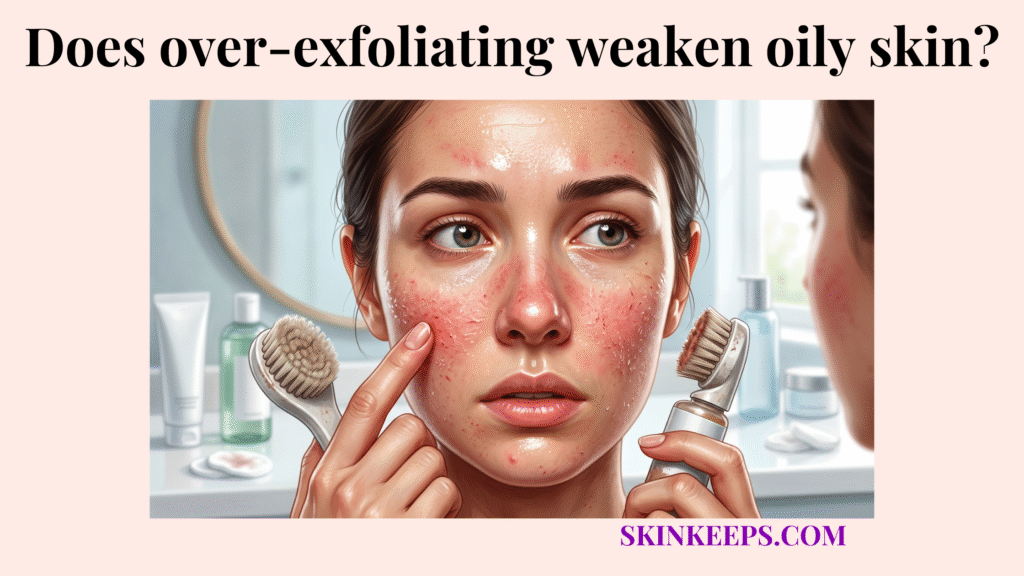
Yes, over-exfoliating can weaken oily skin by irritating the stratum corneum, increasing barrier stress, and making the skin tighter, shinier, and more reactive. This is why oily skin can look glossy after excessive exfoliation while still feeling dry, raw, or uncomfortable.
This guideline explains how excessive exfoliation outpaces normal desquamation, why barrier stress can create the shiny-but-dehydrated look, how scrubs and overused acids can worsen acne-prone flares, and which barrier-support steps help the skin recover. It also shows how to reintroduce exfoliation slowly instead of turning it into another irritation cycle.
Step 1: How does aggressive exfoliation strip the protective stratum corneum of oily skin?
Aggressive exfoliation can strip the protective stratum corneum of oily skin by removing outer corneocytes faster than the barrier can comfortably tolerate. This over-removal matters because the stratum corneum is the surface layer that helps keep irritants out and water in. When exfoliation frequency or strength exceeds tolerance, the skin may become smoother for a moment but more reactive afterward.
Aggressive scrubbing is especially risky for acne-prone skin because friction can irritate lesions and surrounding barrier tissue. AAD warns that scrubbing acne-prone skin can irritate the skin and cause acne to flare. This is why oily skin skincare mistakes should treat over-exfoliation as a correction problem, not a stronger cleansing strategy. [AAD]
Forced desquamation
Forced desquamation from aggressive exfoliation removes corneocytes faster than the skin can comfortably tolerate. This forced shedding disrupts the normal surface rhythm that lets the barrier renew gradually. When the shedding pace is pushed too hard, oily skin can become sting-prone and less tolerant of products that previously felt normal.
Surface damage from over-exfoliation
Surface damage from over-exfoliation occurs when harsh friction or overused acids irritate the barrier and reduce skin tolerance. AAD advises selecting an exfoliation method that suits skin type and notes that dry, sensitive, or acne-prone skin may prefer a mild chemical exfoliator because mechanical exfoliation may be too irritating. This supports cautious exfoliation rather than aggressive scrubbing for breakout-prone oily skin. [AAD]
Step 2: Why does accelerated shedding trigger higher TEWL and tightness in oily skin?
Accelerated shedding can contribute to higher TEWL and tightness in oily skin by weakening the surface barrier that normally helps slow water loss. TEWL and stratum corneum hydration are commonly used to reflect different aspects of skin physiology, including barrier dysfunction and water comfort. This is why over-exfoliated skin can feel tight even when oil is still present. [PMC]
The tightness is not proof that exfoliation is working effectively. This tightness often means the surface barrier is uncomfortable or irritated. When the barrier feels stressed, the skin may sting from products that were previously tolerated well.
The evaporation problem
The evaporation problem arises when a stressed stratum corneum becomes less effective at maintaining water comfort. This weaker water comfort can make oily skin feel tight, sting-prone, or flaky. The visible oil may still return because surface sebum and water retention are controlled by different skin processes.
The shiny-but-stripped look
The shiny-but-stripped look develops because surface sebum can remain visible while the underlying barrier feels dehydrated and irritated. This creates a confusing paradox where the face reflects light like a mirror but feels actively tight underneath. Recognizing this dual state is critical for proper barrier rehabilitation.
| Skin State | Barrier Status | How It Feels | How It Looks |
|---|---|---|---|
| Balanced oily skin | More stable | Comfortable, slick mainly in oily zones | Controlled shine |
| Over-exfoliated oily skin | Barrier stressed, water comfort reduced | Tight, stinging, flaky | Shiny yet irritated |
| Irritated oily skin | Product tolerance reduced | Red, warm, reactive | Shine plus redness |
| Recovering oily skin | Barrier comfort improving | Less tight, less sting-prone | Shine becomes more predictable |
Step 3: Why can over-exfoliated oily skin become shinier, redder, and harder to control?
Over-exfoliated oily skin can become shinier, redder, and harder to control because barrier irritation makes normal oil return feel heavier and less stable. This irritation can lower tolerance to cleansers, acids, retinoids, and sunscreen. The result is skin that still looks oily but behaves more like sensitive skin.
A rebound oiliness tendency can appear when the user keeps exfoliating to chase the shine. This pattern does not mean the skin is producing emergency oil on command. It means the routine is repeatedly stripping the surface, so oil return feels harder to manage against a background of tightness and irritation.
Inflammatory worsening
Inflammatory worsening happens when persistent barrier stress leaves oily skin redder, sting-prone, and less tolerant of routine products. This reduced tolerance matters because acne-prone skin often already receives drying or active treatments. When exfoliation is added too aggressively, the skin can become irritated before it becomes clearer.
Rebound oiliness tendency
A rebound oiliness tendency can occur after repeated stripping when oil return feels more noticeable against a tight, irritated barrier. This phenomenon is closely related to over-washing oily skin, as both repeated cleansing and repeated exfoliation degrade surface comfort similarly. Managing this tendency requires barrier stabilization rather than more friction.
| Step | What Happens | Common Result |
|---|---|---|
| Over-exfoliation | Barrier is over-disrupted | More irritation |
| TEWL stress rises | Water comfort becomes less stable | Tightness and stinging |
| Oil control destabilizes | Shine returns while comfort worsens | Oily-yet-dehydrated feel |
| Acne-prone skin gets irritated | Product tolerance drops | More flare-prone skin |
Step 4: Why can over-exfoliation worsen breakouts in oily skin?
Over-exfoliation can worsen breakouts in oily skin because abrasive friction and overused acids irritate acne-prone tissue instead of calmly clearing congestion. AAD states that scrubbing acne-prone skin can irritate the skin and cause acne to flare. This makes aggressive exfoliation a risk for breakout-prone oily skin rather than a reliable shortcut to clearer pores. [AAD]
Overused acids can also worsen acne-prone routines when they are layered too often or combined with other irritating actives. Salicylic acid can help clogged pores when used appropriately, but it can still sting or dry the skin if the barrier is already irritated. The ingredient comparison belongs inside oily skin active ingredients rather than being overused on this page.
Scrubbing worsens acne-prone irritation
Scrubbing worsens acne-prone irritation because abrasive friction aggravates inflamed lesions and surrounding barrier tissue. This mechanical aggravation increases redness or discomfort instead of soothing the breakout. Avoiding stiff brushes and rough physical scrubs protects the vulnerable epidermis from unnecessary trauma.
Barrier damage makes breakouts harder to calm
Barrier damage makes breakouts harder to calm because irritated skin tolerates standard acne treatments less comfortably. This lowered tolerance makes treating the actual lesions frustrating, as the skin now stings upon contact with previously safe formulations. Fixing this issue means addressing oily skin harsh products to eliminate stripping before attempting acne clearance.
| Method | Main Mechanism | Likely Effect on Oily, Acne-Prone Skin |
|---|---|---|
| Harsh scrub particles or aggressive brushes | Mechanical friction | More irritation and redness |
| Overused strong acids | Repeated chemical over-exfoliation | Barrier stress and stinging |
| Gentle, appropriately spaced exfoliation | Controlled surface turnover | Better tolerated when used correctly |
| Temporary exfoliation pause | Barrier recovery support | Useful when skin is stinging or tight |
Step 5: Which barrier-repair ingredients help rehabilitate over-exfoliated oily skin?
Barrier-repair ingredients help rehabilitate over-exfoliated oily skin by supporting water comfort, lipid organization, and product tolerance without adding unnecessary heaviness. AAD recommends moisturizer when acne-prone skin feels dry and says applying it after washing helps trap water in the skin. This supports lightweight moisturizer use during an over-exfoliation recovery phase. [AAD]
Ceramide-focused barrier support can be useful when the stratum corneum feels compromised. Review literature discusses ceramide-dominant lipid products as helping replenish stratum corneum intercellular spaces. This supports ceramide and cholesterol language as barrier reinforcement, not a cure-all. [PMC]
Biomimetic lipids and barrier support
Biomimetic lipids and barrier-support ingredients such as ceramides and cholesterol help reinforce the compromised surface barrier. This intercellular lipid support mimics the skin’s natural protective mortar. These ingredients provide essential reinforcement in a lightweight, non-comedogenic format perfectly suited for an oily profile.
Soothing humectants
Soothing humectants like panthenol, glycerin, and hyaluronic acid assist recovery by improving water comfort in the stratum corneum. This lightweight hydration binds essential moisture without leaving a greasy, suffocating film behind. These components alleviate the tight, papery feeling associated with a stripped surface.
| Ingredient Type | Main Role | Best Use in Over-Exfoliated Oily Skin |
|---|---|---|
| Ceramides/cholesterol support | Reinforce barrier organization | Restore tolerance and comfort |
| Panthenol | Soothe and support comfort | Reduce irritated feel |
| Humectants such as glycerin and hyaluronic acid | Improve water balance | Help tight, dehydrated oily skin |
| Fragrance-free lightweight moisturizers | Support recovery without heaviness | Daily barrier stabilization |
Step 6: What routine helps oily skin recover from over-exfoliation and safely resume exfoliation later?
A routine that helps oily skin recover from over-exfoliation requires a short barrier recovery phase followed by slow, tolerance-based exfoliation reintroduction. The recovery phase should pause scrubs, brushes, and strong acids while the skin feels tight, stinging, or reactive. This phase is not a detox; it is a reduction in irritation exposure.
Safe reintroduction should follow skin type and tolerance rather than a fixed schedule. AAD recommends selecting an exfoliation method that suits the skin type and notes that mechanical exfoliation may be too irritating for acne-prone skin. This supports slow reintroduction with gentler methods instead of returning immediately to daily exfoliation. [AAD]
Short barrier-recovery phase
A short barrier-recovery phase requires pausing scrubs, brushes, and strong acids while the skin feels stinging, tight, or highly irritated. This break gives the tissue time to recalibrate. Using an oily skin moisturizer ensures the skin stays hydrated during this phase without feeling heavy or congested.
Safe reintroduction
Safe reintroduction of exfoliation should occur only after stinging and tightness improve, using a gentler method at a lower frequency. This cautious approach prevents the skin from immediately relapsing into a compromised state. Integrating these steps into comprehensive oily skin care tips helps establish long-term maintenance without triggering a new irritation cycle.
Daily Barrier Recovery and Safe Exfoliation Checklist
FAQs
Does over-exfoliating weaken oily skin?
Yes, over-exfoliating can weaken oily skin by irritating the stratum corneum, increasing barrier stress, and making the skin feel tight, shiny, sting-prone, or more reactive.
Can over-exfoliating make oily skin look shinier?
Yes, over-exfoliating can make oily skin look shinier because surface oil can still return while the barrier feels dehydrated or irritated. This creates the shiny-but-stripped pattern.
Can scrubs make acne worse?
Yes, harsh scrubs can make acne worse by irritating acne-prone skin. AAD states that scrubbing can irritate skin and cause acne to flare.
Is chemical exfoliation safer than physical exfoliation?
Chemical exfoliation can be better tolerated for some acne-prone users, but it can still irritate when overused. AAD says acne-prone skin may prefer a mild chemical exfoliator because mechanical exfoliation may be too irritating.
Why does oily skin feel tight after exfoliating?
Oily skin can feel tight after exfoliating because surface oil and water comfort are separate. Exfoliation overuse can leave the barrier irritated while sebaceous glands continue producing oil.
What ingredients help over-exfoliated oily skin recover?
Helpful ingredients include lightweight humectants such as glycerin and hyaluronic acid, soothing ingredients such as panthenol, and barrier-support lipids such as ceramides and cholesterol.
Should I stop all exfoliation if my skin is stinging?
Yes, temporarily pause scrubs, strong acids, and retinoids if the skin is stinging, peeling, or very tight. Reintroduce exfoliation only after comfort improves.
How should oily skin restart exfoliation safely?
Oily skin should restart exfoliation slowly with a gentler method and lower frequency. If tightness or stinging returns, reduce frequency again.
Conclusion
Over-exfoliating weakens oily skin when excessive friction or acid use irritates the stratum corneum and lowers barrier tolerance. The solution is not more scrubbing or stronger acids. The solution is a short barrier-recovery phase, lightweight hydration, and slow reintroduction of exfoliation only after stinging and tightness improve. Healthy oily skin needs controlled turnover, not constant removal.